

Do You Have Gender Dysphoria? Take This Free 2-Minute Test
Exploring distress around gender? This free Gender Dysphoria Test reflects DSM-5-TR criteria and measures gender-related distress.
Published Updated
If you’re in distress or having thoughts of suicide or self-harm, support is available right now. You deserve care exactly as you are. In the US, call or text 988 (Suicide & Crisis Lifeline) any time. Trans Lifeline (1-877-565-8860) is a peer support line run by and for trans people. The Trevor Project (call 1-866-488-7386, text START to 678-678) offers 24/7 affirming support for LGBTQ+ young people.
Gender dysphoria is the distress that can arise when the gender a person knows themselves to be doesn’t match the sex they were assigned at birth. The word that matters most in that sentence is distress. Gender dysphoria is not the same as being transgender, and it is not a measure of how “really” trans someone is. It describes a feeling — a discomfort, a tension, sometimes a deep pain — that some (though not all) people experience around the incongruence between their inner sense of gender and their body, their social role, or how others see them.
This distinction is the single most important thing to understand before taking this test. Being transgender is not a mental disorder. When the American Psychiatric Association revised its diagnostic manual in 2013, it deliberately renamed the old “Gender Identity Disorder” to “Gender Dysphoria” — moving the focus away from identity itself and onto the distress, precisely so that having a gender different from your assigned sex would no longer be framed as a disorder (APA, 2013). The diagnosis exists today mainly to enable access to supportive, gender-affirming care for those who want it — not to label anyone’s identity as a problem.
So this test reflects on the presence and intensity of gender-related distress — not on whether you “are” trans, nonbinary, or cisgender. You do not need to feel distress to have a valid gender identity. This free Gender Dysphoria Test is informed by the DSM-5-TR criteria (APA, 2022) and the WPATH Standards of Care, version 8 (2022). 15 questions. Private, affirming, instant results.
What Is Gender Dysphoria?
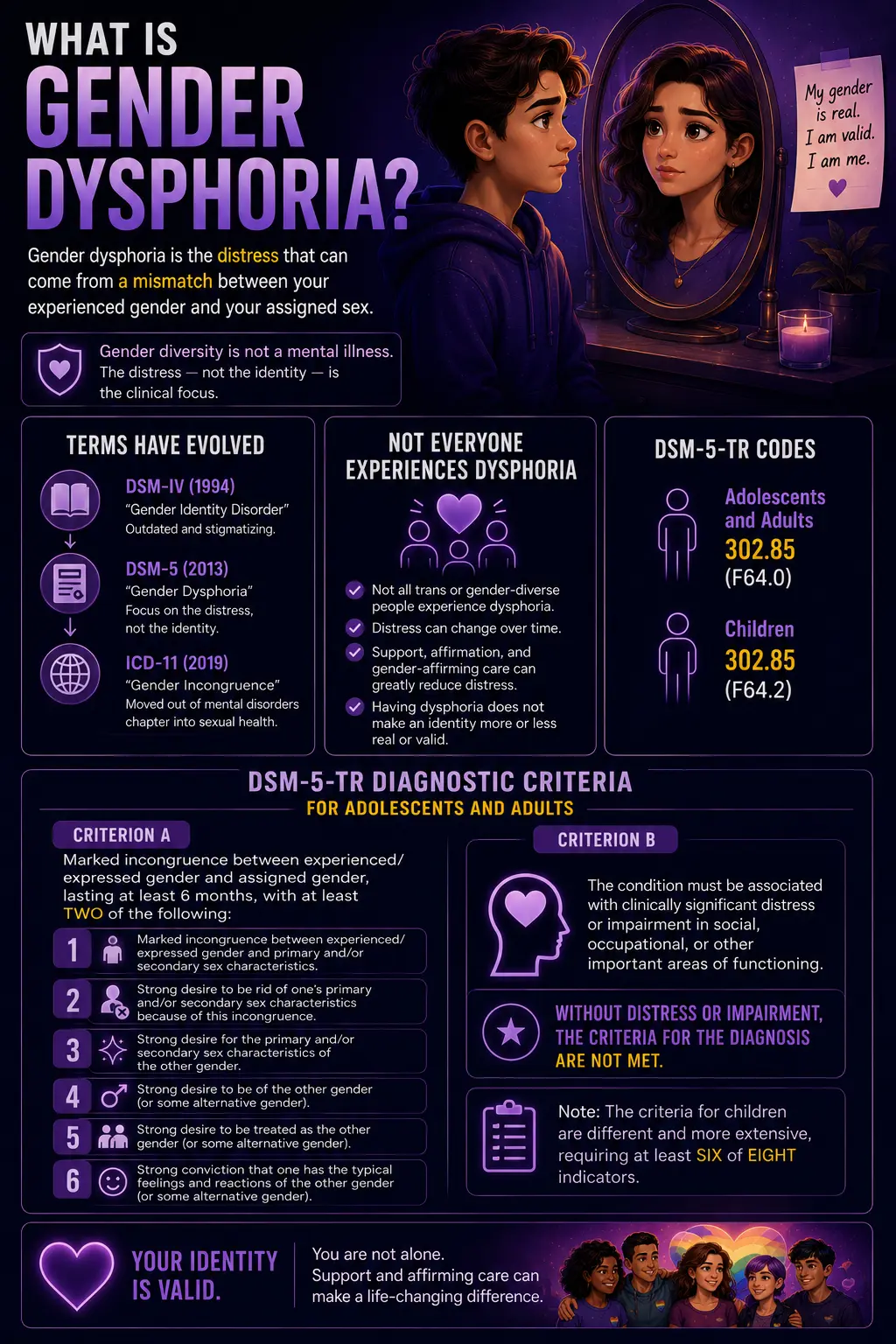
Gender dysphoria — DSM-5-TR code 302.85 (F64.0 in adolescents and adults; F64.2 in children) — refers to the clinically significant distress or impairment that can result from a marked incongruence between a person’s experienced or expressed gender and their assigned sex. It is classified in its own chapter in the DSM-5-TR, deliberately separated from both the sexual dysfunctions and the paraphilic disorders, reflecting the understanding that gender diversity itself is not pathological.
The terminology has evolved specifically to reduce stigma. The DSM-IV (1994) used “Gender Identity Disorder” — a term now considered outdated and stigmatizing, because it framed the identity itself as disordered. The DSM-5 (2013) replaced it with “Gender Dysphoria,” shifting the clinical focus to the distress rather than the identity. The World Health Organization went further: in the ICD-11 (2019), the category was renamed “gender incongruence” and moved out of the mental disorders chapter entirely, into a chapter on conditions related to sexual health — an explicit statement that gender incongruence is not a mental illness.
Critically, not every transgender or gender-diverse person experiences gender dysphoria, and a person’s distress can change over time — often decreasing significantly with social support, affirmation, and (for those who want it) gender-affirming care. The presence of dysphoria is not what makes someone’s gender identity real or valid; many trans people experience little or no dysphoria, particularly when affirmed and supported.
The DSM-5-TR diagnostic criteria for gender dysphoria in adolescents and adults require a marked incongruence between one’s experienced/expressed gender and assigned gender, lasting at least 6 months, manifested by at least two of the following six indicators (APA, 2022):
- A marked incongruence between experienced/expressed gender and primary and/or secondary sex characteristics.
- A strong desire to be rid of one’s primary and/or secondary sex characteristics because of this incongruence.
- A strong desire for the primary and/or secondary sex characteristics of the other gender.
- A strong desire to be of the other gender (or some alternative gender).
- A strong desire to be treated as the other gender (or some alternative gender).
- A strong conviction that one has the typical feelings and reactions of the other gender (or some alternative gender).
In addition (Criterion B), the condition must be associated with clinically significant distress or impairment in social, occupational, or other important areas of functioning. Without distress or impairment, the criteria for the diagnosis are not met — which is exactly the point: the distress, not the identity, is the clinical focus. (Note: the criteria for children are different and more extensive, requiring at least six of eight indicators.)
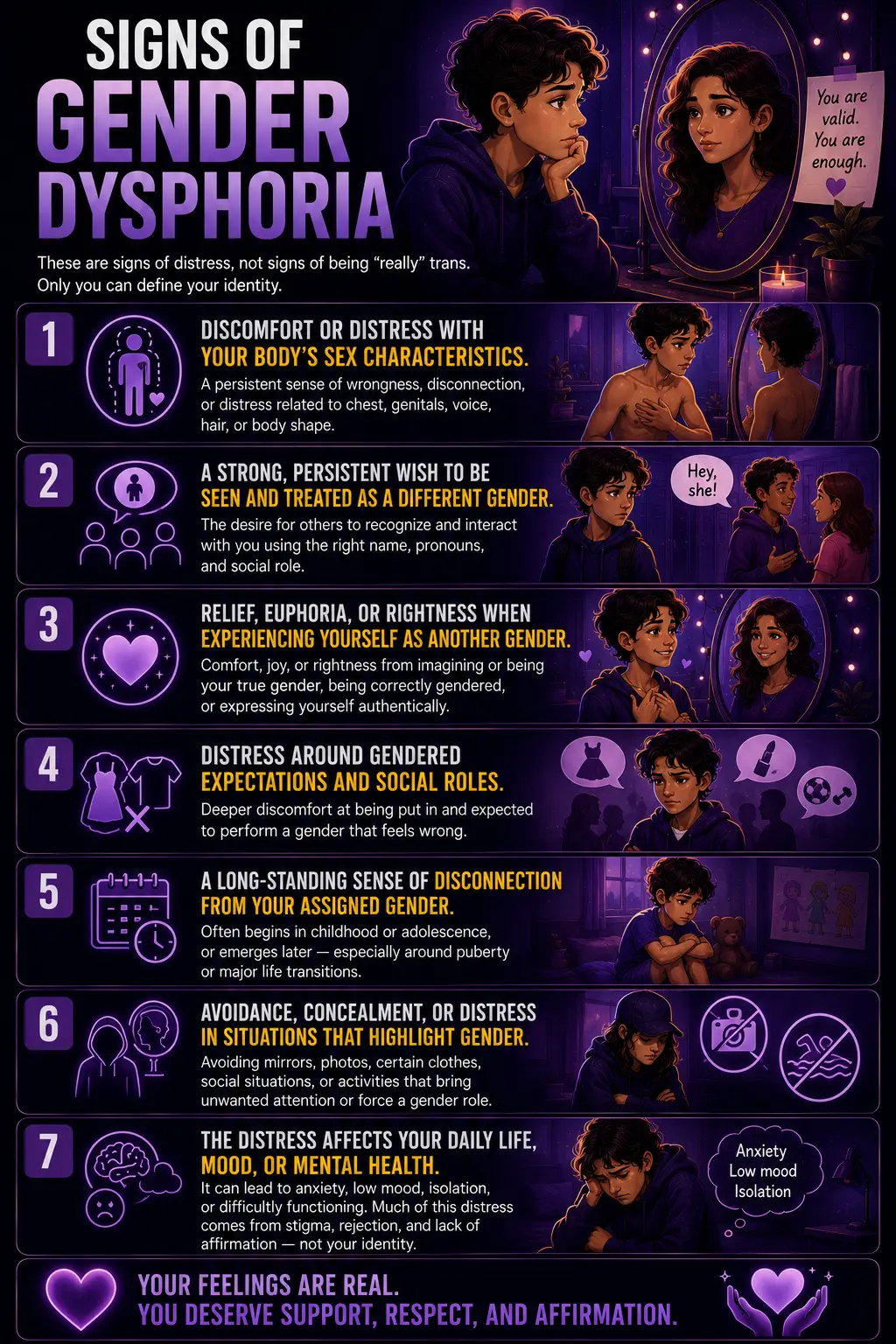
Signs of Gender Dysphoria
These are common experiences of gender-related distress. Recognizing them in yourself doesn’t diagnose anything, and it doesn’t define your identity — only you can do that. They simply describe the kinds of distress that often bring people to explore the question of gender dysphoria. Remember, throughout: these are signs of distress, not signs of being “really” trans. Some people feel many of these intensely; some trans and nonbinary people feel few of them, especially when supported and affirmed.
Discomfort or distress with your body’s sex characteristics. A persistent sense of wrongness, disconnection, or distress related to primary or secondary sex characteristics — chest, genitals, voice, facial or body hair, body shape. This body-focused distress (sometimes called physical or anatomical dysphoria) is one of the most commonly described forms, though it is not universal and not required.
A strong, persistent wish to be seen and treated as a different gender. The desire for others to recognize, address, and interact with you as a gender different from the one you were assigned — through name, pronouns, and social role. The distress here is often most acute in moments of misgendering, when you’re addressed in ways that don’t match your sense of self.
Relief, euphoria, or rightness when imagining or experiencing yourself as another gender. Sometimes the clearest signal isn’t pain but its opposite — the relief, comfort, or even joy (often called gender euphoria) that comes from imagining yourself as another gender, being correctly gendered, or expressing gender in a way that fits. The contrast between that relief and the everyday discomfort is itself information.
Distress around gendered expectations and social roles. Discomfort with the gender roles, expectations, and norms tied to your assigned sex — not simply disliking stereotypes, but a deeper distress at being placed in and expected to perform a gender category that feels wrong.
A long-standing sense of disconnection from your assigned gender. For many people with gender dysphoria, the feeling traces back to childhood or early adolescence — a persistent, often hard-to-articulate sense of not fitting the gender they were assigned. For others, it emerges or intensifies later, frequently around puberty or major life transitions. Both patterns are real.
Avoidance, concealment, or distress in situations that highlight gender. Avoiding social situations, photos, mirrors, certain clothing, swimming, or intimate situations because they force an unwanted gender role or draw attention to body features that cause distress. Concealment of gender expression to avoid scrutiny or to manage distress.
The distress affects your daily life, mood, or mental health. When gender-related distress begins to affect your wellbeing — contributing to anxiety, low mood, isolation, or difficulty functioning — that impact is significant. Importantly, much of this distress is driven or worsened by external factors: stigma, rejection, and lack of affirmation (what researchers call minority stress), rather than by the gender identity itself.
Gender Dysphoria vs Gender Incongruence vs Body Dysmorphia
| Feature | Gender Dysphoria | Gender Incongruence | Body Dysmorphic Disorder |
|---|---|---|---|
| What it describes | The distress arising from the incongruence between experienced gender and assigned sex | The incongruence itself, without any assumption of distress or disorder | Preoccupation with a perceived flaw in appearance unrelated to gender |
| Is it a mental disorder? | The distress is a diagnosis (to enable care); the identity is NOT a disorder | No — ICD-11 places it under sexual health, outside mental disorders | Yes — classified in the Obsessive-Compulsive and Related Disorders |
| Classification | DSM-5-TR: Gender Dysphoria (own chapter), 302.85 / F64.0 | ICD-11: Gender Incongruence, HA60-HA61 (sexual health chapter) | DSM-5-TR: 300.7 / F45.22 |
| Core focus | Gender identity and the distress of incongruence | Gender identity and bodily/social alignment | A specific perceived appearance defect, not gender identity |
| What resolves it | Affirmation, social/medical transition for those who want it, support, and reduced stigma | Affirmation and alignment with experienced gender, as desired | CBT-BDD and SSRIs; cosmetic procedures do NOT help |
| PsyMed test | This test | LGBTQ+ Test (identity exploration) | Body Dysmorphic Disorder Test |
The distinction between gender dysphoria and body dysmorphic disorder is sometimes confused because both can involve distress about the body, but they are fundamentally different. In gender dysphoria, body-related distress is specifically about sex characteristics being incongruent with one’s experienced gender — and it typically resolves through gender affirmation and transition. In body dysmorphic disorder, the preoccupation is with a perceived appearance flaw (skin, nose, hair, symmetry) unrelated to gender identity, and it does not resolve through physical alteration. A clinician distinguishes them by what the distress is actually about.
Understanding Your Gender Dysphoria Test Score
An important reminder before reading your result: this score reflects the intensity of gender-related distress you described — not whether you “are” transgender, nonbinary, or cisgender. A low score does not mean you aren’t trans, and a high score does not diagnose anything. Your identity is yours to know and name; this is only a reflection of distress, which is one part of a much larger picture.
| Score Range | Category | What It Suggests |
|---|---|---|
| 0 – 15 | Minimal Gender-Related Distress | Little gender-related distress was indicated. This says nothing about your identity — only that gender-related distress is not prominent for you right now. |
| 16 – 30 | Mild Gender-Related Distress | Some gender-related distress or questioning is present. Exploring these feelings, with support if helpful, may bring clarity. There is no required conclusion. |
| 31 – 45 | Moderate Gender-Related Distress | Meaningful gender-related distress across several areas. Speaking with a gender-affirming professional may help you explore and address it. |
| 46 – 60 | Significant Gender-Related Distress | Strong, pervasive gender-related distress. Affirming support can make a real difference. You deserve care and you don’t have to navigate this alone. |
What Causes Gender Dysphoria?
The origins of gender identity and gender dysphoria are not fully understood, but current scientific understanding points to a combination of biological factors, with gender identity itself regarded as a deeply rooted aspect of a person rather than a choice or a result of upbringing.
Biological factors. Research suggests that gender identity has neurobiological correlates and is influenced by prenatal factors, including prenatal hormone exposure affecting brain development. Twin studies indicate a heritable component to gender identity and gender incongruence. Gender identity is understood to be established early and to be highly stable — it is not something that can be deliberately changed, which is why attempts to change it (analogous to conversion therapy for sexual orientation) are both ineffective and harmful, and are condemned by major medical organizations.
The role of distress and minority stress. It is essential to distinguish the gender incongruence itself from the distress that may accompany it. A significant portion of the distress experienced by transgender and gender-diverse people arises not from being trans, but from external sources: stigma, discrimination, rejection, violence, and lack of affirmation. This is the minority stress model, well-established in research. The clinical and research consensus is that affirmation and support substantially reduce distress, while rejection and lack of access to affirming care substantially increase it.
Gender-Affirming Care and Support
For people experiencing gender dysphoria, a range of supportive options exists — and the right path is different for each person. The current clinical guidelines are the WPATH Standards of Care, version 8 (World Professional Association for Transgender Health, 2022), which emphasize individualized, multidisciplinary, and affirming care.
Affirming therapy and support. Working with a gender-affirming therapist can help explore gender identity, process distress, and navigate decisions — without any predetermined outcome. The goal of affirming therapy is not to push toward or away from any particular identity or path, but to support the person’s own self-understanding. Social support, community, and connection with other gender-diverse people are also consistently associated with reduced distress.
Social transition. For many, expressing gender in alignment with their identity — through name, pronouns, clothing, and social role — significantly reduces dysphoria and is fully reversible. This is often the first step people explore.
Medical options, for those who want them. Some people pursue medical gender-affirming care, such as hormone therapy or surgery. These are significant medical decisions made in collaboration with qualified healthcare providers, guided by guidelines such as the WPATH Standards of Care, and involve professional assessment and informed consent. They are not steps to undertake casually or alone — but for those for whom they are appropriate, research consistently associates access to wanted gender-affirming medical care with reduced dysphoria and improved wellbeing.
If you are a minor, or are not in a safe or supportive environment, please know that support is still available confidentially through the resources listed at the end of this page — and that your safety comes first. You do not have to make any decisions or tell anyone anything before you are ready.
Frequently Asked Questions
What is gender dysphoria?
Gender dysphoria (DSM-5-TR 302.85 / F64.0) is the clinically significant distress that can arise from a marked incongruence between a person’s experienced or expressed gender and the sex they were assigned at birth. The DSM-5-TR criteria for adolescents and adults require this incongruence to last at least 6 months, manifested by at least two of six specific indicators, along with clinically significant distress or impairment. Crucially, gender dysphoria refers to the distress, not to being transgender, which is not a mental disorder. The diagnosis exists primarily to enable access to gender-affirming care for those who want it.
Is being transgender a mental illness?
No. Being transgender is not a mental illness or disorder. This is the established position of every major medical and psychological organization. The diagnostic term “gender dysphoria” refers specifically to the distress that some transgender people experience due to the incongruence between their gender and assigned sex — not to the identity itself. The DSM-5 deliberately renamed the old “Gender Identity Disorder” to “Gender Dysphoria” in 2013 to make exactly this distinction, and the WHO’s ICD-11 (2019) moved gender incongruence out of its mental disorders chapter entirely. Many transgender people experience little or no dysphoria, especially when they are affirmed and supported.
What is the difference between gender dysphoria and gender identity disorder?
“Gender Identity Disorder” (GID) is the older, now-outdated term used in the DSM-IV (1994). It was replaced in 2013 by “Gender Dysphoria” in the DSM-5. The change was deliberate and significant: “Gender Identity Disorder” framed the identity itself as disordered, which was stigmatizing and inaccurate. “Gender Dysphoria” shifts the focus to the distress that may accompany gender incongruence, recognizing that the identity is not a disorder. If you encounter the term “gender identity disorder” today, it reflects outdated terminology — the current and accurate term is gender dysphoria.
Do I have to feel dysphoria to be transgender?
No. You do not need to experience gender dysphoria to be transgender, nonbinary, or gender-diverse. Many trans people experience significant dysphoria; many others experience little or none, particularly when they are affirmed, supported, and able to live as their authentic gender. Gender euphoria — the joy and rightness of being recognized and expressing your true gender — is just as valid an experience as dysphoria. Your gender identity is defined by your own sense of who you are, not by how much distress you do or don’t feel. A low score on this test does not mean you aren’t trans; it means gender-related distress may not be prominent for you right now.
Can gender dysphoria change over time?
Yes. The intensity of gender dysphoria can vary considerably over time and across circumstances. For many people, dysphoria decreases significantly with social support, affirmation, living as their authentic gender, and — for those who want it — gender-affirming care. Distress often intensifies in unsupportive or hostile environments and around specific triggers (puberty, misgendering, situations that highlight body features). Because so much gender-related distress is driven by external factors like stigma and lack of affirmation (minority stress), changes in environment and support can substantially affect how much dysphoria a person experiences.
What should I do if this test suggests significant gender-related distress?
If this test reflects significant gender-related distress, consider reaching out to a gender-affirming mental health professional who can help you explore your experience without any predetermined agenda. The goal of affirming care is to support your own self-understanding, not to push you toward or away from any identity or decision. You might also connect with supportive communities and resources (listed below) where other gender-diverse people share their experiences. If you are a minor or are not in a safe environment, the confidential resources below — including Trans Lifeline and The Trevor Project — can offer support without requiring you to disclose anything to anyone in your life before you are ready. There is no timeline you have to follow.
Is this test a diagnosis?
No. This test is a reflection and screening tool, not a diagnostic instrument. Only a qualified mental health professional can diagnose gender dysphoria through a comprehensive clinical assessment. Validated clinical instruments used by professionals include the Gender Identity/Gender Dysphoria Questionnaire for Adolescents and Adults (GIDYQ-AA) and the Utrecht Gender Dysphoria Scale (UGDS). This test can help you reflect on and articulate gender-related distress, which may be useful if you choose to speak with a professional — but it cannot and does not diagnose anything.
Further reading
LGBTQ+ Identities Explained separates gender identity from sexual orientation and defines the terms around transition, which is useful context for the questions here.
Related Tests
- LGBTQ+ Test — explores both sexual orientation and gender identity together; a broader starting point if you’re questioning multiple dimensions of identity.
- Coming Out Readiness Test — for those considering whether and how to share their identity with others.
- Body Dysmorphic Disorder Test — distinguishes appearance-preoccupation distress from gender-related body distress; useful for clarifying what body distress is about
- Kinsey Scale Test — explores sexual orientation, which is distinct from gender identity; the two are separate dimensions.
- Gay Test — if the question is who you are attracted to rather than what gender you are, this is the one to take.
- Anxiety Test — gender-related distress and minority stress frequently co-occur with anxiety; worth assessing separately.
- Clinical Depression Test — minority stress and unaddressed dysphoria are associated with depression; affirmation and support are protective.
- Social Anxiety Test — distress in social situations that highlight gender can overlap with social anxiety; the mechanisms differ, but can co-occur.
Support & Resources
Exploring gender can bring up many feelings, and you don’t have to navigate it alone. These resources are confidential, affirming, and free:
- Trans Lifeline — peer support hotline run by and for trans people: 1-877-565-8860. translifeline.org
- The Trevor Project — 24/7 crisis support for LGBTQ+ young people (under 25). Call 1-866-488-7386, or text START to 678-678. thetrevorproject.org/get-help
- PFLAG — support for LGBTQ+ people and their families and friends. pflag.org
- WPATH — the World Professional Association for Transgender Health, source of the Standards of Care for gender-affirming care. wpath.org
- 988 Suicide & Crisis Lifeline — call or text 988 (US), available 24/7 and LGBTQ+ affirming.
References
- American Psychiatric Association. (2022). Diagnostic and Statistical Manual of Mental Disorders, Fifth Edition, Text Revision (DSM-5-TR). Gender Dysphoria 302.85 (F64.0/F64.2). psychiatry.org
- Coleman, E., et al. (2022). Standards of Care for the Health of Transgender and Gender Diverse People, Version 8 (WPATH SOC-8). International Journal of Transgender Health, 23(sup1), S1–S259. wpath.org
- World Health Organization. (2019). International Classification of Diseases, 11th Revision (ICD-11) — Gender Incongruence (HA60–HA61), classified under conditions related to sexual health, outside mental disorders. icd.who.int
- Merck Manual Professional Edition. (2026). Gender Incongruence and Gender Dysphoria. [DSM-5-TR criteria; prevalence 0.02-0.1% in health systems; WPATH SOC-8] merckmanuals.com
- Zucker, K.J. (2017). The DSM-5 Diagnostic Criteria for Gender Dysphoria. [Epidemiology; criteria operationalization] medscape.com
- StatPearls / NCBI Bookshelf. (2023). Gender Dysphoria. [Self-reported transgender prevalence 0.5-1.3%; WPATH SOC; terminology history] ncbi.nlm.nih.gov
- American Medical Association Journal of Ethics. (2010). Proposed DSM-5 Revisions to Sexual and Gender Identity Disorder Criteria. [GID → Gender Dysphoria rationale; de-stigmatization] journalofethics.ama-assn.org
- Cohen-Kettenis, P.T., & Pfäfflin, F. (2010). The DSM diagnostic criteria for gender identity disorder in adolescents and adults. Archives of Sexual Behavior, 39(2), 499–513. [GIDYQ-AA; criteria development]
Related Tests
See All Quiz →

Sexual Orientation & Gender Identity
What’s Your Sexual Orientation or Gender Identity? Take This Free LGBTQ+ Test
→

You may also like
See All Quiz →