
Psychotic Disorders · Self-reflection
Schizophrenia Test: a careful self-check, not a diagnosis
Fifteen questions about experiences linked to psychosis. Before you start, one fact worth having: the National Institute of Mental Health states plainly that “a person can experience psychosis and never be diagnosed with schizophrenia or any other disorder”. A high score here does not mean you have schizophrenia.

This self-check cannot diagnose schizophrenia or psychosis, and it has no validated cut-off. Schizophrenia is diagnosed by a clinician after assessment, including ruling out physical and substance-related causes.
-
THE FORMAT15 questionsRate how often each experience has applied to you, from “Never” to “Always”.
-
WHAT IT IS NOTNot a diagnosisSchizophrenia is diagnosed by a psychiatrist through clinical assessment. No questionnaire can do it.
-
WORTH KNOWINGRecovery is commonThe WHO states that “at least one in three people with schizophrenia will be able to fully recover”.
The self-check
Take the self-check
Answer about your own experience over recent months rather than about one unusual night. If any of these questions are distressing, you can stop — the help routes further down this page do not require a score. This is a house-written questionnaire, not a validated instrument, and it cannot identify schizophrenia or psychosis.
Your result
What the answer ranges mean
- 0–15 Low — few indicators reported
- 16–30 Mild — some experiences reported
- 31–45 Moderate — several areas endorsed
- 46–60 High — many areas endorsed
This self-check cannot diagnose schizophrenia or psychosis, and it has no validated cut-off. Schizophrenia is diagnosed by a clinician after assessment, including ruling out physical and substance-related causes.
A questionnaire length, not a diagnostic threshold.
The short answer
What is schizophrenia?
Schizophrenia is a mental disorder in which, as the World Health Organization describes it, people “may experience psychosis, which involves changes in a person’s sense of reality”, alongside disorganised thinking and changes in motivation and emotional expression. It affects roughly 1 in 300 people worldwide, usually begins between the ages of 16 and 30, and — the part most people never read — it is treatable, with the WHO stating that “at least one in three people with schizophrenia will be able to fully recover”. No questionnaire can diagnose it: that requires assessment by a psychiatrist or other qualified clinician, including ruling out physical causes.
Clinicians group the features into three kinds. Psychotic symptoms are changes in the sense of reality — hallucinations, which NIMH describes as experiences where “a person may hear voices, see visions, or feel sensations that others around them do not”, and delusions, which NIMH defines as “strongly held beliefs that are not consistent with objective reality”. Negative symptoms are losses: reduced motivation, withdrawal from other people, flattened emotional expression, difficulty experiencing pleasure. Cognitive symptoms affect attention, concentration and working memory. The DSM-5-TR requires at least two of five core features, one of which must be a delusion, hallucination or disorganised speech, continuously present for at least six months with at least one month of active symptoms, together with a drop in functioning and the exclusion of other causes including substances and medical conditions. That six-month requirement matters: a shorter episode is a different diagnosis, not a milder version of this one. DSM-5 also removed the old subtypes — “paranoid schizophrenia” and the rest — because they were unreliable and unstable over time, so a clinician today will not use them.
Looking yourself up is not a symptom. One of the lasting findings in this field is that people with schizophrenia are far more likely to be victims of violence than perpetrators of it, and the stereotype in the other direction is the main reason people delay getting assessed — which is the one thing that genuinely makes outcomes worse.
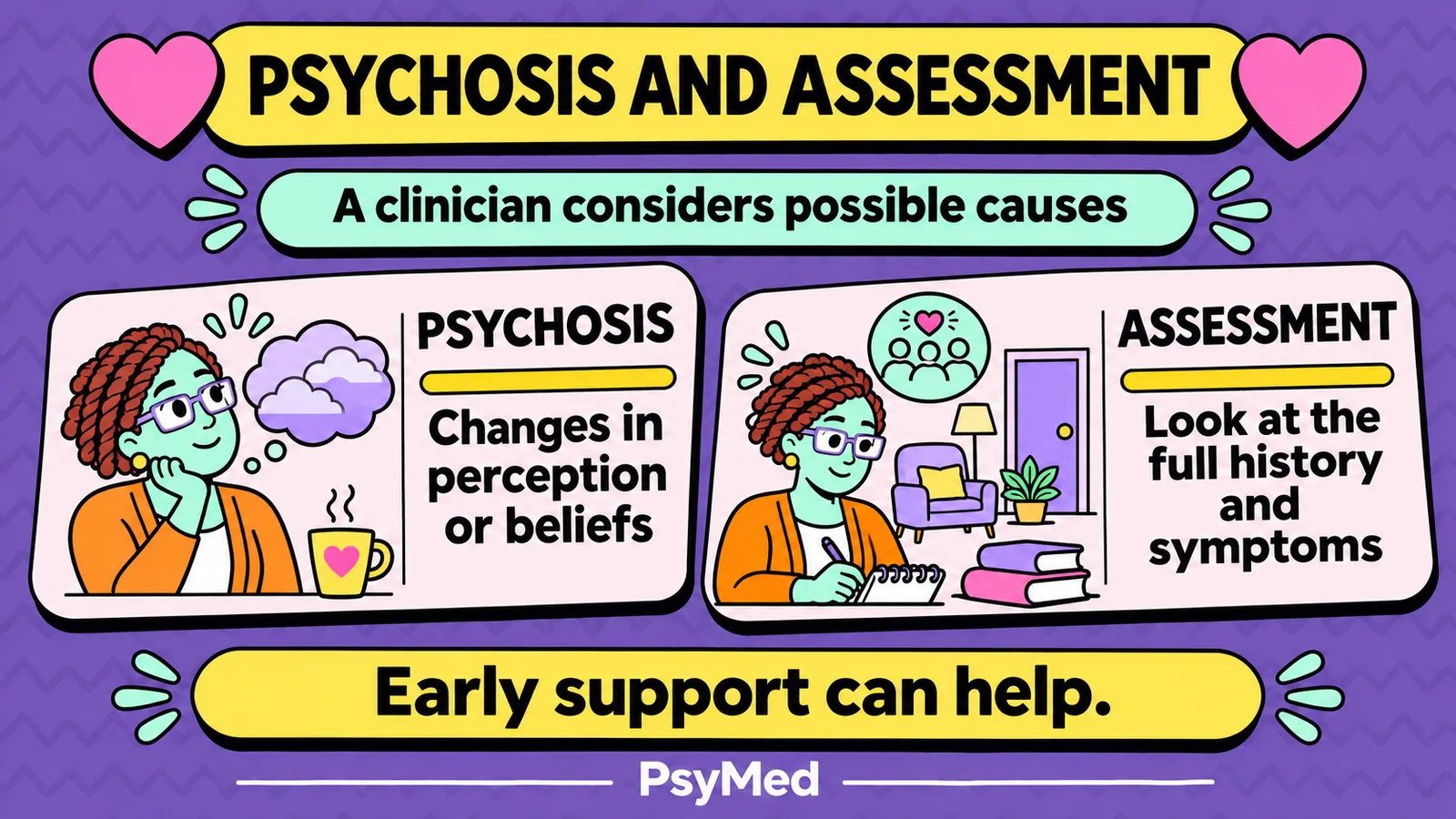
The WHO reports that schizophrenia affects approximately 24 million people, or about 1 in 300 people worldwide, and that it “is treatable”. Onset is typically in late adolescence and the twenties, and it is “not common in children” — childhood-onset schizophrenia is estimated at fewer than 0.04% of cases.
View sourceUnderstand the themes
The fifteen areas this self-check asks about
The items follow the three groups clinicians use, plus the two things that actually determine whether an assessment is needed: how long it has been going on, and what it is costing you.
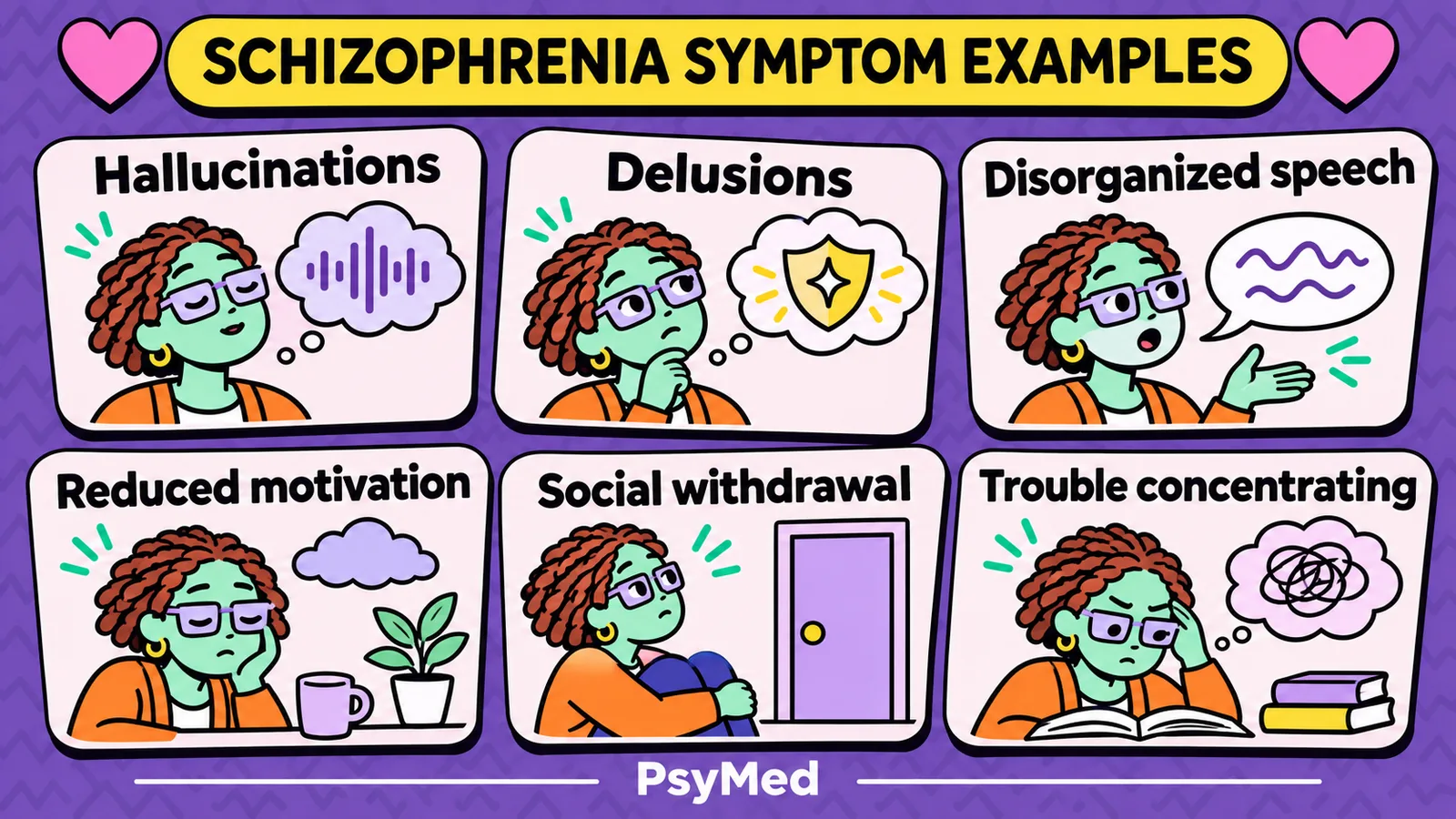
Hearing or sensing things others do not
Voices, sounds or sensations with no external source. Worth knowing: these are reported by a minority of the general population who never develop any disorder, and NIMH notes a person can experience psychosis without ever being diagnosed with anything.
Beliefs that others around you reject
Convictions — about being watched, followed, targeted or singled out — that people who know you well do not share, and that stay fixed when you are shown evidence against them.
Thoughts or speech losing their thread
Jumping between unconnected ideas, losing the thread mid-sentence, or being told repeatedly that you are hard to follow.
Motivation and feeling draining away
The negative symptoms, which are often the most disabling and the least recognised: withdrawal, flattened emotion, difficulty starting anything, loss of pleasure. These are easy to mistake for depression, and the overlap is real.
Attention, memory and concentration
Difficulty holding information in mind, following a conversation, or finishing tasks you used to manage without effort.
Duration, and what it costs you
The DSM-5-TR requires six months of disturbance with a drop in work, study or relationships. Two items here ask about both, because that is what distinguishes a difficult period from the pattern clinicians assess.
Psychosis, schizophrenia and the conditions nearby
Several different things get searched for as “schizophrenia”, and they are not the same. This is the distinction that most changes what your result means.
| What it means | What that implies | |
|---|---|---|
| Psychosis | A set of symptoms, not a diagnosis — a change in the sense of reality. It occurs in depression, bipolar disorder, severe sleep deprivation, substance use, and some physical illnesses. | NIMH: “a person can experience psychosis and never be diagnosed with schizophrenia or any other disorder.” Having had a psychotic experience does not put you on a path to this diagnosis. |
| Schizophrenia | A specific diagnosis requiring at least two of five core features, at least one of them psychotic, with six months of disturbance and a drop in functioning. | Diagnosed by a clinician after assessment and after ruling out substances and medical causes. The six-month requirement is why a single episode cannot be this diagnosis. |
| Schizoaffective disorder | Psychotic symptoms alongside a major mood episode — depression or mania — where the psychosis also occurs outside the mood episodes. | A separate diagnosis that is easy to confuse with both schizophrenia and bipolar disorder. If mood episodes are prominent, say so when you are assessed. |
| Brief psychotic disorder and schizophreniform disorder | Psychotic symptoms lasting less than one month, or between one and six months, respectively. | These exist precisely because a short episode is not schizophrenia. Many people recover fully and never meet criteria for anything longer-term. |
| Clinical high risk (CHR-P) | A research category for people with attenuated symptoms who may be at elevated risk. | A major meta-analysis found a 25% transition rate to psychosis within three years — which means roughly three in four people identified as high risk did not transition. Risk is not destiny. |
Interpretation and context
What a real assessment involves
Worth knowing in advance, because not knowing what happens at an appointment is one of the main reasons people avoid making one.
- 01 01
A conversation, not a test
A psychiatrist or other qualified clinician asks about your experiences, how long they have gone on, your history and your functioning. There is no blood test or brain scan that diagnoses schizophrenia.
- 02 02
Physical causes get ruled out first
The DSM-5-TR requires excluding substance use and medical conditions, so expect questions about alcohol, cannabis, stimulants, medication and physical health, and possibly basic tests. This is routine, not suspicion.
- 03 03
Time is part of the criteria
Because six months of disturbance is required, a clinician may not give a diagnosis at a first appointment — and that is correct practice rather than being dismissed. Treatment for what you are experiencing can start regardless.
There is no validated cut-off for these 15 items, so the four ranges describe how much you endorsed and nothing more. There is deliberately no score here that says “you have schizophrenia”, because no questionnaire can establish that and a page that implied otherwise would be doing harm. What a high score is genuinely useful for is making the appointment.
Context matters
What raises risk, and what does not
Some context that tends to be either missing or wrong in what people read first.
No single cause, and nothing you did
The WHO states that “research has not identified one single cause”, and describes an interaction of genetic and environmental factors. Schizophrenia is not caused by bad parenting, weak character or personal failure.
Having a relative with it raises risk without determining anything
Family history is the strongest known risk factor, and most people with an affected relative never develop it. A family history is a reason to get assessed promptly if something changes, not a sentence.
Early treatment changes outcomes
The WHO notes that “most people with schizophrenia are not receiving mental health care”, and specialist early-intervention services for a first episode of psychosis improve outcomes. The practical implication of a worrying score is to get seen sooner rather than to read more.
Useful support
Treatment, and what the outcome data actually says
The treatment picture is considerably better than the cultural image of this condition suggests.
- 01 / MEDICATION
The foundation of treatment
Antipsychotic medication is the mainstay for psychotic symptoms. Which one, at what dose, and for how long is a prescriber’s decision made with you — and side effects are a legitimate part of that conversation rather than something to endure silently.
- 02 / PSYCHOSOCIAL CARE
Not an optional extra
The WHO lists psychoeducation, family interventions, supported employment and assisted living among effective care, and states that “assertive community treatment, family intervention and supported employment” are among the facilitators of recovery. Negative and cognitive symptoms in particular respond better to these than to medication alone.
- 03 / OUTCOMES
Recovery is a real outcome
The WHO states that “at least one in three people with schizophrenia will be able to fully recover”, and that “schizophrenia is treatable”. Many more live full lives with ongoing support. This is the fact that the stereotype most reliably omits.
Clinical reference: World Health Organization, Schizophrenia fact sheet and NIMH, Schizophrenia. Educational notes only, not a treatment plan.
Practical next steps
What to do next, whatever your score
These apply whatever your total was.
- 01
Talk to a doctor rather than to a search engine
A GP can assess you and refer you on, and in many countries can refer directly to an early intervention in psychosis service. You do not need to be certain anything is wrong to make the appointment.
- 02
Write down what has changed, and when
Specific experiences, roughly when they started, how often they happen and what has got harder. Because duration is part of the criteria, a timeline is the single most useful thing you can bring.
- 03
Tell one person you trust
Isolation makes everything about this harder, and someone who knows you can give a clinician information you cannot see from the inside. If you are supporting someone else, saying you have noticed and you are not going anywhere is worth more than any advice.
If you are in crisis, or frightened by what you are experiencing, please get help now rather than finishing this page. In the US: call or text 988 for the Suicide & Crisis Lifeline, free, confidential and available 24/7. In the UK: call 111 and select the mental health option, or Samaritans free on 116 123, 24/7. Anywhere else, findahelpline.com lists verified crisis lines by country. If you or someone else is in immediate danger, call your local emergency number. For information rather than crisis support, the SAMHSA National Helpline on 1-800-662-HELP (4357) runs 24/7 for treatment referrals, though SAMHSA is explicit that “we do not provide counseling”. The NAMI HelpLine on 1-800-950-NAMI (6264) offers information and support but is not a crisis line and not 24/7 — it runs Monday to Friday, 10am to 10pm ET, and is closed on federal holidays. For a crisis, use 988.
Good questions to ask
Schizophrenia FAQs
The questions people most often arrive with, answered directly.
No, and you should be sceptical of any page that implies it can. Schizophrenia is diagnosed by a psychiatrist or other qualified clinician through clinical assessment: the DSM-5-TR requires at least two of five core features, at least one of them a delusion, hallucination or disorganised speech, with disturbance continuously present for at least six months, a decline in functioning, and other causes ruled out including substance use and medical conditions. No questionnaire, including this one, can establish any of that. What a self-check can usefully do is help you decide to make an appointment and give you something concrete to describe when you get there.
No. Psychosis is a set of symptoms — changes in the sense of reality, such as hallucinations or delusions — and schizophrenia is one diagnosis in which psychosis occurs. NIMH states directly that “a person can experience psychosis and never be diagnosed with schizophrenia or any other disorder”. Psychosis also occurs in bipolar disorder, severe depression, post-partum illness, substance use, extreme sleep deprivation and various physical conditions. Having had a psychotic experience is not the same as being on a path to schizophrenia.
Before clear psychotic symptoms appear there is often a period of gradual change: withdrawing from friends and family, a drop in performance at school or work, declining personal care, unusual or suspicious thinking, loss of motivation and flattened emotional expression. Because these are non-specific — depression and ordinary adolescence can look similar — they are a reason to get assessed rather than a basis for self-diagnosis. Onset is typically between 16 and 30.
Limited insight is a recognised feature, and some people do not recognise their experiences as symptoms. But it is worth noticing that if you are reading this page and considering the question, you are exercising exactly the kind of self-reflection that complete lack of insight would prevent. Worrying about whether you have schizophrenia is, on its own, far more commonly a feature of anxiety than of psychosis.
Family history is the strongest known risk factor, and it is not determinative. The WHO states that “research has not identified one single cause” and describes an interaction between genetic and environmental factors; most people with an affected relative never develop the condition. A family history is a good reason to get assessed promptly if something changes, not a prediction.
Yes. The WHO states plainly that “schizophrenia is treatable” and that “at least one in three people with schizophrenia will be able to fully recover”. Treatment combines antipsychotic medication with psychosocial support — psychoeducation, family interventions, supported employment and assisted living are all listed by the WHO as effective. Early treatment improves outcomes, which is why the WHO notes it is a problem that “most people with schizophrenia are not receiving mental health care”.
They are unrelated conditions that popular culture constantly conflates. Schizophrenia involves psychosis — changes in the sense of reality — and does not involve separate identities. Dissociative identity disorder involves disruption of identity and memory. One practical difference: people with DID who hear voices typically experience them as coming from inside their own mind, whereas voices in schizophrenia are more often experienced as external. The Dissociative Identity Disorder Test covers the other condition.
No. DSM-5 removed the subtypes — paranoid, disorganised, catatonic, undifferentiated and residual — because they had limited reliability and did not stay stable in the same person over time. A clinician today diagnoses schizophrenia and describes the current symptoms, so you may still see the older term in writing and in people’s own accounts, but it is not a current diagnostic category.
The WHO reports that schizophrenia affects approximately 24 million people, or about 1 in 300 people worldwide. It typically begins in late adolescence or the twenties and “is not common in children” — childhood-onset schizophrenia is estimated at fewer than 0.04% of cases.
Describe what has changed and when, in plain words, rather than naming a diagnosis. Which experiences, how often, how long they have gone on, what has got harder at work, in study or with other people. Be honest about alcohol, cannabis, stimulants, prescribed medication and sleep — not because anyone is judging, but because ruling out substance-related and medical causes is a required part of the assessment and withholding it makes the answer wrong.
Editorial transparency
Sources and review information
Prepared by the PsyMed Editorial Team. This is an educational page, not a clinical assessment, and no licensed clinical reviewer is claimed. Sources checked: November 16, 2026. The stored questions, answer labels, weights and score ranges are preserved from the existing test; this redesign does not establish validation. Read how we build our tests and who we are.
One useful observation
Getting assessed early is the single most useful thing you can do.
A score on this page settles nothing. What is worth acting on is simple: if something has changed and it is costing you, get assessed. Early help is associated with better outcomes, and recovery is a real and common outcome.
Take the self-check