
Dissociative Disorders · Self-reflection
Dissociative Identity Disorder Test: a self-check, not a verdict
Twenty-eight questions about memory gaps, detachment and a sense of identity that does not hold steady. Two things worth knowing before you start: dissociation itself is common and usually harmless, and dissociative identity disorder looks almost nothing like its portrayal in films. No questionnaire can diagnose it.

This self-check cannot diagnose dissociative identity disorder or any other dissociative disorder, and it has no validated cut-off. Diagnosis requires extended clinical assessment by a qualified clinician.
-
THE FORMAT28 questionsRate how often each experience applies to you, from “Never” to “Very Often”.
-
NOT THE FILMSRarely obviousResearch suggests only about 6% of people with DID present in an obvious, visible way.
-
HOW IT IS DIAGNOSEDA long interviewAssessment uses extended clinical interviews. There is no free online version of any of them.
The self-check
Take the self-check
Answer about your own experience, across recent months rather than one specific day. Some of these questions touch on distressing material, and you can stop at any point — the help routes further down this page do not depend on finishing. This is a house-written questionnaire, not a validated instrument, and it cannot identify dissociative identity disorder or any other dissociative disorder.
Your result
What the answer ranges mean
- 0–28 Low — few dissociative experiences
- 29–56 Moderate — several experiences reported
- 57–120 High — many experiences reported
This self-check cannot diagnose dissociative identity disorder or any other dissociative disorder, and it has no validated cut-off. Diagnosis requires extended clinical assessment by a qualified clinician.
A questionnaire length, not a diagnostic threshold.
The short answer
What is dissociative identity disorder?
Dissociative identity disorder (ICD-11 code 6B64) is a condition in which a person’s sense of identity is disrupted, with two or more distinct personality states, accompanied by gaps in memory for everyday events, personal information or traumatic events that go well beyond ordinary forgetting. It was called multiple personality disorder until the name changed in 1994. It is strongly associated with severe, repeated childhood trauma, and — the part the films never convey — it is usually hidden rather than dramatic: research suggests only around 6% of people with DID present in an obvious, visible way. Most people with the diagnosis spend years being treated for depression, anxiety or PTSD before anyone identifies it.
Clinicians look at five symptom areas, and most of them have nothing to do with the thing people expect. Amnesia is gaps in memory for ordinary events or personal information. Depersonalisation is feeling detached from your own body, feelings or actions. Derealisation is the sense that the world around you is unreal, flat or staged. Identity confusion is genuine uncertainty about who you are. Identity alteration is observable shifts in behaviour, manner or capability. The ICD-11 additionally requires that the identity disruption is not a normal part of a widely accepted cultural or religious practice, and that it is not due to substances or another condition. Two things follow from that list. The first is that four of the five areas are about memory, detachment and unreality rather than about distinct personalities — which is why so many people with DID are identified only after years in treatment for something else. The second is that the diagnosis requires distress or impairment: unusual inner experiences that cost you nothing are not a disorder.
Dissociation by itself is extremely common and usually nonpathologic. Losing a stretch of a motorway drive, missing the end of a film you were watching, going through a familiar routine without registering it — these are ordinary experiences of attention and absorption, not symptoms. What distinguishes a dissociative disorder is the severity, the memory loss, and the cost.
Prevalence estimates for dissociative identity disorder in the United States are generally around 1 to 1.5% of the population — not the vanishing rarity the condition is often assumed to have, and not the epidemic its critics sometimes describe. Reliable global figures are not available, so be sceptical of any worldwide number.
View sourceUnderstand the themes
The areas this self-check asks about
The 28 items are grouped by the symptom domains clinicians work through, which is why most of them ask about memory and detachment rather than about identity.
Memory gaps beyond ordinary forgetting
Stretches of recent time you cannot account for, events others remember involving you that you do not, or evidence that you did something you have no memory of choosing. Six items cover this, because amnesia is central to the diagnosis and is often what finally brings people in.
Detachment from yourself
Depersonalisation: feelings that seem muffled or observed rather than felt, a body that does not quite feel like yours, a voice that sounds like someone else’s while you are speaking.
The world feeling unreal
Derealisation: familiar places looking flat or staged, people close to you seeming unfamiliar, sounds and colours altered, time stretching or collapsing in ways that do not match the clock.
Uncertainty about who you are
Identity confusion: genuine difficulty saying what you are like, preferences and opinions that shift so much it is unclear which are yours, a sense of being internally divided.
Shifts others can see
Identity alteration: changes in how you speak, move or carry yourself that you did not decide on; abilities that come and go; other people remarking that you seem like a different person from one occasion to the next.
Absorption, and what it costs
The final items ask about absorption in an inner world, and then about impairment and distress — because without cost there is no disorder, however unusual the experiences.
The dissociative disorders, and what DID is not
Two different clarifications people need here: how DID differs from the other dissociative disorders, and how it differs from the conditions it gets confused with.
| What it involves | How it differs from DID | |
|---|---|---|
| Dissociative amnesia | Inability to recall important autobiographical information, usually of a traumatic or stressful nature, beyond ordinary forgetfulness. | The memory loss is there without the disruption of identity into distinct personality states. |
| Depersonalisation-derealisation disorder | Persistent detachment from yourself, or from your surroundings, with reality testing intact — you know it is a feeling rather than a fact. | Detachment and unreality without the amnesia and identity disruption that DID requires. |
| Partial dissociative identity disorder | An ICD-11 category in which non-dominant personality states occur but do not repeatedly take executive control of behaviour. | A distinct ICD-11 diagnosis rather than a milder label — which is one reason self-diagnosis is unreliable here. |
| PTSD and complex PTSD | Trauma-related symptoms including intrusion, avoidance and hyperarousal; dissociative symptoms are common and PTSD has a recognised dissociative subtype. | Shares the trauma background and much of the symptom picture, which is why many people are treated for PTSD for years first. The PTSD Test is often the more useful starting point. |
| Schizophrenia | A psychotic disorder involving changes in the sense of reality: hallucinations, delusions, disorganised thinking. | Unrelated, despite constant conflation in popular culture. DID does not involve psychosis. Where people with DID hear voices, these are typically experienced as coming from inside their own mind, whereas voices in schizophrenia are more often experienced as external. See the Schizophrenia Test. |
| Borderline personality disorder | Instability of identity, relationships and emotion, with dissociation under stress recognised in the criteria. | Overlaps genuinely and co-occurs often, which is a real diagnostic difficulty rather than a distinction you can settle yourself. |
Interpretation and context
How it is actually diagnosed
This is the part most worth knowing, because the gap between what a real assessment involves and what is available online is enormous.
- 01 01
Extended clinical interviews, not questionnaires
The standard research instrument is the Structured Clinical Interview for DSM-5 Dissociative Disorders (SCID-D). It is a 277-item interview administered by a trained clinician, available only for purchase from its publisher. There is no free online SCID-D, and anything presenting itself as one is not the instrument.
- 02 02
Ruling other things out takes time
Substances, medical and neurological conditions, other psychiatric diagnoses and — per the ICD-11 — accepted cultural and religious practice all have to be considered. Assessment is typically a process over several appointments rather than a single verdict.
- 03 03
It is usually found late
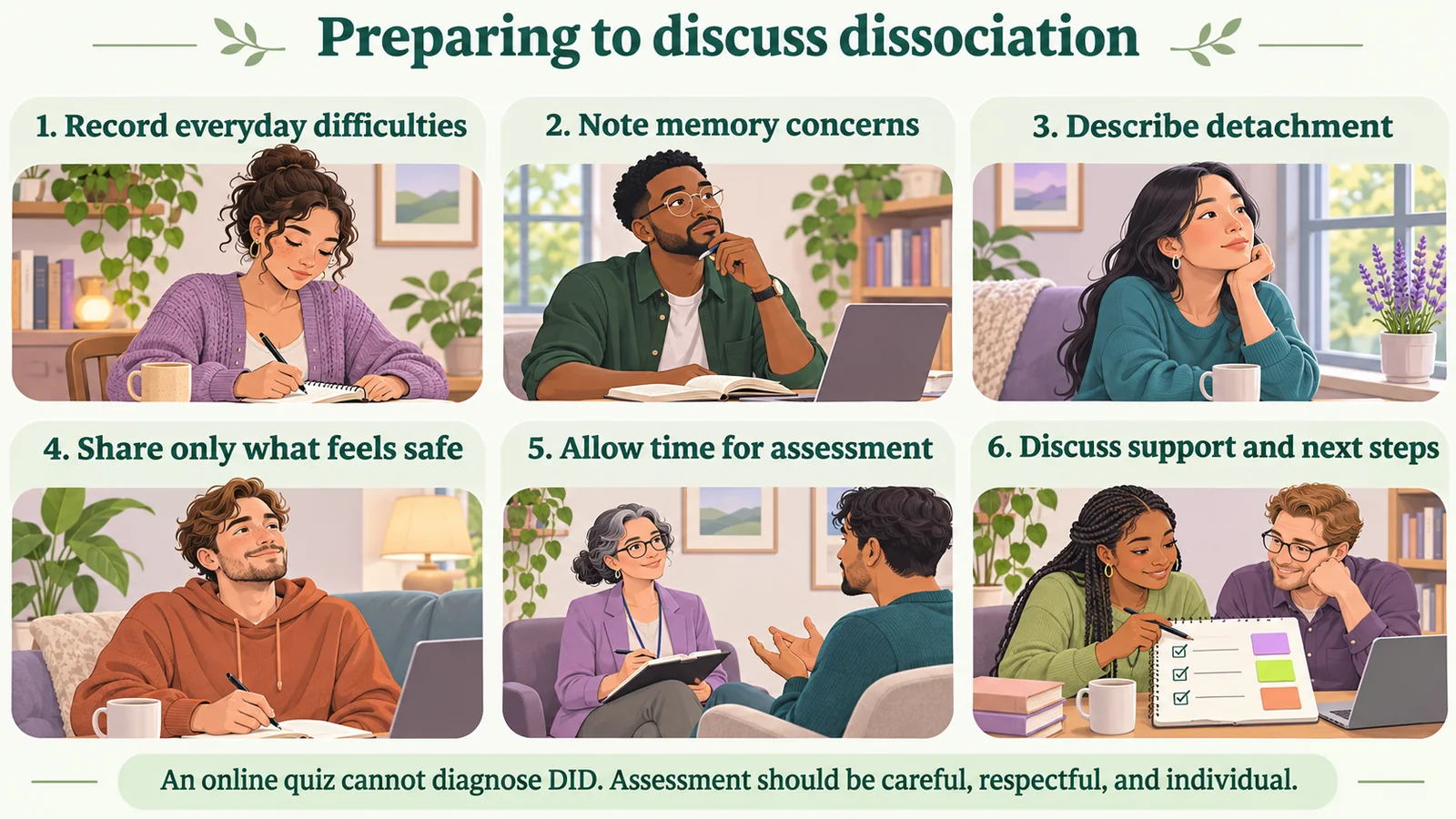
Because amnesia and detachment dominate the picture and the identity features are often hidden, most people with DID are treated for depression, anxiety or PTSD for years first. Arriving with a written account of memory gaps and detachment gives a clinician something a questionnaire cannot.
There is no validated cut-off for these 28 items, no published psychometrics, and the 0–112 total cannot be mapped onto any clinical scale or converted into a score on one. The three ranges describe how much you endorsed and nothing more. If you have seen a specific threshold quoted for dissociation questionnaires elsewhere, it belongs to a different instrument with a different scale and does not transfer here.
Context matters
Trauma, controversy, and what is actually agreed
The honest version, including the disagreement, because you will encounter it anyway.
The trauma association is strong
DID is strongly associated with severe, repeated childhood trauma, typically beginning early and often involving abuse or profound neglect. The prevailing clinical model understands dissociation as a survival response to experiences a child had no other way to escape.
There is genuine academic controversy
A minority of researchers argue that DID presentations can be shaped by suggestion, media exposure or therapeutic influence rather than reflecting a distinct trauma-generated condition. This debate is real and worth knowing about. What it does not mean: DID is a recognised diagnosis in both the DSM-5-TR and the ICD-11, and the people who experience these symptoms are genuinely distressed by them regardless of which model turns out to explain them best.
Self-diagnosis is unusually unreliable here
More than almost any other condition, this one is difficult to assess from the inside: the symptoms include memory gaps and unobservable shifts, the portrayal in media is pervasive and wrong, and the overlap with PTSD and borderline personality disorder is substantial. That is an argument for getting assessed, not for dismissing what you are experiencing.
Useful support
What treatment looks like
Treatment exists, it is well described, and it is slower and less dramatic than fiction suggests.
- 01 / PSYCHOTHERAPY
The core of treatment
Trauma-informed psychotherapy is the mainstay, usually in phases: establishing safety and stabilisation first, then working with traumatic memory, then integration and rebuilding a life. The first phase is not a preliminary — for many people it is where most of the work happens.
- 02 / WHAT IT IS NOT
Not a dramatic cure
There is no medication that treats DID itself; medication may help co-occurring depression, anxiety or sleep problems. And treatment is not a single revelatory session — that is a film device, not a clinical one.
- 03 / FINDING SOMEONE
Ask directly about experience
Not every therapist has experience with dissociative disorders, and it is reasonable to ask before you start. The International Society for the Study of Trauma and Dissociation publishes public resources and treatment guidelines; note that ISSTD is a professional organisation and does not take live phone calls or provide crisis support.
Clinical reference: ISSTD, Dissociation and Dissociative Disorders fact sheet and StatPearls, Dissociative Identity Disorder. Educational notes only, not a treatment plan.
Practical next steps
What to do next
Whatever your total was.
- 01
Write down the memory gaps, concretely
Specific instances where time is missing, where someone described something you do not remember, or where there is evidence of something you did not recall doing. This is the most useful material to bring, and the hardest to reconstruct on the spot in an appointment.
- 02
Take it to a trauma-informed clinician
Ask directly whether they have experience with dissociative disorders. If the answer is no, that is useful information rather than a dead end — ask for a referral to someone who does.
- 03
Do not try to settle it yourself
There is no free online instrument that can assess this, and the condition overlaps heavily with PTSD and borderline personality disorder. If the symptoms are costing you something, that is already reason enough to be seen, with or without a label.
There is no dissociation-specific crisis line, so the general crisis services are the right route and they are equipped for this. In the US: call or text 988 for the Suicide & Crisis Lifeline, free, confidential and 24/7. In the UK: Samaritans free on 116 123, 24/7, or call 111 and select the mental health option. Anywhere else, findahelpline.com lists verified crisis lines by country. If you or someone else is in immediate danger, call your local emergency number. For treatment referrals rather than crisis support, the SAMHSA National Helpline runs 24/7 on 1-800-662-HELP (4357), though SAMHSA is explicit that “we do not provide counseling”.
Good questions to ask
Dissociative identity disorder FAQs
Including the two questions people are most reluctant to ask.
No. Diagnosis requires extended clinical assessment: the standard research instrument is the Structured Clinical Interview for DSM-5 Dissociative Disorders (SCID-D), a 277-item interview administered by a trained clinician and available only for purchase from its publisher. There is no free online SCID-D, and anything claiming to be one is not the instrument. A self-check like this one can help you decide to seek assessment and give you something concrete to describe; it cannot do more than that.
Dissociation itself is common and usually nonpathologic — losing part of a familiar drive, missing the end of a film, going through a routine without registering it. These are ordinary features of attention and absorption. A dissociative disorder involves dissociation that is severe, persistent, accompanied by memory loss or identity disruption, and causing real distress or impairment. The presence of dissociative experiences is not the threshold; their severity and cost is.
This question comes up constantly, and the honest answer has two parts. ISSTD’s public materials note that people who genuinely have dissociative identity disorder typically disavow or minimise the diagnosis rather than claim it — doubt and denial are characteristic rather than disqualifying. But doubt does not confirm anything either, and the question cannot be resolved by thinking harder about it. What is true regardless: if these experiences are distressing you or getting in your way, that distress is real and worth taking to someone, whatever its eventual name.
No. They are unrelated conditions that popular culture persistently conflates. Schizophrenia is a psychotic disorder involving changes in the sense of reality — hallucinations, delusions, disorganised thinking. DID involves disruption of identity and memory, and does not involve psychosis. One practical difference: where people with DID hear voices, they typically experience them as coming from inside their own mind, whereas voices in schizophrenia are more often experienced as external.
The prevailing clinical model links it to severe, repeated childhood trauma, typically beginning early and often involving abuse or profound neglect, with dissociation functioning as a survival response to experiences a child had no other way to escape. There is also genuine academic controversy: a minority of researchers argue that some presentations are shaped by suggestion, media exposure or therapeutic influence. That debate is real and unresolved, and it does not change the fact that DID is a recognised diagnosis in the DSM-5-TR and the ICD-11, nor that people with these symptoms are genuinely distressed by them.
Prevalence estimates in the United States are generally around 1 to 1.5% of the population. Reliable global figures are not available, so treat any worldwide number with caution. It is neither as vanishingly rare as it is often assumed to be, nor as common as its critics sometimes suggest.
The name changed to dissociative identity disorder in 1994. The current term is the one in both the DSM-5-TR and the ICD-11, where it appears at code 6B64; the ICD-11 also includes a separate category, partial dissociative identity disorder, for presentations in which non-dominant identity states do not repeatedly take executive control of behaviour.
Because the visible, dramatic presentation people expect is the exception: research suggests only around 6% of people with DID present in an obvious way. Four of the five symptom areas clinicians assess — amnesia, depersonalisation, derealisation and identity confusion — are about memory and detachment rather than about distinct personalities, and they look a great deal like PTSD, depression and anxiety. Most people with the diagnosis are treated for something else for years first.
Yes. Trauma-informed psychotherapy is the mainstay, usually structured in phases: safety and stabilisation, then work with traumatic memory, then integration and rebuilding. No medication treats DID itself, although medication may help co-occurring depression, anxiety or sleep problems. Treatment is gradual rather than revelatory — the single dramatic breakthrough is a film device. Not every therapist has experience with dissociative disorders, so it is reasonable to ask before starting.
A written account of specific memory gaps is the single most useful thing: instances where time is missing, where someone described an event you do not remember, or where there was evidence of something you had no memory of doing. Add any experiences of detachment or unreality, roughly when things started, and what it has cost you at work, in study or with other people. Be honest about alcohol, drugs, medication and sleep, since those have to be considered as part of the assessment.
Editorial transparency
Sources and review information
Prepared by the PsyMed Editorial Team. This is an educational page, not a clinical assessment, and no licensed clinical reviewer is claimed. Sources checked: November 16, 2026. The stored questions, answer labels, weights and score ranges are preserved from the existing test; this redesign does not establish validation. Read how we build our tests and who we are.
One useful observation
Dissociation is a response to something, not a character flaw.
Dissociation is a response to something, not a character flaw and not a performance. Whatever its eventual name, if these experiences are costing you something, that is reason enough to be seen.
Take the self-check