
Screening questionnaire · Eating and body image
EAT-26 Test: Eating Attitudes Test screening.
The published 26-item Eating Attitudes Test, free and private. It scores your attitudes toward food, eating and body image against the instrument's own referral threshold of 20 — a screen, not a diagnosis.
For screening only. The EAT-26 indicates whether a professional conversation is worthwhile; it cannot confirm or rule out an eating disorder.
-
THE SCREEN26 standardized questionsThe published EAT-26, used worldwide since 1982.
-
PRIVACY FIRSTNo account neededFree to take, with no sign-up. Your result appears right away.
-
CLEAR BOUNDARIESA screen, not a diagnosisIt flags whether a professional conversation is worthwhile.
The screening questionnaire
Take the EAT-26 test
Answer based on your current attitudes toward food, eating and your body, as honestly as you can. There are no right answers. This is a screening questionnaire, not a diagnosis, and it is written for adults.
Your score
What the bands mean
- 0–10 Low — few eating-concern indicators on this screen
- 11–19 Below cutoff — some concerns, below the referral threshold
- 20–39 At or above cutoff — a professional evaluation is recommended
- 40–78 High — well above the threshold, evaluation strongly recommended
Responses reflecting more eating concern score 3, 2 or 1, and the rest score 0, for a total of 0–78. A score of 20 or higher is the instrument’s established referral threshold.
The instrument’s established referral threshold, not a diagnosis by itself.
The short answer
What is the EAT-26 (Eating Attitudes Test)?
The EAT-26 is a 26-item self-report questionnaire that measures attitudes, feelings and behaviors related to eating and body image. It was created by David Garner and colleagues at the University of Toronto in 1982 as a shorter version of the original 40-item Eating Attitudes Test, and it has become one of the most established and extensively researched screening instruments in the field.
It is used in schools, universities, clinics and research studies as a simple, standardized first step. The questions tap three underlying areas: dieting and preoccupation with being thinner; thoughts about food and symptoms associated with bulimia; and control over eating, including pressure from others around food.
The EAT-26 screens; it does not diagnose. It identifies whether a fuller evaluation is worthwhile.
The EAT-26 was published in 1982 in Psychological Medicine by Garner, Olmsted, Bohr and Garfinkel, who reported its psychometric features and clinical correlates. Its authors make it freely available for educational, clinical and research use with appropriate citation.
View sourceKnow the signs
Signs of disordered eating
Disordered eating shows up as a recognizable set of warning signs, many of them emotional and behavioral rather than physical, and often hidden. You do not need all of them, and noticing some does not mean you have an eating disorder.
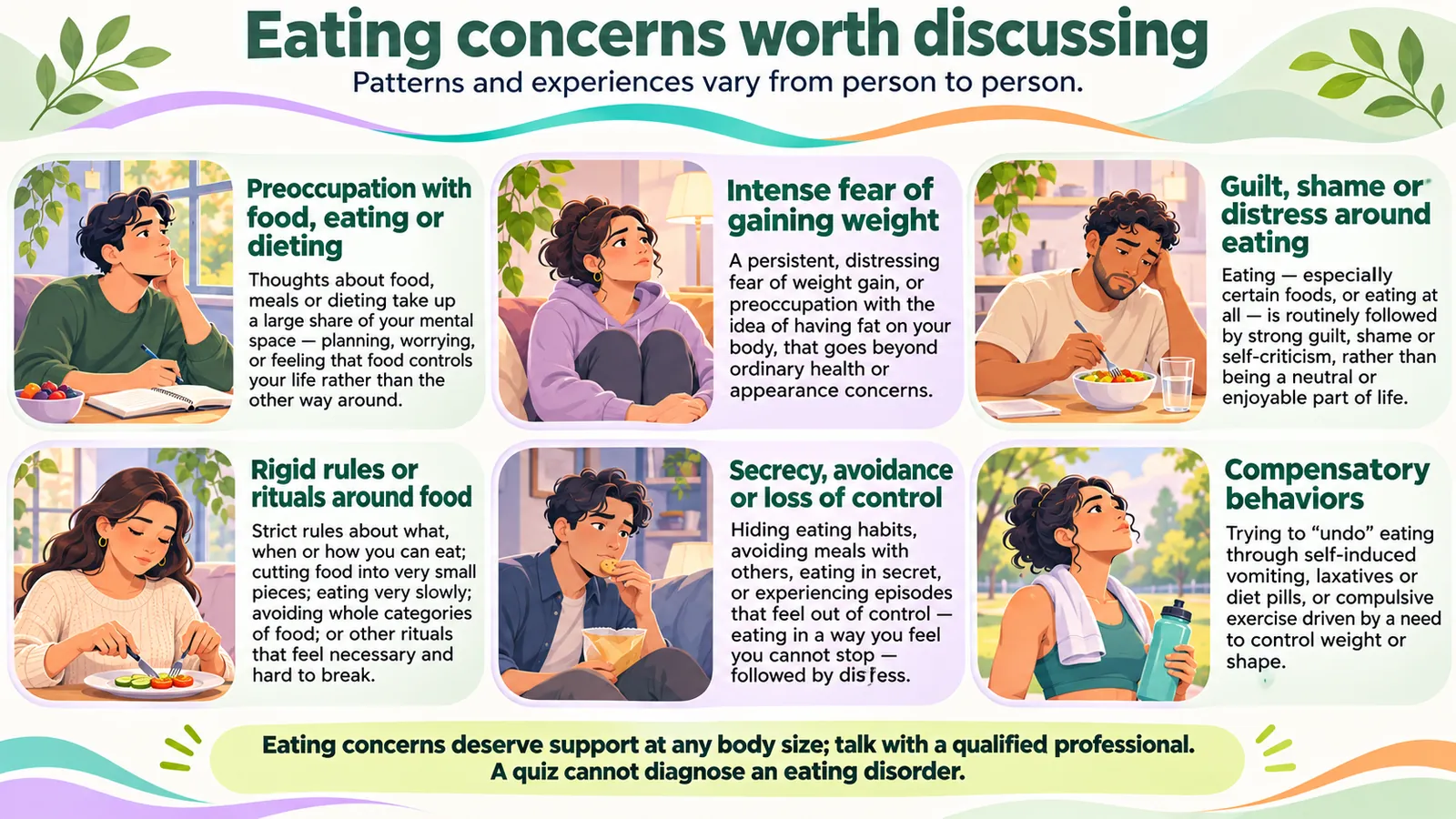
Preoccupation with food, eating or dieting
Thoughts about food, meals or dieting take up a large share of your mental space — planning, worrying, or feeling that food controls your life rather than the other way around.
Intense fear of gaining weight
A persistent, distressing fear of weight gain, or preoccupation with the idea of having fat on your body, that goes beyond ordinary health or appearance concerns.
Guilt, shame or distress around eating
Eating — especially certain foods, or eating at all — is routinely followed by strong guilt, shame or self-criticism, rather than being a neutral or enjoyable part of life.
Rigid rules or rituals around food
Strict rules about what, when or how you can eat; cutting food into very small pieces; eating very slowly; avoiding whole categories of food; or other rituals that feel necessary and hard to break.
Secrecy, avoidance or loss of control
Hiding eating habits, avoiding meals with others, eating in secret, or experiencing episodes that feel out of control — eating in a way you feel you cannot stop — followed by distress.
Compensatory behaviors
Trying to “undo” eating through self-induced vomiting, laxatives or diet pills, or compulsive exercise driven by a need to control weight or shape. These warrant professional support regardless of anything else.
A screening score vs. a clinical diagnosis
Both are useful, but they answer different questions. Only a qualified professional can do the second.
| Feature | EAT-26 screening score | Clinical diagnosis |
|---|---|---|
| What it answers | Is a fuller conversation about eating worthwhile? | Is a specific eating disorder present, and which one? |
| How it is produced | Your own answers to 26 standardized statements. | A comprehensive assessment by a qualified health professional. |
| What it can miss | Difficulties not captured by these particular questions, or not recognized or reported. | Far less, because the clinician can ask follow-up questions and examine context. |
| Do the behavioral questions matter? | Yes, in both. A “yes” to binge eating, vomiting, or laxative or diet-pill use warrants a professional conversation whatever the total score. | |
How the screen works
How is the EAT-26 scored and interpreted?
The EAT-26 produces one total score plus a short set of behavioral questions. Both parts carry weight, and neither produces a diagnosis.
- 01 The scale
Six response options per item
Each of the 26 statements is answered Always, Usually, Often, Sometimes, Rarely or Never. The responses reflecting more eating concern score 3, 2 or 1; the remainder score 0. One item is reverse-scored.
- 02 The threshold
A total of 20 or more
Totals run from 0 to 78. A score of 20 or above is the instrument’s established threshold indicating that a referral for professional evaluation is recommended.
- 03 Clinical context
What only a professional can add
A clinician considers your history, physical health, how long difficulties have lasted and how much they affect your life, and can assess conditions this screen does not distinguish, such as binge eating disorder.
The EAT-26 also asks, about the past six months: have you gone on eating binges where you feel you may not be able to stop; have you ever made yourself sick to control your weight or shape; have you ever used laxatives, diet pills or diuretics to control your weight or shape; and have you ever been treated for an eating disorder. A “yes” to any of these indicates it would be wise to speak with a professional, no matter what your total score is.
Understanding the context
What contributes to disordered eating?
There is no single cause. Eating difficulties are generally understood as arising from a combination of biological, psychological and social factors, and they are not a failure of willpower or character.
Biological and family factors
Eating disorders can run in families, and genetic and biological factors are thought to contribute. Family history does not determine your future.
Psychological factors
Perfectionism, difficulty tolerating distress, low self-esteem and co-occurring anxiety or low mood frequently accompany eating difficulties.
Social and cultural pressure
Weight stigma, appearance-focused environments, dieting culture and comments from others about food or bodies can all feed preoccupation with eating and shape.
Evidence-based care
Can eating difficulties be treated?
Yes, and they genuinely improve with proper treatment. The right approach depends on what is happening, how long it has lasted, your physical health and your preferences.
- 01 / TALK THERAPY
Psychological therapy
Eating-disorder-focused cognitive behavioural therapy is a first-line option for adults. For children and young people, family-based approaches involve parents or carers directly in supporting eating.
- 02 / MEDICAL & NUTRITIONAL
Medical and nutritional care
Eating disorders affect physical health, so assessment and monitoring matter alongside therapy. A prescriber may also treat co-occurring conditions such as depression or anxiety.
- 03 / ONGOING SUPPORT
Continued and coordinated support
Recovery is rarely linear. Scheduled follow-up, people who know what is going on, and a plan for difficult stretches all support treatment over time.
Clinical guidance: NICE guideline NG69, eating disorders: recognition and treatment. Do not start or stop treatment based on an online result.
Practical next steps
What should you do with your result?
Treat this as information, not a verdict. You do not need a high score, or the perfect words, to ask for support.
- 01
Share it with someone who can help
If you scored 20 or above, or answered “yes” to any behavioral question, bring the result to a healthcare professional. Your doctor is a good starting point and can refer you onward.
- 02
Take one smaller step if that is too much
Tell one trusted person what you are experiencing, or contact the Alliance for Eating Disorders helpline on 1-866-662-1235 for free, judgment-free guidance on where to turn.
- 03
Bring a fuller picture
Note how long this has been going on, what a typical day of eating looks like, and anything that makes it better or worse. Low mood often accompanies eating difficulties and is worth mentioning.
In the US, call or text 988 (Suicide & Crisis Lifeline, 24/7), or call 911 for an emergency. For eating-disorder support specifically, the National Alliance for Eating Disorders helpline is 1-866-662-1235. Elsewhere, contact local emergency services or find a helpline at findahelpline.com. A questionnaire is not the right tool for a crisis.
Good questions to ask
EAT-26 test FAQs
Short, practical answers to the most common questions about the Eating Attitudes Test and this screening.
This questionnaire cannot tell you. The EAT-26 is a screen: it indicates whether you report enough eating-related concern that a fuller professional evaluation would be worthwhile. A score of 20 or more, or a “yes” to any of the behavioral questions, means it is worth speaking to a qualified professional. A lower score does not rule anything out. Only a comprehensive assessment by a health professional can determine whether an eating disorder is present and which one.
The EAT-26 (Eating Attitudes Test) is a 26-question screening questionnaire that measures attitudes and behaviors related to eating, weight and body image. Developed by David Garner and colleagues at the University of Toronto in 1982, it is one of the most widely used eating disorder screening tools in the world. It is used in clinics, schools, universities and research as a standardized first step.
A total score of 20 or more is the established cutoff indicating that a referral for professional evaluation is recommended. The score ranges from 0 to 78. The total is not the only thing that matters: answering “yes” to any of the behavioral questions about binge eating, self-induced vomiting, or laxative and diet-pill use indicates a professional conversation is warranted regardless of your total. A high score is a signal to seek assessment, not a diagnosis in itself.
No. The EAT-26 is a screening tool, not a diagnostic instrument. It can indicate that eating-related concerns are present and that further evaluation would help, but it cannot tell you whether you have a specific eating disorder such as anorexia nervosa, bulimia nervosa or binge eating disorder. Only a qualified health professional can determine that through a comprehensive assessment.
Yes. No screening tool is perfect, and it is possible to have a serious problem with eating and not score above the cutoff — for example if you do not recognize or do not report certain attitudes, or if your difficulties are not well captured by these particular questions. This is exactly why the behavioral questions matter regardless of score, and why a low number should never override your own sense that something is wrong.
Because some behaviors are clinically significant on their own, whatever the questionnaire total says. Binge eating with a sense of lost control, self-induced vomiting, and use of laxatives, diet pills or diuretics to control weight or shape each warrant a professional conversation independently. The behavioral questions ask about the past six months.
This page reproduces the published EAT-26 in full, with its original 26 items, its six-point response scale and its standard scoring, and cites the 1982 paper in which it appeared. The authors make the instrument freely available for educational, clinical and research use with appropriate citation. The presentation here is designed to be supportive and non-triggering, and leaves out body-measurement and numeric targets that the total-score screen does not require.
Yes, for many people. Eating disorders are serious health conditions, and they are treatable; they also tend to deepen without help, which is why acting sooner matters. Psychological therapy, medical and nutritional care, and continued support all have evidence behind them. Recovery is rarely a straight line, and that is normal rather than a sign of failure.
Yes. The test is free, needs no account or sign-up, and your result appears immediately on this page. You are welcome to take it more than once, and nothing obliges you to share the outcome with anyone.
Editorial transparency
Sources and review information
This page reproduces the Eating Attitudes Test (EAT-26), developed by David M. Garner, Marion P. Olmsted, Yvonne Bohr and Paul E. Garfinkel and published in Psychological Medicine in 1982. The EAT-26 is made freely available by its authors for educational, clinical and research use with appropriate citation. The surrounding explanation was prepared by the PsyMed Editorial Team from the public clinical resources listed here. We are writers and researchers, not clinicians, and no licensed clinician is claimed as a reviewer. Read how we build our tests and who we are.
Medical and editorial references
- Garner, D.M., Olmsted, M.P., Bohr, Y., & Garfinkel, P.E. (1982). The Eating Attitudes Test: psychometric features and clinical correlates. Psychological Medicine, 12(4), 871–878. doi.org/10.1017/S0033291700049163
- Garner, D.M., & Garfinkel, P.E. (1979). The Eating Attitudes Test: an index of the symptoms of anorexia nervosa. Psychological Medicine, 9(2), 273–279. doi.org/10.1017/S0033291700030762
- EAT-26 self-test, scoring and permission information (eat-26.com)
- NICE NG69: Eating disorders — recognition and treatment
- MedlinePlus: Eating Disorders
- American Psychiatric Association. (2022). Diagnostic and Statistical Manual of Mental Disorders (5th ed., text rev.).
EAT-26 © Garner et al. (1982), reproduced with attribution.
Struggling with food is not a failure of willpower
A difficult relationship with food deserves attention.
Use this screen to organize your thoughts, then speak with a qualified professional if eating or body image is affecting your life. Eating disorders are treatable, and people recover.
Take the screening