
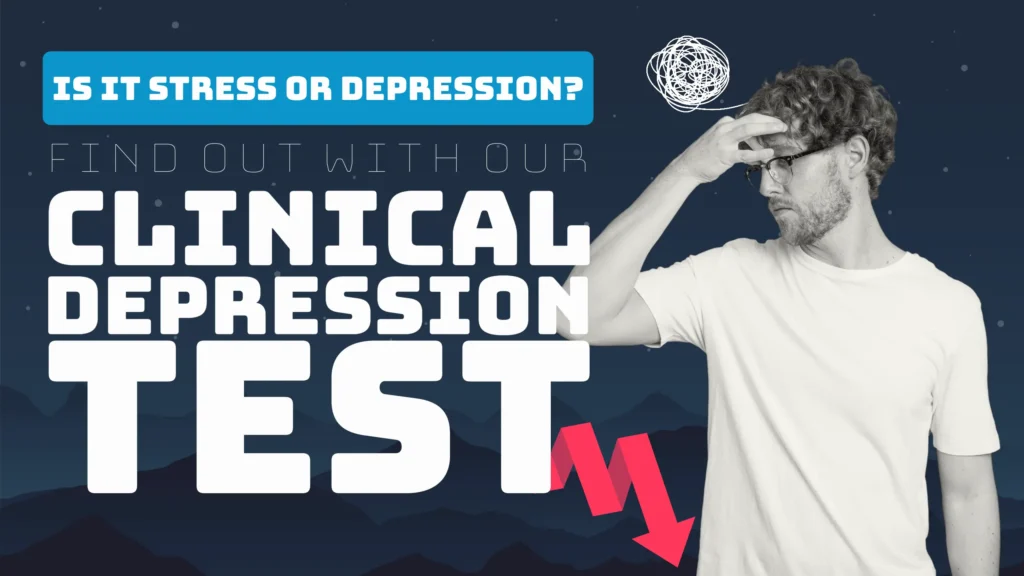
Free Clinical Depression Test (PHQ-9)
A nine-item adult screener based on the PHQ-9, covering mood, interest, sleep, energy, appetite and concentration over the past two weeks. See which symptoms stand out, what your score band means, and what to do next.
Published Updated
You don’t have to go through this alone. Support is available right now.
📞 988 Suicide & Crisis Lifeline — call or text 988 (24/7, free, confidential)
💬 Crisis Text Line — text HOME to 741741
If you’re having thoughts of death or of harming yourself, please reach out now — depression is treatable, these feelings can ease with support, and you deserve help. Outside the US, contact your local emergency number or a crisis line in your country.
Everyone feels down, flat, or low from time to time — that’s part of being human. Clinical depression is different. It’s a persistent, heavy state that lingers for weeks or longer and reaches into everything: your energy, your sleep, your appetite, your concentration, your sense of yourself, and your ability to feel pleasure in things you used to enjoy. It isn’t a weakness or a mood you should be able to “snap out of,” and it isn’t your fault. It’s a real, common, and highly treatable medical condition.
This free clinical depression test uses the PHQ-9 (Patient Health Questionnaire-9) — the most widely used and rigorously validated depression screening tool in the world, used by doctors everywhere and mapped directly onto the official diagnostic criteria for major depressive disorder. It’s 9 questions about the past two weeks, and your results are private and instant. It’s a screening tool, not a diagnosis — but it’s the same set of questions a clinician would likely start with.
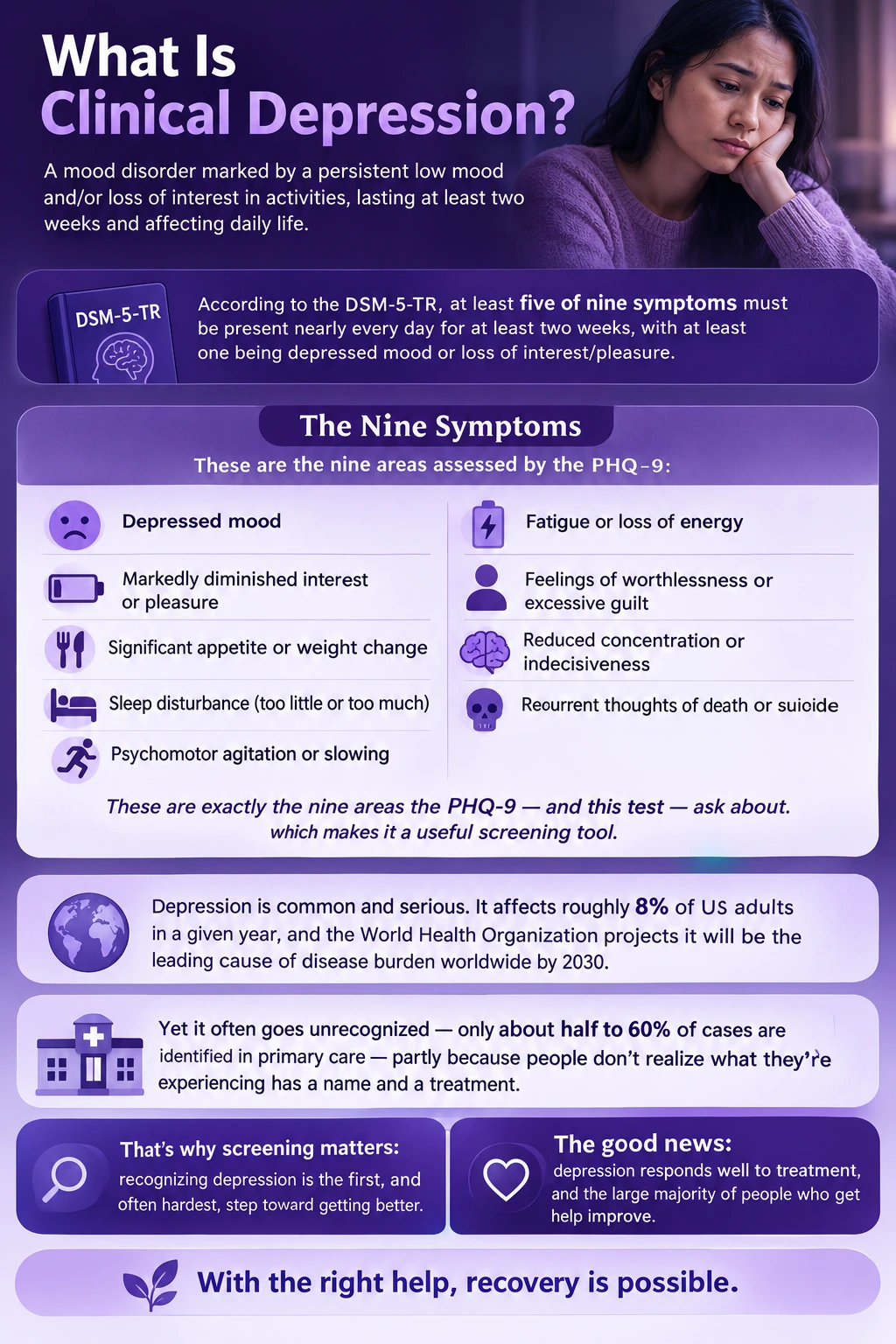
What Is Clinical Depression?
Clinical depression — known clinically as major depressive disorder (MDD) — is a mood disorder characterized by a persistently low mood and/or a loss of interest or pleasure in almost all activities, lasting at least two weeks and causing significant distress or difficulty functioning. It’s distinct from ordinary sadness or grief in its persistence, its depth, and the way it pervades mind and body together.
According to the DSM-5-TR, a diagnosis of major depressive disorder requires at least five of nine symptoms present nearly every day for at least two weeks, with at least one being either depressed mood or loss of interest/pleasure (anhedonia). The nine symptoms are: depressed mood; markedly diminished interest or pleasure; significant appetite or weight change; sleep disturbance (too little or too much); psychomotor agitation or slowing; fatigue or loss of energy; feelings of worthlessness or excessive guilt; reduced concentration or indecisiveness; and recurrent thoughts of death or suicide. These are exactly the nine areas the PHQ-9 — and this test — ask about, which is what makes it such a useful screening tool.
Depression is common and serious. It affects roughly 8% of US adults in a given year, and the World Health Organization projects it will be the leading cause of disease burden worldwide by 2030. Yet it often goes unrecognized — only about half to 60% of cases are identified in primary care — partly because people don’t realize what they’re experiencing has a name and a treatment. That’s precisely why screening matters: recognizing depression is the first, and often hardest, step toward getting better. And the encouraging truth underneath all of this is that depression responds well to treatment; the large majority of people who get help improve.
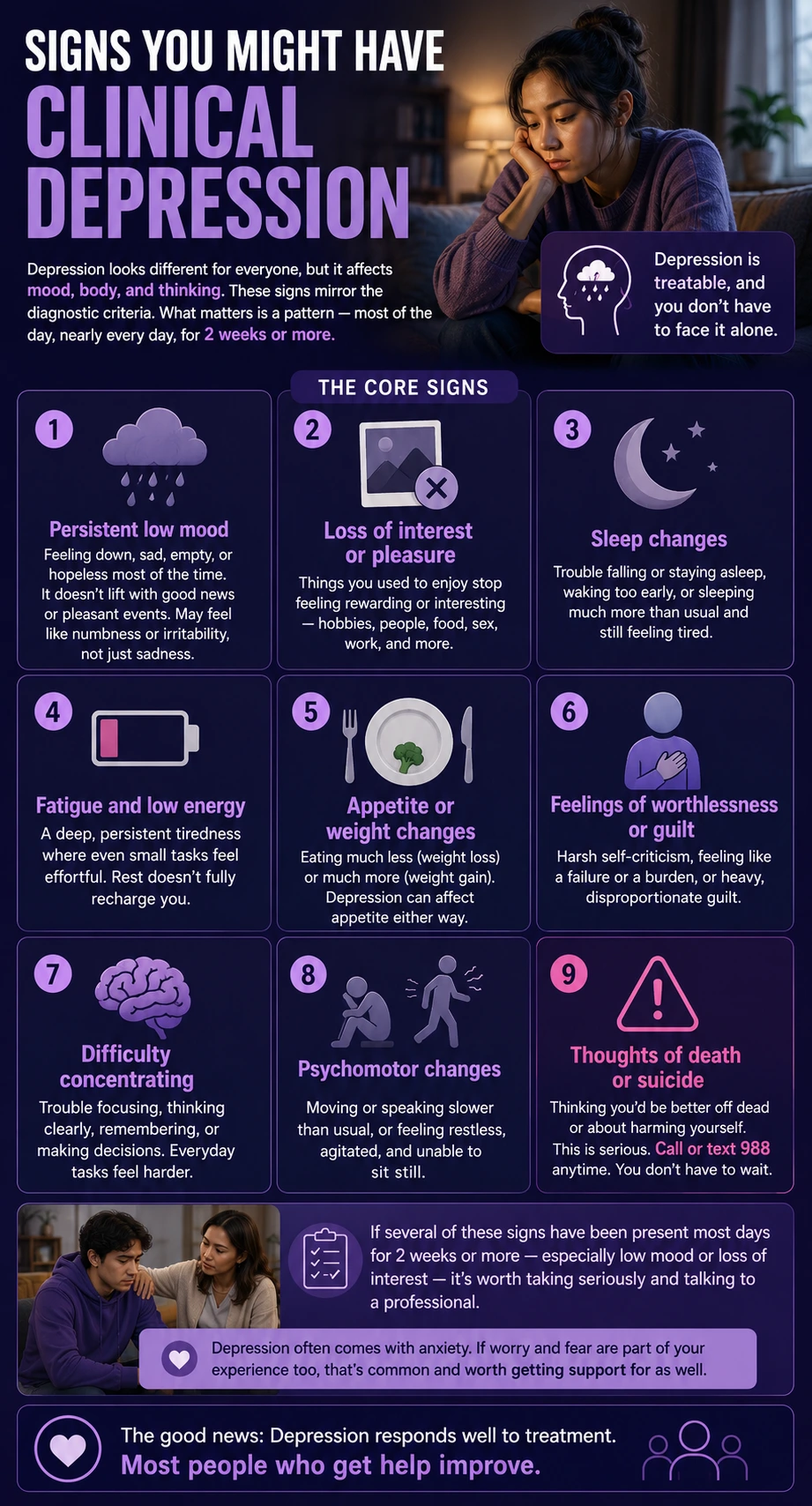
Signs You Might Have Clinical Depression
Depression shows up differently from person to person, but it consistently affects mood, body, and thinking together. These are the core signs, which mirror the diagnostic criteria. What matters is not a single bad day but a cluster of these present most of the day, nearly every day, for two weeks or more.
-
Persistent low mood
Feeling down, sad, empty, or hopeless most of the time — a heaviness that doesn’t lift with circumstances the way ordinary sadness does. Some people experience this more as numbness or emptiness than as sadness, and in some (especially men and adolescents) it can look like irritability.
-
Loss of interest or pleasure (anhedonia)
Things you used to enjoy — hobbies, people, food, sex, work you cared about — stop feeling rewarding or interesting. This loss of pleasure is one of the two core features of depression, and for many people it’s the most telling one.
-
Sleep changes
Trouble falling or staying asleep, waking far too early, or sleeping much more than usual and still feeling unrested. Depression commonly disrupts sleep in both directions.
-
Fatigue and loss of energy
A pervasive tiredness where even small tasks feel effortful, and you feel drained regardless of rest. This exhaustion is physical as much as emotional.
-
Appetite or weight changes
Eating much less with weight loss, or eating more with weight gain — depression can push appetite in either direction.
-
Feelings of worthlessness or guilt
Harsh self-criticism, a sense of being a failure or a burden, or heavy, disproportionate guilt about things that aren’t your fault. Depression distorts self-perception in a persistently negative direction.
-
Difficulty concentrating
Trouble focusing, thinking clearly, remembering, or making decisions — reading, working, or following a conversation can feel unexpectedly hard.
-
Psychomotor changes
Moving or speaking noticeably more slowly than usual, or the opposite — being restless, agitated, and unable to sit still — to a degree others might notice.
-
Thoughts of death or suicide
Recurrent thoughts that you’d be better off dead, or thoughts of harming yourself. This is the most serious sign, and it deserves immediate attention regardless of anything else. If this is present for you, please reach out now — call or text 988. You don’t have to wait until things get worse, and you don’t have to face these thoughts alone.
If several of these have been present most days for two weeks or more — and especially if they include low mood or loss of interest — it’s worth taking seriously and worth talking to someone about. Depression also frequently travels with anxiety, so if worry and fear are part of your experience too, that’s common and worth screening for as well.
How This Test Works
This Clinical Depression test uses the PHQ-9, a validated 9-item questionnaire. Over the last two weeks, how often have you been bothered by each of the following? For each, choose:
Not at all = 0 | Several days = 1 | More than half the days = 2 | Nearly every day = 3
Your answers produce a score from 0 to 27, which places you in one of five validated severity categories. Because the PHQ-9 is a genuinely validated instrument that maps onto the diagnostic criteria for depression, this gives a more meaningful result than an informal quiz — though it’s still a screen, not a diagnosis.
One important note before you begin: the final question asks about thoughts of death or self-harm. If you find yourself answering anything other than “Not at all” to that question, please treat that as important on its own — regardless of your total score — and reach out to someone, whether that’s 988, a doctor, or a person you trust. Answer honestly; the test is private, and honesty is what makes it useful.
Understanding Your Clinical Depression Test Score
| Score | Severity | What It Suggests |
|---|---|---|
| 0 – 4 | Minimal or None | Little or no indication of depression. Ordinary ups and downs without a persistent depressive pattern. |
| 5 – 9 | Mild | Some depressive symptoms present. Worth watching and, if they persist, worth discussing with a professional. |
| 10 – 14 | Moderate | A level often consistent with clinical depression (the ≥10 threshold). A professional assessment is recommended. |
| 15 – 19 | Moderately Severe | Significant depressive symptoms. Professional treatment is strongly recommended. |
| 20 – 27 | Severe | Severe depressive symptoms very likely affecting most areas of life. Please reach out for support soon. |
What Causes Depression?
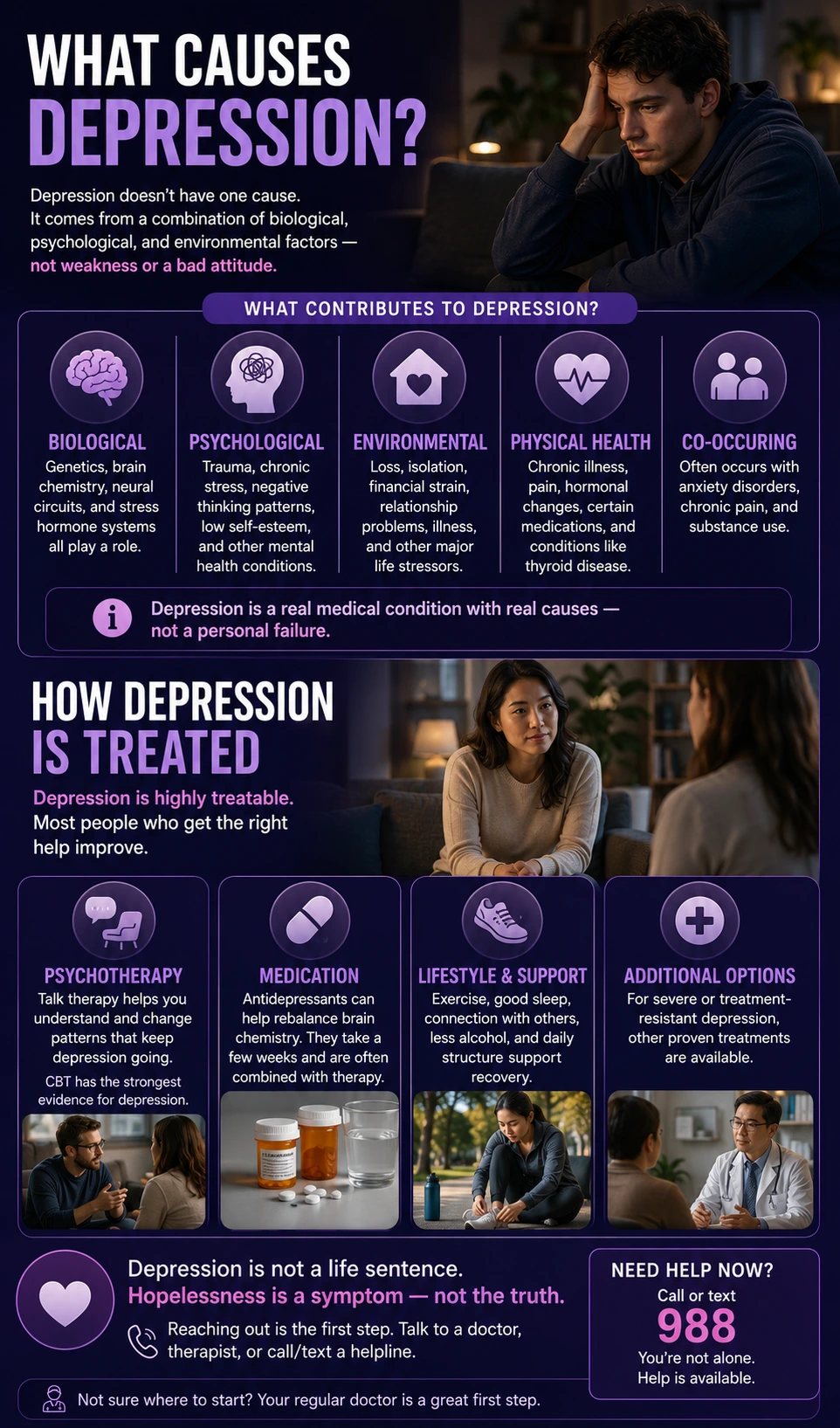
Depression doesn’t have a single cause — it arises from a combination of biological, psychological, and environmental factors, and it’s never simply a matter of weakness or attitude. Biologically, depression runs in families (there’s a real genetic component) and involves differences in brain chemistry, neural circuits, and stress-hormone systems. Psychologically, factors like a history of trauma, chronic stress, certain thinking patterns, low self-esteem, and other mental health conditions raise vulnerability. Environmentally, major life stresses — loss, isolation, financial strain, relationship difficulties, illness — can trigger or deepen depression.
Physical health matters too: chronic illness, chronic pain, hormonal changes, certain medications, and conditions like thyroid disease can cause or worsen depressive symptoms, which is one reason a medical check-up is a sensible part of assessment. Depression also commonly co-occurs with other conditions — anxiety disorders especially, but also chronic pain and substance use. What’s worth taking from all this is that depression is a genuine health condition with real mechanisms, not a personal failing — and understanding that is part of why it responds to real treatment rather than to being told to cheer up.
How Depression Is Treated
Depression is highly treatable, and this is worth emphasizing because depression itself distorts your sense of whether anything will help. The large majority of people who get proper treatment improve.
Psychotherapy is a cornerstone. Cognitive Behavioral Therapy (CBT) has the strongest evidence base — it helps identify and change the thinking and behavior patterns that maintain depression. Other approaches, including interpersonal therapy and behavioral activation, are also effective. For many people, therapy alone is enough, particularly for mild to moderate depression.
Medication helps many people, especially for moderate to severe depression. Antidepressants (commonly SSRIs and SNRIs) work by acting on the brain systems involved in mood; they typically take a few weeks to reach full effect and are often combined with therapy. A prescriber can help find the right fit, which sometimes takes some adjustment.
Lifestyle and support meaningfully aid recovery: regular physical activity (which has genuine antidepressant evidence), consistent sleep, connection with others, reducing alcohol, and structure in daily life. These support treatment rather than replacing it for clinical depression, but they matter. For severe or treatment-resistant depression, additional options exist and are worth discussing with a specialist.
The essential message: depression is not a life sentence, and feeling hopeless is a symptom of the illness rather than an accurate read on your future. Reaching out — to a doctor, a therapist, or a helpline — is the step that starts recovery, even though depression is the very thing that makes that step feel hard. If you don’t know where to begin, your regular doctor is a perfectly good starting point.
Frequently Asked Questions
What is the PHQ-9?
The PHQ-9 (Patient Health Questionnaire-9) is a validated nine-item questionnaire that screens for depression and measures its severity. Developed by Drs. Robert Spitzer, Janet Williams, and Kurt Kroenke in 2001, it’s the most widely used depression screening tool in the world, translated into over 70 languages and used by doctors everywhere. Its nine items map directly onto the nine diagnostic criteria for major depressive disorder, so the same answers serve as both a screen and a severity score. Each item is rated 0 to 3 based on the past two weeks, for a total from 0 to 27, with established severity bands. A score of 10 or higher is the standard threshold suggesting possible major depression (with about 88% sensitivity and specificity). It’s free to use, briefer than many alternatives, and genuinely validated — which is why this test is based on it.
Can this test diagnose depression?
No. Even though it uses the validated PHQ-9, this is a screening tool, not a diagnosis. A score can tell you whether your symptoms are consistent with depression and how severe they appear, and whether it’s worth seeking help — but an actual diagnosis of major depressive disorder requires a professional evaluation by a healthcare provider, who will consider your full history, rule out other causes (like thyroid problems or medication effects), and assess how the criteria apply to you over time. Think of your result as meaningful, research-based information to bring to that conversation, not a conclusion. A low score also doesn’t override your own sense that something’s wrong — if you’re concerned, that concern is worth taking to a professional regardless.
What’s the difference between depression and sadness?
Sadness is a normal, healthy human emotion — a response to loss, disappointment, or difficulty — that comes and goes and typically lifts with time or circumstances. Clinical depression is different in persistence, depth, and reach. It lasts most of the day, nearly every day, for at least two weeks, and it doesn’t reliably lift when good things happen. Crucially, it goes beyond mood: it affects sleep, energy, appetite, concentration, self-worth, and the ability to feel pleasure, and it interferes with daily functioning. A key marker is anhedonia — losing interest or pleasure in things you normally enjoy — which ordinary sadness doesn’t usually cause. If low mood is persistent, pervasive, and affecting how you function, that points toward depression rather than sadness.
How common is depression?
Very common. Depression affects roughly 8% of US adults in any given year, and it’s a leading cause of disability worldwide — the World Health Organization projects it will be the single largest contributor to global disease burden by 2030. It can affect anyone, of any age, background, or circumstance. Despite being so common, it’s frequently under-recognized — only about half to 60% of cases are identified in primary care — often because people don’t recognize what they’re experiencing as a treatable condition, or feel too ashamed or exhausted to raise it. If you’re dealing with depression, you are in very large company, and — importantly — in very treatable company.
When should I see a doctor about depression?
A good rule of thumb: if depressive symptoms have lasted more than two weeks, are affecting your daily life, work, or relationships, or are distressing you, it’s worth talking to a doctor or mental health professional. You don’t need to wait until things are severe or until you’re “sure” — screening tools like this one exist precisely to help you decide, and a professional can take it from there. You should seek help urgently — the same day — if you’re having thoughts of death, suicide, or harming yourself: call or text 988 (Suicide & Crisis Lifeline) any time. There’s no threshold of “bad enough” you need to reach before you’re allowed to ask for help; distress that’s affecting your life is reason enough.
Is depression treatable?
Yes — depression is one of the most treatable mental health conditions, and the large majority of people who receive proper treatment improve significantly. The main treatments are psychotherapy (especially CBT and other evidence-based approaches), medication (typically antidepressants for moderate to severe depression), or a combination, alongside supportive lifestyle changes. Finding the right treatment sometimes takes some adjustment, and recovery isn’t always instant or perfectly linear — but the core truth is genuinely hopeful: depression responds to treatment, and the hopelessness it creates is a symptom of the illness, not an accurate forecast. Even severe depression, which can feel utterly permanent from the inside, very often lifts substantially with the right help.
Further reading
Depression rarely shows up as sadness alone. What Is Anhedonia? covers the loss of pleasure that often comes with it and is easily mistaken for apathy. In older adults low mood and memory problems can look alike, and our dementia test helps tell them apart. If the low points have felt dangerous, 20 Best Books About Suicide gathers writing on survival, grief and getting through.
Related Tests
- Anxiety Test — depression and anxiety very commonly occur together; worth screening alongside
- Bipolar Test — if you’ve had periods of unusually high energy or elevated mood, depression may be part of a bipolar pattern
- Dysthymia Test — for persistent, longer-lasting low-grade depression (persistent depressive disorder)
- Seasonal Affective Disorder Test — for depression that arrives and lifts with the seasons; SAD is major depression with a seasonal pattern rather than a separate condition
- High-Functioning Depression Test — for depression hidden behind an outwardly capable, productive life
- Edinburgh Postnatal Depression Scale — validated specifically for depression during pregnancy or after birth
- Burnout Test — burnout can look like and overlap with depression; this helps distinguish work-related exhaustion
- Suicidal Ideation Test — if thoughts of death or self-harm are present, a more focused screen with crisis resources
References
- Kroenke, K., Spitzer, R.L., & Williams, J.B.W. (2001). The PHQ-9: Validity of a Brief Depression Severity Measure. Journal of General Internal Medicine, 16(9), 606–613. [Original PHQ-9 validation; 0–27 scoring and severity bands] pubmed.ncbi.nlm.nih.gov
- American Psychiatric Association. (2022). Diagnostic and Statistical Manual of Mental Disorders, Fifth Edition, Text Revision (DSM-5-TR). Major Depressive Disorder. psychiatry.org
- Bains, N., & Abdijadid, S. (2023). Major Depressive Disorder. StatPearls. [DSM-5 criteria; PHQ-9 use; WHO burden projection] ncbi.nlm.nih.gov
- Maurer, D.M., Raymond, T.J., & Davis, B.N. (2018). Depression: Screening and Diagnosis. American Family Physician, 98(8), 508–515. [~8% prevalence; USPSTF screening; PHQ-9 performance] aafp.org
- US Preventive Services Task Force. (2023). Screening for Depression and Suicide Risk in Adults. [Recommendation to screen all adults, including perinatal] uspreventiveservicestaskforce.org
Related Tests
See All Quiz →

You may also like
See All Quiz →