
Educational self-assessment · Sleep & daily wellbeing
Insomnia Test: Understand your sleep difficulties.
Use the seven-question Insomnia Severity Index to reflect on sleep difficulties over the last two weeks. See your score, learn what it means, and prepare for a conversation about your sleep.
For self-reflection, not a diagnosis. If you are thinking about suicide or self-harm, call or text 988 (US), or find support at findahelpline.com. In immediate danger, call your local emergency number.
- THE SELF-CHECK7 questionsReflect on the last two weeks.
- NO SIGN-UPFree to takeYour result appears after you finish.
- CLEAR BOUNDARIESInformation, not a diagnosisLearn what the score can and cannot tell you.
Take Test
Take the insomnia test
This insomnia test uses the Insomnia Severity Index (ISI). For adults reflecting on their own sleep, answer for the last two weeks. The questions use different answer scales, so read each set of choices. This is a screening and severity measure, not a diagnosis.
Your score
What the bands mean
- 0–7 No clinically significant insomnia
- 8–14 Subthreshold insomnia
- 15–21 Clinical insomnia: moderate severity
- 22–28 Clinical insomnia: severe
These are the ISI scoring categories, not a diagnosis. A clinician considers your history and other possible explanations.
The recall period for the ISI, not the duration required for a chronic diagnosis.
The short answer
What is insomnia?
Insomnia involves difficulty getting to sleep, staying asleep, or getting satisfactory sleep despite having the opportunity and conditions to sleep. It can interfere with daytime activities.
A short period of disrupted sleep and a chronic sleep disorder are different questions. Your answers can help describe the present problem; a clinician needs the broader history.
If worry is also part of your experience, the Anxiety Test offers a separate reflection on that topic. Neither score explains the other.
This self-check does not replace an individual assessment. Read the methodology and limitations before interpreting your result.
NHLBI describes chronic insomnia as sleep difficulty at least three nights a week for three months or longer. The ISI’s two-week recall period is different from this diagnostic duration.
Symptoms
Signs to notice
These experiences can be worth discussing. No single sign identifies the cause.
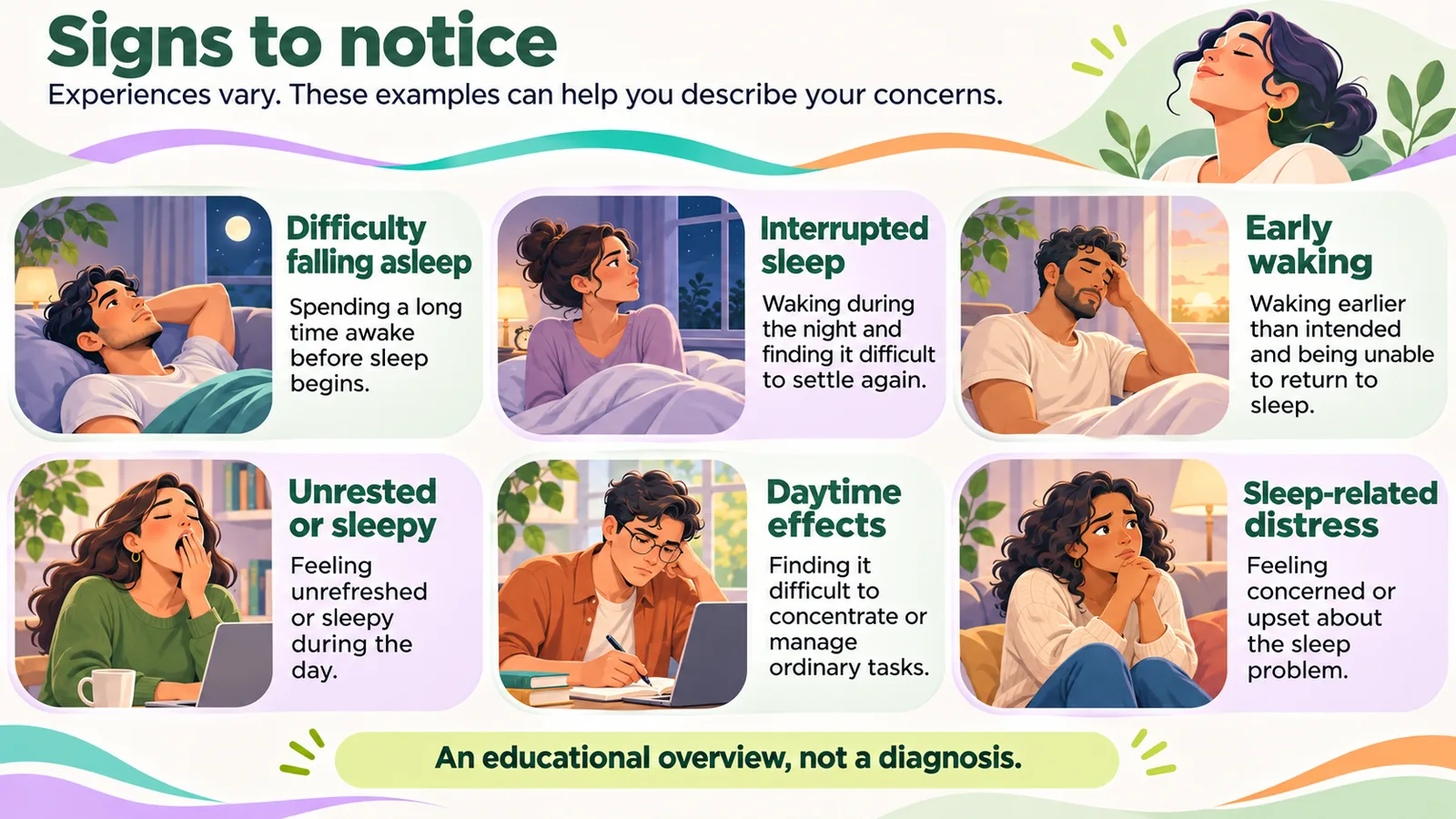
Difficulty falling asleep
Spending a long time awake before sleep begins.
Interrupted sleep
Waking during the night and finding it difficult to settle again.
Early waking
Waking earlier than intended and being unable to return to sleep.
Unrested or sleepy
Feeling unrefreshed or sleepy during the day.
Daytime effects
Finding it difficult to concentrate or manage ordinary tasks.
Sleep-related distress
Feeling concerned or upset about the sleep problem.
ISI score vs. clinical assessment
Both can be useful, but they answer different questions.
| Feature | ISI questionnaire | Clinical assessment |
|---|---|---|
| What it asks | How severe recent sleep difficulties feel. | Whether a sleep disorder is present and what contributes to it. |
| Information used | Seven self-report answers covering the last two weeks. | Sleep history, daytime impact, health and other relevant assessment. |
| What it provides | A severity score and category. | An individualized assessment and plan. |
Diagnosis
How is insomnia assessed?
An online score does not replace an individual assessment.
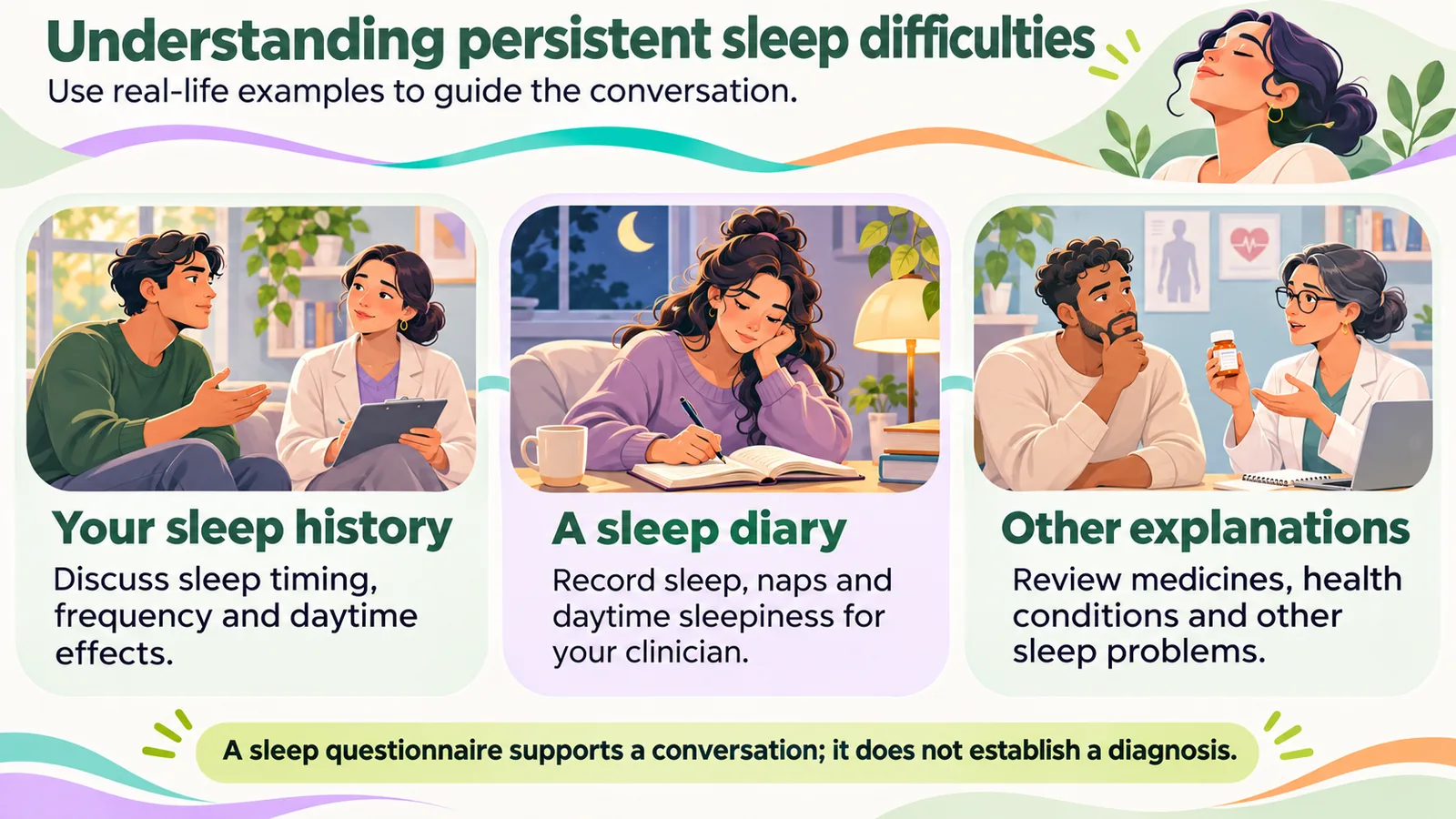
- 01 Assessment
Your sleep history
Describe when sleep problems began, their frequency, and their effect during the day.
- 02 Assessment
A sleep diary
A clinician may suggest recording sleep, wake times, naps and daytime sleepiness.
- 03 Assessment
Other explanations
Further assessment may be needed to understand what is contributing to your sleep difficulties.
Bring your experiences and their everyday impact to a qualified professional. You can ask for support regardless of this result.
Causes
What can contribute to insomnia?
An individual assessment considers the wider context. A questionnaire score cannot explain a person’s experiences on its own.
Schedule and surroundings
Shift work, travel, noise and light can disrupt sleep.
Stress and sleep worry
Life stress and worrying about sleep can contribute to a continuing problem.
Habits and substances
An irregular routine and caffeine, nicotine or alcohol can affect sleep.
Treatment
What treatment can help?
A useful plan responds to your individual needs.
- 01 / SUPPORT
Ask about CBT-I
Cognitive behavioral therapy for insomnia is usually the first treatment option for long-term insomnia.
- 02 / SUPPORT
Review sleep habits
Discuss a regular sleep schedule, a sleep-friendly room and habits that may disrupt rest.
- 03 / SUPPORT
Discuss medicines individually
A healthcare professional can explain when medicine may be useful, along with its risks and follow-up needs.
Next Steps
What can you do next?
You can ask for support without waiting for a particular score.
- 01
Bring a sleep record
Record your nights and daytime difficulties for the appointment.
- 02
Describe the whole picture
Mention ongoing mood concerns, health conditions and medicines. A depression self-check can organize a separate concern.
- 03
Ask about options
Discuss a plan that fits your circumstances. If prolonged work stress is a concern, the Burnout Test explores that experience separately.
If you are thinking about suicide or self-harm, call or text 988 (US), or find support at findahelpline.com. In immediate danger, call your local emergency number.
Questions and answers
Insomnia Test FAQs
Practical context for interpreting this self-check.
This questionnaire cannot decide that. A healthcare professional considers your sleep history, daytime functioning and other possible explanations. A score can be a useful starting point for that conversation.
The sum of seven 0–4 answers gives a total from 0 to 28. The score is grouped into the standard ISI categories shown above. These categories describe reported severity; they are not a diagnosis.
The last two weeks are the recall period used by this ISI questionnaire. That recent snapshot does not establish whether sleep difficulties have lasted long enough to be chronic.
No. The ISI rates different aspects of sleep with different labels. Read each question and its choices before answering; all answers contribute 0–4 points.
No. CBT-I is a structured treatment approach. General sleep habits can be discussed as part of care, but they are not the whole treatment.
Yes. A score cannot rule out a concern you want assessed. Describe what is happening and how it affects you, even if your score is low.
No. Discuss sleep medicines and other treatments with a qualified healthcare professional. An online score is not a reason to start or stop medication.
Editorial transparency
Sources and review information
Editorially reviewed by the PsyMed Editorial Team on . This is an editorial source review, not a clinical review.
Prepared by the PsyMed Editorial Team, writers and researchers rather than clinicians. No licensed clinician is claimed as a reviewer. Read how we build our tests and who we are.
Methodology
The existing seven ISI items and their individual 0–4 answer scales are preserved. They cover sleep difficulties, satisfaction, impact, noticeability and distress. The score is the sum of all seven answers. The ISI is © Charles M. Morin; it is not a PsyMed house scale.
A place to start
You deserve support for difficult nights.
Use your result to describe what has been happening, then discuss persistent sleep concerns with a healthcare professional.
Take the self-check