
Anxiety & Fear Disorders · Self-reflection
Scopophobia Test: the fear of being watched or stared at
Fifteen questions about feeling observed, judged and exposed. Scopophobia is a descriptive term rather than a diagnosis — the experience it names is usually assessed as social anxiety disorder. This self-check cannot diagnose either.
Scopophobia is a descriptive term, not a diagnosis. This self-check cannot identify social anxiety disorder, a specific phobia or anything else, and there is no validated cut-off for it.
-
THE FORMAT15 questionsRate how often each statement applies, from “Never” to “Very Often”.
-
THE TERMNot a diagnosisScopophobia appears in neither DSM-5-TR nor ICD-11. The fear it describes is real regardless.
-
WHAT YOU GETA clearer questionFeedback to help you decide whether to raise this with a professional.
The self-check
Take the scopophobia self-check
Answer about yourself, as honestly as you can, thinking about how things have generally been rather than one bad day. There are no right answers. This is a house-written questionnaire, not a validated diagnostic measure, and it cannot identify or rule out any condition.
Your result
What the answer ranges mean
- 0–15 Low — minimal concern
- 16–30 Mild — some patterns present
- 31–45 Moderate — meaningful impact
- 46–60 High — worth professional support
Scopophobia is a descriptive term, not a diagnosis. This self-check cannot identify social anxiety disorder, a specific phobia or anything else, and there is no validated cut-off for it.
A questionnaire length, not a diagnostic threshold.
The short answer
What is scopophobia?
Scopophobia is the fear of being watched or stared at. It is a descriptive label rather than a formal diagnosis — it appears in neither the DSM-5-TR list of anxiety disorders nor as a titled category in ICD-11 — and current research treats it as a symptom rather than a condition in its own right, with a 2025 paper in PCN Reports calling gaze anxiety (scopophobia) “a frequently observed and reported symptom that is closely associated with social anxiety disorder”. In practice, the fear it names is most often assessed and treated as social anxiety disorder, which the National Institute of Mental Health defines as “an intense, persistent fear of being watched and judged by others”.
That overlap is not a technicality — it is the most useful thing to know about this fear, because it points at treatment that exists. Being looked at is inherently evaluative, so a fear of it usually belongs on the social-anxiety side rather than being a specific phobia of the kind the APA Dictionary describes as “a marked and persistent fear of a specific object, activity, or situation”. The practical dividing line is what the fear is about: social anxiety disorder centres on being negatively judged by other people, while a specific phobia centres on a circumscribed thing. Research using the word “scopophobia” itself is very thin — a 2023 paper in BMC Medical Education notes that studies on the topic are “exceedingly rare worldwide” — which is exactly why no validated scopophobia questionnaire exists and why this page cannot offer you a cut-off. What the literature does offer is well-established treatment for the condition this fear usually sits inside.
Do not confuse scopophobia with scopophilia (also spelled scoptophilia), which the APA Dictionary defines as “sexual pleasure derived from watching others”. The words differ by two letters and mean opposite things, in opposite directions of gaze.
Social anxiety disorder — which the National Institute of Mental Health defines as “an intense, persistent fear of being watched and judged by others” — affected an estimated 7.1% of U.S. adults in the past year, with specific phobia at 9.1%. Both figures come from survey fieldwork conducted in 2001–2003 using the diagnostic criteria of the time. There is no verified prevalence figure for scopophobia itself.
View sourceUnderstand the themes
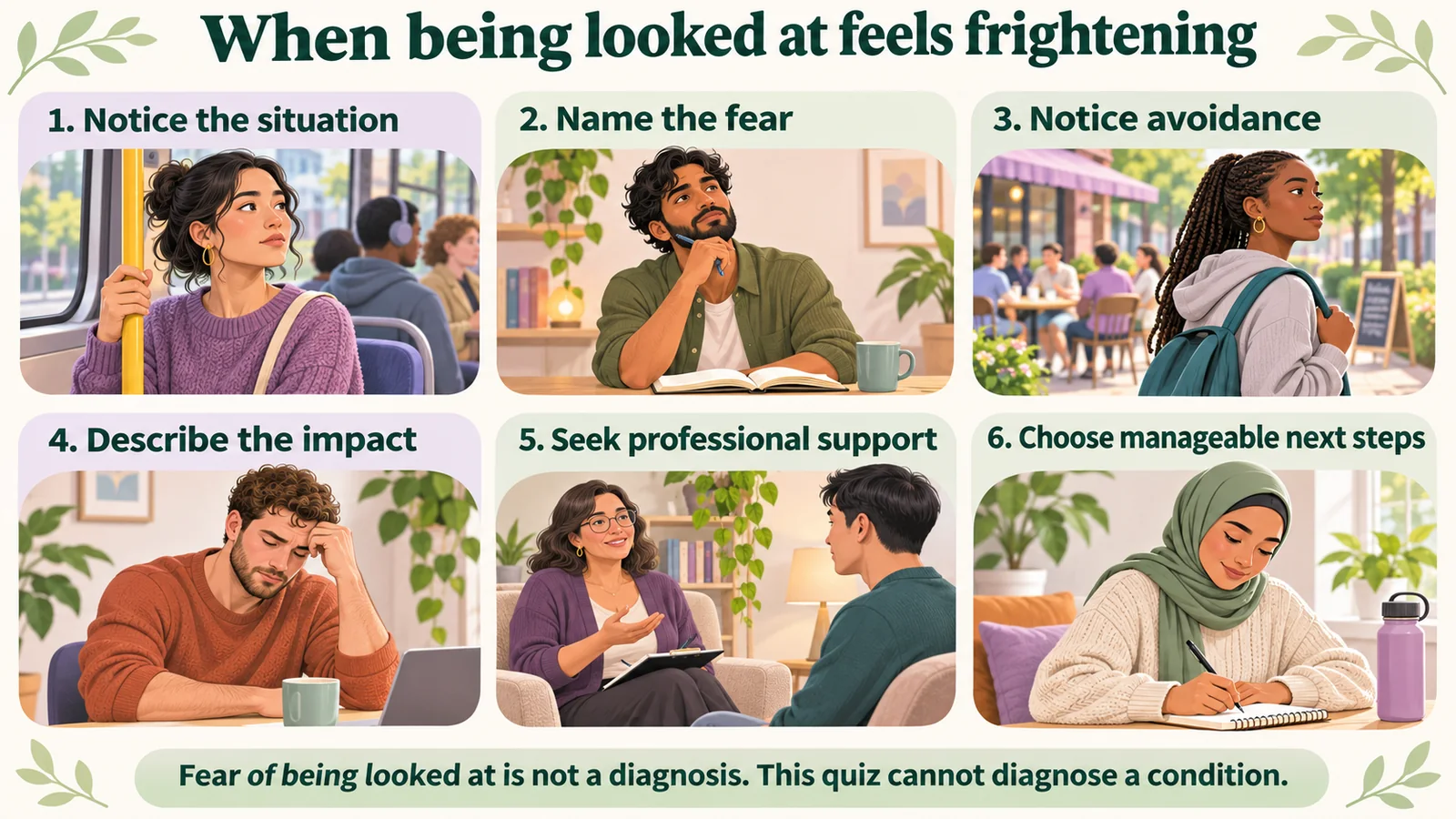
The fifteen themes this self-check asks about
The items cover the feeling itself, the body’s response, and the ways a fear of being seen quietly reshapes a life.
The sense of being watched
A persistent feeling that people are looking at you in shops, waiting rooms or on public transport, even with no particular reason to think so.
Reading judgement into a glance
Assuming that someone who looks in your direction is criticising or thinking badly of you, rather than simply looking around.
Self-monitoring instead of being present
Spending the mental energy of a social situation tracking how you look and move. The National Institute of Mental Health notes people with social anxiety often analyse their own performance afterwards for flaws.
The body’s response
A racing heart, sweating, shaking or breathlessness that feels out of proportion — and then the fear that the blushing or trembling will itself be noticed, which makes the fear feed itself.
Avoiding visibility
Choosing corner seats, avoiding eye contact, declining photographs or video calls, or sitting with your back to a wall. NIMH notes avoidance “may feel helpful in the short term, but the anxiety is likely to remain without treatment”.
The cost over time
Turning down events, presentations, networking or roles that involve being seen. This is the theme that matters most clinically, because interference with daily life is part of how social anxiety disorder is defined.
Terms that get confused with scopophobia
Several of these are used interchangeably online. They do not mean the same things, and one of them is not related at all.
| Term | What it actually means | Relationship to scopophobia |
|---|---|---|
| Scoptophobia | The same idea under an older spelling, found mainly in mid-twentieth-century psychoanalytic writing. The APA Dictionary records the same o/to variation in the sibling pair scopophilia and scoptophilia. | A spelling variant, not a separate condition. Neither form appears in the APA Dictionary of Psychology. |
| Scopophilia / scoptophilia | A sexual construct entirely: the APA Dictionary defines it as “sexual pleasure derived from watching others in a state of nudity, undressing, or engaging in sexual activity”. | Unrelated, despite the near-identical spelling. This is the most consequential confusion on the topic. |
| Social anxiety disorder | A recognised diagnosis, ICD-11 6B04, formerly called social phobia. NIMH defines it as “an intense, persistent fear of being watched and judged by others”, lasting at least six months and interfering with daily life. | The usual clinical home for this fear, and where the evidence-based treatment sits. |
| Ophthalmophobia | Often listed online as a synonym. It literally means fear of eyes, and it appears just once in the PubMed database, in a 1951 paper. | Unverified. We found no authoritative source confirming the two are the same, so we do not present them as synonyms. |
Interpretation and context
How should you read your result?
Read the total as a description of how much of this you reported, then read the individual items for where it actually lands in your life.
- 01 01
Interference matters more than intensity
Social anxiety disorder is defined partly by feelings that “last at least 6 months and interfere with daily life, such as work, school, or relationships”, in NIMH’s words. A moderate total with real avoidance costs more than a high total that changes nothing.
- 02 02
What the fear is about shapes what helps
If the dread is specifically about being judged, that points toward social anxiety and the treatments developed for it. If it is narrower and not about evaluation, a clinician may think about specific phobia instead. Both are treatable.
- 03 03
A questionnaire cannot sort that out
There is no validated scopophobia measure to compare your total against, no published cut-off, and no threshold at which this page could tell you something has become a disorder.
Pages that offer you a scopophobia “severity level” are inventing it. No validated instrument for scopophobia exists — the one published study on the subject had to write its own questions, and its authors noted research on the topic is “exceedingly rare worldwide”. Our four ranges describe how much you endorsed, nothing more.
Context matters
What else belongs in the picture?
No research establishes causes for scopophobia specifically. These are the factors the authorities describe for phobias and social anxiety generally.
Family history and temperament
NIMH notes social anxiety disorder “may run in families”, and lists feeling distressed or nervous in new situations in childhood among the risk factors for phobias, alongside a history of anxiety in biological relatives.
A specific experience
For phobias generally NIMH lists “exposure to a traumatic event involving a specific object or situation” as a risk factor. Being humiliated while visible is a common thread in how people describe the start of this fear.
What else is going on
NICE names avoidant personality disorder, alcohol and substance misuse and mood disorders among the things to consider when assessing social anxiety. If low mood or general worry is part of the picture, the Social Anxiety Test or the Generalized Anxiety Disorder Test may fit better than this one.
Useful support
What actually helps with a fear of being watched
This is the part worth reading even if you skip the questions, because the treatment evidence here is unusually clear.
- 01 / FIRST LINE
Cognitive behavioural therapy
NIMH calls CBT “a well-established and effective treatment for anxiety disorders such as phobias” and, for social anxiety disorder, “the ‘gold standard’ choice for psychotherapy”. The UK’s NICE recommends individual CBT specifically developed for social anxiety, based on the Clark and Wells or Heimberg models.
- 02 / THE ACTIVE INGREDIENT
Exposure, done gradually and on purpose
NIMH singles it out: “Exposure therapy is a CBT method that is particularly effective for treating phobias”, focusing on “confronting the fears underlying a phobia to help people engage in activities and situations they have been avoiding”. This is the opposite of what avoidance does.
- 03 / IF THERAPY IS NOT AVAILABLE YET
Supported self-help, and a prescriber conversation
For people who decline CBT, NICE suggests CBT-based supported self-help. Medication is a prescriber decision; NIMH lists SSRIs and SNRIs for social anxiety disorder, and notes beta-blockers are “commonly the medication of choice for the ‘performance anxiety’ type”.
Clinical guidance: NICE CG159, social anxiety disorder. Worth knowing: NICE advises clinicians “do not routinely offer mindfulness-based interventions or supportive therapy to treat social anxiety disorder”, so treat app-based calm as general self-care rather than treatment. Do not start or stop medication based on an online result.
Practical next steps
Choose one manageable next step
Pick the smallest thing that moves you toward being seen rather than away from it.
- 01
Name one avoidance you want back
Not the hardest one. One specific situation you have been routing around — a seat, a meeting, a photograph — that you would like to stop organising your life to avoid.
- 02
Ask specifically for CBT for social anxiety
The evidence is for a particular thing, not therapy in general. NICE names individual CBT developed for social anxiety disorder, built on the Clark and Wells or Heimberg models. It is reasonable to ask a clinician whether that is what you would be getting.
- 03
Keep this result as a description, not a verdict
Bring the specific items you scored highly to an appointment. “I avoid video calls and I rehearse conversations afterwards for hours” is more useful to a clinician than any total.
This self-check is not a crisis service. If you are thinking about suicide or self-harm, or distress feels unmanageable right now, please reach out: in the US, call or text 988 for the Suicide & Crisis Lifeline, which states it is “available 24/7/365” and that “your conversations are free and confidential”. Elsewhere, findahelpline.com lists verified helplines by country. If someone is in immediate danger, call your local emergency number.
Good questions to ask
Scopophobia FAQs
Direct answers on the term, the diagnosis question and what helps.
Scopophobia is the fear of being watched or stared at. A 2023 paper in BMC Medical Education describes it as “the fear of being watched or stared at”, and recent research treats it as a symptom rather than a condition in its own right: a 2025 paper in PCN Reports calls gaze anxiety (scopophobia) “a frequently observed and reported symptom that is closely associated with social anxiety disorder”. Someone described as scopophobic experiences that fear, which in clinical settings is usually assessed as part of social anxiety.
The experience is real; the label is not a formal diagnosis. Scopophobia does not appear in the American Psychiatric Association’s list of DSM-5-TR anxiety disorders, and no ICD-11 category is titled scopophobia — the relevant official categories are specific phobia (6B03) and social anxiety disorder (6B04). The APA Dictionary of Psychology has no entry for it either. Clinicians recognise the fear, but record it under a recognised diagnosis.
They overlap heavily, and in practice fear of being stared at is most often part of social anxiety disorder. NIMH defines social anxiety disorder as “an intense, persistent fear of being watched and judged by others” — almost the wording people use for scopophobia. The distinguishing feature is that social anxiety concerns being negatively evaluated by other people, whereas a specific phobia centres on a particular object or situation rather than on judgement.
Scopophobia and scoptophobia are variant spellings of the same idea, scoptophobia being the older form found mainly in mid-twentieth-century psychoanalytic writing. Neither is a separate condition and neither appears in the APA Dictionary of Psychology or as an ICD-11 category. Ophthalmophobia is sometimes listed online as a synonym, but we found no authoritative source confirming that — it literally means fear of eyes and appears once in PubMed, in 1951. Note also the unrelated word scopophilia, which means something entirely different.
“Fear of being perceived” is an everyday phrase rather than a clinical one; it appears in none of the authoritative sources we checked, including the APA Dictionary, NIMH, MedlinePlus and ICD-11. What people usually mean by it maps onto social anxiety disorder, which NIMH describes as anxiety in situations where someone “may be scrutinized, evaluated, or judged by others”. The feeling is well recognised even though the phrase is not a diagnostic term.
There is no verified prevalence figure for scopophobia — no reliable study has measured how many people have it, and a 2023 paper notes that research using the term is “exceedingly rare worldwide”. The closest available number comes from a single study of 283 medical students in Brazil, in which 14.5% were rated at high risk using questions the authors wrote themselves; that is a screening result in one occupational group in one country, not a population prevalence. What is measured is the umbrella conditions: NIMH estimates 7.1% of U.S. adults had social anxiety disorder in the past year and 9.1% had a specific phobia, from survey fieldwork in 2001–2003.
No research establishes causes for scopophobia specifically. For phobias generally, NIMH says genetic and environmental factors both play a role, and lists risk factors including “exposure to a traumatic event involving a specific object or situation”, feeling distressed in new situations in childhood, and a history of anxiety in biological relatives. For social anxiety disorder, NIMH notes it “may run in families” and that the roles of brain function, stress and environment are still being examined.
NIMH lists the signs that commonly appear when people with social anxiety disorder have to be around or perform in front of others: blushing, sweating or trembling, a rapid heart rate, feeling their mind going blank or feeling sick, a rigid posture or very soft voice, and difficulty making eye contact. People also avoid the situations that trigger it and may analyse their own performance afterwards for flaws. NIMH notes avoidance “may feel helpful in the short term, but the anxiety is likely to remain without treatment”.
The fear itself is not physically dangerous, but it can be genuinely disabling if it leads you to avoid work, study or social life. The encouraging part is that it responds to treatment: NIMH describes CBT as “a well-established and effective treatment for anxiety disorders such as phobias” and singles out exposure therapy as “particularly effective for treating phobias”, while NICE recommends individual CBT developed specifically for social anxiety disorder as the first-line treatment.
Editorial transparency
Sources and review information
Prepared by the PsyMed Editorial Team. This is an educational page, not a clinical assessment, and no licensed clinical reviewer is claimed. Sources checked: November 16, 2026. The stored questions, answer labels, weights and score ranges are preserved from the existing test; this redesign does not establish validation. Read how we build our tests and who we are.
References
- National Institute of Mental Health. Phobias and Phobia-Related Disorders
- National Institute of Mental Health. Social Anxiety Disorder statistics
- National Institute of Mental Health. Specific Phobia statistics
- National Institute of Mental Health. Social Anxiety Disorder: What You Need to Know
- American Psychiatric Association. What are Anxiety Disorders? (DSM-5-TR list)
- APA Dictionary of Psychology. Specific phobia
- NICE CG159. Social anxiety disorder: recognition, assessment and treatment
- Association of scopophobia with online learning fatigue among medical students in Brazil. BMC Med Educ, 2023
One useful observation
The fear has a name. What matters is what it costs you.
Whether the right word is scopophobia, gaze anxiety or social anxiety matters far less than whether this is shaping your choices. If it is, that is the thing to take to someone who can help.
Take the self-check