Self-check · Anxiety
Zung Anxiety Scale: the 20-item SAS, scored the way its author intended
The classic Zung Self-Rating Anxiety Scale, free and private — and reported as an index, which is how the severity levels were actually defined. Most free versions get that wrong.
A screening questionnaire, not a diagnosis. It measures how often you have had these symptoms, not what is causing them.
-
THE REAL SAS20 statementsZung’s own wording, five of them reverse-scored.
-
SCORED AS AN INDEXThe way Zung defined itThe severity levels are index values. Most free copies apply them to the raw total, which under-calls every band.
-
PRIVATENothing is saved or sentFree, no account, no sign-up. Your result stays in your browser.
A screening tool
Take the Zung Anxiety Scale
Twenty statements about how often you have had these symptoms recently. About three minutes, and the result appears only in your browser.
Your result
What the ranges mean
- 20–35 Index under 45 — normal range
- 36–47 Index 45–59 — mild to moderate, and clinically significant
- 48–59 Index 60–74 — marked to severe
- 60–80 Index 75 and above — extreme
Each statement scores 1 to 4 across twenty items, giving a raw total of 20–80. That raw total is then converted to an index: index = raw ÷ 80 × 100, which runs from 25 to 100. The severity levels Zung published are index values, which is why the raw ranges above look uneven. Zung set an index of 45 — a raw score of 36 — as the point where anxiety becomes clinically significant.
An index of 45 is the point Zung set for clinically significant anxiety. On the raw total that is 36 — nine points lower than the number most free versions use.
The short answer
What is the Zung Self-Rating Anxiety Scale?
A twenty-item questionnaire, published by the psychiatrist William W. K. Zung in 1971, that measures how often someone has recently experienced the symptoms of anxiety. It has been in use for over fifty years in clinics, primary care and research, which is both its strength and its limitation. The strength is that it is brief, free, widely understood and quick to score. The limitation is that it was built around the anxiety of its era — heavily physical, close to what would now be called panic — and it predates the way anxiety disorders are currently classified. It measures intensity of symptoms. It does not tell you which anxiety disorder, if any, you have.
Each statement is rated on four levels, from “a little of the time” to “most of the time”. Five of the twenty are worded the healthy way round — “I feel calm and can sit still easily” — and are scored in reverse, which is why you should read each one on its own terms rather than settling into a rhythm.
The SAS measures how intense your symptoms are, not what is causing them. A high score is a reason to ask someone; it is not an answer.
Dunstan and Scott (2018) reviewed how the Zung scales are scored in published research and found widespread confusion between the index and the raw score. They also note something worth knowing: beyond Zung’s single cut-off at an index of 45, there are no officially established severity ranges for this scale. The four levels everyone quotes are conventional rather than authoritative.
View sourceThe items
What the twenty statements cover
Grouped by what they actually ask about. The balance is the thing worth noticing.
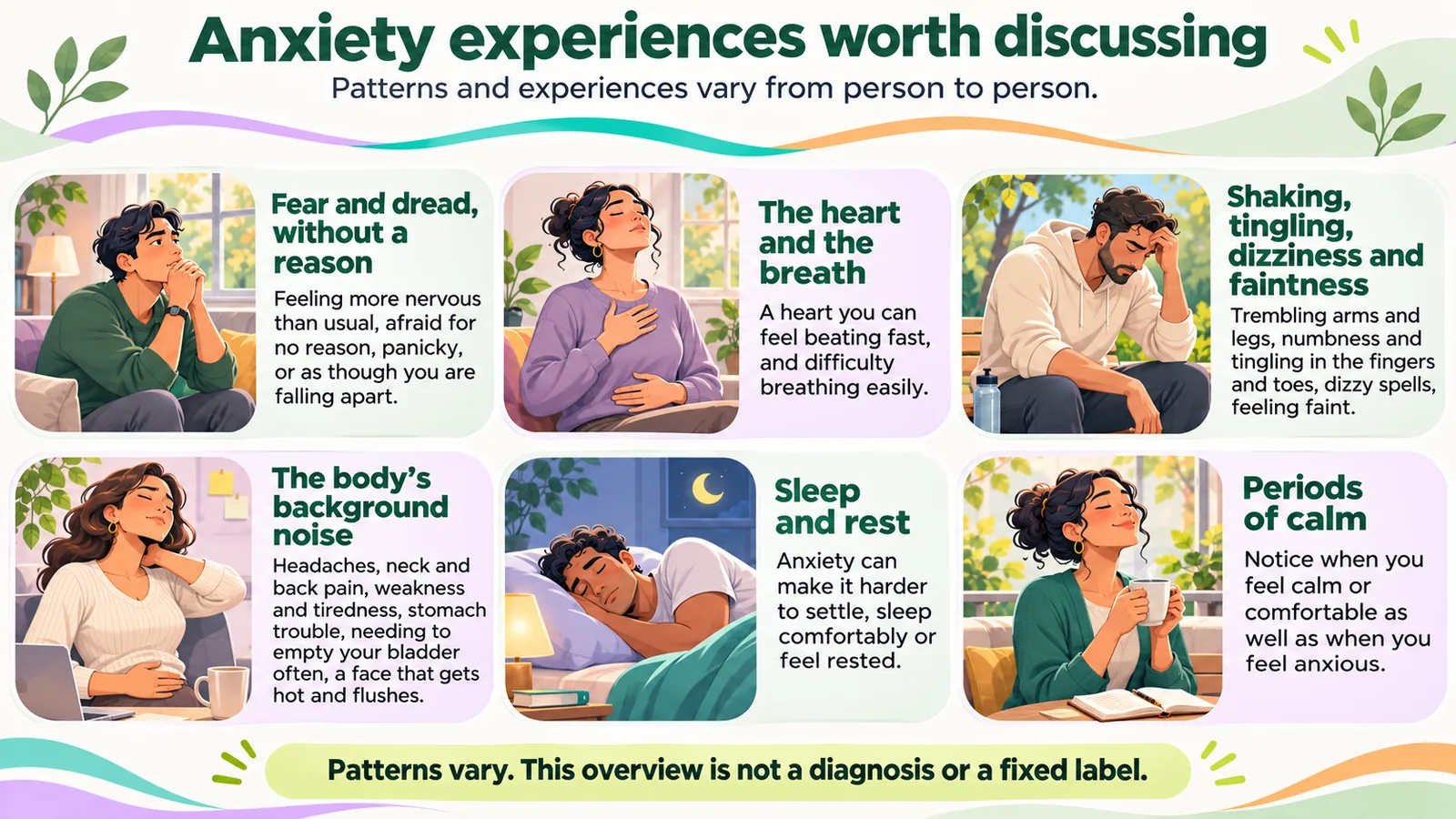
Fear and dread, without a reason
Feeling more nervous than usual, afraid for no reason, panicky, or as though you are falling apart. These four open the scale and are the closest it comes to asking about anxiety as an experience rather than a sensation.
The heart and the breath
A heart you can feel beating fast, and difficulty breathing easily. Both are scored, and both are the symptoms people most often describe as the frightening part — the ones that make anxiety feel like something medical.
Shaking, tingling, dizziness and faintness
Trembling arms and legs, numbness and tingling in the fingers and toes, dizzy spells, feeling faint. This cluster is large, and it is why the SAS catches panic particularly well.
The body’s background noise
Headaches, neck and back pain, weakness and tiredness, stomach trouble, needing to empty your bladder often, a face that gets hot and flushes. Easy to dismiss one at a time, and telling when they arrive together.
Sleep, and what happens in it
Falling asleep easily and getting a good night’s rest — reverse-scored — and nightmares. Sleep is often the first thing anxiety takes and the first thing that returns when it is treated.
The reverse-scored five
Feeling that everything is all right, feeling calm and able to sit still, breathing easily, having dry and warm hands, sleeping well. Agreeing strongly with these lowers your score. They exist to stop people answering on autopilot, and they are why you should read each statement properly.
Index, raw, and why it matters
The same answers, two different numbers.
| What it is | What it runs from | What it is for |
|---|---|---|
| Raw total | Twenty items scored 1–4, added up. | Runs 20 to 80. It is what the quiz adds up. |
| Index score | The raw total divided by 80, times 100. | Runs 25 to 100. It is what the severity levels were defined on. |
| The error | Index levels applied to the raw total. | Under-calls severity by about one band, every time. |
| So what does that look like in practice? | A raw score of 44 is an index of 55 — mild to moderate, and over the clinical threshold. Scored the common wrong way, that same person is told their anxiety is in the normal range. The gap is widest exactly where it matters most, at the point where someone first crosses into clinically significant anxiety. | |
What the numbers mean
What a typical score actually looks like
Published norms from an Australian sample of 351 adults give some useful anchors, all as raw scores.
- 01 Community, screening negative
Raw 32.2 on average
People in the community who did not screen positive for depression or anxiety averaged a raw 32.2. That sits comfortably inside the normal range, which is what you would hope to see from people who are not especially anxious, and it is a fair anchor for reading your own total against.
- 02 Community, screening positive
Raw 44.3 on average
People in the community who did screen positive averaged a raw 44.3 — an index of 55. Under the corrected ranges that is mild to moderate anxiety. Under the common wrong scoring it would be reported as normal.
- 03 Clinical sample, screening positive
Raw 44.9 on average
People already in clinical care who screened positive averaged a raw 44.9, barely different from the community group. The scale measures symptom intensity, so being in treatment does not by itself lower the number — what moves it is whether the symptoms themselves have eased.
It cannot diagnose anything, and it cannot tell you what is driving your symptoms. Thyroid problems, some medications, heavy caffeine, and alcohol withdrawal all produce the physical symptoms this scale asks about, and the questionnaire has no way to tell them apart from anxiety. It is also weighted toward physical and panic symptoms, so constant worry with a quiet body can score low. And it asks about recent symptoms, so an unusually hard week moves the number. None of that makes it useless — it makes it a starting point for a conversation rather than the end of one.
Things people ask early
The questions that come up first
Three worth answering before the detail.
Is the Zung scale still used?
Yes, though it is older than the measures most clinics reach for first. It remains common in research and in primary care because it is brief, free and well understood. Newer anxiety measures are built around current diagnostic categories; the SAS predates them.
Why is my result shown as two numbers?
Because the severity levels were defined on the index, not on the raw total. Showing both lets you check the result against any other source without having to work out which number it is quoting.
Does a high score mean I have an anxiety disorder?
No. It means the symptoms this scale measures have been frequent and intense recently. What is causing them is a separate question, and one a clinician is equipped to answer.
What helps
What to do with a raised score
Anxiety at every level on this scale is treatable, and the treatments are well established. The main thing that delays help is waiting to be sure it is bad enough.
- 01 / START HERE
Take the number to a doctor
Both numbers, and roughly how long it has been going on. A score with a duration attached is far more useful to a clinician than a description of how you have been feeling, and it takes thirty seconds to say.
- 02 / RULE THINGS OUT
Check the physical causes
Thyroid function, medication side effects, caffeine, alcohol. These produce exactly the symptoms this scale asks about, and ruling them in or out is quick and worth doing before anything else.
- 03 / TREATMENT
Therapy, medication, or both
Cognitive behavioural therapy has the strongest evidence base for anxiety, and medication works for many people. They are not in competition, and for marked or severe anxiety the combination is often what helps most. Ask about both.
Background: National Institute of Mental Health, Anxiety Disorders. This page is educational and is not medical advice.
What to do next
What should you do with your result?
Three things that make the number useful rather than just worrying.
- 01
Write down both scores and the date
Scores move with circumstances, so a single number means less than two numbers a month apart. Retaking it later tells you the direction, which is what anyone treating you actually wants to know.
- 02
Note which items you scored highest on
Panic symptoms, sleep, and physical tension point toward different kinds of help. The pattern inside the total is more actionable than the total.
- 03
Ask, even if the number is modest
This scale can miss persistent worry almost entirely. If something about your anxiety concerns you, that is reason enough, whatever it returned.
Anxiety at its worst can feel genuinely frightening and physically overwhelming, and it can arrive faster than any appointment. If it feels unbearable, or you are having thoughts of harming yourself, please reach out now rather than waiting. In the US you can call or text 988 to reach the Suicide and Crisis Lifeline — free, confidential and available twenty-four hours a day. If anyone is in immediate danger, call 911 or your local emergency number. Elsewhere, you can find a line in your own country at findahelpline.com. A questionnaire is not the right tool for an urgent moment, and you do not need a score to justify asking for help. Anxiety this intense is treatable, and it is not something you have to carry alone.
Good questions to ask
Zung Anxiety Scale — FAQs
What people actually ask about the SAS and its scoring.
A raw total below 36 — an index below 45 — is the normal range, because an index of 45 is the point Zung set for clinically significant anxiety. For a sense of what ordinary looks like, community participants who did not screen positive for depression or anxiety averaged a raw 32.2 in the published norms. Be careful comparing with other sites: many quote a normal range of up to 44, which is the index threshold mistakenly applied to the raw total.
Almost always because of the index-versus-raw confusion. The severity levels of 45, 60 and 75 were defined on the index, which is the raw total divided by 80 and multiplied by 100. A site that applies those numbers directly to the raw total will report you as roughly one band less severe than the scale intends. Check which number a result is quoting before comparing it with anything.
Twenty items, each rated 1 to 4, giving a raw total of 20 to 80. Five items are worded positively and scored in reverse, so agreeing with them lowers your total. The raw total is then converted to an index by dividing by 80 and multiplying by 100, giving a range of 25 to 100. The severity levels are read off the index.
It depends which number you mean, which is exactly the problem. A raw 45 is an index of 56, which is mild to moderate anxiety and above the clinical threshold — worth mentioning to a doctor, not an emergency. An index of 45 is a raw 36, the threshold itself. If a result does not say which it is quoting, it is not safe to interpret.
No, and nothing self-administered can. It measures how frequent and intense your symptoms have been recently, not what is causing them or which disorder fits. A clinician can tell the difference between anxiety and the several physical conditions that produce identical symptoms. Our Anxiety Test is a reasonable second look, but the same limit applies to it.
Because it was built that way. Most of the twenty items are physical or panic symptoms — heart rate, dizziness, trembling, stomach trouble, faintness — and comparatively few are about worry as a mental experience. That makes it good at detecting the anxiety you can feel in your body and poor at detecting the person who worries constantly without physical symptoms.
Trust that over the number. This scale has a known blind spot for persistent worry with few physical symptoms, and it only asks about recent weeks. A low total with a strong sense that something is wrong is worth raising with a doctor, and a questionnaire that missed it is not evidence against you.
Yes, and that is one of the more useful things you can do with it. A single score is a snapshot of a particular stretch of time. Two scores a few weeks apart show a direction, and direction is what tells you whether something is helping.
Yes. The test is free, needs no account or sign-up, and your result appears only in your browser. Nothing is sent to us.
Editorial transparency
Sources and review information
This page uses the Zung Self-Rating Anxiety Scale, a published instrument. Its twenty statements are not our wording but Zung’s own, reproduced unchanged and credited below, and scored by his published method. Surrounding content is written and reviewed by the PsyMed Editorial Team from the sources listed here. We are writers and researchers, not clinicians, and this page is educational rather than diagnostic. Read how we build our tests and who we are.
Research and editorial references
- Zung, W.W.K. (1971). A rating instrument for anxiety disorders. Psychosomatics, 12(6), 371–379 — the original publication of the scale used on this page, and the source of its items and its scoring method. doi.org/10.1016/S0033-3182(71)71479-0
- Dunstan, D.A., & Scott, N. (2018). Assigning clinical significance and symptom severity using the Zung scales: levels of misclassification arising from confusion between index and raw scores. Depression Research and Treatment, 2018 — the source for the index conversion, for the index-45 (raw 36) clinical cut-off, for the finding that 8 of 40 reviewed SAS papers applied index criteria to raw scores with 10 more unclear, and for the point that no official severity ranges exist beyond that cut-off. Linked to the open-access copy; the publisher blocks automated access. pmc.ncbi.nlm.nih.gov/articles/PMC5828114
- Dunstan, D.A., & Scott, N. (2020). Norms for Zung’s Self-rating Anxiety Scale. BMC Psychiatry, 20, 90. doi:10.1186/s12888-019-2427-6 — the source of every normative figure quoted above: 351 Australian adults, with mean raw scores of 32.2 for community participants screening negative, 44.3 for community participants screening positive, and 44.9 for clinical participants screening positive. All are raw scores, not index scores.
- National Institute of Mental Health, Anxiety Disorders — for the general description of anxiety disorders and their treatment, linked above. We quote no prevalence figure on this page, because none was needed and none was traced to a primary source.
A screen, not a verdict
Check both numbers, then talk to someone.
The Zung scale is a fifty-year-old instrument that still does a useful job, provided it is scored the way its author defined it. Whatever your total, the symptoms you recognised in those twenty statements are the part worth saying out loud to a doctor.
Take the test