
Screening · Mood
Seasonal Affective Disorder Test: does your mood follow the light?
Fifteen questions on mood, sleep, appetite and the time of year — free, private and nothing saved. A screening tool for a seasonal pattern of depression, not a diagnosis.
This is a screening questionnaire, not a diagnosis, and it does not ask about suicidal thoughts. If you are having them, call or text 988 (US, 24/7) now.
-
A SEASONAL PATTERN15 questionsOn mood, sleep, appetite and the time of year.
-
NOT A DIAGNOSISA screening toolOnly a clinician can diagnose a seasonal pattern of depression.
-
PRIVATENothing is saved or sentFree, no account, no sign-up. Your result stays in your browser.
Screening
Take the seasonal affective disorder test
Answer for how the low months usually go for you rather than for how today feels. Fifteen questions, about two minutes, and the result appears only in your browser.
Your result
What the ranges mean
- 0–15 Few signs — little suggestion of a seasonal depressive pattern
- 16–30 Some seasonal patterns — a noticeable dip worth tracking
- 31–45 Significant patterns — consistent with SAD, worth raising with a clinician
- 46–60 Strong patterns — a clear seasonal depressive pattern; please get assessed
Each question scores 0 (Never) to 4 (Always), for a total of 0–60. A higher total means more of the seasonal pattern was present. No score diagnoses anything, and the ranges are not clinical cut-offs — the diagnosis depends on timing across years, which a questionnaire cannot establish.
How long SAD symptoms typically last, according to NIMH — closer to a third of the year than a bad fortnight.
The short answer
What is seasonal affective disorder?
A type of depression with a recurrent seasonal pattern, with symptoms lasting about four to five months of the year. In most cases symptoms begin in late autumn or early winter and lift in spring and summer — winter-pattern SAD, or winter depression. Some people instead experience depressive symptoms through spring and summer, which NIMH calls summer-pattern SAD and describes as less common. Melrose (2015) frames it the way clinicians do: a recurrent major depressive disorder with a seasonal pattern, rather than a separate illness of its own.
There is also a milder version. A subsyndromal form, S-SAD, is what most people mean by “winter blues” — a real seasonal dip that does not reach the threshold for a depressive episode. Feeling flatter in February is extremely common; what distinguishes SAD is the depth, the duration and the reliability of the pattern.
SAD is tied to changes in daylight, not to the calendar — which is what separates it from “holiday blues”.
NIMH puts the distinction plainly: the depression associated with SAD is related to changes in daylight hours, not the calendar, so the stresses of the holidays or of predictable seasonal changes in work and school schedules are not the same thing. That is a useful self-check. If your low reliably tracks the light rather than the events of the season, it points more toward SAD.
View sourceSigns
What does seasonal depression look like?
SAD carries the ordinary symptoms of depression plus a set that differs by pattern. Not everyone has all of them, and the winter and summer forms look strikingly different from each other.
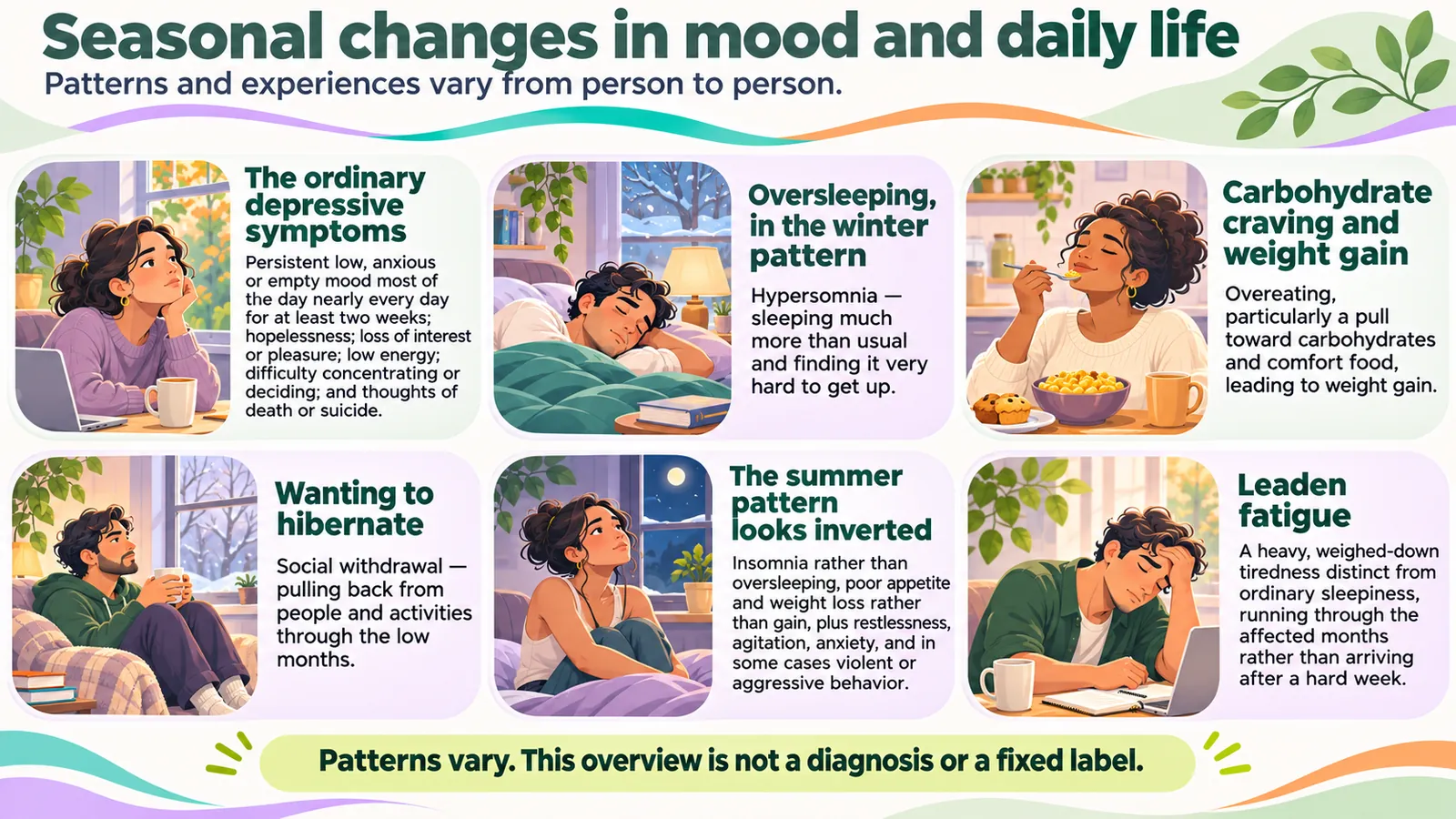
The ordinary depressive symptoms
Persistent low, anxious or empty mood most of the day nearly every day for at least two weeks; hopelessness; loss of interest or pleasure; low energy; difficulty concentrating or deciding; and thoughts of death or suicide.
Oversleeping, in the winter pattern
Hypersomnia — sleeping much more than usual and finding it very hard to get up. The 1984 paper that named the syndrome recorded this on sleep studies, along with reduced slow-wave sleep.
Carbohydrate craving and weight gain
Overeating, particularly a pull toward carbohydrates and comfort food, leading to weight gain. This was one of the features in the original description and it remains one of the most distinctive.
Wanting to hibernate
Social withdrawal — pulling back from people and activities through the low months. NIMH lists this among the winter-pattern symptoms specifically.
The summer pattern looks inverted
Insomnia rather than oversleeping, poor appetite and weight loss rather than gain, plus restlessness, agitation, anxiety, and in some cases violent or aggressive behaviour. It is less common and less studied.
Leaden fatigue
A heavy, weighed-down tiredness distinct from ordinary sleepiness, running through the affected months rather than arriving after a hard week.
Winter pattern, summer pattern and holiday blues
Three things that all involve feeling worse at a particular time of year, and are not the same.
| Pattern | What it looks like | What gives it away |
|---|---|---|
| Winter-pattern SAD | Oversleeping, overeating, carbohydrate craving, withdrawal. | Begins late autumn or early winter, lifts in spring. The common form. |
| Summer-pattern SAD | Insomnia, appetite loss, restlessness, agitation, anxiety. | Runs through spring and summer. Less common and less researched. |
| Holiday blues | Sadness or anxiety around a particular time of year. | Tracks the events and stresses of the season, not the daylight. |
| Can it really be inverted like that? | Yes. Summer-pattern SAD is well described and its symptoms run opposite to the winter form on sleep and appetite. NIMH notes there are no treatments specific to it, which is part of why it gets less attention. | |
How it is diagnosed
The three things a clinician is checking
The questions on this page cannot establish any of these, because the diagnosis depends on timing across years rather than on how you feel today. That is the honest limit of a single questionnaire.
- 01 Depressive symptoms
The symptoms are actually present
Either the general symptoms of depression or the pattern-specific ones above. A seasonal dip without depressive symptoms is not SAD, and severity still has to be there.
- 02 At least two consecutive years
The pattern has repeated
Depressive episodes occurring in the same season for at least two years in a row. NIMH notes that not everyone with SAD has symptoms every single year, but the seasonal repetition is the core of it.
- 03 More seasonal than not
The timing is genuinely seasonal
Depressive episodes in that season must be more frequent than episodes at other times of the year. If you are low year-round and slightly worse in winter, that points toward depression without a seasonal pattern instead.
It cannot diagnose SAD, because two of the three criteria are about timing across years. It also does not ask about suicidal thoughts at all, so a low score says nothing about them — if you are having them, that needs attention now regardless of what this page returned. And it cannot distinguish SAD from a seasonal pattern within bipolar disorder, from year-round depression that worsens in winter, or from thyroid problems, anaemia and vitamin D deficiency, which produce overlapping fatigue and low mood and are worth ruling out with a blood test.
Things people ask early
The questions that come up first
Three that are worth answering before the detail.
Is this just the winter blues?
Possibly, and that is a real thing rather than a dismissal — the subsyndromal form, S-SAD, is exactly that. The difference is degree: SAD reaches the threshold of a depressive episode and interferes with work, relationships or daily functioning. The last question on this test asks about interference for that reason.
Does a low score mean I am fine?
Not necessarily. These fifteen questions cover the seasonal pattern, and they do not ask about suicidal thoughts at all. A low total means this particular pattern was not strongly present, not that nothing is wrong.
Do I have to wait two winters to get help?
No. The two-year criterion is how the seasonal pattern is confirmed, not a waiting period before you are allowed treatment. Depression is treated on the symptoms you have now.
Treatment
What actually helps, and how well
NIMH groups the treatments into four categories, used alone or together. Light therapy and vitamin D are for the winter pattern; psychotherapy and antidepressants treat depression generally, so they apply to both.
- 01 / SINCE THE 1980s
Light therapy
The mainstay for winter-pattern SAD: sitting in front of a 10,000-lux light box for about 30 to 45 minutes daily, usually first thing in the morning, from autumn to spring. It is roughly twenty times brighter than ordinary indoor light and filters out UV. People with certain eye conditions, or on medications that increase light sensitivity, need medical supervision or an alternative.
- 02 / EQUALLY EFFECTIVE
CBT adapted for SAD
CBT-SAD runs as two weekly group sessions over six weeks, replacing negative thoughts about the season and scheduling engaging activities to offset the loss of interest. Compared directly against light therapy it was equally effective — some symptoms improved slightly faster with light, but a study following patients over two winters found the benefits of CBT lasted longer.
- 03 / FOUR TO EIGHT WEEKS
Antidepressants and vitamin D
Antidepressants can work alone or alongside talk therapy, and they take four to eight weeks; sleep, appetite and concentration often improve before mood does, which is worth knowing before deciding a medication has failed. Vitamin D is the fourth category, for the winter pattern.
Background: American Psychiatric Association, Seasonal Affective Disorder. This page is educational and is not medical advice; treatment decisions belong with a clinician.
What to do next
What should you do with your result?
The useful output is a record you can hand to a clinician, because the thing they need is the timing and you are the only source for it.
- 01
Write down the months, not the feelings
When does it start, when does it lift, and has that happened before? Two years of rough dates is more diagnostically useful than any score on this page.
- 02
Ask for the ordinary blood tests
Thyroid problems, anaemia and low vitamin D all produce seasonal-looking fatigue and low mood. Ruling them out is quick and it is worth doing before anything else.
- 03
Do not wait for the next winter
If this winter is already hard, that is enough reason to make an appointment. Light therapy is most often started in autumn, so earlier in the season is better than later.
Please do not wait on this. If you are having thoughts of suicide or of harming yourself — whatever this test returned, and remember it never asked — reach out now. In the US, call or text 988 (Suicide & Crisis Lifeline), free, confidential and available 24/7, or chat at 988lifeline.org. Outside the US you can find a local line at findahelpline.com. If you are in immediate danger, call 911 or your local emergency number.
Good questions to ask
Seasonal affective disorder — FAQs
What people most often want to know about seasonal depression.
Yes, though not as a standalone illness. It is recognised as a recurrent depressive disorder with a seasonal pattern — the seasonality is a pattern that major depression or bipolar disorder can take, rather than a separate condition. That framing is not a downgrade: it is treated as the depression it is, with some treatments specific to the winter pattern.
By degree, and the milder version has a name too: the subsyndromal form, S-SAD, is what most people mean by winter blues. Feeling flatter and sleepier in the dark months is very common. SAD reaches the threshold of a depressive episode, lasts about four to five months, and interferes with work, relationships or daily life. If your dip is noticeable but you are functioning, S-SAD is the likelier description — which does not mean you have to just endure it.
Yes. Summer-pattern SAD is well described, and its symptoms run opposite to the winter form: insomnia rather than oversleeping, poor appetite and weight loss rather than weight gain, plus restlessness, agitation and anxiety. It is less common, less researched, and NIMH notes there are no treatments specific to it, so the general depression treatments are used.
It has been the mainstay for winter-pattern SAD since the 1980s, and the original 1984 study found that extending the photoperiod with bright artificial light had an antidepressant effect. The usual protocol is a 10,000-lux box for 30 to 45 minutes each morning from autumn to spring. When compared directly with CBT adapted for SAD, the two came out equally effective — light worked slightly faster on some symptoms, while the CBT benefits lasted longer across two winters. Check with a clinician first if you have an eye condition or take anything that increases light sensitivity.
It usually begins in young adulthood and occurs much more often in women than men. Because the winter pattern is the common one, it is more frequent farther from the equator where winter daylight is shorter. It is also more common in people who already have depression or bipolar disorder — especially bipolar II — and it sometimes runs in families. If low mood is present year-round rather than seasonally, the Depression Test is the more appropriate starting point.
Not settled, and the honest answer includes that. The leading accounts involve serotonin, which shorter daylight appears to disrupt; melatonin, with the winter pattern associated with producing too much of it and the summer pattern with too little; and vitamin D, which is thought to support serotonin activity and falls with less sun exposure. NIMH is candid that some of these theories have not been systematically tested, and that summer-pattern SAD in particular is poorly understood.
Worth checking, yes. Thyroid problems, anaemia and vitamin D deficiency all produce fatigue, low mood and poor concentration that can look seasonal, and they are ruled out with a straightforward blood test. A seasonal pattern within bipolar disorder is the other important alternative, because it changes which treatments are suitable. Neither can be sorted out by a questionnaire.
Because the fifteen stored questions are about the seasonal pattern, and we have not added to or altered them. We would rather say plainly what the test does not cover than let a low score imply more than it can: thoughts of death or suicide are a symptom of depression, this page does not screen for them, and a low total here does not rule them out. If you are having them, please use the lines above now rather than taking another questionnaire.
Yes. The test is free, needs no account or sign-up, and your result appears only in your browser. Nothing is sent to us.
Editorial transparency
Sources and review information
This is a screening questionnaire, not a diagnosis. Its fifteen questions are original questions written by our team to cover the seasonal-pattern, depressive and atypical-feature clusters described in the sources below; the Seasonal Pattern Assessment Questionnaire is not reproduced. Content is written and reviewed by the PsyMed Editorial Team from the sources listed here. We are writers and researchers, not clinicians, and this page is educational rather than diagnostic. Read how we build our tests and who we are.
Research and editorial references
- Melrose, S. (2015). Seasonal Affective Disorder: An Overview of Assessment and Treatment Approaches. Depression Research and Treatment, 2015, 178564 — a recurrent major depressive disorder with a seasonal pattern; S-SAD as the subsyndromal form; risk higher in women, the young, those far from the equator and those with a family history; the SPAQ as a screening instrument. pmc.ncbi.nlm.nih.gov
- National Institute of Mental Health. Seasonal Affective Disorder. NIMH health publication — symptoms lasting about 4–5 months a year; winter- and summer-pattern symptom lists; the three diagnostic criteria; the daylight-not-calendar distinction; the four treatment categories, the 10,000-lux protocol and the CBT-SAD comparison. nimh.nih.gov
- Rosenthal, N.E., Sack, D.A., Gillin, J.C., Lewy, A.J., Goodwin, F.K., Davenport, Y., Mueller, P.S., Newsome, D.A., & Wehr, T.A. (1984). Seasonal affective disorder: a description of the syndrome and preliminary findings with light therapy. Archives of General Psychiatry, 41(1), 72–80. doi:10.1001/archpsyc.1984.01790120076010 — the paper that named the syndrome: 29 patients, most with a bipolar affective disorder and especially bipolar II; hypersomnia, overeating and carbohydrate craving; and the first finding that bright artificial light had an antidepressant effect.
- American Psychiatric Association. Seasonal Affective Disorder — patient-facing overview of the seasonal pattern and its treatment. psychiatry.org — linked above under Treatment.
A pattern worth naming
Four or five months a year is too long to just get through.
If the same months are hard every year, that is a pattern with a name and with treatments that work. Write down the dates, rule out the ordinary physical causes, and take it to someone who can assess it properly.
Take the test