
Self-check · Emotions
Control Freak Quiz: how strong is your need to be in control?
Fifteen statements on delegating, standards and sitting with uncertainty — free, private and nothing saved. The need for control is usually anxiety rather than arrogance, and that makes it changeable.

“Control freak” is a colloquial term, not a clinical condition. This is a self-reflection tool and identifies no disorder.
-
A LEARNED PATTERN15 statementsOn delegating, standards and sitting with uncertainty.
-
NOT A DIAGNOSISA colloquial term“Control freak” names a tendency, not a condition. It appears in no diagnostic manual.
-
PRIVATENothing is saved or sentFree, no account, no sign-up. Your result stays in your browser.
Where you land
Take the control freak quiz
Answer for how you generally are rather than for one unusual week. Fifteen statements, about two minutes, and the result appears only in your browser.
Your result
What the ranges mean
- 0–15 Easygoing — comfortable with uncertainty and with other people’s methods
- 16–30 Some controlling tendencies — present in places, not a dominant pattern
- 31–45 Notably controlling — a clear streak worth softening where it costs you
- 46–60 Strong tendencies — likely affecting your stress and your relationships
Each statement scores 0 (Strongly disagree) to 4 (Strongly agree), for a total of 0–60. A higher total means a stronger need for control. Some preference for order and high standards is entirely healthy; what this is asking is how strong the need has become and what it is costing.
There is no condition called “control freak”. It is a colloquial description of a tendency, and no score here identifies a disorder.
The short answer
What is a “control freak”?
A colloquial term for a strong, persistent need to control the people, tasks and situations around you — usually because uncertainty feels genuinely uncomfortable. It is not a clinical diagnosis. It describes a tendency that sits on a spectrum, and the useful question is not whether you like things done a certain way but how strong the need is and what it costs you and the people around you. Plenty of the behaviour looks like diligence from outside, which is part of why it goes unexamined for years.
What drives it is the more interesting part. The pattern is consistently traced back to anxiety and a low tolerance for uncertainty: unpredictability registers as a threat, and managing every outcome is how the threat gets neutralised. That often develops somewhere that genuinely was unpredictable, which taught a reasonable lesson — take charge and you are safe. The trouble is the loop it creates: the more you control, the more you depend on controlling, because you never get the evidence that things would have been fine anyway.
Wanting things done well is not the problem. Needing to be the one who does them, and being unable to let go, is where the cost starts.
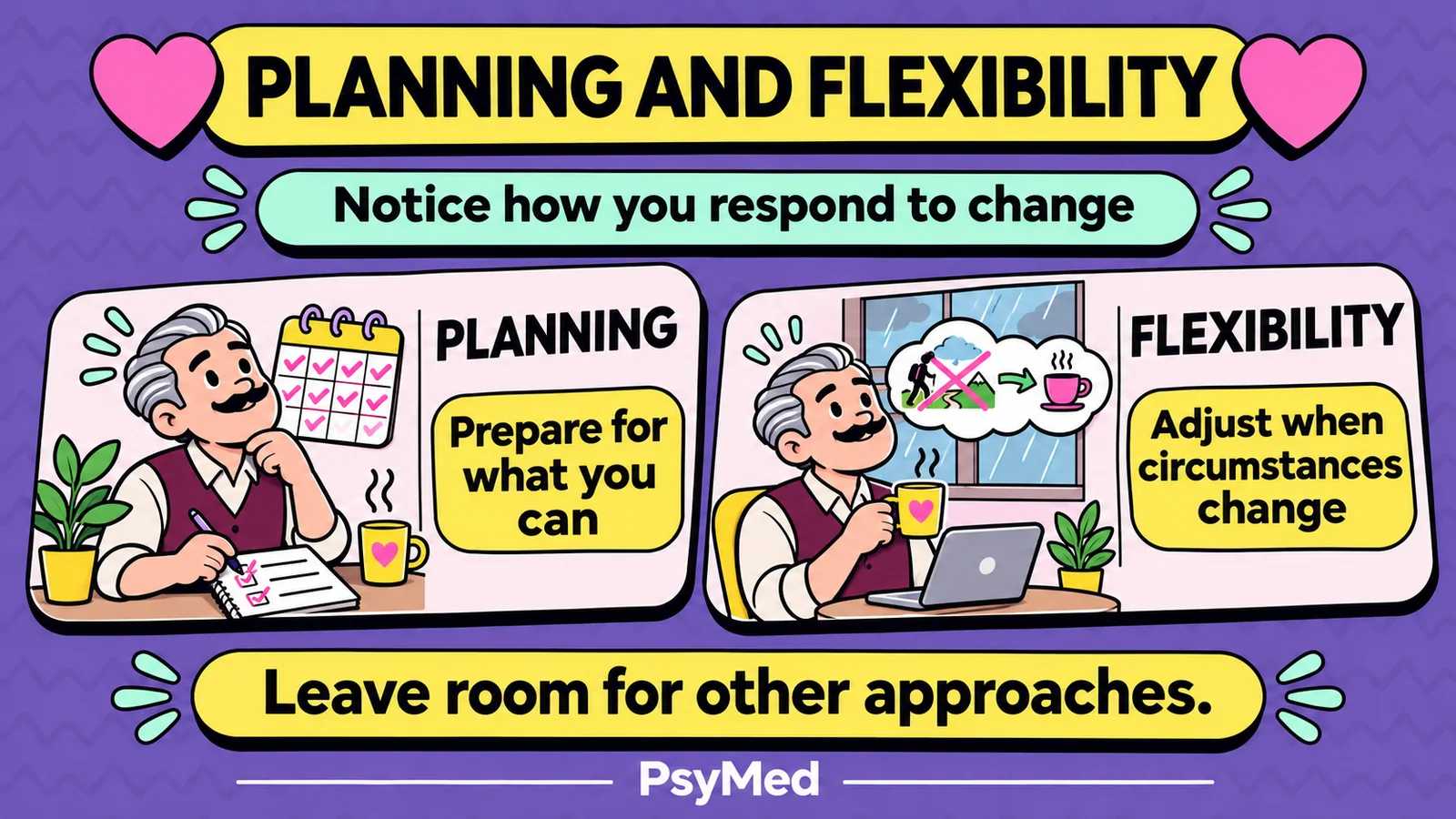
Carleton and colleagues (2007) developed the short Intolerance of Uncertainty Scale, the measure most used for the trait underneath this one — the difficulty of not knowing how something will turn out. It is worth naming because it moves the target: the work is rarely about the dishwasher or the spreadsheet, and almost always about tolerating not knowing.
View sourceSigns
What does it actually look like?
These rarely announce themselves — they look like diligence, high standards or simply caring a lot, until you notice the pattern underneath. Read them as a regular way of operating rather than a bad day.
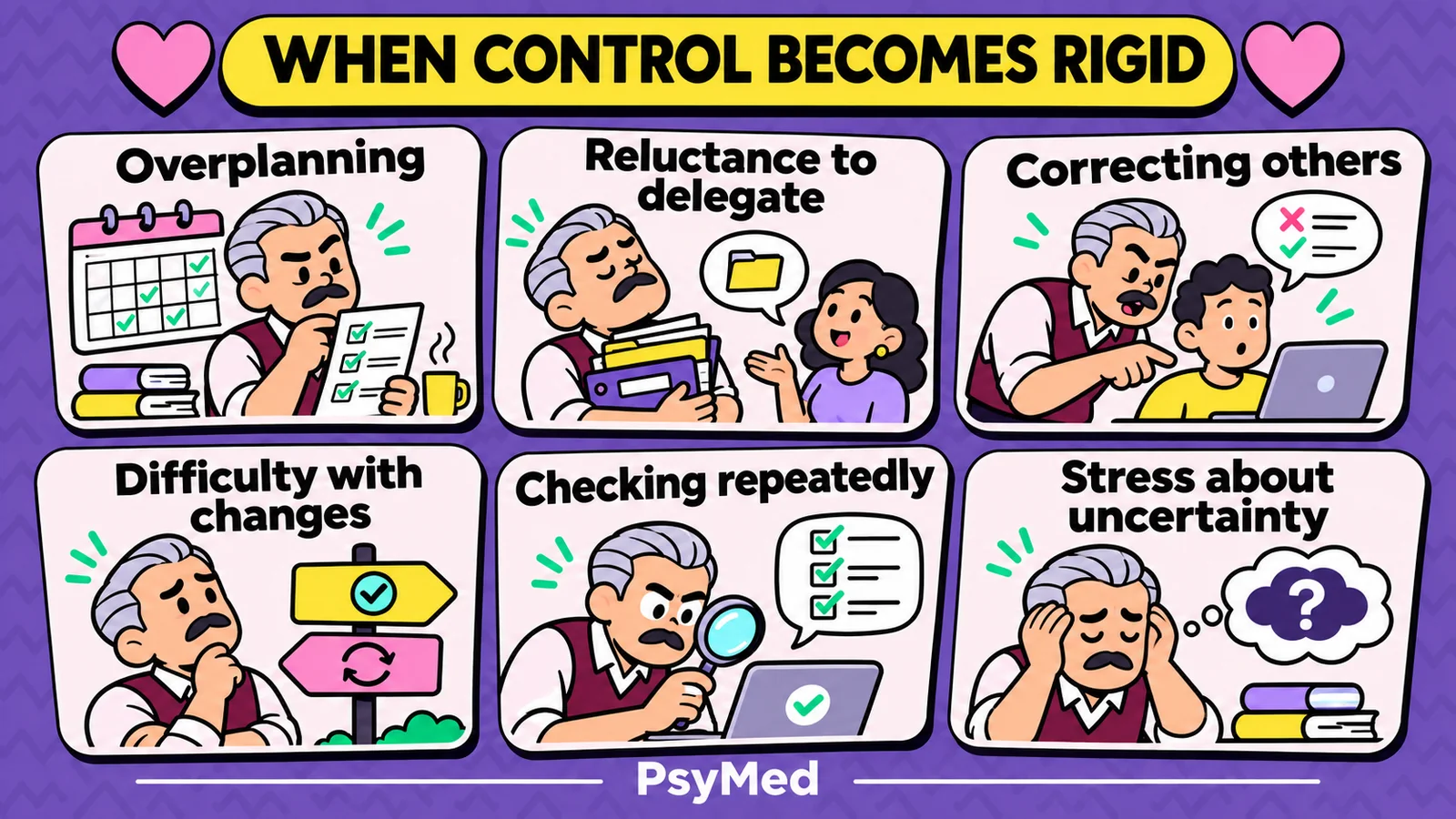
Delegating feels genuinely hard
Handing something over means risking it being done differently, so you would often rather do it yourself. The cost lands twice: you are overloaded, and everyone around you feels untrusted.
You hover after handing it over
Even once it is delegated you check in constantly and oversee each step. The focus is on how it gets done rather than whether it gets done.
There is a right way, and it is yours
You redo or correct other people’s work when it deviates from how you would have done it, and find the deviation itself irritating rather than merely different.
“Good enough” is uncomfortable
You hold yourself and often others to exacting standards. It makes you effective and it makes you hard to satisfy, and the two are the same trait.
Changed plans throw you
A shift in the plan produces anxiety or irritation rather than mild inconvenience. You prefer to know what is coming, and ambiguity reads as stressful rather than open.
You cannot settle when someone else is driving
Handing over the reins makes you tense rather than relieved. You are most at ease when you are the one managing it, which is the clearest tell that the need is doing real work.
Organised, controlling, or OCPD
Three things that look similar from outside and are quite different from inside.
| Pattern | What it looks like | What gives it away |
|---|---|---|
| Organised | Structure, planning, high standards. | You can adapt, delegate and cope when the plan changes. |
| Controlling | The same, plus difficulty letting go. | Letting go feels threatening, not merely inconvenient. |
| OCPD | Pervasive perfectionism and rigidity. | It runs across nearly all of life and feels entirely justified. |
| Can you be controlling in only one area? | Commonly, yes — strongly controlling at work and relaxed at home, or the reverse. Situation-specific is the usual shape, and it is one of the things that distinguishes a tendency from a personality disorder. | |
Or is it OCPD?
Three differences that actually separate them
Obsessive-compulsive personality disorder is the nearest diagnosis, and most people with controlling tendencies do not have it. These are the axes clinicians weigh.
- 01 Pervasiveness
How much of life it covers
Everyday controlling behaviour tends to be situation-specific. OCPD is pervasive, showing up across nearly every area, and that breadth is the first thing assessed.
- 02 Self-awareness
Whether it feels like a problem
People with controlling tendencies can usually see the pattern and dislike it — ego-dystonic, in the jargon. In OCPD the standards typically feel simply correct, and the problem is located in other people.
- 03 Impairment
What it actually costs
Controlling tendencies create friction in relationships. OCPD causes clinically significant distress and genuinely impairs functioning, and that threshold is what makes it a disorder.
It cannot diagnose anything, and it cannot tell you whether your need for control is proportionate to your actual circumstances — some situations genuinely do require someone to take charge, and a questionnaire cannot see your life. It also cannot separate a controlling tendency from the anxiety disorder, the perfectionism or the trauma history that may be driving it, all of which look similar from the outside and are treated differently.
Things people ask early
The questions that come up first
Three worth answering before the detail.
Is being controlling a disorder?
No. It is a tendency on a spectrum, and for most people a learned response to anxiety rather than a diagnosable condition. An intense and pervasive version can be a feature of OCPD, which is a separate question.
Does a high score mean I am a bad partner or manager?
It means the need is strong, not that you are unkind. Most controlling behaviour comes from wanting things to go well and fearing they will not — which is why it responds to reassurance and practice rather than to being told off.
Can it actually change?
This is one of the more changeable patterns, precisely because it is usually learned rather than fixed. The mechanism is unglamorous: let go of something small, watch it turn out fine, repeat until your nervous system believes it.
Loosening it
What actually helps
The aim is not to stop caring or to lower your standards. It is to stop the need for control making the decisions, and that comes from repeated small evidence rather than resolve.
- 01 / THE REAL TARGET
Treat the uncertainty, not the behaviour
Because the urge to control is really an urge to escape not-knowing, the work is building tolerance for not knowing. When the urge arrives, pause and ask what actually feels at risk. Naming the fear does more than suppressing the behaviour does.
- 02 / SMALL AND REVERSIBLE
Delegate something that does not matter
Hand off a low-stakes task, specify the outcome rather than the method, and then do not intervene. The point is not the task. The point is collecting evidence that it was fine without you, which is the only thing that updates the underlying belief.
- 03 / IF IT RUNS DEEP
Therapy, when the roots are older
Cognitive behavioural approaches target the catastrophic thinking that feeds the need to control, and mindfulness-based ones help you notice the urge without acting on it. If the pattern traces back to a genuinely chaotic or unsafe period, that is worth working through with someone rather than alone.
Background: American Psychological Association, Anxiety. This page is educational and is not medical or psychological advice.
What to do next
What should you do with your result?
Read it as a description of a habit and its cost, not a verdict on your character. The useful detail is which statements you agreed with.
- 01
Notice which cluster you scored on
Delegation, standards, and discomfort with uncertainty are three different problems with three different fixes. A high total made of one cluster is a narrower job than one spread across all three.
- 02
Ask the people affected
The cost of this pattern lands on other people before it lands on you, so they can see it earlier. That conversation is more informative than another questionnaire.
- 03
Pick one thing to let go of this week
Specific, small and genuinely low-stakes. Repetition is what changes it; a resolution to be less controlling in general reliably changes nothing.
If the need for control runs across nearly every area of your life, feels entirely justified to you, and is causing real difficulty at work or at home, that is worth a proper assessment rather than a quiz. The pattern clinicians assess under that description is obsessive-compulsive personality disorder, and the professional overview is at merckmanuals.com. If anxiety is the part that is hardest to live with, that is treatable in its own right and worth raising with a doctor.
Good questions to ask
Control freak quiz — FAQs
What people actually ask about needing to be in control.
No. It is a colloquial term, not a clinical diagnosis, and being controlling is not in itself a disorder. It describes a tendency on a spectrum, and for most people a learned coping pattern driven by anxiety. An intense, pervasive version can feature in obsessive-compulsive personality disorder, and it overlaps with anxiety disorders and perfectionism. The distinction comes down to how pervasive it is, whether you can see it as a problem, and whether it is genuinely impairing your life.
Anxiety and a low tolerance for uncertainty, far more often than arrogance. The need for control is a need for predictability, and when not-knowing is unbearable, managing every outcome is how it gets managed. The pattern usually has history: an environment that was chaotic, unpredictable or unsafe teaches that taking charge is how you stay safe, and that lesson can harden into an adult trait. Perfectionism, low self-esteem and insecure attachment are common companions. None of that is a character defect, which is exactly why it can be unlearned.
Yes, and more readily than most personality patterns, because it is usually a learned habit rather than a fixed trait. Change starts with seeing the pattern and recognising the anxiety under it, then practising tolerance for uncertainty in small, low-stakes ways. Cognitive behavioural approaches target the catastrophic thinking that fuels it; mindfulness helps you notice the urge without obeying it. It is gradual, and it works by accumulating evidence rather than by deciding.
Flexibility, anxiety and cost. Being organised serves your goals: you like structure but can adapt, delegate and cope when plans change. It tips into controlling when the need becomes rigid and anxiety-driven — you cannot let others do it their way, deviation from the plan causes real distress, and the behaviour starts costing you relationships or peace of mind. The practical test is whether you can let go when letting go would be reasonable. If that feels threatening rather than mildly annoying, it leans controlling.
No, and they are routinely confused. Obsessive-compulsive disorder involves intrusive, unwanted thoughts and compulsions performed to relieve them, which the person generally experiences as distressing and senseless. Controlling tendencies are about wanting things done a particular way and are usually experienced as reasonable. OCPD is a third thing again: a pervasive personality pattern of perfectionism and rigidity. If intrusive thoughts and rituals are the better description, the Anxiety Test and our OCD self-check are the more useful starting points.
Not in the way a high score can be. The low range describes comfort with uncertainty and a genuine willingness to let others do things their way, which is a good place to be. The only thing worth checking is that it is comfort rather than avoidance — stepping back because you trust people is different from stepping back because taking responsibility feels risky.
No. But if the result rings true, the people who live or work with you have almost certainly noticed already, and asking them what it is like tends to be more useful than any score.
Not necessarily. An unpredictable or unsafe early environment is a common route to it, but it is not the only one, and plenty of people develop the pattern from temperament, a demanding job or a period when things genuinely did depend on them. Treat the history as one possible explanation to consider, not a conclusion this quiz can reach.
Yes. The quiz is free, needs no account or sign-up, and your result appears only in your browser. Nothing is sent to us.
Editorial transparency
Sources and review information
This is a self-reflection quiz, not an assessment. Its fifteen statements are original statements written by our team around the patterns described in the sources below; no instrument is reproduced, and the Intolerance of Uncertainty Scale is cited rather than reused. Content is written and reviewed by the PsyMed Editorial Team from the sources listed here. We are writers and researchers, not clinicians, and this page is educational rather than diagnostic. Read how we build our tests and who we are.
Research and editorial references
- Carleton, R.N., Norton, M.A., & Asmundson, G.J. (2007). Fearing the unknown: a short version of the Intolerance of Uncertainty Scale. Journal of Anxiety Disorders, 21(1), 105–117 — the short-form measure of the trait underlying most controlling behaviour. doi.org/10.1016/j.janxdis.2006.03.014
- American Psychological Association. Anxiety. APA topic page — on anxiety as a response to perceived threat, the mechanism this page describes underneath the need for control. apa.org/topics/anxiety
- Merck Manual Professional Edition. Obsessive-Compulsive Personality Disorder (OCPD) — on the pervasive pattern of perfectionism, rigidity and need for control that distinguishes the disorder from an everyday tendency. Linked above.
- American Psychiatric Association. (2022). Diagnostic and Statistical Manual of Mental Disorders (5th ed., text rev.) — for the OCPD criteria referred to here. No criteria are reproduced on this page.
A habit, not a verdict
The grip loosens by evidence, not by effort.
Every time you let something go and it turns out fine, the pattern weakens slightly. That is the whole mechanism, and it is why small and repeated beats large and resolved.
Take the quiz