


Attachment Style Test: What’s Your Attachment Style?
A 12-item adult self-assessment of how you handle closeness, distance and reassurance in relationships. See whether your pattern leans secure, anxious, avoidant or disorganised, and what that means day to day.
Published Updated
This free attachment style test uses 12 relationship scenarios to identify which of the four adult attachment styles fits you best — secure, anxious-preoccupied, dismissive-avoidant or fearful-avoidant. It is a tool for reflection, not a diagnosis.
Do you feel secure and steady in relationships — or do you find yourself panicking when someone pulls away, feeling smothered when they get close, or wanting closeness and fearing it at the same time? These patterns aren’t random, and they aren’t character flaws. They reflect your attachment style: the blueprint for connection you developed early in life and carry into your adult relationships.
This free attachment style test helps you discover which of the four attachment styles best describes you — secure, anxious, avoidant, or fearful-avoidant — using scenarios drawn from adult attachment research. It’s a tool for self-understanding, not a diagnosis. By the end you’ll have a clearer sense of why you react the way you do in relationships, and where your growth edges lie. 12 questions, completely private.
What Is an Attachment Style?
An attachment style is the characteristic way you experience closeness, trust, and security in relationships. It develops from your earliest bonds — how the people who raised you responded when you needed comfort, reassurance, or care — and it becomes a kind of internal template for what to expect from others and how safe it feels to depend on them.
The idea began with psychiatrist John Bowlby and psychologist Mary Ainsworth, who studied how infants bond with caregivers. Later, researchers Cindy Hazan and Phillip Shaver extended it to adult romantic relationships, and Kim Bartholomew and Leonard Horowitz mapped out the four-style model used today. Modern attachment research understands these styles as arising from two underlying dimensions: attachment anxiety (how much you fear abandonment and need reassurance) and attachment avoidance (how uncomfortable you are with closeness and depending on others). Where you fall on these two dimensions places you in one of four styles.
Two things are worth knowing up front. First, your attachment style isn’t a fixed label or a life sentence — it can and does change. Second, having an insecure style doesn’t mean you’re broken or unlovable; it means you adapted, sensibly, to the emotional environment you grew up in. Understanding your style is the first step toward relating in healthier, more secure ways.
The Four Attachment Styles
Attachment research describes four main styles — one secure and three insecure. Most people have one dominant style, though you may recognize yourself in more than one.
| Style | How They Relate | Core Fear | ~% of Adults |
|---|---|---|---|
| Secure | Comfortable with both closeness and independence; trusts, communicates openly, handles conflict in a balanced way | No dominant attachment fear | 50–60% |
| Anxious (Preoccupied) | Craves closeness, seeks reassurance, highly sensitive to a partner’s moods and distance | Abandonment / not being loved enough | ~20% |
| Dismissive-Avoidant | Values independence strongly, keeps emotional distance, self-reliant, uncomfortable depending on others | Losing independence / being smothered | ~25% |
| Fearful-Avoidant (Disorganized) | Wants closeness but also fears it; swings between reaching out and pulling away (push-pull) | Getting close and then being hurt or betrayed | 5–10% |
The single secure style and three insecure styles differ mainly in those two dimensions. Secure people are low in both anxiety and avoidance. Anxious people are high in anxiety but low in avoidance — they want closeness intensely. Dismissive-avoidant people are low in anxiety but high in avoidance — they keep distance and rely on themselves. Fearful-avoidant people are high in both — they long for closeness yet fear it, which creates the confusing push-pull that defines this style.
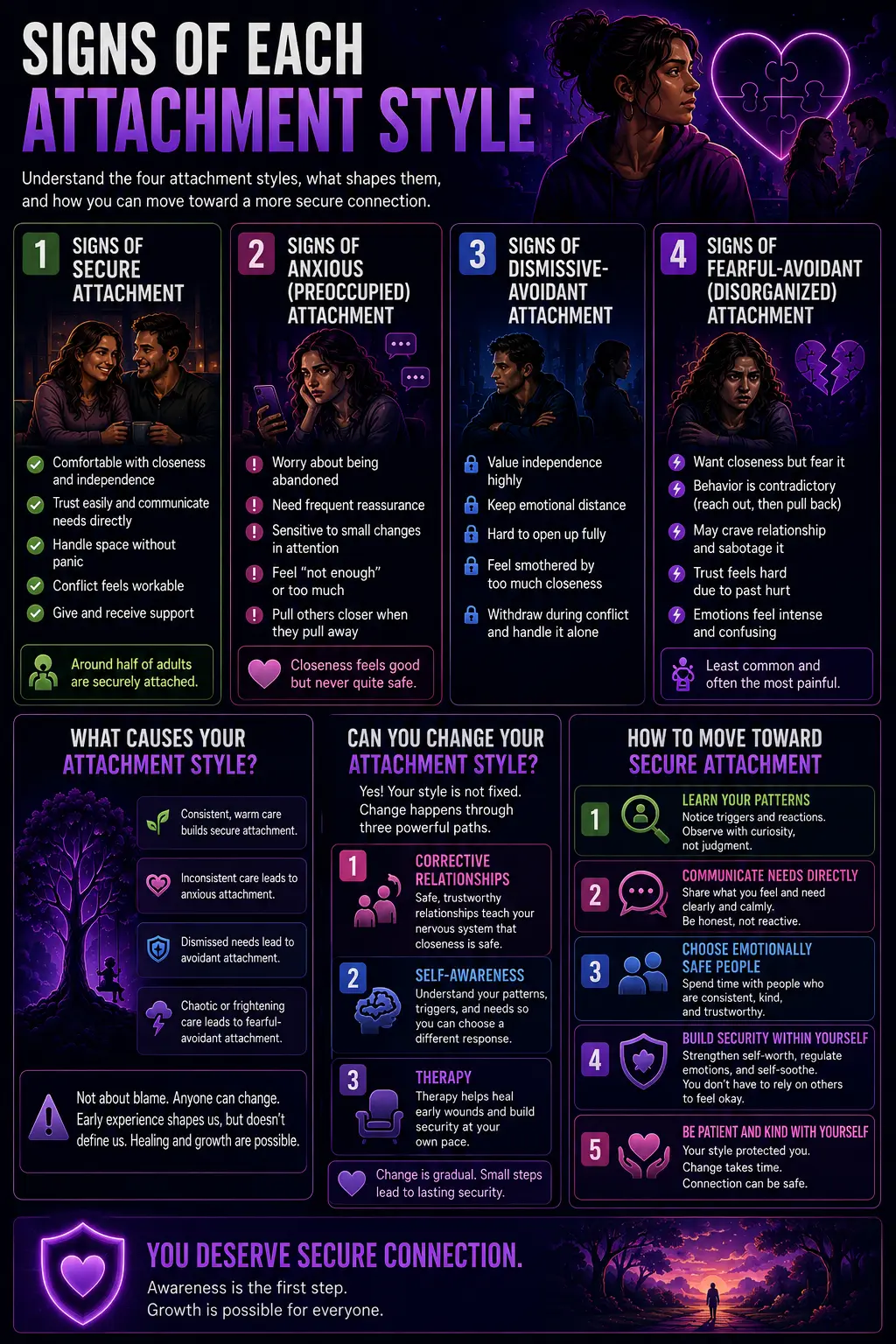
Signs of Each Attachment Style
Here are the everyday signs of each style. As you read, notice which set feels most like you — that’s often your dominant pattern, and it’s what the test below is designed to identify.
-
Signs of secure attachment
You’re comfortable being close and being independent; you trust people fairly easily and communicate your needs directly; you can handle a partner needing space without panicking; conflict feels workable rather than threatening; and you can both offer support and accept it. Around half of adults are securely attached.
-
Signs of anxious (preoccupied) attachment
You worry a lot about being abandoned or not loved enough; you need frequent reassurance; you’re highly sensitive to small changes in a partner’s tone, texting, or attention; you can feel “not enough” or too much; and when someone pulls away, you feel a strong urge to pull them closer. Closeness feels good but never quite safe.
-
Signs of dismissive-avoidant attachment
You value your independence highly and feel uncomfortable depending on others; you tend to keep emotional distance even from people you care about; you find it hard to fully open up; you may feel smothered when someone wants a lot of closeness; and you often handle emotional struggles alone and withdraw during conflict.
-
Signs of fearful-avoidant (disorganized) attachment
You want closeness but also fear it, so your behavior can feel contradictory — reaching out then pulling back; you may crave a relationship and then sabotage it; trust feels genuinely hard because closeness has been linked to hurt; and your emotions in relationships can feel intense and confusing, even to you. This is the least common and often the most painful pattern.
What Causes Your Attachment Style?
Attachment styles form early, primarily shaped by how consistently and warmly your caregivers responded to your emotional needs. When a child’s needs are met reliably and with warmth, the child learns that closeness is safe and others can be trusted — the roots of secure attachment. When responses are inconsistent — loving sometimes, unavailable other times — the child may become anxious, learning to work hard for connection and stay vigilant for signs of withdrawal.
When needs are routinely dismissed or discouraged, the child may become avoidant, learning to rely only on themselves. And when caregivers are frightening, chaotic, or a source of both comfort and fear, the child may develop the fearful-avoidant pattern, caught between needing closeness and fearing it.
Two important caveats. First, this isn’t about blaming parents — caregivers are shaped by their own histories and circumstances, and attachment patterns pass down through generations without anyone choosing them. Second, early experience isn’t destiny. Later relationships, trauma, and healing all continue to shape attachment throughout life, which is exactly why change is possible. If you’d like to explore the related pattern of how open you are in relationships now, our Emotional Availability Test is a natural companion to this one.
How This Attachment Style Test Works
Below are 12 short scenarios about how you tend to feel and behave in close relationships. For each, choose the response that fits you best — the one that reflects your most honest, usual reaction, not the one you think sounds healthiest. Each option corresponds to one of the four attachment styles, and your result is the style you choose most often.
Answer based on how you generally are across your close relationships, rather than one specific person or a single hard moment. There are no right or wrong answers here — only patterns. Your result is private.
Can You Change Your Attachment Style?
Yes — and this is one of the most hopeful findings in attachment research. While your style forms early and can feel deeply ingrained, it is not fixed. Psychologists talk about “earned security”: people who started out insecure can develop a secure attachment style over time. It happens through three main routes, which often work together.
-
Corrective relationships
Being in a steady, trustworthy, emotionally safe relationship — romantic or otherwise — gradually teaches your nervous system that closeness can be relied on. A secure partner, friend, or even a good therapist can offer this.
-
Self-awareness
Simply understanding your patterns — recognizing your triggers, noticing your urges to cling or withdraw, and understanding where they came from — loosens their grip and gives you room to choose a different response. Taking this test is part of that work.
-
Therapy
For patterns rooted in early hurt or trauma — especially the fearful-avoidant style — therapy can be transformative. An attachment-informed therapist can help you understand your history and build security in a safe, paced way.
Change is usually gradual rather than sudden, and it doesn’t mean becoming a different person — it means slowly building the felt sense that connection is safe. Wherever you’re starting from, movement toward security is genuinely possible.
How to Move Toward Secure Attachment
Whatever your style, these steps support the shift toward greater security:
-
Learn your patterns without judgment
Notice when your attachment system gets activated — the urge to seek constant reassurance, or to withdraw and self-protect — and name it with curiosity rather than self-criticism. Awareness creates the space to respond differently.
-
Communicate needs directly
Instead of protesting (anxious) or shutting down (avoidant), practice naming what you feel and need clearly and calmly. Direct, vulnerable communication is the language of secure attachment.
-
Choose emotionally safe people
Security grows fastest around people who are consistent, responsive, and trustworthy. Notice how different people affect your nervous system, and move toward those who help you feel calm.
-
Build security within yourself
Developing self-worth, emotional regulation, and self-soothing means you rely less on others to manage your fears — which paradoxically makes closeness easier. Reflecting on childhood experiences, often with a therapist, helps loosen old patterns.
-
Be patient and kind with yourself
You developed your style for good reasons, and it protected you. Changing it is a gradual process of teaching yourself, gently and repeatedly, that connection can be safe.
Frequently Asked Questions
Is this attachment style test a diagnosis?
No. Attachment styles aren’t disorders or diagnoses — they’re patterns of relating that everyone has, and no attachment style is a mental illness. This test is an educational tool for self-awareness, based on established attachment research, that helps you recognize which pattern most describes you. It can be genuinely useful for understanding your relationships and your growth edges, but it’s a reflection, not a clinical assessment. If your relationship patterns are causing you significant distress, or you’d like support changing them, a therapist — especially one familiar with attachment theory — can help far more than any quiz.
Can I have more than one attachment style?
In a sense, yes. Most people have one dominant style, but attachment exists on two continuous dimensions (anxiety and avoidance) rather than in four rigid boxes, so you may show features of more than one — and your patterns can even differ between relationships. It’s common, for example, to be mostly secure but become somewhat anxious with a particular partner, or to lean avoidant generally but anxious when you’re very invested. If your test result was close between two styles, that mix is real and meaningful. A near-even blend of high anxiety and high avoidance, in particular, often points toward the fearful-avoidant pattern.
Which attachment style is the healthiest?
Secure attachment is generally considered the healthiest, because it’s associated with more stable, satisfying, and resilient relationships — secure people tend to trust, communicate openly, handle conflict well, and balance closeness with independence. That said, it’s important not to turn this into judgment: the insecure styles are understandable adaptations to early environments, not defects, and people with insecure styles form loving, committed relationships all the time. The goal isn’t to shame any style but to move toward greater security, which benefits everyone. And “earned security” is real — many securely attached adults didn’t start that way.
Do attachment styles affect more than romantic relationships?
Yes. Although attachment is most studied in romantic relationships, your style influences friendships, family relationships, parenting, and even how you relate at work — anywhere trust, closeness, and emotional safety are involved. Someone with anxious attachment might seek a lot of reassurance from friends; someone avoidant might keep even close friends at some emotional distance. Understanding your style can therefore improve many kinds of relationships, not just romantic ones. The patterns show up most strongly, though, in your closest and most vulnerable bonds.
What is the rarest attachment style?
Fearful-avoidant (also called disorganized) attachment is the least common, affecting roughly 5–10% of adults. It’s characterized by wanting closeness while also fearing it, producing a confusing push-pull pattern, and it’s often the most painful style to live with because the desire for connection and the fear of it are in constant tension. It typically develops from early environments where a caregiver was both a source of comfort and a source of fear or unpredictability. The most common style, by contrast, is secure attachment, which describes about half to 60% of adults.
Can your attachment style change over time?
Yes — attachment styles can and do change across life. While they form early and tend to be fairly stable, they’re not fixed. Positive, secure relationships can gradually shift an insecure style toward security (“earned security”), while difficult experiences or trauma can sometimes move someone toward more insecurity. Deliberate work — self-awareness, therapy, and choosing emotionally safe relationships — can meaningfully change your patterns over time. This is genuinely good news: whatever your result on this test, it describes where you are now, not where you’re doomed to stay.
Further reading
Attachment style describes the pattern you bring to close relationships; emotional intelligence describes the skills you use inside them. The EQ test measures those skills across self-awareness, empathy and social skills. Attachment style shapes the patterns you bring to friendships; the good friend quiz looks at the behaviours those patterns produce, and which of them you can practise deliberately. Attachment shapes how safe it feels to let someone else take the wheel. If control is specifically where that shows up for you, our quiz on controlling tendencies rates how strong the need has become.
Related Tests
- Emotional Availability Test — the deepest companion to this test; how open and present you are in relationships, closely tied to attachment
- Codependency Test — for anxious-leaning patterns of over-giving and losing yourself in relationships
- Toxic Relationship Quiz — if a relationship feels genuinely unsafe rather than just affected by attachment patterns
- Self-Esteem Test — self-worth is a foundation of secure attachment, especially for anxious patterns
- Fake Friend Test — attachment shapes friendships too; a look at reciprocity and trust in a friendship
- Social Anxiety Test — for fear of judgment and rejection, which often overlaps with anxious attachment
References
- Bowlby, J. (1988). A Secure Base: Parent-Child Attachment and Healthy Human Development. Basic Books. [Attachment theory foundations] simplypsychology.org
- Ainsworth, M.D.S., Blehar, M.C., Waters, E., & Wall, S. (1978). Patterns of Attachment. [The Strange Situation and infant attachment classifications] attachmentproject.com
- Hazan, C., & Shaver, P. (1987). Romantic love conceptualized as an attachment process. Journal of Personality and Social Psychology, 52(3), 511–524. [Extension of attachment theory to adult romantic relationships] pubmed.ncbi.nlm.nih.gov
- Bartholomew, K., & Horowitz, L.M. (1991). Attachment Styles Among Young Adults: A Test of a Four-Category Model. Journal of Personality and Social Psychology, 61(2), 226–244. [The four-style model; anxiety x avoidance dimensions] pubmed.ncbi.nlm.nih.gov
- Brennan, K.A., Clark, C.L., & Shaver, P.R. (1998); Fraley, R.C., Waller, N.G., & Brennan, K.A. (2000). Experiences in Close Relationships (ECR / ECR-R). [The two-dimension self-report measure of adult attachment] pubmed.ncbi.nlm.nih.gov
- Mikulincer, M., & Shaver, P.R. (2016). Attachment in Adulthood: Structure, Dynamics, and Change (2nd ed.). Guilford Press. [Change in attachment; earned security] guilford.com
-
Question of
When a partner needs some space, I usually:
-
Understand and use the time for myself, trusting we’re fine
-
Worry something is wrong and want reassurance
-
Feel relieved to have my own space back
-
Feel anxious about it but also pull away myself
Correct Wrong
-
-
Question of
When someone gets emotionally close to me, I:
-
Enjoy the closeness and open up
-
Want even more closeness and worry it won’t last
-
Start to feel smothered and want distance
-
Want it but also feel scared and guarded
Correct Wrong
-
-
Question of
After a conflict with someone I love, I tend to:
-
Talk it through and trust we’ll resolve it
-
Ruminate and fear they’ll leave me
-
Withdraw and handle my feelings alone
-
Swing between wanting to reconnect and shutting down
Correct Wrong
-
-
Question of
When it comes to depending on other people, I:
-
Am comfortable relying on others and being relied on
-
Lean on others a lot and fear being “too much”
-
Prefer to rely only on myself
-
Want support but find it hard to trust it
Correct Wrong
-
-
Question of
When a partner doesn’t reply for a while, I:
-
Assume they’re busy and don’t worry much
-
Get anxious and start imagining the worst
-
Barely notice; I’m doing my own thing
-
Worry, then tell myself I don’t care
Correct Wrong
-
-
Question of
My general view of relationships is:
-
Closeness is safe, and I can be myself
-
I crave closeness but fear being abandoned
-
Independence matters more to me than closeness
-
I long for closeness but expect to get hurt
Correct Wrong
-
-
Question of
When someone offers me emotional support, I:
-
Accept it and feel comforted
-
Welcome it and want a lot of it
-
Feel uncomfortable and tend to deflect it
-
Part of me wants it, part of me distrusts it
Correct Wrong
-
-
Question of
When it comes to opening up about my feelings, I:
-
Share openly with people I trust
-
Share a lot, sometimes seeking reassurance
-
Keep my feelings mostly to myself
-
Want to open up but fear being judged or hurt
Correct Wrong
-
-
Question of
When a relationship gets serious, I:
-
Feel secure and move forward with trust
-
Feel intense but worry about losing them
-
Start feeling trapped and want to pull back
-
Feel both drawn in and an urge to run
Correct Wrong
-
-
Question of
My biggest fear in relationships is:
-
I don’t carry one dominant fear; I feel fairly secure
-
Being abandoned or not loved enough
-
Losing my independence or being smothered
-
Getting close and then being betrayed or hurt
Correct Wrong
-
-
Question of
When my partner is upset with me, I:
-
Stay present and try to understand them
-
Panic that they’ll leave and over-apologize
-
Detach and wait for it to blow over
-
Feel overwhelmed and both cling and withdraw
Correct Wrong
-
-
Question of
Looking back at my past relationships, I’ve:
-
Generally felt secure and trusting
-
Often felt anxious about where I stand
-
Kept partners somewhat at arm’s length
-
Wanted closeness but feared or sabotaged it
Correct Wrong
-
Related Tests
See All Quiz →

You may also like
See All Quiz →

Emotional and Trait Assessments · Personality
Big Five Personality Test: Discover Your OCEAN Traits
→