

Sexual Orientation & Gender Identity
Am I Straight? Take This 15-Item Quiz and Explore Your Identity
→
Sexual Orientation & Gender Identity
If you’ve been wondering “am I trans?”, that question is worth exploring gently and without pressure — and you’re far from alone in asking it. This free, private am I trans quiz offers a space to reflect on your relationship with gender: how you feel about the gender you were assigned at birth, and whether another way of being feels more true. Lots of people spend real time here, and there’s no rush and no wrong place to land.
Let’s be clear up front: a quiz cannot tell you whether you’re trans. Only you can know that, in your own time, and it’s completely okay to be uncertain or to have your understanding shift. What this quiz can do is give you a structured, private way to reflect on feelings that can be hard to sort out alone. Think of it as a mirror for your own experience, not a verdict — and know that whatever you discover, you’re worthy of respect and support exactly as you are. 15 questions, completely private, no sign-up.
Exploring your gender can bring up big feelings, and not everyone around you may be supportive. You don’t have to navigate it alone. The Trevor Project offers free, confidential support for LGBTQ+ young people 24/7 at 1-866-488-7386 (or text START to 678-678). The Trans Lifeline (peer support run by and for trans people) is at 1-877-565-8860. No question is too big or too small to reach out about.
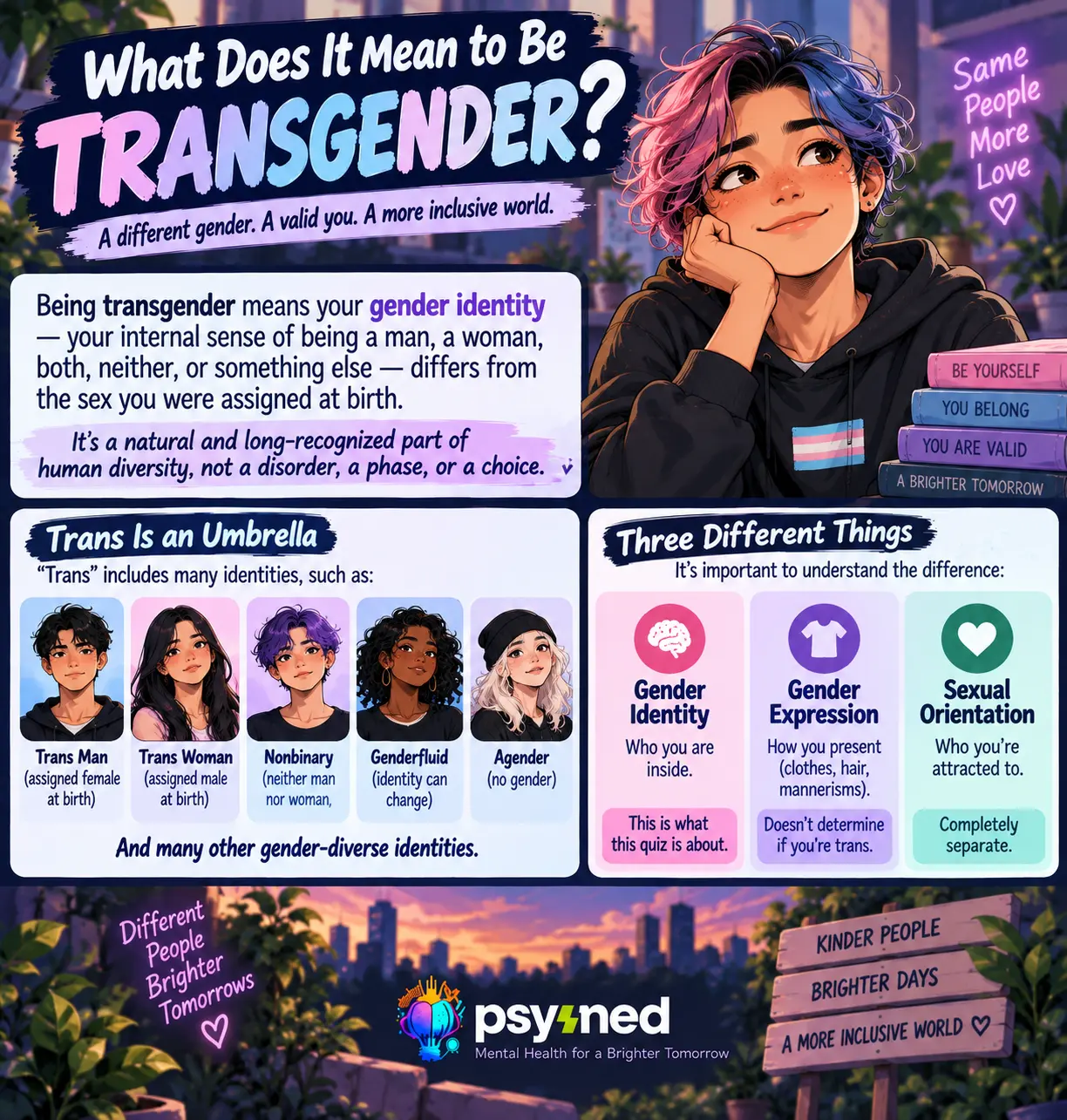
Being transgender means your gender identity — your internal sense of being a man, a woman, both, neither, or something else — differs from the sex you were assigned at birth. It’s an ordinary and long-recognized part of human diversity, not a disorder, a phase, or a choice. “Trans” is an umbrella that includes binary trans people (for example, someone assigned male at birth who is a woman), as well as nonbinary, genderfluid, agender, and other gender-diverse identities that sit outside or between “man” and “woman.”
One thing matters enormously here and causes a lot of confusion, so it’s worth stating plainly: gender identity, gender expression, and sexual orientation are three different things. Gender identity is who you are inside. Gender expression is how you present — clothes, hair, mannerisms — and what counts as “masculine” or “feminine” is culturally defined and varies widely, so liking certain clothes or hobbies tells you nothing about whether you’re trans. Sexual orientation is who you’re attracted to, which is entirely separate again — trans people can be straight, gay, bi, or any orientation. This am I trans quiz is only about the first one: your inner sense of your own gender. If it’s attraction you’re trying to understand rather than identity, the Kinsey Scale Test is the better place to start.
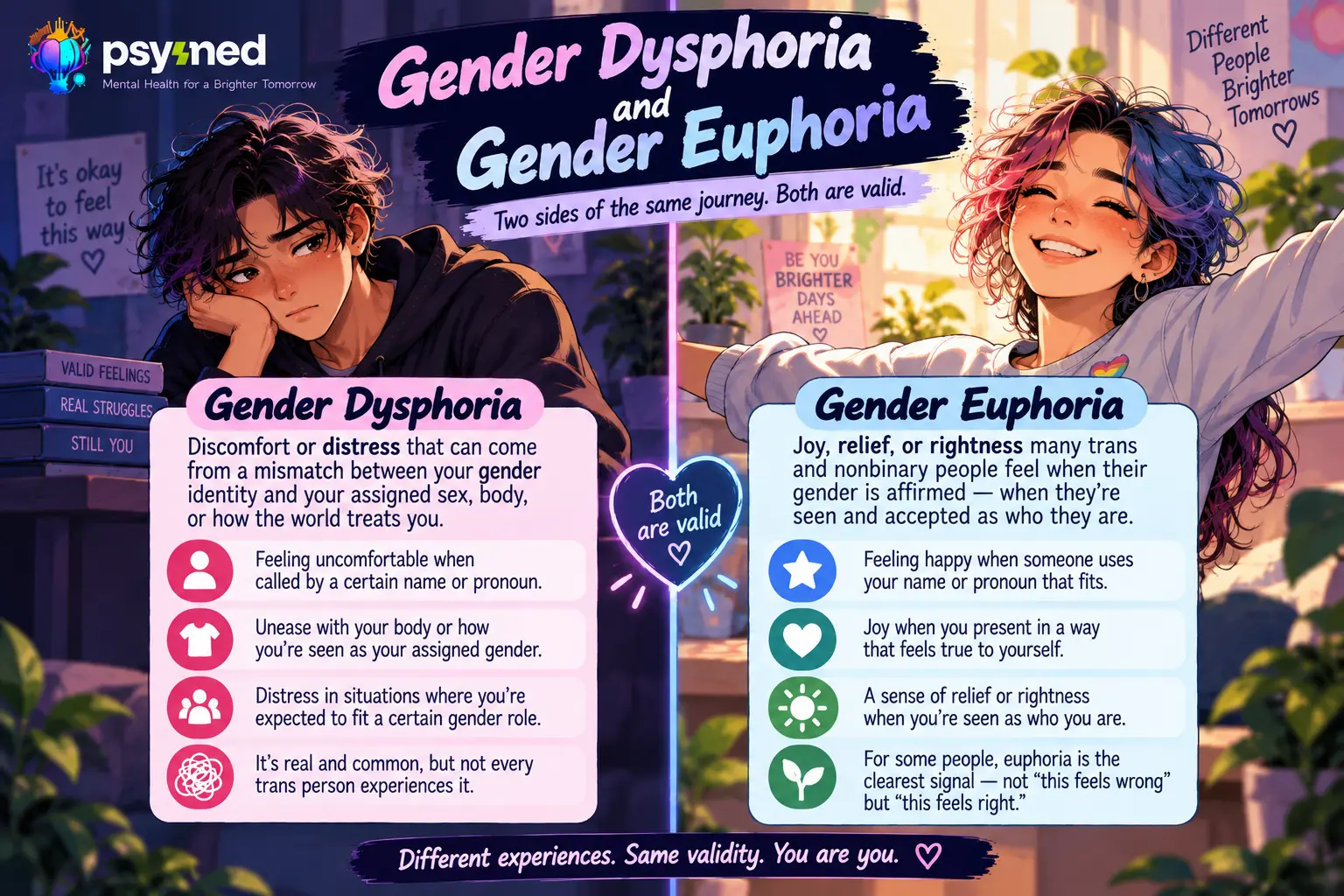
Two feelings often help people understand their gender, and it helps to know both — because many people look only for distress and miss the equally important signal of joy.
Gender dysphoria is the discomfort or distress that can come from a mismatch between your gender identity and your assigned sex, body, or how the world treats you — for example, feeling wrong when called by a certain name or pronoun, or unease with being seen as your assigned gender. It’s real and common, but importantly, not every trans person experiences it, and its absence doesn’t mean you’re not trans. If that distress specifically is what you want to look at more closely, our Gender Dysphoria Test focuses on that construct directly.
Gender euphoria is the other side: the joy, relief, or rightness many trans and nonbinary people feel when their gender is affirmed — when someone uses a name or pronoun that fits, when they present in a way that feels true, or when they’re simply seen as who they are. Euphoria is just as meaningful a signal as dysphoria, and for some people it’s the clearer one: not “this feels wrong” but “this feels right.” As you reflect (and as you answer this quiz), it’s worth paying attention to both — the moments of discomfort and the moments where a different way of being brings a spark of relief or happiness.
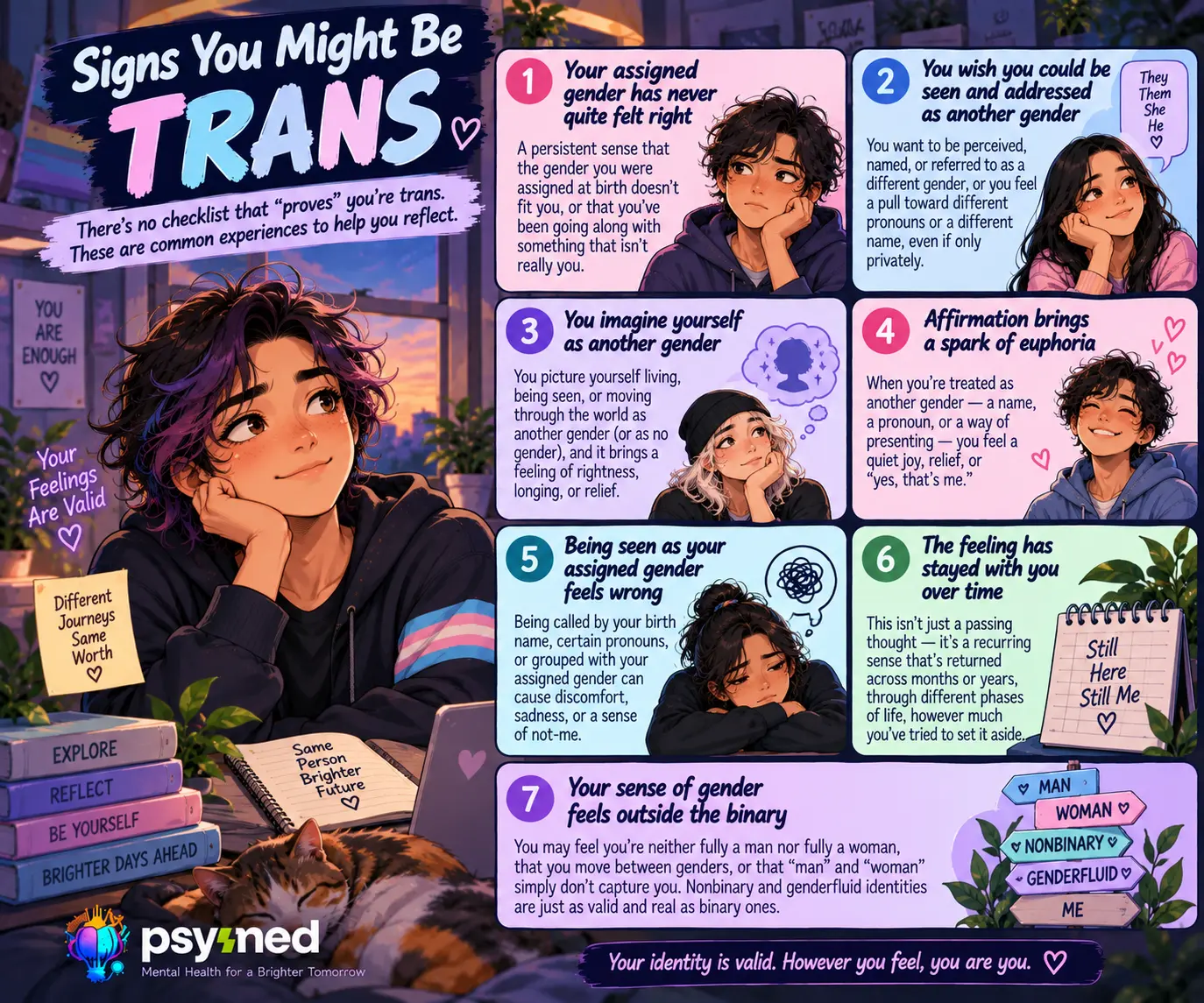
There’s no checklist that “proves” someone is trans — everyone’s experience is unique, and only you can decide what fits. But these are experiences that trans and questioning people commonly describe, offered as gentle prompts for reflection rather than a test to pass. Notice which resonate, and remember: these are about your inner sense of gender, not about stereotypes of how any gender “should” look or act.
A persistent sense — sometimes quiet, sometimes strong — that being the gender you were assigned at birth doesn’t fit you, or that you’ve been going along with something that isn’t really you. This feeling may have been there for years, even if you couldn’t name it.
You find yourself wanting to be perceived, named, or referred to as a gender other than the one you were assigned — or you feel a pull toward different pronouns or a different name, even if only privately.
You picture yourself living, being seen, or moving through the world as another gender (or as no gender), and that image brings a feeling of rightness, longing, or relief rather than being merely idle curiosity.
When you’re treated as another gender — a name, a pronoun, a way of presenting — even in small or imagined moments, you feel a quiet joy, relief, or “yes, that’s me.” That gender euphoria is meaningful information.
Being called by your birth name, referred to with certain pronouns, or grouped with your assigned gender produces discomfort, sadness, or a sense of not-me — a form of gender dysphoria that can be subtle or strong.
This isn’t a single passing thought but a recurring sense — returning across months or years, through different phases of life, however much you’ve tried to set it aside or explain it away.
You may feel you’re neither fully a man nor fully a woman, that you move between genders, or that “man” and “woman” simply don’t capture you. Nonbinary and genderfluid identities are just as valid and real as binary ones.
If several of these resonate, you might find that “trans,” “nonbinary,” or another word fits — or you might land somewhere else entirely, and every outcome is valid. None of it is decided by a quiz, and there’s no timeline you have to meet.
This quiz has 15 statements about your inner sense of gender — how you feel about your assigned gender, and whether another way of being feels more true. For each, choose how much you agree, answering honestly about how you genuinely feel rather than what you think you “should” feel:
Strongly Disagree = 0 | Disagree = 1 | Neutral = 2 | Agree = 3 | Strongly Agree = 4
Your answers add up to a score from 0 to 60, reflecting how closely your feelings align with experiences trans and gender-questioning people commonly describe. Please read the result in the spirit it’s meant: it reflects what you told it, not a ruling on who you are. And an important note — a lower score doesn’t rule anything out. Many trans people spent years not recognizing or allowing these feelings, so if your instinct says something the number doesn’t, trust your instinct. Answer privately; no one sees your results but you.
Before your result, one reminder worth holding onto: these bands describe where your answers landed today, not a fixed truth about you. Understanding your gender is a personal process that unfolds differently for everyone — quickly for some, over years for others, and both are completely normal. Whatever your score, the only person who gets to name your gender is you, and “trans,” “nonbinary,” “questioning,” “cisgender,” or no label at all are all valid places to be.
| Score Range | Reflection | What It Might Suggest |
|---|---|---|
| 0 – 15 | Few Signs Today | Few of these feelings showed up — though only you know your own experience. |
| 16 – 30 | Some Questioning | Some feelings around gender worth gently exploring at your own pace. |
| 31 – 45 | Strong Signs | Your feelings align in many ways with how trans and gender-diverse people describe theirs. |
| 46 – 60 | Very Strong Signs | Your feelings closely match how many trans and gender-diverse people experience their own. |
Coming to understand your gender can feel exciting, freeing, confusing, or frightening — sometimes all at once, especially if the people around you aren’t supportive. If you’re struggling, you don’t have to carry it alone. The Trevor Project (1-866-488-7386) and Trans Lifeline (1-877-565-8860) offer free, confidential, affirming support. Reaching out is a sign of strength.
If you’re in a period of questioning your gender, here’s something worth hearing plainly: this is a normal, healthy part of understanding yourself, not a problem or a sign that anything is wrong with you. People explore their gender at every age — in childhood, in their teens, and well into adulthood — and there’s no deadline for reaching an answer or any requirement to reach a fixed one. Many trans people come to understand themselves later in life, after years of not having the words or the safety to explore; that doesn’t make their identity any less real.
A few things many people find helpful: give yourself permission to explore without pressure to conclude; experiment gently and safely (a name, pronouns, or a bit of self-expression, in whatever spaces feel safe) and notice how it feels; learn from other trans and nonbinary people’s stories, which can be clarifying and remind you that you’re not alone; and consider talking with a gender-affirming therapist — one whose role is to support your exploration, not steer you toward any particular outcome.
Coming out to others is entirely your choice and something to do only if and when you feel safe and ready. Go at your own pace, be kind to yourself, and remember that whatever you discover about your gender is valid. Questioning can also knock your confidence, especially when the people around you aren’t affirming — the Self-Esteem Test is a gentle way to check in on that side of things.
No — and any quiz claiming to definitively do so is overpromising. Your gender identity is something only you can determine, from your own inner sense of yourself, and it can take time to understand. What an “am I trans” quiz like this one can genuinely offer is a structured, private way to reflect on your feelings about gender — a mirror rather than a verdict. Some people take a quiz like this and feel a jolt of recognition; others feel more uncertain, and both are completely okay. Importantly, because many people suppress or don’t recognize these feelings for years, even a low score doesn’t rule out being trans. Hold any result loosely, and let your own sense of yourself lead.
They’re two completely different things, and mixing them up is one of the most common sources of confusion. Gender identity is your internal sense of your own gender — whether you’re a man, a woman, both, neither, or something else — which is about who you are. Sexual orientation is about who you’re attracted to — whether that’s men, women, more than one gender, or no one.
These are entirely independent: a trans person can be straight, gay, bisexual, pansexual, asexual, or any orientation, just like a cisgender person can. So being trans says nothing about your orientation, and your orientation says nothing about whether you’re trans. This quiz is only about gender identity; if you’re exploring who you’re attracted to, the Kinsey Scale Test or the LGBTQ+ Identity Test is a better fit.
These aren’t competing options — nonbinary is generally understood as part of the trans umbrella, because it also describes a gender identity that differs from the sex assigned at birth. Some nonbinary people call themselves trans, some don’t, and both are correct; the word is yours to choose. Broadly: if your sense of yourself points clearly to “the other one” from what you were assigned, a binary trans identity (trans man or trans woman) may fit. If it feels more like neither, both, somewhere in between, or something that shifts over time, words like nonbinary, genderfluid, agender, or genderqueer may fit better.
Many people try on several words over the years before one settles, and changing the word you use isn’t a sign you were wrong earlier — it’s an ordinary part of getting to know yourself. If you’d like to explore this more broadly, our LGBTQ+ Identity Test covers a wider range of identities.
No. While many trans people experience gender dysphoria — distress from the mismatch between their gender identity and their assigned sex or how they’re perceived — not all do, and its absence doesn’t mean you’re not trans. Some people experience their gender primarily through gender euphoria: the joy and rightness they feel when their true gender is affirmed, rather than distress about their assigned one. Others feel relatively little of either but simply know their gender differs from what they were assigned.
Being trans is about your gender identity, not about how much distress you do or don’t feel. So if you don’t relate strongly to dysphoria but something about another gender feels right or true for you, that’s still absolutely worth exploring.
No. Being transgender is not a mental illness or a disorder — it’s a normal part of human diversity, recognized as such by major medical and psychological organizations. There’s an important distinction here: “gender dysphoria” is a clinical term for the distress some trans people feel due to the mismatch between their identity and their assigned sex, and it exists as a diagnosis mainly so that people can access supportive care — but the dysphoria is the distress, not the trans identity itself. Being trans is not something to be cured or fixed.
The distress that can accompany it is very often eased by affirmation and support (social, and for some people medical), and much of the difficulty trans people face comes from stigma and lack of acceptance rather than from being trans.
First, know there’s nothing you’re required to do — no obligation to label yourself, come out, or take any particular step on anyone’s timeline but your own. If you’d like to explore, some things people find helpful include reflecting honestly on your feelings (noticing gender euphoria and dysphoria), gently and safely experimenting with a name, pronouns, or expression to see how they feel, learning from other trans and nonbinary people’s experiences, and, if it feels right, talking with people you trust or a gender-affirming therapist.
Coming out to others is entirely your choice, and your safety comes first — it’s okay to explore privately for as long as you need. Go at your own pace, be gentle with yourself, and if you’re struggling, reach out to a supportive resource like The Trevor Project (1-866-488-7386) or Trans Lifeline (1-877-565-8860).
Questioning and exploring your gender can be joyful, but it can also come with real stress — especially without affirming people around you. If you’re looking for support, The Trevor Project (for LGBTQ+ young people, 1-866-488-7386), Trans Lifeline (peer support by and for trans people, 1-877-565-8860), and the LGBT National Help Center offer free, confidential, affirming support. You deserve to be seen and respected as who you are.
Sexual Orientation & Gender Identity
Am I Straight? Take This 15-Item Quiz and Explore Your Identity



Emotional and Trait Assessments
Are You a Psychopath? Take This Free Psychopath Test (PCL-R Based)Here you'll find all collections you've created before.