

Sexual Orientation & Gender Identity
What’s Your Sexual Orientation or Gender Identity? Take This Free LGBTQ+ Test
→
Wondering "am I bisexual?" This free, private bisexual quiz helps you explore your attractions and feelings on the spectrum — no labels forced, no sign-up.
Published Updated
If you’ve found yourself wondering whether you might be bisexual, you’re asking a real and valid question — and you’re in very good company. Lots of people, at all ages, spend time reflecting on who they’re attracted to and what that means for how they understand themselves. There’s no rush, no test you can fail, and no wrong answer to arrive at.
It helps to say this clearly up front: a quiz cannot tell you your sexual orientation. Only you can know that, and it’s completely okay if you don’t know yet — or if your understanding shifts over time. What this bisexual quiz can do is give you a structured, private way to reflect on your own feelings and attractions, which many people find genuinely clarifying when the question has been sitting on their mind. Think of it as a mirror for your own thoughts, not a verdict. 15 questions, completely private, no sign-up.
Bisexuality is a sexual orientation in which a person experiences romantic or sexual attraction to more than one gender. In older definitions, it was described as attraction to “both men and women,” but contemporary understanding is broader: many bisexual people are also attracted to non-binary people and others whose gender doesn’t fit neatly into those two categories. What unites the experience is attraction that isn’t limited to a single gender.
A few things are important to understand, because they’re widely misunderstood:
Some bisexual people are attracted fairly equally to different genders; many have “leanings” — a stronger pull toward one gender than another — and some find those leanings shift over time or by situation. You don’t have to feel a perfect 50/50 split to be bisexual. Being mostly attracted to one gender but genuinely, sometimes, to another still falls under the bisexual umbrella.
You can be bisexual whether or not you’ve ever dated or been physically involved with more than one gender. Your attractions define your orientation, not your track record. A person who has only ever been in relationships with one gender can absolutely still be bisexual — and many people realize this about themselves after years, or decades, of relationships with a single gender.
One of the oldest and most harmful myths is that bisexuality is a temporary stop between straight and gay, or a way of not having “made up your mind.” Contemporary psychology has firmly rejected this. Bisexuality is a stable, valid orientation in its own right — as real and complete as being straight or gay. (More on why this myth matters below.)
The idea that sexuality exists on a spectrum rather than in two boxes isn’t new — researchers have been describing it for over 75 years.
In 1948, Dr. Alfred Kinsey and his colleagues introduced the Kinsey Scale, which placed sexual orientation on a continuum from 0 (exclusively heterosexual) to 6 (exclusively homosexual). The whole point was that huge numbers of people don’t sit at either end — they fall somewhere in between. Bisexuality broadly spans the middle of that scale (around 1 to 5). It was groundbreaking for its time in framing sexuality as a range rather than a strict either/or.
Three decades later, in 1978, Dr. Fritz Klein — who went on to found the American Institute of Bisexuality — developed the Klein Sexual Orientation Grid to capture more of the real complexity. Rather than a single number, the Klein Grid looks at seven different dimensions: sexual attraction, sexual behavior, sexual fantasies, emotional preference, social preference, lifestyle, and self-identification. Crucially, it asks about each of these across past, present, and ideal — building in the reality that orientation can be experienced differently over time. This bisexual quiz draws on that spirit, looking at attraction, romance, and feelings together rather than any single measure.
Both models point to the same liberating idea: sexuality is varied and personal, and the middle of the spectrum — where bisexuality lives — is one of the most populated parts of it, not a rare exception. As the researchers themselves stressed, these tools are ways to understand yourself better, not machines for handing down definitive labels.
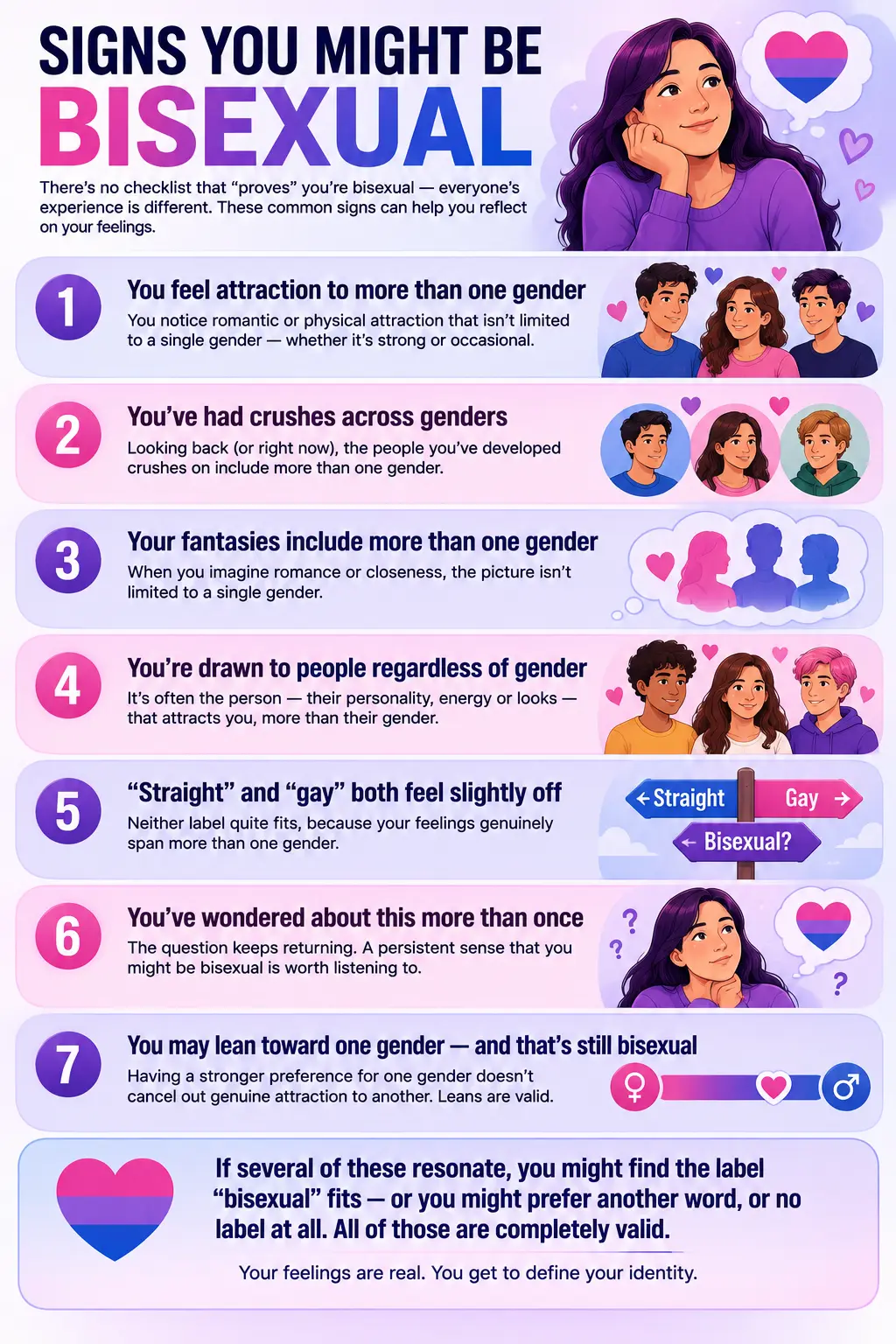
There’s no checklist that “proves” someone is bisexual — everyone’s experience is different, and only you can decide what fits. But these are experiences that bisexual people commonly describe, offered here as gentle prompts for reflection rather than a bisexual quiz to pass. Recognizing some of these in yourself doesn’t obligate you to any label; it’s simply information about your own feelings.
The most central thread: noticing romantic or physical attraction that isn’t limited to a single gender — whether that feels strong and frequent or quieter and occasional.
Looking back (or right now), the people you’ve felt drawn to, developed crushes on, or found yourself thinking about include more than one gender.
When you imagine romance, closeness, or connection, the picture isn’t limited to a single gender. Fantasy is one of the dimensions researchers like Klein specifically looked at, because it often reflects attraction honestly.
Sometimes it’s the person — their energy, their looks, who they are — that draws you, more than their gender being the deciding factor.
When you try on the labels, neither quite fits — not because you’re confused, but because your actual feelings genuinely span more than one gender.
The question itself keeps returning. While questioning doesn’t automatically mean you’re bisexual, a persistent sense that this might be part of you is worth listening to rather than dismissing.
Perhaps you’re mostly attracted to one gender but genuinely, sometimes, to another. That leaning doesn’t cancel out the attraction; many bisexual people describe exactly this.
If several of these resonate, you might find the label “bisexual” fits — or you might prefer another word, or no label at all. All of those are completely valid outcomes, and none of them are decided by a bisexual quiz.
This test asks 15 questions about your attractions, feelings, and experiences. For each, choose the answer that best reflects how you genuinely feel — not what you think you “should” feel:
Not at all = 0 | Rarely = 1 | Sometimes = 2 | Often = 3 | Very much = 4
Your answers add up to a score from 0 to 60 that reflects where your current feelings tend to fall on the spectrum of attraction. Please read the result in the spirit it’s meant: it’s a reflection of what you told it, not a ruling on who you are. There’s no score that “makes” you bisexual or “disproves” it — only you can know your orientation, and it’s genuinely okay for that to be a work in progress. Answer honestly and privately; no one sees your results but you.
Before your result, one reminder worth holding onto: these bands describe where your answers landed today, not a fixed truth about you. Sexuality can be clear for some people and take years to understand for others, and both are normal. Whatever your score, the only person who gets to name your orientation is you.
| Score Range | Reflection | What It Might Suggest |
|---|---|---|
| 0 – 15 | Mostly One-Gender Attraction | Your answers point mostly toward attraction to a single gender — though only you can say what fits. |
| 16 – 30 | Some Attraction to More Than One Gender | Some multi-gender attraction is present. Worth reflecting on gently, at your own pace. |
| 31 – 45 | Notable Bisexual Leanings | Clear attraction across more than one gender — a pattern many bisexual people recognize. |
| 46 – 60 | Strong Bisexual Pattern | Strong, consistent attraction to more than one gender, closely matching how bisexuality is described. |
Coming to understand your sexuality can feel exciting, confusing, freeing, or daunting — sometimes all at once, especially if the people around you aren’t supportive. If you’re finding it hard, you don’t have to carry it alone. The Trevor Project offers free, confidential support for LGBTQ+ young people, any time, at 1-866-488-7386 (or text START to 678-678). There’s no problem too big or too small to reach out about.
A few persistent myths cause real harm and real confusion, so they’re worth naming and clearing up directly.
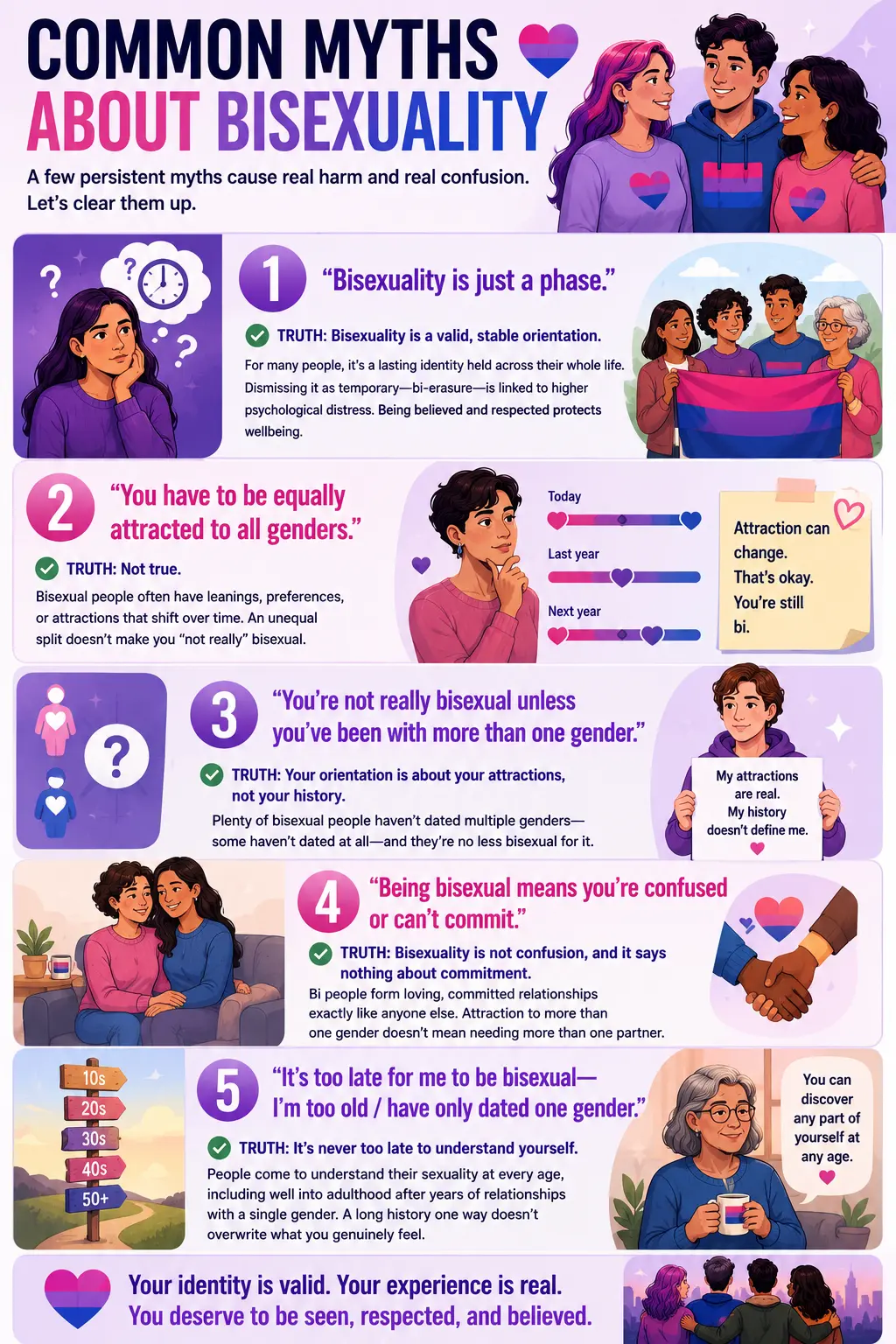
This is one of the most damaging myths, and it’s not supported by evidence — contemporary psychology firmly recognizes bisexuality as a stable, valid orientation. For some people it’s a lasting identity held across their whole life. This myth matters beyond hurt feelings: dismissing someone’s orientation as temporary — an experience often called bi-erasure — is one of the most documented contributors to psychological distress among bisexual people. Being believed and taken seriously genuinely protects wellbeing.
Not true. Bisexual people often have leanings, preferences, or attractions that shift over time. An unequal split doesn’t make you “not really” bisexual.
Your orientation is about your attractions, not your history. Plenty of bisexual people haven’t dated multiple genders — some haven’t dated at all — and they’re no less bisexual for it.
Bisexuality is not confusion, and it says nothing about someone’s ability to be faithful or committed. Bi people form loving, committed relationships exactly like anyone else. Attraction to more than one gender doesn’t mean needing more than one partner.
People come to understand their sexuality at every age, including well into adulthood after years of relationships with a single gender. A long history one way doesn’t overwrite what you genuinely feel. It’s never too late to understand yourself more fully.
If you’re in a period of questioning, it’s worth hearing plainly: this is a normal, healthy part of understanding yourself, not a problem or a sign that something is wrong. Lots of people explore these questions, and there’s no deadline for arriving at an answer — or any requirement to arrive at a fixed one at all.
A few things that many people find helpful while questioning: give yourself permission to explore without pressure to reach an immediate conclusion; remember that labels are tools that serve you, not boxes you owe anyone; know that whatever you discover — bisexual, straight, gay, fluid, unsure — is valid; and be patient and gentle with yourself, treating this the way you’d want a good friend to treat themselves. If you’d like support, that can come from LGBTQ+ community spaces, an affirming therapist, trusted friends, or resources like The Trevor Project. Understanding yourself is a journey, and you’re allowed to take it at whatever pace feels right.
No — and any quiz claiming to definitively do so is overpromising. Sexual orientation is something only you can determine about yourself, based on your own attractions and feelings. What a bisexual quiz like this one can genuinely offer is a structured, private way to reflect on your experiences, which many people find clarifying when they’ve been turning the question over. Think of your result as organized information about your own feelings, a mirror rather than a verdict. Some people take a quiz like this and feel a click of recognition; others feel more uncertain, and both are completely okay. The goal is thoughtful self-reflection, not a label handed down by a score.
This is a common and honest question, and the line isn’t always sharp. Curiosity about other genders is very common and doesn’t by itself define an orientation. What tends to distinguish bisexual attraction is a genuine romantic or sexual pull toward more than one gender — not just intellectual curiosity or a passing thought, but real attraction you actually feel. That said, you don’t have to sort this out immediately, and the two aren’t always cleanly separable at first. For many people, time and experience bring clarity. If your feelings are genuine attractions rather than abstract curiosity, and they keep showing up, that may point toward bisexuality — but there’s no rush to decide, and “still exploring” is a perfectly valid answer for as long as you need it to be.
Absolutely. Your sexual orientation is defined by your attractions, not by your relationship history or experience. Many bisexual people have only dated one gender — sometimes because of circumstance, sometimes because they realized their orientation later, sometimes simply because that’s how their life unfolded. Some bisexual people haven’t dated anyone at all and still know they’re attracted to more than one gender. You don’t have to “prove” your bisexuality through experience; the feelings themselves are what count. A person who has spent their whole life in relationships with one gender can come to understand that they’ve been bisexual all along, and that understanding is completely valid.
For the large majority of bisexual people, no — bisexuality is a stable, lasting orientation, and contemporary psychology recognizes it as valid and enduring rather than transitional. The “it’s just a phase” idea is a myth that has caused real harm; dismissing bisexuality as temporary (a form of what’s called bi-erasure) is strongly linked to psychological distress in bisexual people, precisely because being disbelieved is painful and isolating. It’s true that some people’s understanding of their sexuality evolves over time — that’s a normal part of self-discovery for anyone — but that fluidity doesn’t make bisexuality less real or less valid. If you’re bisexual, you’re not “going through something” on your way to somewhere else; you’re simply yourself.
First, know that there’s nothing you’re required to do — there’s no obligation to label yourself, come out, or take any particular step on anyone’s timeline but your own. If you’d like to explore, some things people find helpful include: reflecting honestly on your attractions without pressure; learning about others’ experiences (books, articles, and LGBTQ+ community spaces can make you feel less alone); and, if it feels right, talking with people you trust or an affirming therapist. Coming out to others is entirely your choice and something to do only when and if you feel safe and ready. Go at your own pace, be kind to yourself, and remember that understanding your sexuality is a personal journey with no fixed finish line. If you’re struggling, especially without support around you, resources like The Trevor Project (1-866-488-7386) are there for exactly this.
The two overlap and some people use them interchangeably, but there’s a general distinction. Bisexuality is attraction to more than one gender. Pansexuality is often described as attraction to people regardless of gender — where gender isn’t really a factor in who someone finds attractive. Many bisexual people are also attracted to non-binary and other gender-diverse people, so in practice the two identities can look very similar, and the choice between the labels often comes down to which word feels more true to a person’s own experience. Neither is more valid than the other, and some people use both. As with everything here, the right label is whichever one fits you — and you’re allowed to try different words on until one feels right, or to use none at all.
Sexual Orientation & Gender Identity
What’s Your Sexual Orientation or Gender Identity? Take This Free LGBTQ+ Test
Sexual Orientation & Gender Identity
Am I Straight? Take This 15-Item Quiz and Explore Your Identity
Sexual Orientation & Gender Identity
Free Kinsey Scale Test — Where Do You Fall on the Sexual Spectrum?
Addiction and Impulse Control
Is Gambling Becoming a Problem? Take This Free Gambling Addiction Test (PGSI)
Here you'll find all collections you've created before.