


Free 15-Item Am I A Lesbian Test: Free & Confidential
Wondering "am I a lesbian?" This free, private lesbian test helps you reflect on your attraction to women - no labels forced, no wrong answers, no judgment.
Published Updated
If you’ve found yourself wondering “am I a lesbian?”, that question is worth taking seriously and exploring gently — and you’re far from alone in asking it. Lots of women and nonbinary people spend real time reflecting on who they’re drawn to, often after years of assuming they were straight. There’s no rush, no test you can fail, and no wrong answer to arrive at.
Let’s be clear up front: a quiz cannot tell you your sexual orientation. Only you can know that, and it’s completely okay if you’re not sure yet, or if your understanding shifts over time. What this lesbian test can do is give you a private, structured way to reflect on your own attractions — how you experience being drawn to women, and how attraction toward men actually feels for you (which, as you’ll see, is not always as simple as it seems). Think of it as a mirror for your own feelings, not a verdict. 15 questions, completely private, no sign-up.
What Does It Mean to Be a Lesbian?
A lesbian is a woman — or, for some, a nonbinary person aligned with womanhood or lesbian community — who is emotionally, romantically, and/or sexually attracted to women, and not to men. That “not to men” part is what distinguishes being a lesbian from being bisexual or pansexual: a lesbian’s attractions center on women (and, for some, other nonbinary people), rather than spanning more than one gender.
Being a lesbian is a normal, healthy sexual orientation — one of the many ordinary ways human attraction shows up. It isn’t a phase, a rebellion, a wound, or a stage on the way to something else, and it doesn’t require any particular history, appearance, or experience to be real. Some lesbians know from a young age; many realize it later, sometimes after years of dating men. All of those paths are equally valid.
One thing worth naming early, because it causes so much confusion: figuring out that you’re attracted to women is often the “easy” part. The harder part, for many women, is realizing that their attraction to men was never quite what they assumed it was. Understanding why that happens is where the concept of compulsory heterosexuality comes in — and it’s central to making sense of this question.
Compulsory Heterosexuality (Comphet): Why This Feels So Confusing
If you take one idea away from this page, let it be this one. Compulsory heterosexuality — often shortened to comphet — is the societal assumption that everyone is straight by default, and the quiet pressure that trains women, from childhood, to expect and perform attraction to men. The term was coined by the poet and scholar Adrienne Rich in her 1980 essay Compulsory Heterosexuality and Lesbian Existence, and lesbian and queer communities still use it constantly because it names something millions of women have lived.
Here’s why it matters for this lesbian test. Growing up inside a world that assumes you’ll like boys, it’s genuinely easy to mistake other feelings for attraction to men — the wish to be chosen, the comfort of fitting in, the safety of doing what’s expected, admiration, or simple social validation. Many women date men for years, even decades, with a nagging sense that something is missing, before realizing that the attraction they thought they felt was largely a script they’d absorbed, not a desire they actually had.
This is why a lower score on any lesbian quiz — including this one — does not rule out being a lesbian. Comphet works precisely by muddying the signal, so your history of “attraction” to men can pull a number down even when your feelings for women are the realest thing you know. If your result comes out lower than your gut expected, trust your gut and keep reflecting. Understanding comphet doesn’t hand you a label — but it gives you the context that often makes everything else finally click.
Attraction vs. Admiration: A Useful Distinction
One of the trickiest parts of questioning is telling genuine attraction apart from admiration — and comphet thrives in exactly that confusion. A helpful rule of thumb that comes up again and again in lesbian communities and in attraction research:
-
Admiration tends to stay in your head.
You notice a woman’s style, confidence, talent, or beauty and think “I wish I were like her” or “she’s stunning” — appreciation that stays cognitive and comparison-based.
-
Attraction shows up in your body, often when you’re not paying attention.
A flutter, a pull, wanting to be close to her, thinking about her when you didn’t mean to, a physical or romantic charge rather than a wish to emulate. Attraction is about wanting her, not wanting to be her.
The same tool works in reverse for attraction to men: is it a genuine bodily pull, or is it the idea of being wanted, the comfort of approval, or relief at doing what’s expected? These distinctions aren’t always crisp, and you don’t have to sort them perfectly. But holding them in mind while you answer will make your reflection far more honest than a snap judgment.
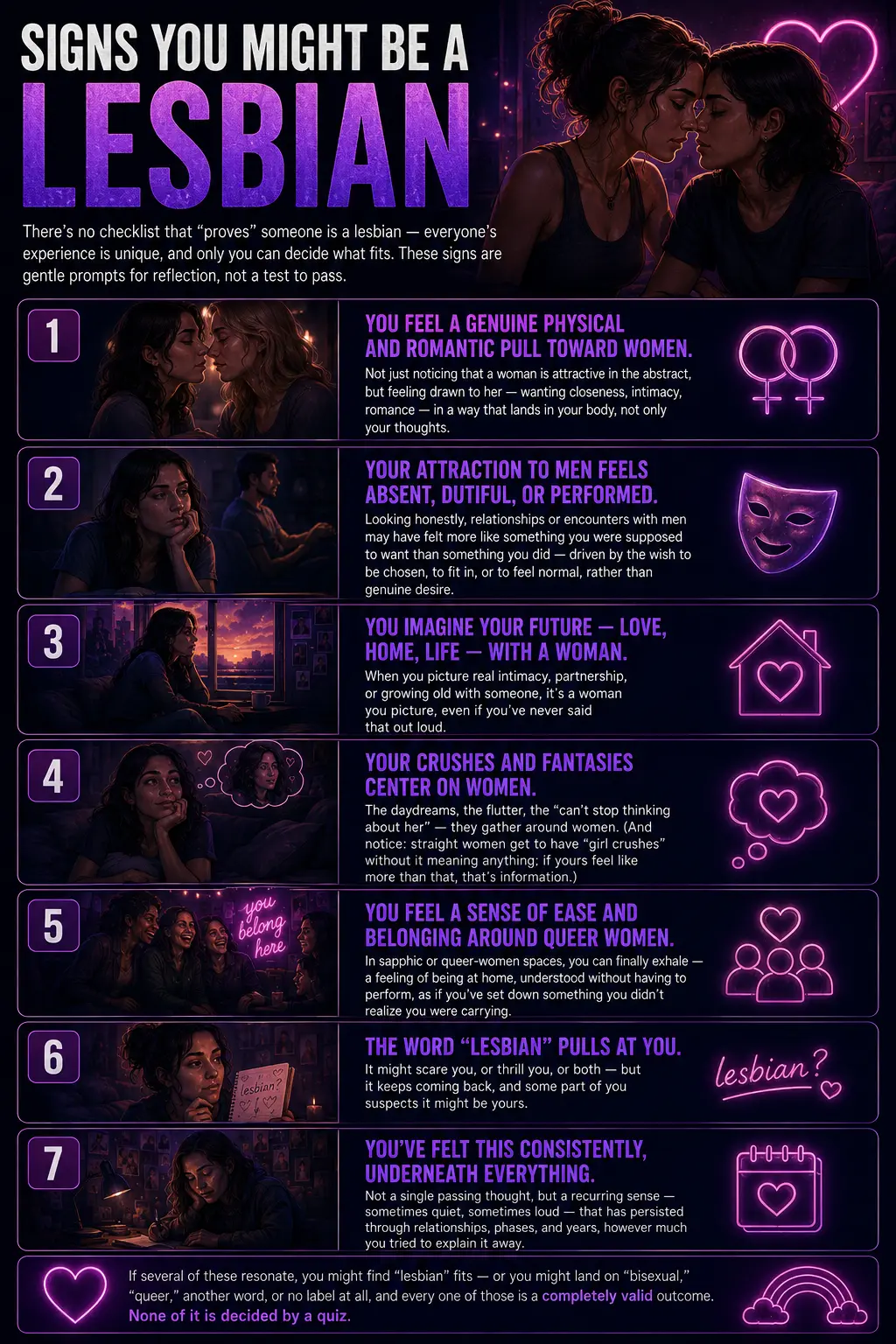
Signs You Might Be a Lesbian
There’s no checklist that “proves” someone is a lesbian — everyone’s experience is unique, and only you can decide what fits. But these are experiences lesbians commonly describe, offered as gentle prompts for reflection rather than a test to pass. Recognizing several of them, especially as lasting patterns, may be worth sitting with.
-
You feel a genuine physical and romantic pull toward women.
Not just noticing that a woman is attractive in the abstract, but feeling drawn to her — wanting closeness, intimacy, romance — in a way that lands in your body, not only your thoughts.
-
Your attraction to men feels absent, dutiful, or performed.
Looking honestly, relationships or encounters with men may have felt more like something you were supposed to want than something you did — driven by the wish to be chosen, to fit in, or to feel normal, rather than genuine desire.
-
You imagine your future — love, home, life — with a woman.
When you picture real intimacy, partnership, or growing old with someone, it’s a woman you picture, even if you’ve never said that out loud.
-
Your crushes and fantasies center on women.
The daydreams, the flutter, the “can’t stop thinking about her” — they gather around women. (And notice: straight women get to have “girl crushes” without it meaning anything; if yours feel like more than that, that’s information.)
-
You feel a sense of ease and belonging around queer women.
In sapphic or queer-women spaces, you can finally exhale — a feeling of being at home, understood without having to perform, as if you’ve set down something you didn’t realize you were carrying.
-
The word “lesbian” pulls at you.
It might scare you, or thrill you, or both — but it keeps coming back, and some part of you suspects it might be yours.
-
You’ve felt this consistently, underneath everything.
Not a single passing thought, but a recurring sense — sometimes quiet, sometimes loud — that has persisted through relationships, phases, and years, however much you tried to explain it away.
If several of these resonate, you might find “lesbian” fits — or you might land on “bisexual,” “queer,” another word, or no label at all, and every one of those is a completely valid outcome. None of it is decided by a quiz.
Lesbian or Bisexual? An Honest Distinction
This question comes up constantly, and it deserves a clear, respectful answer without any ranking of one identity over another. The core difference is simple: a lesbian is attracted to women and not to men, while someone bisexual or pansexual is attracted to more than one gender. Neither is more valid, more evolved, or more “sure” than the other — they’re just different, real experiences.
Where it gets genuinely confusing is that comphet can make a lesbian feel bisexual for a long time, because the conditioned “attraction” to men can seem real from the inside. Many women identify as bisexual on the way to realizing they’re lesbians — and many others are genuinely, lastingly bisexual.
There’s no rush to resolve it, and picking a label now doesn’t lock you in forever. The useful question isn’t “which box is correct?” but “which word feels most honest to my actual attractions right now?” If attraction to more than one gender feels true to you, our Bisexual Test may fit better; if gender isn’t a factor at all, our Pansexual Quiz explores that. And if you’re questioning more broadly, our LGBTQ+ Identity Test takes a wider view.
How This Lesbian Test Works
This quiz asks 15 questions about your attractions and feelings — toward women, and toward men. For each, choose the answer that best reflects how you genuinely feel, not what you think you “should” feel or what would be easiest:
- Not at all = 0
- Rarely = 1
- Sometimes = 2
- Often = 3
- Very much = 4
Your answers add up to a score from 0 to 60, reflecting how closely your attractions match how lesbians commonly describe theirs. Please read the result in the spirit it’s meant: it reflects what you told it, not a ruling on who you are. And remember what you read about comphet — a lower score doesn’t rule anything out, because conditioning can muddy your sense of your own feelings. If your instinct says something the number doesn’t, trust your instinct. Answer honestly and privately; no one sees your results but you.
Your Results
Before your result, one reminder worth holding onto: these bands describe where your answers landed today, not a fixed truth about you. Sexuality is clear for some people early and takes years to understand for others, and both are completely normal. Whatever your score, the only person who gets to name your orientation is you — and “lesbian,” “bisexual,” “queer,” another word, or no label are all valid places to land.
| Score Range | Reflection | What It Might Suggest |
|---|---|---|
| 0 – 15 | Still Early / Exploring | Few of the patterns showed up today — though comphet can hide them, so trust your own sense too. |
| 16 – 30 | Some Signs | Some of your attraction seems to point toward women. Worth reflecting on, at your own pace. |
| 31 – 45 | Strong Signs | Your attractions align in many ways with how lesbians describe theirs. |
| 46 – 60 | Very Strong Signs | Your attractions closely match how many lesbians experience their own. |
Coming to understand your sexuality can feel exciting, freeing, confusing, or daunting — sometimes all at once, especially if the people around you aren’t supportive. If you’re finding it hard, you don’t have to carry it alone. The Trevor Project offers free, confidential support for LGBTQ+ young people, any time, at 1-866-488-7386 (or text START to 678-678). No question is too big or too small to reach out about.
Questioning Your Sexuality Is Healthy
If you’re in a period of questioning, here’s something worth hearing plainly: this is a normal, healthy part of understanding yourself, not a problem or a sign that anything is wrong. People question their sexuality at every age — at 15 and at 55 — and there’s no deadline for reaching an answer, or any requirement to reach a fixed one at all. Many lesbians come out later in life, after marriages to men, after children, after decades; that doesn’t make their identity any less real or any less theirs.
A few things many people find helpful: give yourself permission to explore without pressure to conclude; remember that labels are tools that serve you, not boxes you owe anyone; know that whatever you discover — lesbian, bisexual, queer, straight, unsure — is valid; and be patient with the process, because untangling genuine desire from a lifetime of conditioning takes time. If you’d like support, it can come from LGBTQ+ community spaces, an affirming therapist (especially one who understands comphet), trusted friends, or resources like The Trevor Project. Your journey is yours, and you’re allowed to take it at whatever pace feels right.
Frequently Asked Questions
Can a quiz tell me if I’m a lesbian?
No — and any quiz claiming to definitively do so is overpromising. Your sexual orientation is something only you can determine, based on your own attractions and feelings over time. What a lesbian test like this one can genuinely offer is a structured, private way to reflect on your experiences — how you’re drawn to women, and how attraction to men actually feels for you when you look honestly.
Think of your result as organized information about your own feelings, a mirror rather than a verdict. Some women take a quiz like this and feel a jolt of recognition; others feel more uncertain, and both are completely okay. Importantly, because of compulsory heterosexuality, even a low score doesn’t rule out being a lesbian — so hold any result loosely and let your own sense of yourself lead.
What is compulsory heterosexuality (comphet)?
Compulsory heterosexuality, or “comphet,” is the societal assumption that everyone is straight by default, and the pressure that trains women from childhood to expect and perform attraction to men. The term was coined by Adrienne Rich in her 1980 essay Compulsory Heterosexuality and Lesbian Existence. It matters enormously for lesbians because it can make conditioned or expected “attraction” to men feel genuine for years, masking real attraction to women and delaying self-recognition.
Comphet is why so many lesbians date men — sometimes for a long time — before coming out, and why questioning your sexuality can feel so confusing: you’re trying to separate what you actually feel from what you were taught to feel. Understanding comphet doesn’t give you a label, but it often provides the missing context that makes your own feelings finally make sense.
Can I be a lesbian if I’ve been attracted to men or dated men?
Absolutely. Many — perhaps most — lesbians have dated men, felt what they believed was attraction to men, or spent years in heterosexual relationships before coming out. This is so common precisely because of compulsory heterosexuality: the conditioning to expect attraction to men runs deep, and it can genuinely feel real from the inside.
Your past relationships with men don’t disqualify you from being a lesbian, and they don’t make you “less” of one. What matters is how you understand your attractions now and going forward, not your history. Plenty of women realize in hindsight that their attraction to men was more about expectation, validation, or safety than genuine desire — and that realization doesn’t erase their past, it just brings their present into focus.
How do I know if it’s real attraction or just admiration?
This is one of the most common and genuinely tricky questions, and comphet thrives in the confusion. A useful distinction: admiration tends to stay cognitive — you appreciate a woman’s looks, style, or confidence and might think “I wish I were like her.” Attraction, by contrast, tends to show up in your body, often when you’re not paying attention — a pull to be close to her, wanting her rather than wanting to be her, thinking about her when you didn’t mean to.
Admiration is comparison; attraction is desire. The same test works with men: is what you feel a genuine bodily pull, or is it the wish to be chosen or the comfort of what’s expected? These lines aren’t always sharp, and you don’t need to sort every feeling perfectly — but paying attention to where a feeling lives (head vs. body) and what it wants (to be her vs. to be with her) can bring real clarity over time.
Is being a lesbian a phase?
No. Being a lesbian is a genuine, stable sexual orientation, not a phase, a trend, or a stage on the way to something else. This “just a phase” idea is a form of erasure that’s been aimed at lesbians (and queer people generally) for a very long time, and it isn’t supported by how sexual orientation actually works.
The irony is that the thing far more likely to have been “a phase” — or more accurately, a script — is the assumed attraction to men that compulsory heterosexuality trains into women. Your attraction to women is not a rebellion, a wound, a reaction to bad experiences with men, or a temporary detour. If being a lesbian is who you are, it’s as real and lasting as any other orientation, and you don’t owe anyone proof or justification.
I think I might be a lesbian. What should I do?
First, know there’s nothing you’re required to do — no obligation to label yourself, come out, or take any particular step on anyone’s timeline but your own. If you’d like to explore, some things people find helpful include reflecting honestly on your attractions (using ideas like comphet and the admiration-vs-attraction distinction), learning from other lesbians’ stories and communities (which can be enormously clarifying and make you feel less alone), and, if it feels right, talking with people you trust or an affirming therapist.
Coming out to others is entirely your choice and something to do only if and when you feel safe and ready. Go at your own pace, be kind to yourself, and remember that understanding your sexuality is a personal journey with no fixed finish line. If you’re struggling, especially without support around you, resources like The Trevor Project (1-866-488-7386) are there for exactly this.
Related Tests
- Bisexual Test — if attraction to more than one gender feels true to you, this may fit better
- Pansexual Quiz — for attraction regardless of gender, where gender isn’t the deciding factor
- LGBTQ+ Identity Test — a broader exploration of sexual orientation and identity if you’re questioning widely
- Am I Gay? Test — a broader look at same-gender attraction
- Gender Identity Test — sexual orientation and gender identity are different things; this explores the latter
- Self-Esteem Test — coming to understand your identity can affect self-worth, especially without support
A Note on Support and Wellbeing
Questioning and coming out can be joyful, but it can also come with real stress — especially without affirming people around you. If you’re looking for support, The Trevor Project (for LGBTQ+ young people) and the LGBT National Help Center offer free, confidential, affirming support. And if substance use is part of what you’re navigating — LGBTQ+ people do face higher rates of it, often alongside a shortage of inclusive care — the free, confidential SAMHSA National Helpline (1-800-662-4357) can connect you to affirming treatment support, and this directory of LGBTQIA+-friendly rehab centers lists inclusive options across the U.S. You deserve care that sees all of who you are.
References
- Rich, A. (1980). Compulsory Heterosexuality and Lesbian Existence. Signs: Journal of Women in Culture and Society, 5(4), 631–660. [The origin of the “comphet” concept] jstor.org
- American Psychological Association. Sexual Orientation and Homosexuality. [Orientation as a normal variation; not a choice or disorder] apa.org
- National Academies of Sciences, Engineering, and Medicine (2022). Measuring Sex, Gender Identity, and Sexual Orientation. [Attraction, behavior, and identity as distinct dimensions of orientation] nap.nationalacademies.org
- The Trevor Project. Understanding sexual orientation and support for LGBTQ young people. thetrevorproject.org
- GLAAD. Media Reference Guide — LGBTQ Terms. [Respectful, accurate terminology] glaad.org
Related Tests
See All Quiz →
Sexual Orientation & Gender Identity
What Type of Lesbian Am I Quiz – Discover Your Lesbian Identity
→

You may also like
See All Quiz →