Body Image & Eating Disorders · Self-reflection
Anorexia Test: a self-check on restrictive eating
Fifteen questions about restriction, fear of weight gain and how much space food takes up in your head. It cannot diagnose anorexia nervosa or any other eating disorder — and you do not need to be underweight for any of this to be serious.
This self-check cannot diagnose anorexia nervosa or any other eating disorder, and a low total is not reassurance. Eating disorders occur at every body weight.
-
THE FORMAT15 questionsRate how often each statement applies, from “Never” to “Very often”.
-
ANY BODY SIZEWeight is not the testNIMH: people with eating disorders “can be underweight, average weight, or overweight”.
-
CLEAR LIMITSNot a diagnosisOnly a clinician can assess an eating disorder. This self-check cannot, and a low total is not reassurance.
The self-check
Take the restrictive eating self-check
Answer about yourself over recent weeks, as honestly as you can. There are no right answers. Important before you start: this is a house-written questionnaire, not a validated screening tool, and it cannot tell you whether you have anorexia nervosa or any other eating disorder — only a qualified professional can assess that. A low total is not evidence that nothing is wrong. If you are struggling, you are allowed to ask for help now, at whatever weight you are now.
Your result
What the answer ranges mean
- 0–14 Few signs of restrictive eating
- 15–29 Some signs of restrictive eating
- 30–44 Many signs of restrictive eating
- 45–60 Strong signs of restrictive eating
This self-check cannot diagnose anorexia nervosa or any other eating disorder, and a low total is not reassurance. Eating disorders occur at every body weight.
A questionnaire length, not a diagnostic threshold.
The short answer
What is anorexia nervosa?
Anorexia nervosa is a serious mental and physical illness in which a person severely restricts what they eat, driven by an intense fear of gaining weight and a distorted sense of their own body — the NHS calls it “an eating disorder and serious mental health condition”, and the National Institute of Mental Health describes people with it as severely avoiding or restricting food “due to a distorted self-image or an intense fear of gaining weight”. Restrictive eating can be serious at any body weight, which is why this self-check asks about behaviour and thoughts rather than about any number, and why it cannot diagnose anorexia nervosa or any other eating disorder.
This page contains 15 plain-language statements written in-house, loosely reflecting the kinds of experiences clinicians ask about: how much food is being avoided, how much mental space food and body shape are taking up, and how much eating is being shaped by fear rather than hunger. The total places you in one of four descriptive ranges, and those ranges describe how much of this you reported — nothing more. They are not severity grades and not a diagnosis. Anorexia nervosa, atypical anorexia and the other feeding and eating disorders are diagnosed by a clinician through assessment, history and physical investigation, none of which a questionnaire has. Worth knowing: NEDA says of its own validated screener that “only a licensed medical professional can provide an evaluation, diagnosis, and treatment recommendations”, and that “online tests are not meant to be diagnostic and sometimes they may detect things incorrectly”. If that is true of a validated instrument, it is more true here. The next step is the same whatever your total: NIMH advises that “if you have concerns about your eating behavior or mental health, talk to a primary care provider”, and the NHS puts it even more plainly — “if you think you may have anorexia, even if you’re not sure, see a GP as soon as you can”. That “even if you’re not sure” is doing real work.
You do not have to be underweight to have a serious eating disorder. NIMH states that people with eating disorders “can be underweight, average weight, or overweight”, and that “even people who appear healthy can have eating disorders and be extremely ill”. There is a specific diagnosis for this: NEDA describes atypical anorexia nervosa as presenting “with the same symptoms as anorexia nervosa, except that the person is within a ‘normal’ or higher weight range”, and calls the category it sits in “a serious, life-threatening, but treatable eating disorder”. The UK charity Beat says atypical anorexia is “every bit as serious as anorexia, bulimia, or binge eating disorder”. If you have been telling yourself you are not thin enough for this to count, that reasoning is not supported by the clinical literature.
The National Institute of Mental Health states that eating disorders “can be treated successfully” and that “early detection and treatment are important for recovery” — which is why raising this with a clinician now matters more than any score a questionnaire can give you. NIMH is also clear that “eating disorders are not a choice”.
View sourceUnderstand the themes
The fifteen themes this self-check asks about
The items group around behaviour, fear and preoccupation — the parts of the picture a person can report about themselves.
Eating less than your body needs
Restricting intake or going for long stretches without eating on purpose, including when you are hungry. NIMH describes people with anorexia nervosa as severely avoiding or restricting food intake.
Fear of gaining weight
Fear that persists even when others say there is no need to lose any, and continuing to act on it after weight has already been lost.
How you see your body
Seeing yourself as larger than other people describe, and the sense that your worth on a given day depends on your weight or shape. NEDA describes this as “undue influence of body weight or shape on self-evaluation”.
Rules, guilt and secrecy
Strict rules about what, when or how much you are allowed to eat; guilt or anxiety after eating; eating less around other people or hiding how little you eat.
Food taking over
Thoughts about food, eating or your body occupying much of the day, and avoiding meals out or social plans because food will be involved.
Physical signs and compensating
Feeling cold, dizzy, weak or worn out and linking it to how little you eat, exercising to make up for eating even when unwell, or doing things afterwards to get rid of food. Physical symptoms are a reason to see a doctor now, not later.
The eating disorders, and how they differ
These are distinct diagnoses, and this self-check cannot tell them apart. The rows are here so you can see which description fits.
| Diagnosis | What distinguishes it | Note |
|---|---|---|
| Anorexia nervosa | NIMH: severely avoiding or restricting food intake “due to a distorted self-image or an intense fear of gaining weight”, alongside difficulty maintaining an appropriate body weight. | This self-check asks about these experiences but cannot establish the diagnosis. |
| Atypical anorexia nervosa | NEDA: “all criteria are met for anorexia nervosa, except despite significant weight loss, the individual’s weight is within or above the ‘average’ range”. It sits under Other Specified Feeding or Eating Disorders. | Not a milder version. Beat calls it “every bit as serious”. |
| Bulimia nervosa / binge-eating disorder | NIMH: bulimia nervosa involves regular binge eating followed by behaviours to prevent weight gain; binge-eating disorder involves regularly losing control of eating without those behaviours. | NIMH notes people with bulimia nervosa “may maintain an average weight or be overweight”. |
| ARFID | NIMH: limiting the amount and variety of food eaten “due to their anxiety or fear of the consequences of eating”. Beat is explicit that “in ARFID, beliefs about weight and shape do not contribute to the avoidance or restriction”. | This self-check is not an ARFID screen. Its items are built around weight and shape, so someone with ARFID could score low and still need care — see the ARFID Test instead. |
Interpretation and context
How should you read your result?
The ranges describe how much you endorsed. They are not severity grades, and the lowest one is not a clean bill of health.
- 01 01
There is no threshold to cross
No cut-off on this page separates “fine” from “not fine”, because none has been established for these items. Your answers to individual statements matter more than the total.
- 02 02
A low total is not reassurance
NEDA says of its own validated screener that “online tests are not meant to be diagnostic and sometimes they may detect things incorrectly”. If you are worried about your eating, that worry is itself worth acting on regardless of what you scored here.
- 03 03
It cannot tell the eating disorders apart
The experiences these diagnoses share would push the same items upward, so this check cannot distinguish anorexia nervosa from atypical anorexia, bulimia nervosa, OSFED or ARFID. That sorting is a clinical job.
We have deliberately not given this questionnaire a cut-off, a risk percentage or a severity label. If you want a questionnaire with published validation behind it, NEDA hosts a free screening tool based on the Stanford-Washington University Eating Disorder Screen, and notes it “will not provide a formal eating disorders diagnosis” either.
Context matters
What this self-check cannot distinguish
Some things this self-check genuinely cannot see, and which change what a result means.
Your body does not appear in these answers
Nothing here measures weight, physical health or how long any of this has been going on, and a clinical assessment includes exactly those things. This is why the same total can mean very different situations for two different people.
Disordered eating and an eating disorder are not the same
NEDA describes disordered eating as “a spectrum of problematic eating behaviors and distorted attitudes towards food, weight, shape, and appearance” whose patterns “do not meet the frequency, duration and/or level of psychological impairment thresholds necessary for a diagnosable eating disorder”. It also notes that disordered eating “is a risk factor in the development of an eating disorder”. You do not need to qualify for a diagnosis to deserve support.
Where the restriction comes from matters
If food is being avoided because of texture, choking fear or lack of interest rather than weight and shape, that points toward ARFID and these items will not capture it. If binge eating is the dominant experience, the Binge Eating Disorder Test or the Bulimia Test may fit better.
Useful support
How to get help, and what treatment involves
This is the part that matters more than your result. Care works, and it does not require certainty from you first.
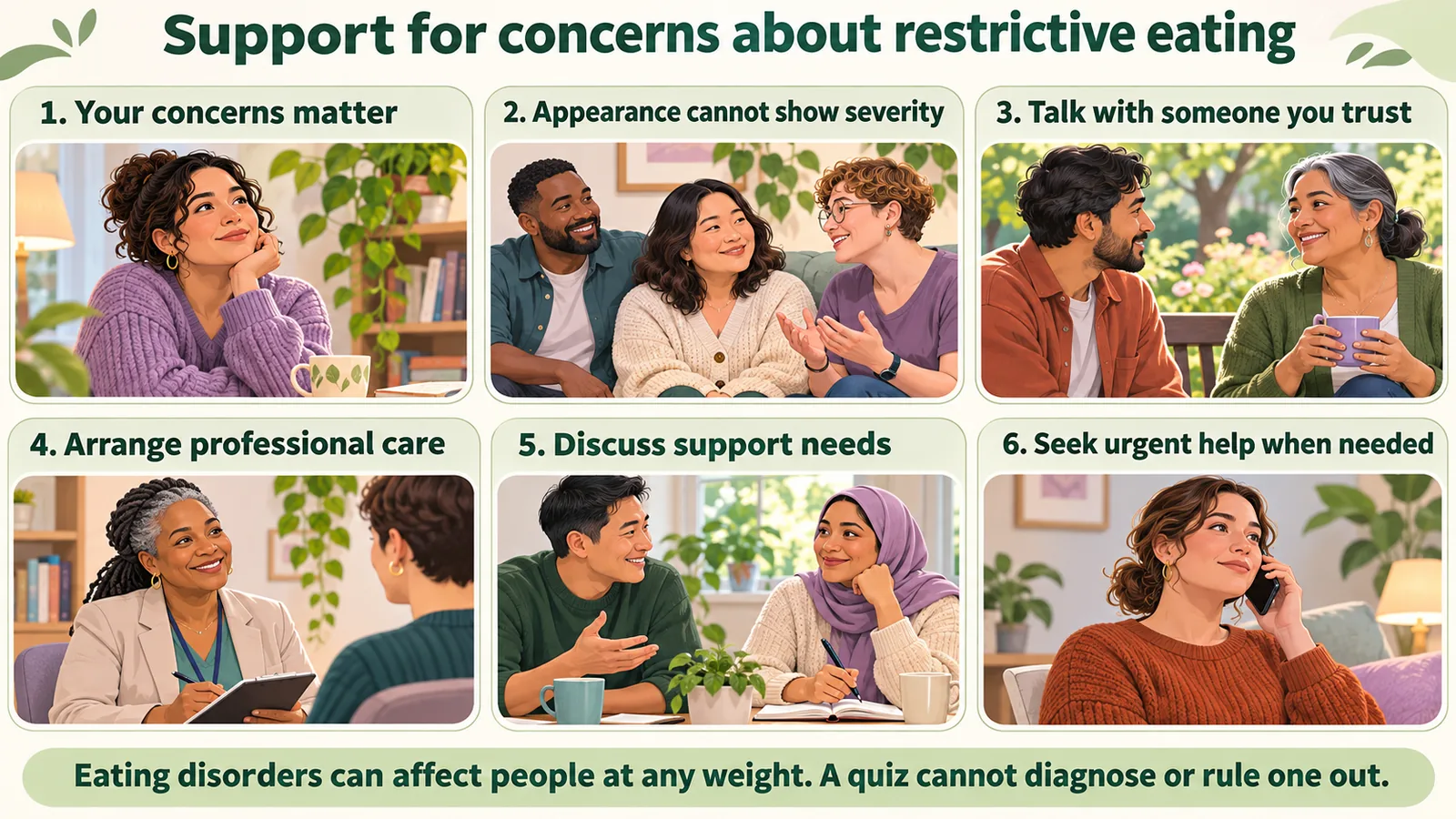
- 01 / FIRST STEP
A primary care or GP appointment
NIMH advises that “if you have concerns about your eating behavior or mental health, talk to a primary care provider”, who “can refer you to a qualified mental health professional, such as a psychologist, psychiatrist, or clinical social worker”. In the UK the NHS says to see a GP “as soon as you can” and will usually refer you to “a specialist eating disorder team or community mental health team”.
- 02 / WHAT TREATMENT LOOKS LIKE
A team, not a single appointment
NEDA says treating anorexia nervosa “requires working with a multidisciplinary team of health and mental health professionals”. NIMH lists psychotherapy, nutritional counselling, and “medical care and monitoring to treat the health consequences of an eating disorder”. The NHS describes “a combination of talking therapy and supervised weight gain”, with family therapy usually offered to children and young people — and NIMH notes family-based treatment “can improve eating disorder treatment outcomes, particularly for adolescents”.
- 03 / IF IT IS SOMEONE ELSE
How to raise it
NEDA’s guidance is to “set a private time and place to talk” and to speak about what you have actually noticed rather than issuing instructions about eating. The NHS advises: “let them know you’re worried about them and encourage them to see a GP. You could offer to go along with them.”
Clinical guidance: NIMH, Eating Disorders: What You Need to Know. Educational information only, not a treatment plan.
Practical next steps
Choose one next step
Any one of these is a reasonable place to start. None of them requires you to be certain.
- 01
Book the appointment without waiting for certainty
The NHS wording is deliberate: see a GP “even if you’re not sure”. You do not need to have decided what is wrong, and you do not need a particular score here.
- 02
Tell one person
Saying it out loud to someone you trust makes the next step considerably easier, and it removes the secrecy that several of these questions ask about.
- 03
Use a helpline if an appointment feels too big
In the US, ANAD runs a free eating disorders helpline on 1-888-375-7767, Monday to Friday 9am–9pm CST, offering “emotional support and referrals”. In the UK, Beat’s helpline for England is 0808 801 0677, open 3pm–8pm Monday to Friday. You can call about yourself or about someone you are worried about.
If you are in immediate danger, or physically unwell — fainting, chest pain, an irregular heartbeat, a seizure, or thoughts of ending your life — call 911 in the US or 999 in the UK, or go to an emergency department. NEDA’s own guidance in a medical or psychiatric emergency is to “seek medical attention or call 911 immediately”. In the US: for any mental health crisis, call or text 988 for the Suicide & Crisis Lifeline, free and confidential, 24/7. For eating-disorder support and referrals, ANAD on 1-888-375-7767 (Mon–Fri, 9am–9pm CST), or the National Alliance for Eating Disorders on 1-866-662-1235 (Mon–Fri, 9am–7pm ET) for help finding treatment. In the UK: Beat — England 0808 801 0677, Scotland 0808 801 0432, Wales 0808 801 0433, Northern Ireland 0808 801 0434, open 3pm–8pm Monday to Friday; Beat can only support people in the UK. Anywhere else: findahelpline.com lists verified helplines by country.
Good questions to ask
Anorexia self-check FAQs
Direct answers on what this can and cannot tell you, and how to get help.
No. Nothing on this page can diagnose anorexia nervosa, and a result here is not a medical opinion. Anorexia nervosa is diagnosed by a clinician through assessment, history and physical investigation — information no questionnaire collects. NEDA says of its own validated screener that “only a licensed medical professional can provide an evaluation, diagnosis, and treatment recommendations”, and that “online tests are not meant to be diagnostic and sometimes they may detect things incorrectly”. The same is true, more so, of this self-check.
Yes, and this is one of the most harmful misconceptions there is. NIMH states that people with eating disorders “can be underweight, average weight, or overweight”, and that “even people who appear healthy can have eating disorders and be extremely ill”. There is a specific diagnosis for this picture: NEDA describes atypical anorexia nervosa as presenting “with the same symptoms as anorexia nervosa, except that the person is within a ‘normal’ or higher weight range”, and Beat says it is “every bit as serious as anorexia, bulimia, or binge eating disorder”.
The NHS names anorexia nervosa, bulimia, binge eating disorder, OSFED and ARFID. In NIMH’s words, people with anorexia nervosa “severely avoid or restrict food intake due to a distorted self-image or an intense fear of gaining weight”; people with bulimia nervosa “regularly binge eat and then engage in unhealthy behaviors to prevent weight gain”; people with binge-eating disorder “regularly lose control of their eating”; and people with ARFID “limit the amount and variety of food they eat due to their anxiety or fear of the consequences of eating”. OSFED covers presentations meeting most but not all criteria for another diagnosis, including atypical anorexia, and NEDA calls it “a serious, life-threatening, but treatable eating disorder”.
In the US, NIMH advises: “if you have concerns about your eating behavior or mental health, talk to a primary care provider”, who can refer you on to a psychologist, psychiatrist or clinical social worker. In the UK, the NHS says “if you think you may have anorexia, even if you’re not sure, see a GP as soon as you can”. You can also call ANAD in the US on 1-888-375-7767 (Monday to Friday, 9am–9pm CST) or Beat in the UK on 0808 801 0677 (England, 3pm–8pm weekdays). You do not need to be certain, and you do not need a particular score here, to be worth seeing.
Strictly, neither. It is 15 house-written statements about restrictive eating and thoughts about food and body shape, and it is not a validated screening instrument. It cannot tell apart anorexia nervosa, atypical anorexia, bulimia nervosa, OSFED or ARFID, because the experiences those diagnoses share would push the same items upward. If you want a questionnaire with published validation behind it, NEDA hosts a free screening tool based on the Stanford-Washington University Eating Disorder Screen.
No — it is the wrong tool for that. ARFID involves avoiding or restricting food for reasons other than body image: Beat states that “in ARFID, beliefs about weight and shape do not contribute to the avoidance or restriction of food intake”, and NIMH describes it as limiting food “due to their anxiety or fear of the consequences of eating”. Because the items here are built around weight, shape and fear of gaining weight, someone with ARFID could score low and still need care. If that description fits better, try the ARFID Test and raise ARFID specifically with a clinician.
NEDA describes disordered eating as “a spectrum of problematic eating behaviors and distorted attitudes towards food, weight, shape, and appearance” whose patterns “do not meet the frequency, duration and/or level of psychological impairment thresholds necessary for a diagnosable eating disorder”. That is not a reason to shrug it off: NEDA also notes that disordered eating “is a risk factor in the development of an eating disorder”. You do not need to qualify for a diagnosis to deserve support.
Care is usually delivered by a team rather than one clinician — NEDA says treating anorexia nervosa “requires working with a multidisciplinary team of health and mental health professionals”. NIMH lists psychotherapy, nutritional counselling, and “medical care and monitoring to treat the health consequences of an eating disorder”. The NHS describes “a combination of talking therapy and supervised weight gain”, offers CBT among the options for adults, and notes that “children and young people will usually be offered family therapy”. NIMH adds that family-based treatment “can improve eating disorder treatment outcomes, particularly for adolescents”.
NEDA’s guidance is to “set a private time and place to talk”, and to speak about what you have actually noticed rather than issuing instructions about eating or making promises you cannot keep. The NHS advises: “let them know you’re worried about them and encourage them to see a GP. You could offer to go along with them.” If there is a medical or psychiatric emergency, NEDA says to “seek medical attention or call 911 immediately” — 999 in the UK. You can also call ANAD on 1-888-375-7767, which lists being worried about a loved one as a reason to call.
Editorial transparency
Sources and review information
Prepared by the PsyMed Editorial Team. This is an educational page, not a clinical assessment, and no licensed clinical reviewer is claimed. Sources checked: November 16, 2026. The stored questions, answer labels, weights and score ranges are preserved from the existing test; this redesign does not establish validation. Read how we build our tests and who we are.
References
- National Institute of Mental Health. Eating Disorders: What You Need to Know
- National Institute of Mental Health. Eating Disorders
- National Eating Disorders Association. Atypical Anorexia
- National Eating Disorders Association. Other Specified Feeding or Eating Disorders (OSFED)
- National Eating Disorders Association. Disordered Eating vs. Eating Disorders
- NHS. Anorexia nervosa — overview
- NHS. Anorexia nervosa — treatment
- Beat. ARFID
One useful observation
You do not need a score to deserve help.
There is no score on this page that earns you help and no score that disqualifies you from it. If your relationship with food is taking up this much room, that is reason enough to talk to someone.
Take the self-check