
Self-reflection · Identity
Am I Trans? A private place to think it through.
Fifteen reflections on how your gender has actually felt — free, private, and nothing saved. No labels forced, no threshold to cross, and no result that decides anything for you.

No test can establish whether someone is trans. This is a reflection tool; only you can decide how you identify.
-
A PLACE TO THINK15 reflectionsOn how your gender has actually felt.
-
PRIVATENothing is saved or sentFree, no account, no sign-up. Your result stays in your browser.
-
NO LABELS FORCEDOnly you decideThis cannot tell you who you are. Nothing can, except you.
A place to think
Take the am I trans quiz
Answer for how things have actually felt, not for what you think the answer should be. There is no right result here, and nothing you choose commits you to anything.
Your result
What the ranges mean
- 0–15 Few signs today — little of this resonated right now
- 16–30 Some questioning — parts of it landed, others did not
- 31–45 Strong signs — a lot of this sounded familiar
- 46–60 Very strong signs — nearly all of it resonated
Each answer scores 0 (Strongly disagree) to 4 (Strongly agree), for a total of 0–60. These ranges describe how much of this resonated with you today. They are not a measurement of how trans you are, and there is no score that makes someone trans or not.
There is no test, scan or questionnaire that can establish whether someone is trans.
The short answer
What does it mean to be trans?
Transgender is an umbrella term for people whose gender identity differs from the sex they were assigned at birth. It covers a lot of ground. Some trans people are binary — men and women whose assigned sex did not match. Many are non-binary, agender, genderfluid or something else again. Some pursue medical transition, some change only how they present or what they are called, and some change nothing visible at all. None of those routes is more genuinely trans than another.
The American Psychological Association draws a distinction worth holding onto: gender identity is your internal sense of who you are, gender expression is how you present it outwardly, and sexual orientation is who you are drawn to. They are three separate things, and knowing one tells you little about the others.
Being trans is not a mental illness. Gender dysphoria — distress about the mismatch — is a diagnosis; being trans is not.
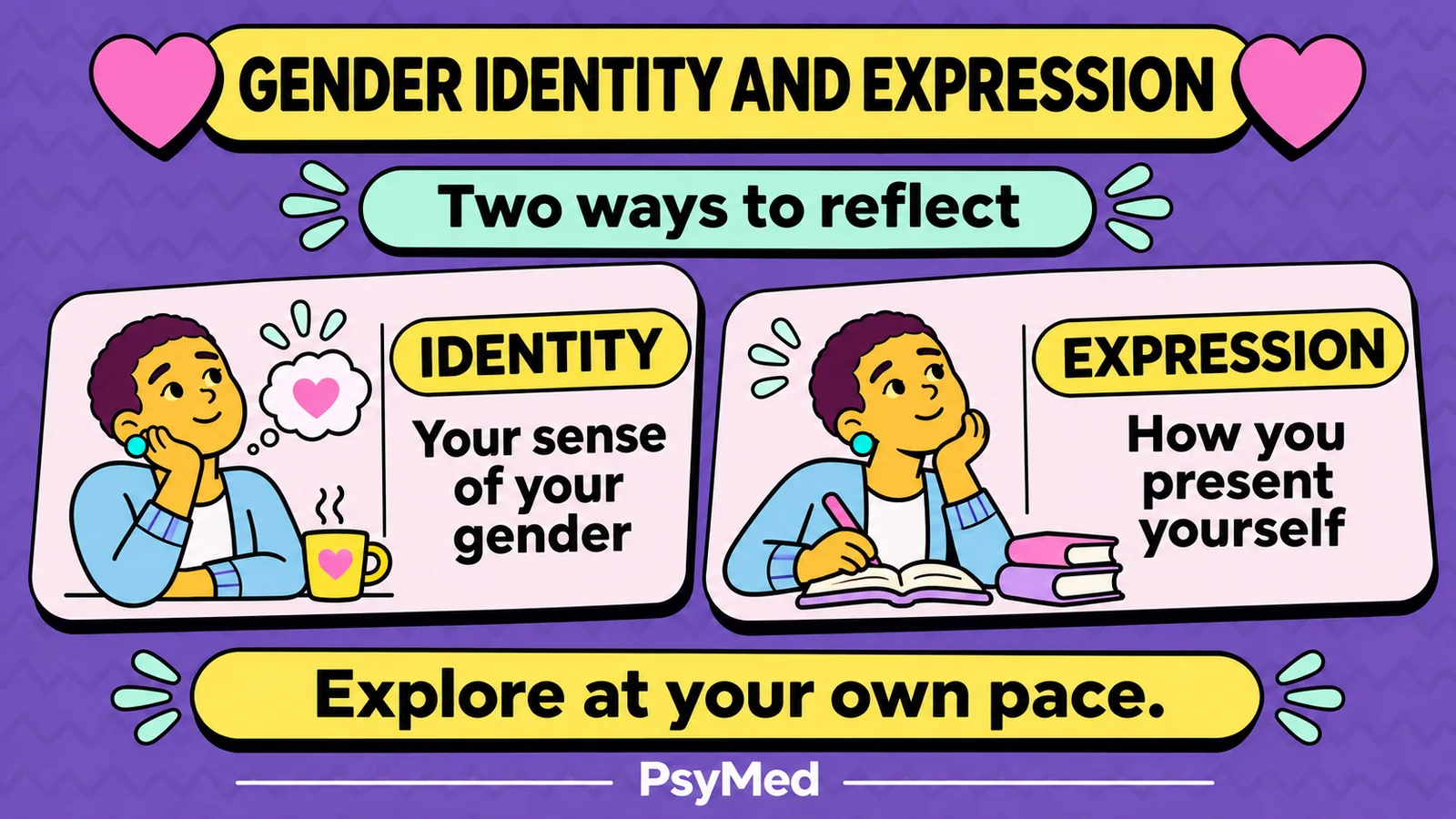
As the American Psychological Association puts it, gender identity is a person’s internal sense of being male, female, some combination, or neither — and it is distinct from both gender expression and sexual orientation. That separation is the single most useful idea for anyone untangling this, because a great many people arrive here having assumed the three must line up.
View sourceWhat people describe
What are people actually noticing?
These are experiences people commonly describe when questioning their gender. They are not symptoms and this is not a checklist — plenty of trans people recognise only some, and cisgender people sometimes recognise one or two.
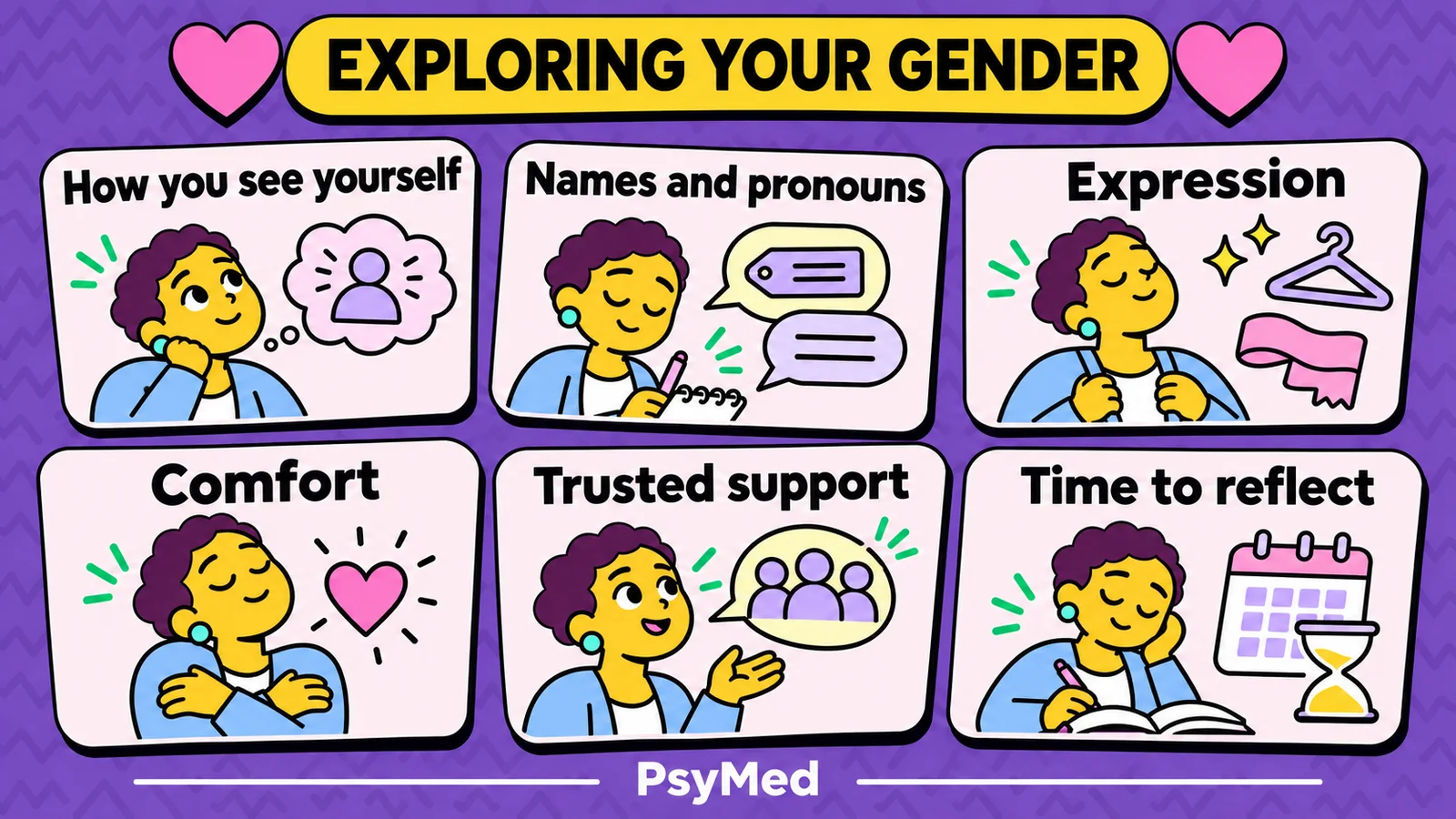
A quiet sense that it never quite fitted
Not necessarily distress, and often not dramatic — more a background feeling of going along with something that was decided for you.
Gender euphoria, not just discomfort
A spark of rightness or relief when you are seen as another gender, even briefly or in your imagination. Many people find this more telling than discomfort is.
Your name or pronouns feel off
Flinching slightly at your birth name or assigned-gender pronouns, or feeling a pull toward different ones — sometimes long before you would say why.
Imagining yourself differently feels good
Picturing yourself living or being seen as another gender, or as no gender, and noticing longing or relief rather than indifference.
It keeps coming back
Having set the question aside before, perhaps more than once, and finding it has returned. Persistence over months or years is something people often weigh heavily.
Being grouped with your assigned gender feels wrong
A sense of “not me” when you are counted as one of the men or one of the women, even when nobody means anything by it.
Identity, expression and orientation
These three get tangled constantly, including by people who are perfectly well-meaning. They are separate.
| Term | What it is | An example |
|---|---|---|
| Gender identity | Your internal sense of your own gender. | Knowing yourself to be a woman, a man, both, neither, or something else. |
| Gender expression | How you present outwardly — clothes, voice, name, mannerisms. | A trans man who dresses in a way others read as feminine is still a man. |
| Sexual orientation | Who you are attracted to. | Transitioning does not determine, or change, who you are drawn to. |
| Does this quiz cover all three? | No. It asks only about gender identity. Orientation is a separate question, and the Kinsey and LGBTQ self-checks cover that ground. | |
What this quiz looks at
The three things these questions ask about
The fifteen statements group loosely into three themes that people questioning their gender tend to describe. None of them is a requirement.
- 01 Incongruence
A mismatch between assigned and felt
The sense that the gender you were given does not describe you. This is what most people mean by the word trans, and it does not have to involve distress to be real.
- 02 Euphoria
Rightness when seen differently
Relief, joy or recognition when you are addressed, treated or imagined as another gender. Increasingly this is what people describe as the clearest signal for them.
- 03 Persistence
It has stayed with you
The question returning over months or years, surviving attempts to put it down. Persistence matters more than intensity, and there is no required duration before your feelings count.
No questionnaire, scan or professional can establish whether someone is trans. There is no biological marker and no threshold to cross. Clinicians can diagnose gender dysphoria — distress arising from a mismatch — and they can support someone exploring their gender, but identity itself is self-known. That is not a limitation of this quiz; it is how the thing works.
Things people often wonder
The questions that come up most
If any of these sound like your internal monologue, you are in very ordinary company.
“What if I am making it up?”
Nearly universal among people questioning their gender, and not a sign of anything. People who are making something up generally do not spend months interrogating whether they are.
“Shouldn’t I have known as a child?”
Some people do. Many do not, and realise in their twenties, forties or later — often because they had no language for it earlier, or because it was not safe to look.
“I don’t hate my body, so can I still be trans?”
Yes. Body-related distress is common but not required, and plenty of trans people describe euphoria about being seen correctly rather than dysphoria about their body.
Support
What helps when you are working this out
There is no deadline and no required order. These are the things people most often say made a difference.
- 01 / NO COMMITMENT NEEDED
Try things that are reversible
A different name among friends, different pronouns in one online space, different clothes at home. People often learn more from a week of being called something else than from months of thinking.
- 02 / PEOPLE WHO GET IT
Find others who have been here
Trans communities, local or online, are where most people find the language for what they are feeling. Hearing someone describe your experience in their words is frequently the turning point.
- 03 / PROFESSIONAL SUPPORT
A gender-affirming therapist
Not to be told what you are, but to have somewhere to think out loud. A good therapist here explores with you rather than steering you toward or away from any conclusion.
Background: American Psychological Association, Transgender People, Gender Identity and Gender Expression. This page is educational and is not medical or psychological advice.
What to do next
What should you do with your result?
Nothing, if you do not want to. The result is a prompt, and prompts can be set down again.
- 01
Notice which questions landed
Which statements you agreed with tells you more than the total does. Euphoria items and incongruence items point in slightly different directions.
- 02
Give it time rather than a decision
You do not owe anyone a conclusion, including yourself. Many people revisit a quiz like this months later and find the answer has clarified on its own.
- 03
Talk to someone who has been through it
A trans friend, a community space, or a gender-affirming therapist. Being understood quickly is worth a great deal when you are untangling this.
You deserve support, and these lines are staffed by people who understand this specifically. Trans Lifeline is run by and for trans people on (877) 565-8860 — you do not have to be in crisis to call. For young people, The Trevor Project is on 1-866-488-7386. In the US you can also call or text 988 (Suicide & Crisis Lifeline), free and 24/7. Outside the US, find a line at findahelpline.com. If you are in immediate danger, call your local emergency number.
Good questions to ask
Am I trans? — FAQs
Honest answers to what people ask most when they are working this out.
No, and be wary of anything that says it can. Gender identity is self-known — there is no test, no scan and no professional assessment that establishes it. What a quiz like this can do is give you language for things you may not have put into words, and show you that other people describe them too.
It is an umbrella term for people whose gender identity differs from the sex they were assigned at birth. It includes binary trans men and women, and non-binary, agender and genderfluid people. It says nothing about whether someone has medically transitioned.
No. Distress is common but it is not a requirement, and many people describe euphoria — relief or joy at being seen correctly — as the clearer signal. Gender dysphoria is a diagnosis; being trans is not.
That worry is close to universal among people questioning their gender, which is exactly why it is poor evidence either way. Giving yourself time, and low-stakes things to try, usually clarifies it better than more thinking does.
No. People come to this at every age, often because earlier there was no language available or no safety to look. Nothing about realising later makes it less real. The Trevor Project has resources written for young people specifically, including on telling family.
No. Major medical and psychological bodies are clear that being trans is not a disorder. Gender dysphoria — the distress that can come from a mismatch — is a recognised diagnosis, which exists so that people can access care, not to pathologise identity.
No. There is no obligation and no timetable. Plenty of people hold this question privately for a long time, and plenty try something small and reversible first. Both are fine.
Then trust yourself over the number. These fifteen statements describe common experiences, not required ones, and a low score simply means these particular wordings did not match yours. It settles nothing.
Yes. The quiz is free, needs no account or sign-up, and your result appears only in your browser. Nothing is sent to us.
Editorial transparency
Sources and review information
This is a self-reflection quiz, not an assessment. Its fifteen statements are original statements written by our team around experiences people commonly describe when questioning their gender; no instrument exists for this and none is reproduced. Content is written and reviewed by the PsyMed Editorial Team from the public sources listed here. We are writers and researchers, not clinicians, and this page is educational rather than diagnostic. Read how we build our tests and who we are.
Sources and support organisations
- American Psychological Association. Transgender People, Gender Identity and Gender Expression — on the distinction between identity, expression and orientation. apa.org apa.org/topics/lgbtq
- American Psychiatric Association. What Is Gender Dysphoria? — on the diagnosis, and on the point that being trans is not in itself a disorder. psychiatry.org psychiatry.org/patients-families/gender-dysphoria
- Trans Lifeline — peer support run by and for trans people, (877) 565-8860. You do not have to be in crisis to call.
- The Trevor Project — crisis support for LGBTQ+ young people, 1-866-488-7386.
However this landed
Only you get to decide who you are.
Use this as a place to think rather than a verdict. There is no deadline, no threshold, and nothing here you have to act on.
Take the quiz