Self-check · Neurodevelopment
Autism Test: 15 questions on the traits adults are most often missed for
Autism is a lifelong difference in how a person communicates, processes sensory information and handles change — not an illness. This free 15-question screen asks how often you recognise the traits associated with it, including masking, and tells you whether a formal assessment is worth pursuing. It cannot diagnose you.
A screening questionnaire, not a diagnosis. Only a qualified clinician can diagnose autism, and this page is not that.
-
TRAITS, NOT SYMPTOMS15 questionsSocial, sensory, routine and masking — answered for your whole life.
-
WHY ADULTS GET MISSEDMasking hides it from screensCamouflaging means changing outward behaviour, and questionnaires ask about outward behaviour. It is the main reason late-diagnosed adults were missed.
-
PRIVATENothing is saved or sentFree, no account, no sign-up. Your result stays in your browser.
A screening tool
Take the autism test
Fifteen statements about how you experience social contact, sensory input, routine and change. About two minutes, and the result appears only in your browser.
Your result
What the ranges mean
- 0–15 Few traits indicated — this pattern is not prominent
- 16–30 Some traits resonate — check whether masking is hiding more
- 31–45 Many traits — worth looking into properly
- 46–60 A strong, consistent pattern across several areas
Each statement scores 0 to 4 across fifteen items, for a total of 0–60. A higher total means more of this pattern, not something worse. What matters more than the number is whether the traits are lifelong and whether they span several areas at once — social, sensory and routine — because isolated traits are ordinary and the combination is what is distinctive.
The childhood item carries more weight than its single point suggests. Autism is lifelong, so traits that appeared only recently usually have another explanation.
The short answer
What is autism?
A lifelong neurodevelopmental difference affecting how a person communicates and interacts socially, alongside restricted or repetitive patterns of behaviour, interests or sensory responses. That is the clinical definition, and it is worth translating. In practice it tends to mean that social interaction takes conscious effort rather than running automatically; that sensory input — noise, light, texture, smell — arrives louder and harder to filter; that routine and predictability genuinely help rather than merely being preferred; and that interests run deep rather than broad. It is described as a spectrum because the combination and intensity differ enormously between people, not because everyone is “a little bit autistic”.
It is a difference in wiring that is present from early development, which is why diagnosis looks for a lifelong pattern rather than a recent change. Autistic people are not broken versions of non-autistic people, and the support that helps is usually about adjusting environments and expectations rather than about correcting the person.
Autism is a developmental difference, not a mental illness and not a decline. It does not arrive in adulthood — though recognising it very often does.
Hull and colleagues (2017) interviewed autistic adults about camouflaging — consciously copying others, scripting conversations in advance, and performing “normal” in social settings. They describe it as effortful, exhausting, and effective enough that other people do not notice, which is precisely why it defeats questionnaires and delays diagnosis.
View sourceThe traits
What the fifteen questions actually cover
Four clusters. A strong showing in one cluster means something different from an even spread across all four.
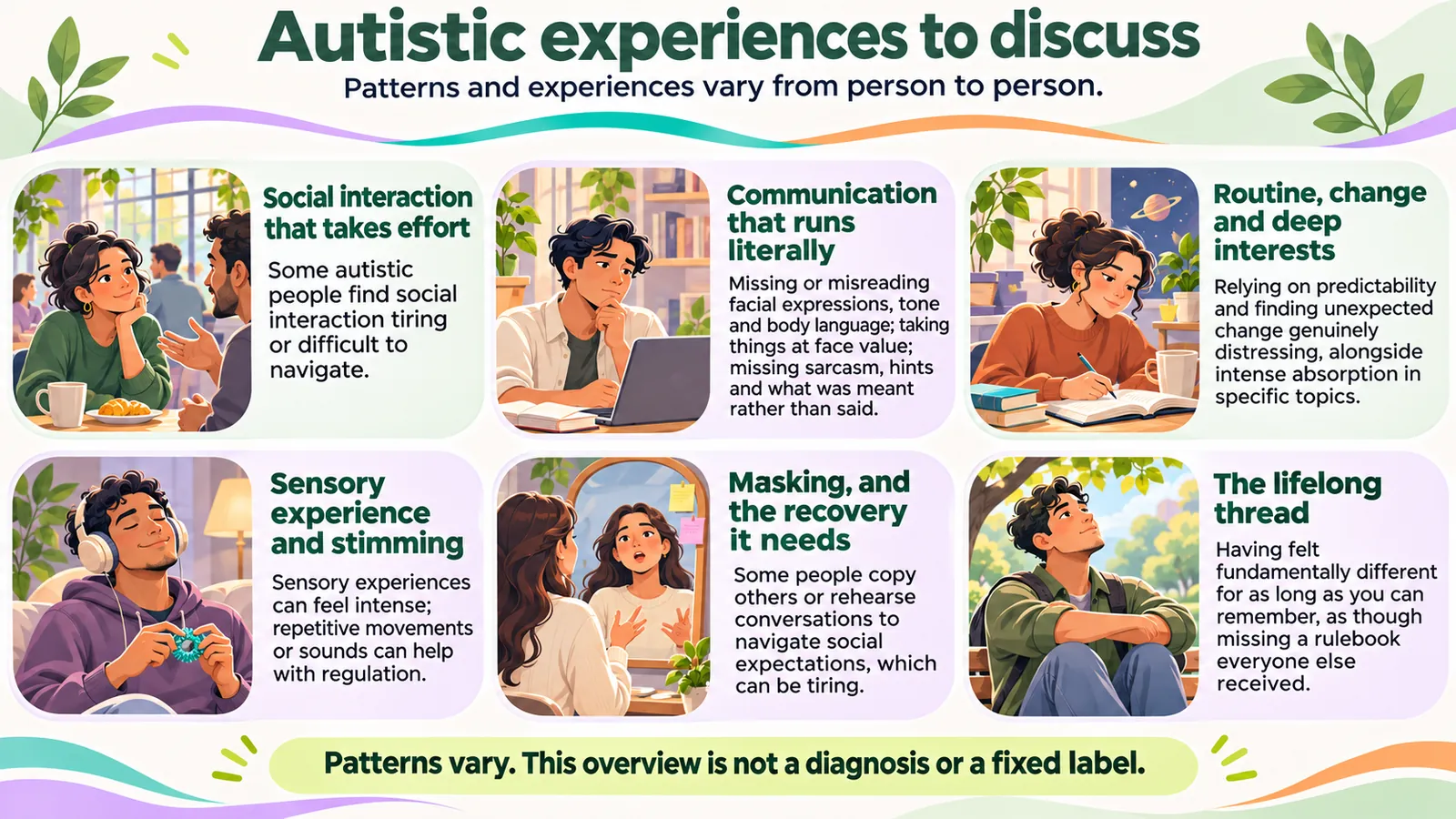
Social interaction that takes effort
Socialising drains rather than energises, conversations are genuinely hard to navigate, and extended contact becomes overwhelming. Not shyness — the difficulty is in the mechanics, not in confidence.
Communication that runs literally
Missing or misreading facial expressions, tone and body language; taking things at face value; missing sarcasm, hints and what was meant rather than said. Often experienced as other people being strangely indirect.
Routine, change and deep interests
Relying on predictability and finding unexpected change genuinely distressing, alongside intense absorption in specific topics. The interest is not a hobby so much as somewhere the mind goes by default.
Sensory experience and stimming
Sounds, lights, textures and smells arriving at an intensity other people do not seem to register, and repetitive movement — rocking, fidgeting, tapping, repeating sounds — that settles the nervous system. Stimming is regulation, not a symptom to suppress.
Masking, and the recovery it needs
Copying others, rehearsing conversations, performing “normal”, and then needing significant time alone afterwards. The recovery requirement is often the clearest sign that the performance was work.
The lifelong thread
Having felt fundamentally different for as long as you can remember, as though missing a rulebook everyone else received. This is the item that distinguishes autism from things that arrive later.
Autism, social anxiety and introversion
Three things that look similar and are not.
| Pattern | What drives it | The giveaway |
|---|---|---|
| Autism | A lifelong difference in processing social and sensory input. | Sensory traits and a childhood thread, not just social difficulty. |
| Social anxiety | Fear of being judged or humiliated. | You want the interaction and dread it. Treatable in its own right. |
| Introversion | A preference for lower stimulation. | Socialising costs energy but is not confusing or hard to decode. |
| What if more than one fits? | That is extremely common and not a contradiction. Many autistic people are also socially anxious, often because years of social difficulty is a reasonable thing to become anxious about. The order usually matters: anxiety that followed a lifetime of difficulty is a different story from anxiety that arrived on its own. | |
Reading your result
What should you actually take from the number?
Three things that matter more than where you landed.
- 01 Whether it is lifelong
The childhood thread
Traits present since childhood point toward autism. Traits that appeared in the last few years point toward something else — burnout, depression, anxiety or a change in circumstances — and that is a genuinely different question worth asking separately.
- 02 Whether it spans clusters
Social and sensory and routine
A high score built from one cluster alone is less distinctive than a moderate score spread across social, sensory and routine traits together. The combination is what characterises autism; individual traits are common in everyone.
- 03 How much you mask
The screen cannot see effort
If you present well socially by working at it constantly, this questionnaire will underestimate you, because it asks what you do rather than what it costs. People who mask heavily are exactly the group most often missed and that is a known limitation rather than a flaw in your answers.
It cannot diagnose autism; only a qualified clinician can, and assessment involves developmental history and usually an informant who knew you as a child. It cannot distinguish autism from ADHD, which co-occurs frequently and shares several of these traits. It cannot see masking, as above. And it cannot tell you what to do with the answer — some people want a formal diagnosis for accommodations, others find that understanding themselves is the whole of what they needed.
Things people ask early
The questions that come up first
Three worth answering before the detail.
Can adults be diagnosed with autism?
Yes, and a great many are. Adult diagnosis usually means a referral through your doctor to a specialist team, and the wait is often long. Nothing stops you acting on the understanding in the meantime.
Is self-diagnosis valid?
Self-identification is common and widely accepted within autistic communities, particularly given assessment waits and cost. A formal diagnosis mainly matters when you need legal accommodations or specific support.
Does a high score mean I am autistic?
No. It means enough traits are present that looking into it properly is reasonable. Several other things produce overlapping patterns, which is exactly what an assessment is for.
Getting assessed
What happens if you take this further
Three things worth knowing before you start, because the process surprises people.
- 01 / THE ROUTE
A referral, then a specialist team
In most health systems the path runs through your doctor to a specialist autism service. Waits are frequently measured in years rather than months, so starting the request early costs little even if you are undecided.
- 02 / WHAT THEY ASK
Developmental history, not just now
Assessment leans heavily on what you were like as a child, often with an informant such as a parent. Write down concrete childhood examples in advance — school reports, specific memories, things family repeat about you.
- 03 / SAY THAT YOU MASK
It is the most common reason adults are missed
If you have spent your life learning to pass, say so directly at assessment. Clinicians who work with adults expect it; those who mostly see children sometimes do not, and a well-masked adult can present as unremarkable in a single appointment.
Background: American Psychiatric Association, What Is Autism Spectrum Disorder?. This page is educational and is not medical advice.
What to do next
What should you do with your result?
Three things that help regardless of whether you pursue a diagnosis.
- 01
Write down the childhood examples now
While the questions are fresh. Developmental history is the part of an assessment people find hardest to reconstruct later, and specifics beat impressions.
- 02
Try the accommodations before the diagnosis
Quieter environments, more recovery time, written instructions, predictable routine. These help immediately and need nobody’s permission.
- 03
Read autistic adults, not only clinical descriptions
Most people find first-hand accounts far more recognisable than diagnostic criteria, which were largely written from observation of children.
Recognising yourself here can bring relief, and it can also bring grief — for the years spent assuming you were failing at something everyone else found easy. Both reactions are common and neither is an overreaction. Autistic burnout, the exhaustion that follows long periods of masking, is real and is frequently mistaken for depression. If you are struggling badly, or having thoughts of harming yourself, please reach out now: in the US you can call or text 988 to reach the Suicide and Crisis Lifeline, free and confidential, any time of day. If anyone is in immediate danger, call 911 or your local emergency number. Elsewhere you can find a line in your own country at findahelpline.com. Autistic people face markedly higher rates of distress, and that is a consequence of how the world is arranged rather than of being autistic.
Good questions to ask
Autism test — FAQs
What people actually ask about autism screening in adults.
No. An online autism screen cannot diagnose autism, and this one does not try to. Diagnosis requires a qualified clinician, a developmental history going back to childhood, and usually an informant who knew you then. What a screen can do is tell you whether enough traits are present that pursuing an assessment is reasonable, which is a genuinely useful thing to know before committing to a long waiting list.
Largely because of masking. Camouflaging means consciously copying others, scripting conversations and performing social ease, and research with autistic adults describes it as effortful, exhausting and effective enough that nobody notices. Diagnostic criteria were also written largely from observation of young boys, so presentations that do not match that template get missed. The combination means many autistic adults — disproportionately women and people who learned to mask early — reach adulthood with no explanation for why everything has been so much harder than it looks.
No. Autism is a neurodevelopmental difference, present from early development and lifelong, rather than an illness that begins at some point and might be cured. That distinction matters practically: the support that helps is mostly about adjusting environments and expectations, not about treating the person. Autistic people do experience mental illness — anxiety and depression at markedly higher rates — but that is a separate thing, and it is largely a response to living in a world arranged for different wiring.
Masking, or camouflaging, is the practice of hiding autistic traits to fit in: copying other people’s expressions, rehearsing conversations in advance, suppressing stimming, performing “normal”. It matters for a screen like this one because questionnaires ask about outward behaviour, and masking is specifically the business of changing outward behaviour. Someone who masks well can score modestly here and still be autistic. The giveaway is the cost: if social situations require constant conscious effort and significant recovery afterwards, that effort is the finding.
It depends on what you need from it. A formal diagnosis is what unlocks legal accommodations at work or in education, and some people find the external confirmation valuable in itself. Others find that understanding is sufficient and the wait, cost and effort are not worth it. Neither choice is more legitimate. Our ADHD Test is worth taking too if attention is part of your picture, because the two co-occur often enough that assessing one without the other frequently misses half the story.
No, and that phrase causes real confusion. Spectrum describes the variation among autistic people — which traits, how intensely, and how much support is needed — not a single line running from non-autistic to very autistic that everyone sits somewhere on. Most people recognise one or two traits here because the individual traits are ordinary human experiences. Autism is the consistent, lifelong combination of them across several domains.
Trust that over the number, particularly if you mask. Fifteen statements cannot capture a life, and this screen is known to understate people who have learned to pass. The more useful questions are whether these traits go back to childhood, whether they span social, sensory and routine domains, and how much effort your social ease actually costs. If the answers point one way and the score points the other, the answers are better evidence.
Autism itself does not progress — it is a developmental difference rather than a degenerative condition. What does change is how much is being demanded of you. Many autistic adults describe coping well until a job, a bereavement, parenthood or a long period of masking exhausts their capacity, which is often called autistic burnout. That is a change in circumstances meeting a fixed difference, not the autism worsening.
Yes. The test is free, needs no account or sign-up, and your result appears only in your browser. Nothing is sent to us.
Editorial transparency
Sources and review information
These fifteen statements are a house scale, written for this page. They are our own wording and not the AQ-10, the RAADS-R or any other published instrument — those are cited below as background, not used here. Content is written and reviewed by the PsyMed Editorial Team from the sources listed here. We are writers and researchers, not clinicians, and this page is educational rather than diagnostic. Read how we build our tests and who we are.
Research and editorial references
- Allison, C., Auyeung, B., & Baron-Cohen, S. (2012). Toward brief “red flags” for autism screening: the short Autism Spectrum Quotient (AQ-10). Journal of the American Academy of Child & Adolescent Psychiatry, 51(2), 202–212 — cited as background on brief autism screening. The AQ-10 is not used on this page; our items are our own. doi.org/10.1016/j.jaac.2011.11.003
- Hull, L., Petrides, K.V., Allison, C., Smith, P., Baron-Cohen, S., Lai, M.C., & Mandy, W. (2017). “Putting on my best normal”: social camouflaging in adults with autism spectrum conditions. Journal of Autism and Developmental Disorders, 47(8), 2519–2534 — the source for everything this page says about masking, including why it defeats screening questionnaires. doi.org/10.1007/s10803-017-3166-5
- Lai, M.C., Lombardo, M.V., Auyeung, B., Chakrabarti, B., & Baron-Cohen, S. (2015). Sex/gender differences and autism. Journal of the American Academy of Child & Adolescent Psychiatry, 54(1), 11–24 — the source for the point that diagnostic criteria derived largely from young boys miss other presentations. Also: NICE Clinical Guideline CG142 on autism in adults, for the assessment pathway described above.
- American Psychiatric Association, What Is Autism Spectrum Disorder? — for the DSM-5 framing used above, linked in the treatment section. We quote no prevalence figure on this page, because the argument does not need one and none was traced to a primary source we had checked.
A screen, not a verdict
Recognition is the useful part, diagnosis or not.
If this described you, the understanding is available immediately and the accommodations need nobody’s permission. A formal assessment is worth pursuing when you need it to unlock something specific — and worth starting early, because the queue is long.
Take the test