
Self-reflection · Neurodevelopment and attention
Sensory Processing Disorder Test: Explore your sensory experiences.
Reflect on how sounds, textures, movement and other sensations fit into your daily life. This original 15-item self-check offers a starting point for conversation, not a diagnosis.

For reflection only. Sensory processing disorder is not an independent DSM-5 diagnosis; this quiz cannot confirm or rule out a condition.
-
THE SELF-CHECK15 sensory statementsReflect on your usual sensory experiences.
-
EASY TO STARTNo account neededFree to take, with no sign-up. Your result appears right away.
-
CLEAR BOUNDARIESReflection, not a diagnosisLearn what your answers can and cannot tell you.
The self-check
Take the sensory processing disorder test
These 15 statements are written in a first-person voice for self-reflection. Choose how true each is for your usual experience. A caregiver may use the statements as discussion prompts about a child, but this is not a validated child assessment and the score cannot be interpreted as an age-based comparison.
Your score
What the bands mean
- 0–15 Low — few endorsed sensory difficulties
- 16–30 Mild — some endorsed sensory difficulties
- 31–45 Moderate — more endorsed sensory difficulties
- 46–60 High — many endorsed sensory difficulties
Each answer scores 0 to 4, for a total of 0–60. This original educational self-check has not been clinically validated. Bands describe your answers; they are not diagnostic cutoffs. Sensory processing disorder is not a standalone DSM-5 diagnosis.
An original reflection tool, not a standardized diagnostic instrument.
The short answer
What is sensory processing disorder?
Sensory processing disorder (SPD) is a term used for sensory difficulties that affect everyday activities. It is not recognized as an independent diagnosis in DSM-5. Sensory processing describes how people receive, interpret and respond to information from their body and surroundings.
People can experience the same sound, light, touch or movement differently. A useful starting point is the impact on activities, rather than whether someone has ordinary likes or dislikes. This test offers language for reflection, not proof that the brain is functioning incorrectly.
The Royal College of Occupational Therapists recommends a thorough assessment and clearly defined goals when sensory interventions are considered for children and young people.
Diagnostic status matters: SPD is not a separate DSM-5 diagnosis. That limitation does not dismiss the sensory experiences you want help understanding.
Patterns worth noticing
What might sensory difficulties look like?
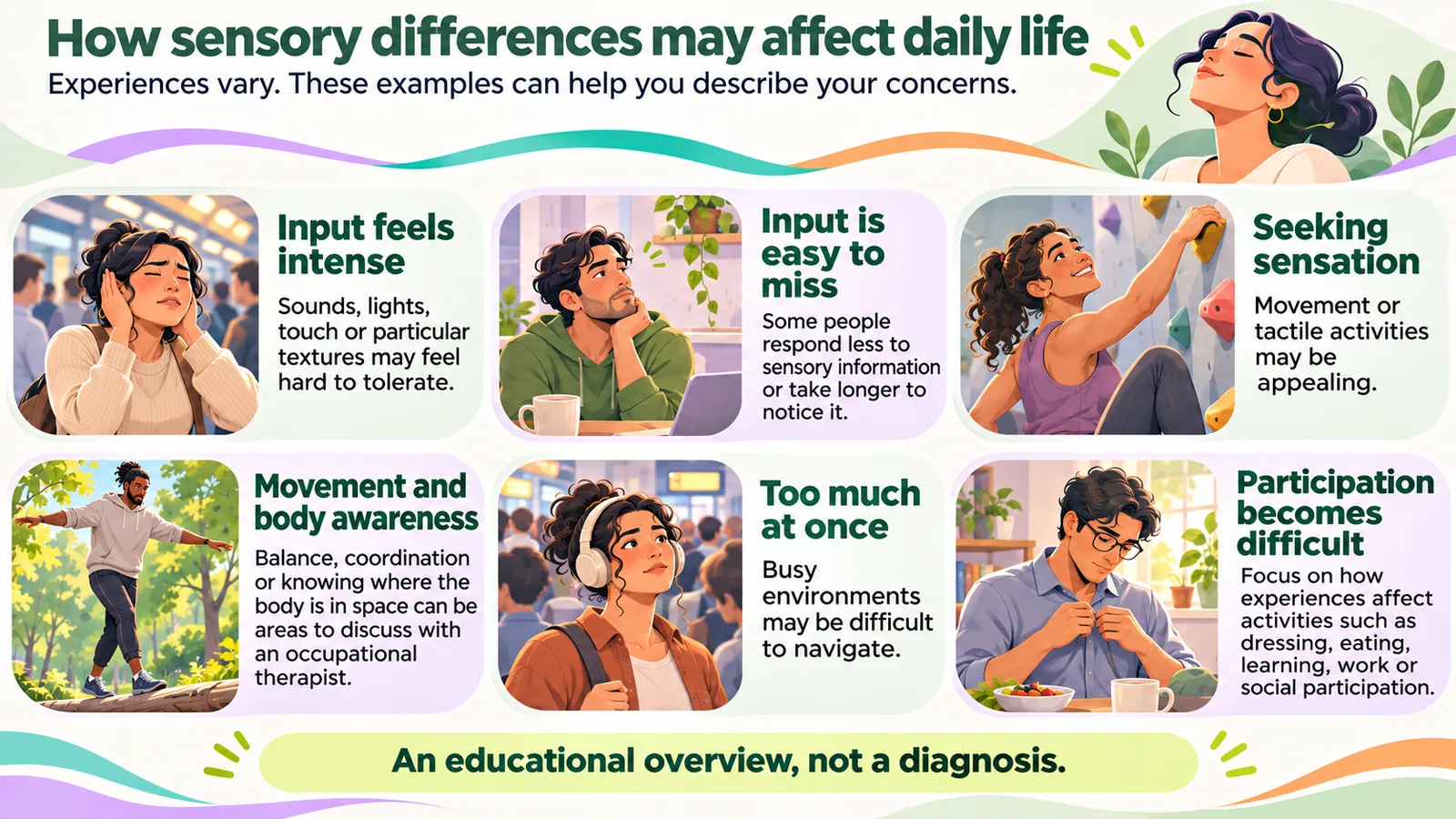
Input feels intense
Sounds, lights, touch or particular textures may feel hard to tolerate. Notice the specific sensation and setting.
Input is easy to miss
Some people respond less to sensory information or take longer to notice it. This quiz cannot identify the reason.
Seeking sensation
Movement or tactile activities may be appealing. A preference for stimulation alone does not establish a disorder.
Movement and body awareness
Balance, coordination or knowing where the body is in space can be areas to discuss with an occupational therapist.
Too much at once
Busy environments may be difficult to navigate. Note when a break or change of setting feels useful.
Participation becomes difficult
Focus on how experiences affect activities such as dressing, eating, learning, work or social participation.
Sensory difficulties, autism and ADHD
Sensory experiences alone do not determine a diagnosis.
| Topic | What to keep in mind |
|---|---|
| Sensory difficulties | Describe the experience and its impact; this is not a diagnostic finding from a quiz. |
| Autism | Sensory symptoms can occur in autism, but assessment also considers other developmental features. |
| ADHD | Sensory concerns may coexist with attention or activity-level difficulties; overlap does not prove ADHD. |
The Autism Test and ADHD Test explore related topics, with their own limitations.
An individual picture
How are sensory difficulties assessed?
Describe the experiences and activities you want help understanding.
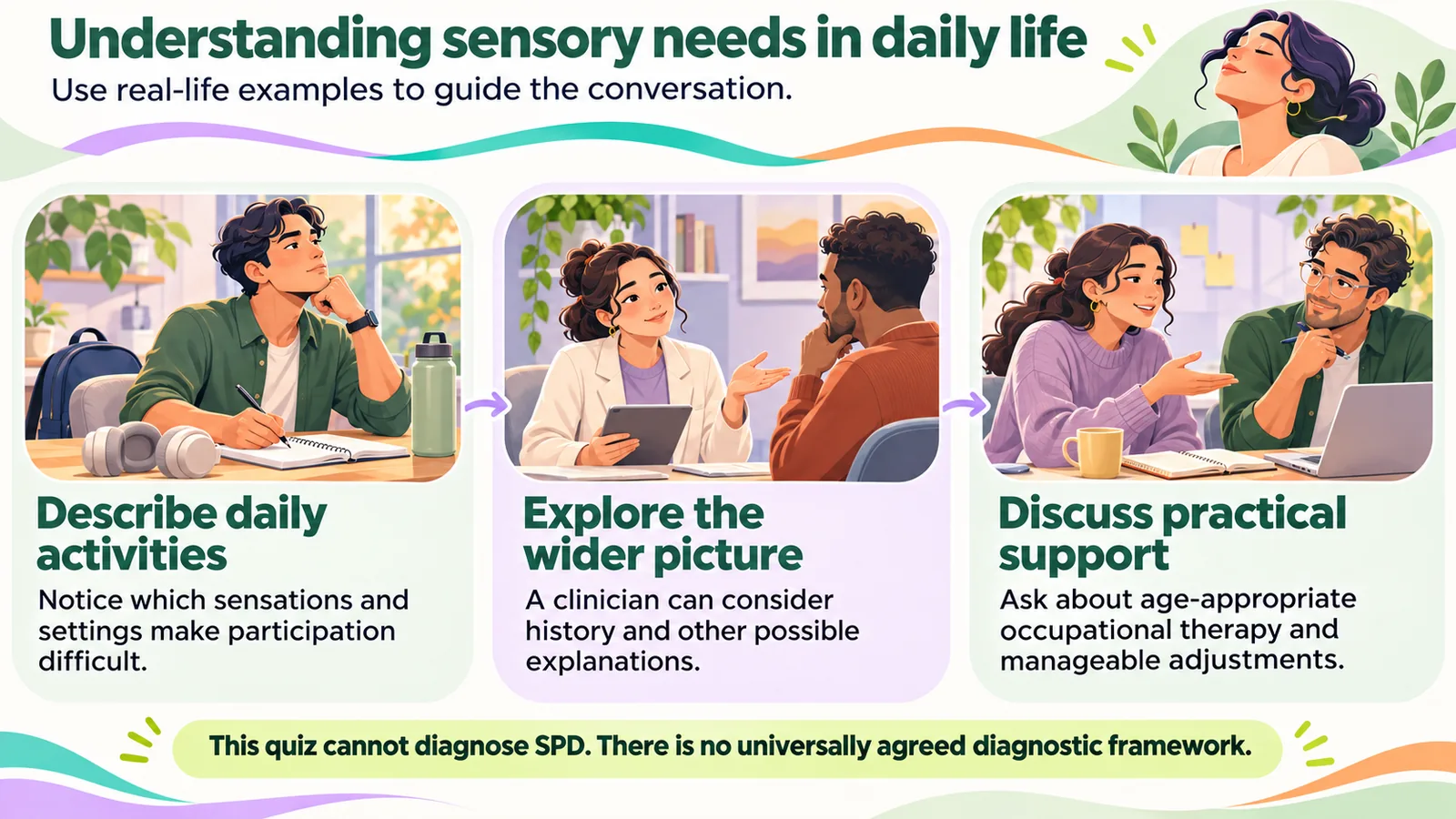
- 01 Daily activities
Your daily experiences
A clinician or occupational therapist can ask about your concerns, daily routines and developmental or medical history. For children, assessment may include caregiver questionnaires and observation of movement and everyday activities.
- 02 Clinical context
The wider picture
There is no agreed diagnostic framework that makes a score on this original quiz an SPD diagnosis. Bring examples of what is difficult and what you want to do more comfortably. Assessment can consider other explanations and co-occurring needs.
- 03 Age and setting
Find age-appropriate support
For adults, ask whether the service has experience with adults and the activities that concern you. The pediatric guidance cited here cannot establish adult treatment outcomes.
The original quiz is not a validated assessment. You can ask for support based on everyday impact, regardless of the total.
Understanding the context
Is this the same as being highly sensitive?
Different self-checks explore different experiences. Their scores cannot be combined into a diagnosis.
Sensitivity as a separate topic
Our Sensory Processing Sensitivity Test explores a separate self-reflection topic. Neither quiz can tell you why a sensation feels intense or whether a clinical assessment would identify a particular condition.
Reading and spelling
If reading and spelling are your main concern, the Dyslexia Test has a different focus. Choose a resource for the difficulty you want to describe, rather than combining quiz scores into a diagnosis.
Everyday impact
Bring examples of the sensations, settings and activities that matter to you. A total score cannot establish the cause of a difficulty.
Practical support
What can help with sensory difficulties?
- 01 / DAILY ACTIVITIES
Start with meaningful activities
Choose a concrete goal, such as taking part in a classroom routine or getting dressed more comfortably. An occupational therapist can consider barriers to participation.
- 02 / ENVIRONMENT
Discuss environmental adjustments
Ask about changes to noise, lighting, clothing or routines that fit the person and setting. Support should be individualized rather than a universal equipment list.
- 03 / REVIEWING BENEFITS
Review benefits and limits
Evidence for sensory integration and sensory-based approaches is debated. If an intervention is proposed, ask about its rationale, goals and how benefit will be measured.
A quiz cannot select a therapy or promise improvement. Use professional advice to evaluate specific approaches and equipment.
Your next conversation
What should you do with your result?
- 01
Keep a short record
Note the sensation, setting, activity and impact. Include what felt manageable as well as what was difficult.
- 02
Ask for an assessment
Speak with a healthcare professional or occupational therapist when sensory concerns interfere with everyday participation.
- 03
Set a practical goal
Discuss what you hope to do more comfortably and how you will review any support offered.
Questions worth asking
Sensory processing disorder test FAQs
This quiz cannot tell you. SPD is not a standalone DSM-5 diagnosis. If sensory experiences are affecting your activities, discuss the pattern with a healthcare professional or occupational therapist.
No. These are 15 original PsyMed statements. The total and bands have not been clinically validated and cannot confirm or rule out a condition.
The first-person statements can help you organize observations for a conversation, but the quiz is not a validated child assessment. Do not treat the result as a comparison with children of the same age.
Sensory processing occurs throughout life. Adults with concerns can ask for an individual assessment; the pediatric sources on this page do not validate an adult diagnosis or treatment plan.
No. Sensory symptoms can occur in autism, but sensory experiences alone do not establish autism. A broader developmental assessment considers other features.
No. Each response scores 0–4, producing a 0–60 total. The four descriptive bands summarize endorsement of this set of statements, not a clinical probability or level of disability.
No. Evidence and professional views differ. Ask a qualified practitioner about the rationale, specific goals and how progress will be reviewed.
No. A total can miss a specific difficulty that matters to you. You can ask for support based on everyday impact regardless of this result.
Editorial transparency
Sources and review information
Editorially reviewed by the PsyMed Editorial Team on . This is an editorial source review, not a clinical review.
Prepared by the PsyMed Editorial Team, writers and researchers rather than clinicians. No clinician review is claimed. The unchanged original quiz covers sensitivity, reduced noticing, seeking, body awareness and daily impact; it has not been validated against an assessment. These sources inform the article, not a claim that the quiz is a standardized instrument.
Read how we build our tests and about PsyMed.
Understanding your experience
Start with the activities that matter to you.
Use these statements to organize a conversation about sensory experiences and support.
Take the self-check