


Control Freak Quiz: How Strong Is Your Need for Control?
Do you need to control everything? This free 15-question control freak quiz rates your need for control, why it happens, and how to start loosening the grip.
Published Updated
If people have called you a “control freak” — or you’ve quietly wondered whether you need to control everything — this free, private control freak quiz can help you see the pattern clearly. It measures how strong your need for control is across the ways it usually shows up: struggling to delegate, needing things done your way, discomfort when plans change, and difficulty sitting with uncertainty. Take it as honest self-reflection, not a label.
Here’s something worth knowing before you start, because it reframes the whole thing: the need for control almost always comes from anxiety, not arrogance. Underneath most controlling behavior is a nervous system trying to feel safe by making the world predictable — often shaped by past experiences where things felt chaotic or out of your hands. That means being controlling isn’t a character flaw or a life sentence; it’s a learned pattern, and learned patterns can change. There’s no shame in what you find here, only useful insight.
What Is a “Control Freak”?
A “control freak” is a colloquial term for someone with a strong, persistent need to control the people, tasks, and situations around them — usually because uncertainty and letting go feel deeply uncomfortable. It’s not a clinical diagnosis; it describes a personality tendency that exists on a spectrum, where the key question isn’t whether you like things a certain way, but how strong the need is and what it costs you and the people around you.
What drives it is the important part. Psychologists consistently trace controlling behavior back to anxiety and an intolerance of uncertainty — the brain treats unpredictability as a threat and tries to neutralize it by managing every outcome. This need for control often develops from earlier experiences where life felt chaotic, unsafe, or out of control (unpredictable caregiving, trauma, or a perfectionistic environment), which taught the nervous system that taking charge is the only way to feel secure. The result is a feedback loop: the more you control, the more you rely on control, because you never get to learn that things can turn out fine without your intervention. Understanding this engine — that control is fundamentally a bid for safety, not a character defect — is what makes change possible.
Signs You Might Be a Control Freak
Controlling tendencies rarely announce themselves — they often look like diligence, high standards, or “just caring a lot” until you notice the pattern underneath. As you read these signs, notice how many feel familiar as a regular way of operating, not a rare bad day. The more that resonate, the stronger the tendency — and every one of them can soften with practice.
You struggle to delegate
Handing tasks to others feels genuinely hard, because you worry they won’t do it “right.” You’d often rather do things yourself than risk them being done differently — which leaves you overloaded and everyone else feeling untrusted.
You micromanage
Even after handing something off, you hover, check in constantly, and want to oversee every step. You focus on how things get done, not just the result, and find it hard to let people find their own way.
It has to be done your way
You believe there’s a right way to do things — usually your way — and you find yourself redoing others’ work, correcting them, or feeling frustrated when they deviate from how you’d have done it.
You’re a perfectionist with high standards
You hold yourself (and often others) to exacting standards, and mistakes or “good enough” feel genuinely uncomfortable. This can make you effective, but also hard to satisfy and quick to criticize.
Changed plans and surprises unsettle you
When plans shift unexpectedly, you feel thrown, anxious, or irritated. You like to plan things thoroughly and know what’s coming, and spontaneity or ambiguity can feel more stressful than exciting.
You can’t relax when you’re not in control
Handing over the reins — letting someone else drive, plan, or decide — makes you tense rather than relieved. You feel most at ease when you’re the one managing things, and uneasy when you’re not.
You give a lot of unsolicited advice and directives
You often tell people how they should do things, offer correction they didn’t ask for, or steer situations and decisions — sometimes experienced by others as controlling even when you mean well.
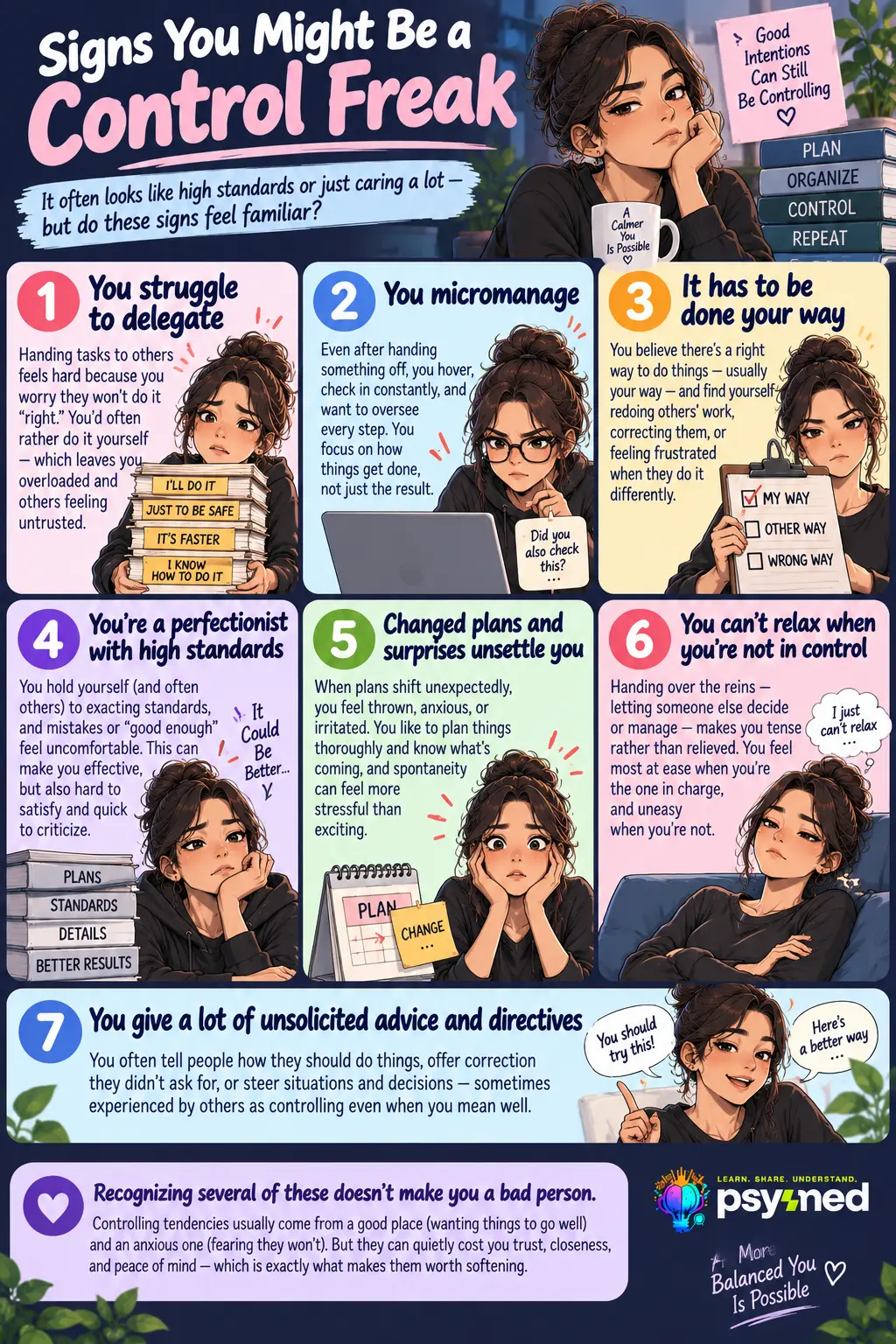
Recognizing several of these doesn’t make you a bad person — controlling tendencies usually come from a good place (wanting things to go well) and an anxious one (fearing they won’t). But they can quietly cost you trust, closeness, and peace of mind, which is exactly what makes them worth softening.
Control Freak or OCPD? Knowing the Difference
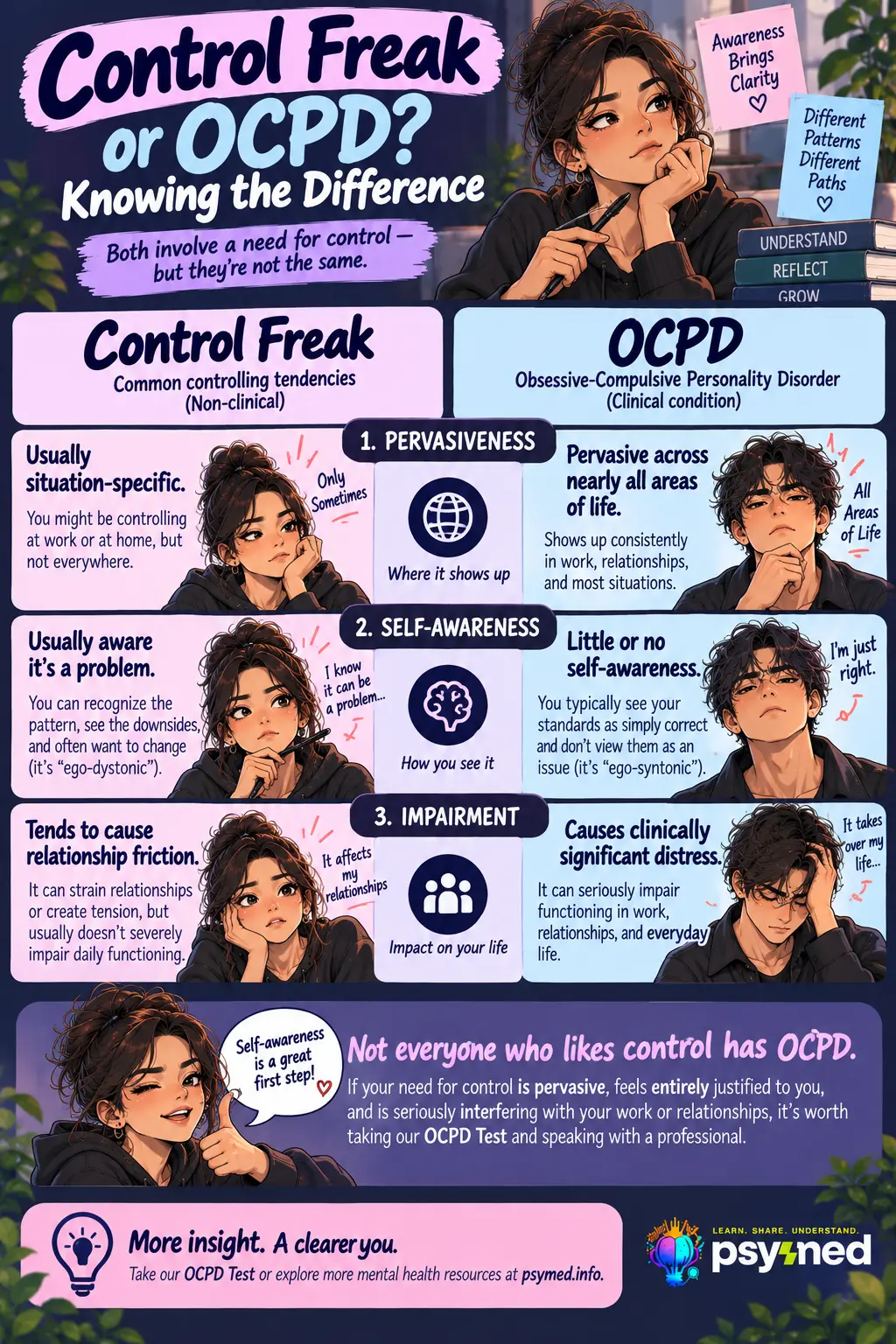
Because “control freak” overlaps with a real clinical condition, it helps to know where the line is. The closest diagnosis is Obsessive-Compulsive Personality Disorder (OCPD) — a pervasive pattern of perfectionism, rigidity, and need for control — but most people with controlling tendencies do not have OCPD. Three differences usually distinguish them.
Pervasiveness
Everyday controlling behavior is often situation-specific (you’re controlling at work, or about the house, but not everywhere); OCPD is pervasive, showing up across nearly all areas of life.
Self-awareness
People with controlling tendencies can usually recognize the pattern and see it as a problem (it’s “ego-dystonic”); in OCPD, the person typically experiences their standards as simply correct and doesn’t see them as an issue (it’s “ego-syntonic”).
Impairment
Controlling tendencies tend to cause relationship friction; OCPD causes clinically significant distress and genuinely impairs functioning. If your need for control is pervasive, feels entirely justified to you, and is seriously interfering with your work or relationships, it’s worth exploring our OCPD Test and speaking with a professional.
If it’s more situational and you can already see it’s a pattern you’d like to change, this quiz — and the good news about how changeable it is — is the right place to start.
How This Control Freak Quiz Works
This quiz has 15 statements about how you relate to control, uncertainty, and other people’s ways of doing things. For each, choose how much you agree, thinking about how you generally are rather than one unusual situation:
Strongly Disagree = 0 | Disagree = 1 | Neutral = 2 | Agree = 3 | Strongly Agree = 4
Your answers add up to a score from 0 to 60, where a higher score reflects a stronger need for control. Remember, some preference for order and high standards is completely healthy — this quiz is about noticing when the need for control becomes strong enough to cost you. Answer honestly rather than aspirationally; a genuine picture is the only kind you can grow from. Your result is private.
Understanding Your Results
Your score reflects how strong your need for control is — but read every level with self-compassion, not judgment. Controlling tendencies are a learnable pattern rooted in a bid for safety, so wherever you land is a starting point, not a fixed trait.
| Score | Level | What It Suggests |
|---|---|---|
| 46 – 60 | Strong Control Freak Tendencies | A strong need for control that’s likely affecting your stress and relationships. |
| 31 – 45 | Notably Controlling | A clear controlling streak worth softening in the areas where it costs you. |
| 16 – 30 | Some Controlling Tendencies | Some need for control in certain areas, but not a dominant pattern. |
| 0 – 15 | Easygoing | You’re comfortable with uncertainty and letting others do things their way. |
How to Loosen the Need for Control
Because controlling behavior is a learned, anxiety-driven pattern rather than a fixed trait, it responds well to deliberate practice — and the goal isn’t to stop caring, but to stop letting the need for control run the show. Here’s what actually helps.
Address the anxiety underneath, not just the behavior
Since the urge to control is really an urge to escape the discomfort of uncertainty, the most effective work is building your tolerance for not knowing. When the urge to control appears, pause and ask “what feels at risk right now?” — naming the underlying fear helps shift your brain out of threat mode.
Practice delegating — and allow imperfection
Start small: hand off a low-stakes task, define the outcome you want rather than the exact process, and then resist the urge to intervene. Letting others find their own way (and occasionally get it wrong) is how you learn that things turn out fine without you.
Loosen your grip on “good enough.”
Perfectionism fuels control, so practicing accepting “good enough” in low-stakes areas eases the pressure.
Try mindfulness
Mindfulness helps you notice the anxious urge to control without automatically acting on it — creating a gap where you can choose differently.
Consider therapy if it runs deep
Cognitive behavioral therapy and mindfulness-based approaches have strong evidence for reducing controlling behavior and the anxiety that drives it, and a therapist can help with roots in trauma or long-standing patterns.
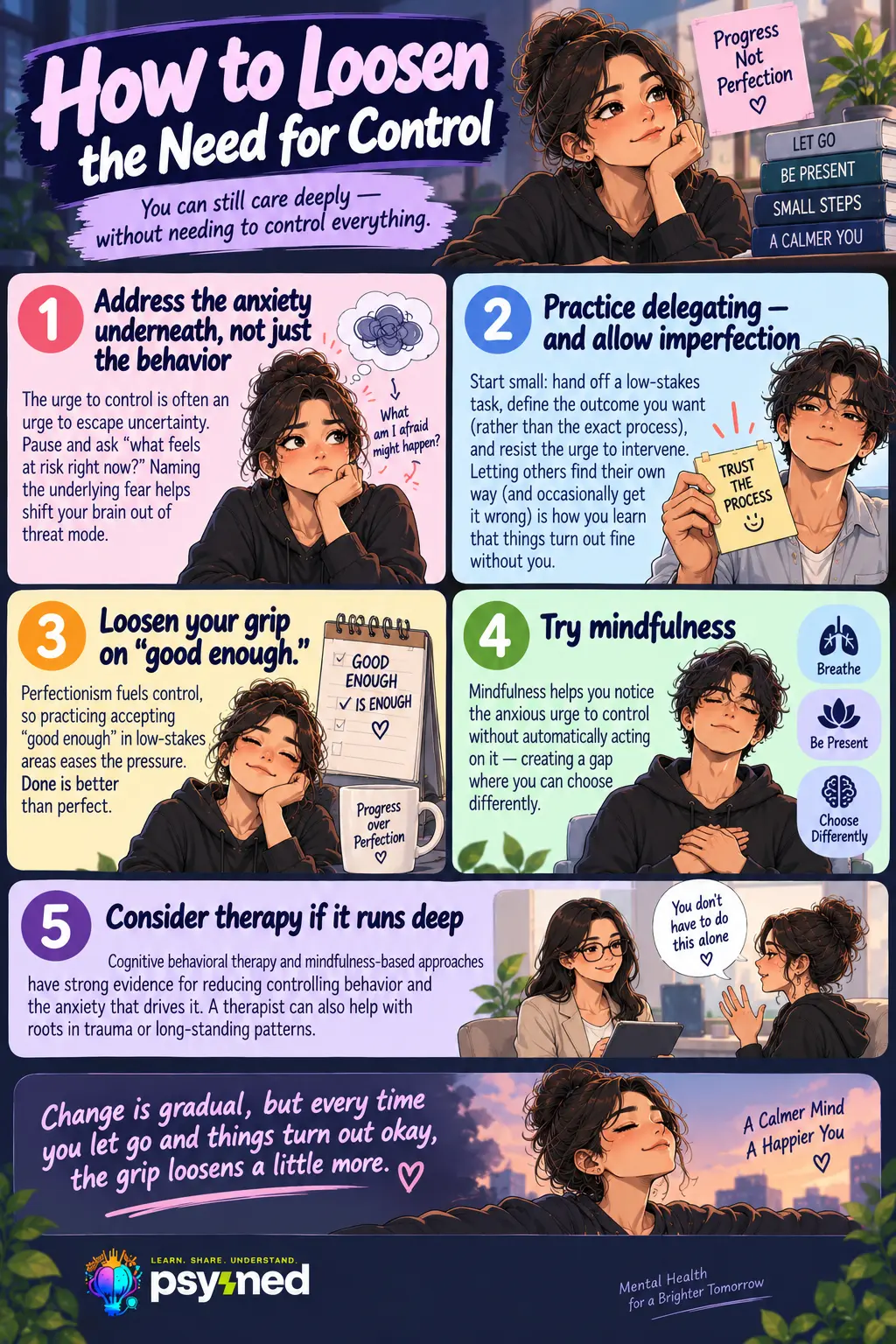
Change is gradual, but every time you let go and things turn out okay, the grip loosens a little more.
Frequently Asked Questions
Is being a control freak a mental disorder?
No — “control freak” is a colloquial term, not a clinical diagnosis, and being controlling is not in itself a mental disorder. It describes a personality tendency that exists on a spectrum, and for most people it’s a learned coping pattern driven by anxiety rather than a diagnosable condition. That said, an intense, pervasive need for control can be a feature of certain conditions, most notably Obsessive-Compulsive Personality Disorder (OCPD), and it also overlaps with anxiety disorders and perfectionism.
The distinction usually comes down to how pervasive the pattern is, whether the person sees it as a problem, and whether it’s genuinely impairing their life. If your controlling tendencies are situational and you can recognize them, that points to a changeable trait rather than a disorder.
What causes someone to be controlling?
Controlling behavior is almost always driven by anxiety and an intolerance of uncertainty — at its core, the need for control is a need for safety and predictability. When someone can’t tolerate not knowing how things will turn out, they try to neutralize that discomfort by managing every outcome. This pattern typically has roots in earlier experiences: growing up in a chaotic, unpredictable, or emotionally unsafe environment can teach a child that taking charge is the only way to feel secure, and that lesson can harden into an adult trait.
Trauma, perfectionism, low self-esteem, and insecure attachment are all common contributors. The important and hopeful point is that these are learned responses to real needs, not character defects — which is exactly why they can be unlearned.
Can a control freak change?
Yes, and this is genuinely good news: controlling behavior is one of the more changeable personality patterns, precisely because it’s usually a learned, anxiety-driven habit rather than a fixed trait. Change starts with recognizing the pattern and understanding its anxiety engine, then gradually practicing tolerance for uncertainty and letting go.
Approaches with strong evidence include cognitive behavioral therapy (which targets the catastrophic thinking that fuels the need to control), mindfulness (which helps you notice the urge without acting on it), and gradual delegation exercises (which teach your nervous system, through experience, that things turn out fine without your constant intervention). It takes intention and practice, and change is gradual, but people meaningfully reduce controlling behavior all the time. The trait describes a habit, not a cage.
What’s the difference between being organized and being a control freak?
The difference is about flexibility, anxiety, and cost. Being organized, conscientious, and having high standards are healthy traits that serve you — you like structure, but you can adapt when needed, delegate when it makes sense, and cope when plans change. Controlling tendencies cross a line when the need for control becomes rigid and anxiety-driven: when you can’t let others do things their way, can’t tolerate deviation from the plan, feel real distress when you’re not in charge, and the behavior starts costing you relationships or peace of mind.
In short, organization serves your goals; controlling behavior, at its extreme, serves your anxiety. A useful test is whether you’re able to let go when it would be reasonable to — if letting go feels genuinely threatening rather than just mildly uncomfortable, that leans toward controlling.
Related Tests
- OCPD Test — if your need for control is pervasive and may be the clinical disorder (OCPD)
- Anxiety Test — anxiety is the engine behind most controlling behavior
- OCD Test — for intrusive thoughts and compulsions (different from OCPD and controlling traits)
- Attachment Style Test — insecure attachment often underlies a need for control in relationships
- Anger Management Test — controlling tendencies and frustration when things aren’t “right” often overlap
References
- Carleton, R.N., Norton, M.A., & Asmundson, G.J. (2007). Fearing the unknown: A short version of the Intolerance of Uncertainty Scale. Journal of Anxiety Disorders, 21(1), 105–117. [Intolerance of uncertainty as a driver of controlling behavior] pubmed.ncbi.nlm.nih.gov
- American Psychological Association. Control and the need for control. [Psychology of control and anxiety] apa.org
- GoodTherapy. Control Issues: Understanding and Overcoming the Need for Control. goodtherapy.org
- Psych Central. Why Do You Need to Control Everything? Causes of Controlling Behaviors. psychcentral.com
Related Tests
See All Quiz →
Emotional and Trait Assessments
Are You a Psychopath? Take This Free Psychopath Test (PCL-R Based)
→


You may also like
See All Quiz →