
Emotional and Trait Assessments
Sensory Processing Sensitivity Test: Are You Highly Sensitive?
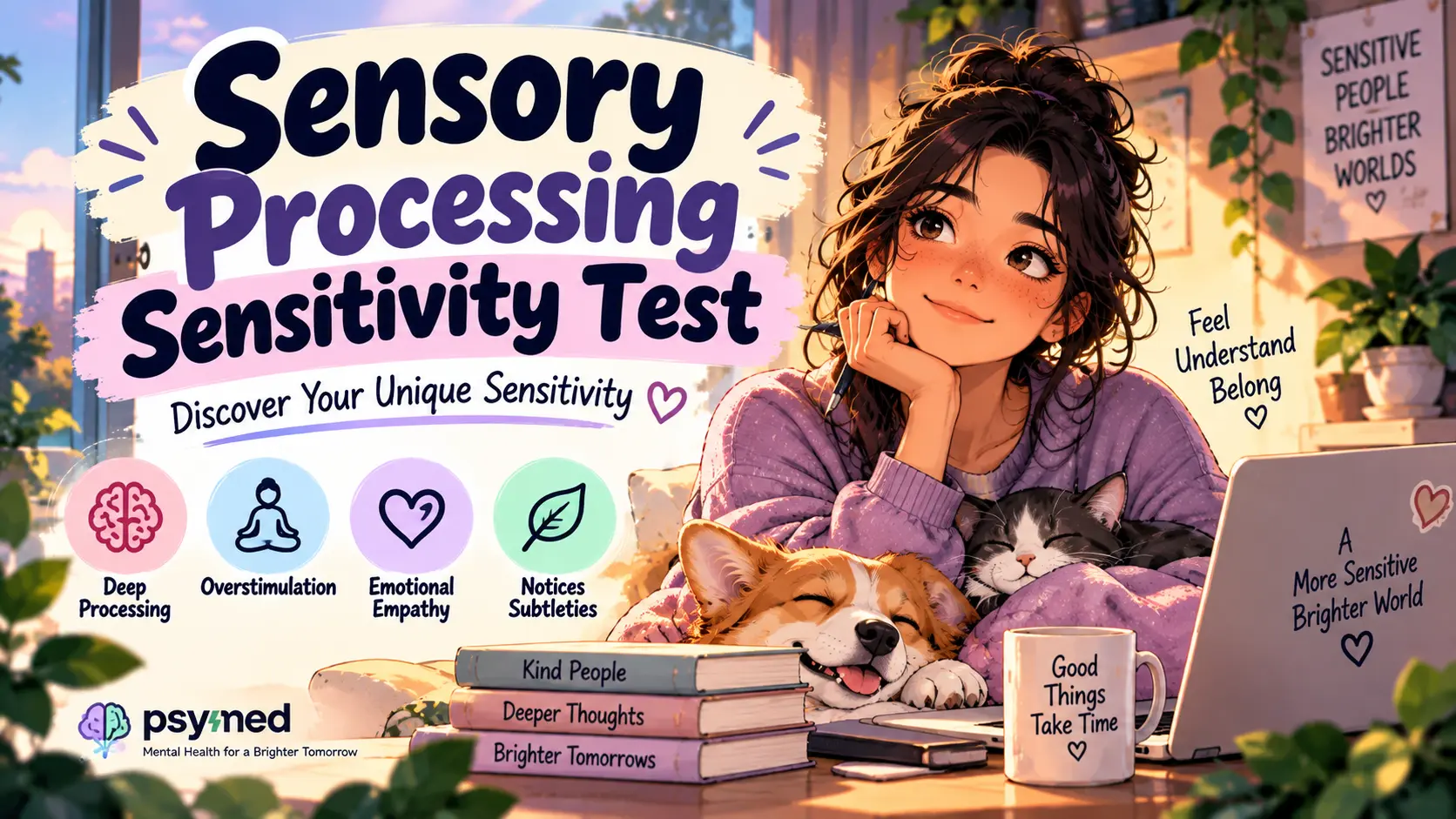
This free Sensory Processing Sensitivity test helps you discover how highly sensitive you are — a real, well-researched personality trait, not a disorder. Sensory Processing Sensitivity (SPS) is the scientific name for the trait behind the “Highly Sensitive Person” (HSP): a nervous system that processes experiences more deeply, feels emotions more intensely, notices subtle details others miss, and can become overwhelmed by too much stimulation. This quiz measures where you fall, with an instant, private result.
Being highly sensitive is completely normal — an estimated 15 to 30% of people have this trait — and it comes with real strengths as well as challenges. So there’s no “good” or “bad” result here: this is simply a way to understand how your nervous system is wired, so you can work with it rather than against it. If you’ve often been told you’re “too sensitive,” this might help you see that quality in a new, more accurate light.
What Is Sensory Processing Sensitivity?
Sensory Processing Sensitivity (SPS) is a normal, inherited personality trait characterized by a nervous system that is more responsive to both internal and external stimuli — processing everything more deeply and thoroughly than average. It was formally defined by psychologist Dr. Elaine Aron in the 1990s (building on Carl Jung’s earlier idea of an “innate sensitiveness”), and people high in the trait are often called Highly Sensitive Persons (HSPs). Research estimates that 15 to 30% of the population are highly sensitive, and the trait is found across many species, suggesting it’s an evolutionary strategy — a “notice before acting” way of engaging with the world.
Crucially, SPS is a trait, not a disorder. It’s not something to be diagnosed, treated, or cured — it’s a natural variation in how the nervous system works, and it isn’t a mental illness. Highly sensitive people simply take in more information and reflect on it more deeply, which is why they can be both remarkably perceptive and empathetic and more easily overstimulated. Dr. Aron summarizes the trait with the acronym DOES: Depth of processing, Overstimulation, Emotional reactivity and empathy, and sensitivity to Subtleties. This quiz measures all four.
The Four Traits of a Highly Sensitive Person (DOES)
Aron’s DOES framework captures the four core features of high sensitivity — and this Sensory Processing Sensitivity test measures each. Together they explain why HSPs experience the world so richly, and why they need more downtime to recover.
- Depth of processing is the foundation: HSPs think about things more deeply, reflect before acting, notice connections and meanings, and process experiences thoroughly rather than skating over the surface.
- Overstimulation is the natural flip side — because they take in and process so much, HSPs get overwhelmed more easily by loud, busy, or chaotic environments, and need more rest and quiet to recover. This is the one genuinely challenging part of the trait.
- Emotional reactivity and empathy mean HSPs feel emotions intensely — their own and other people’s — and are often deeply moved by beauty, art, and others’ feelings; they frequently sense what someone else is feeling before it’s said.
- Sensitivity to subtleties is the fine-tuned radar: noticing small changes, quiet sounds, subtle shifts in mood, or details others overlook.
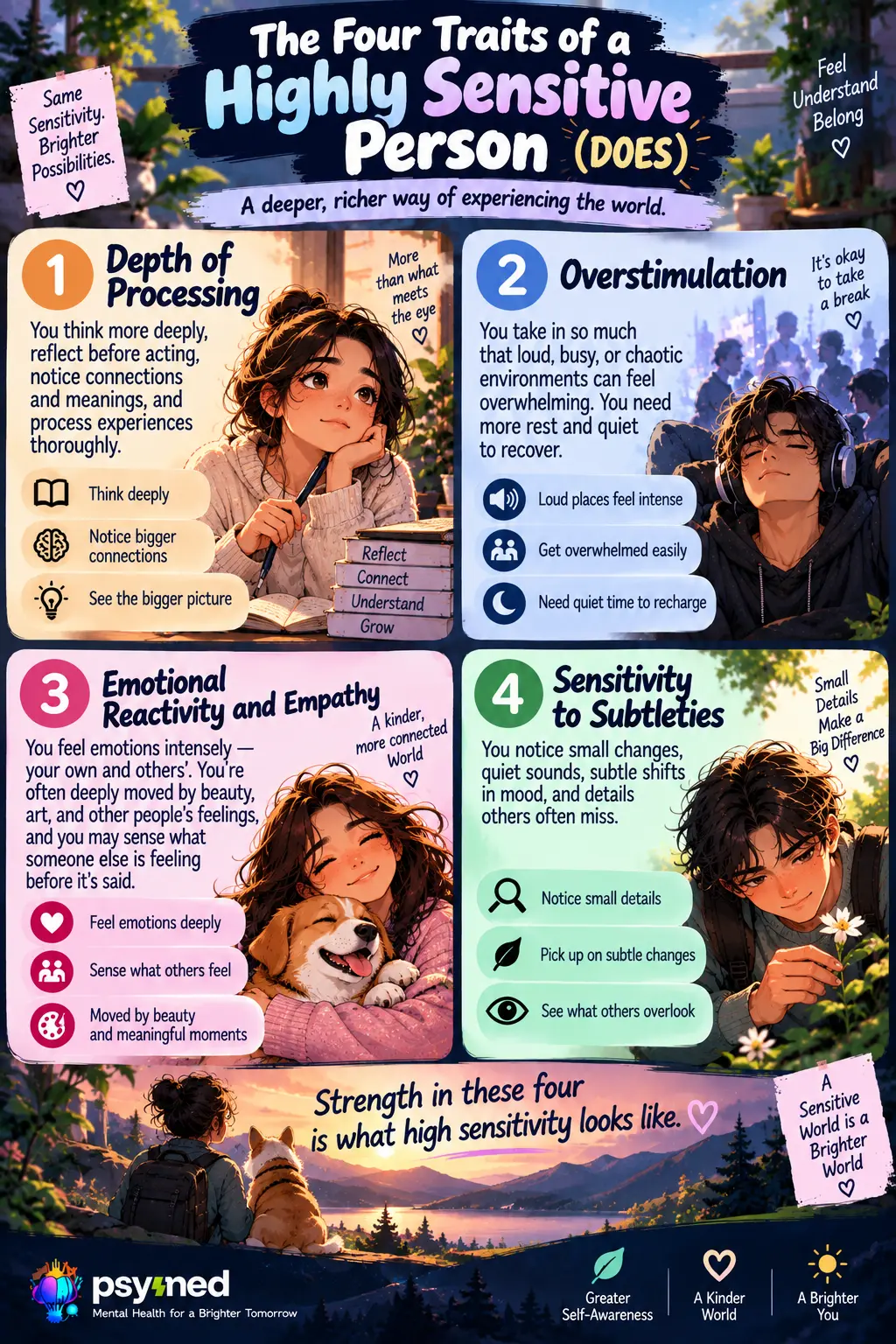
Strength in these four is what high sensitivity looks like.
SPS vs. Sensory Processing Disorder: An Important Difference
This is worth clearing up, because the similar names cause real confusion: Sensory Processing Sensitivity (SPS) and Sensory Processing Disorder (SPD) are not the same thing. SPS, the trait this test measures, is unusually good, deep sensory processing — a highly sensitive person notices and integrates subtleties skillfully, and their sensitivity is a normal temperament trait, not a dysfunction. SPD, by contrast, is a neurological difficulty integrating sensory input — the brain struggles to organize and respond to sensory information appropriately — and it’s most often discussed in the context of children and of autism.
Put simply: an HSP’s nervous system works well and just takes in more; a person with SPD has a genuine difficulty processing what comes in. The two can look similar from the outside (both may involve feeling overwhelmed by noise or textures), but they’re fundamentally different. SPS also overlaps behaviorally with autism and ADHD — all three can involve overstimulation — but high sensitivity is a distinct trait, not a neurodevelopmental condition. If your sensory experiences feel more like a difficulty processing input than a tendency to notice and feel deeply, our Autism Test may be more relevant.
Signs You’re a Highly Sensitive Person
High sensitivity shows up as a consistent pattern across the four DOES areas — in how deeply you process, how easily you’re overwhelmed, how intensely you feel, and how much you notice. As you read these signs, see how many ring true. The more that resonate, the more likely you’re high in the trait — and remember, this is a way of being wired, not a flaw.
You process everything deeply
You reflect on experiences thoroughly, think before you act, and notice layers, meanings, and connections others skip past. You may need time to absorb things, and you dislike being rushed into decisions.
You get overstimulated easily
Loud, busy, bright, or chaotic environments wear you out faster than they do most people, and after a lot of input — a crowded event, a demanding day — you feel a strong need to retreat to quiet and recover. This is the main challenge of being highly sensitive.
You feel emotions intensely
Your feelings run deep and strong — joy, sadness, and everything in between — and you’re easily moved by beauty, music, art, or a touching moment. You may cry more readily, or feel things long after others have moved on.
You’re highly empathetic and attuned to others
You pick up on other people’s emotions quickly, often sensing how someone feels before they say anything, and you can absorb the moods around you. This deep empathy is a gift, though it can leave you drained by others’ feelings.
You notice subtle details others miss
Small changes register with you — a faint sound, a shift in someone’s tone, a rearranged room, a subtle smell or texture. Your fine-tuned awareness catches things that pass most people by.
You’re deeply affected by others’ distress and by conflict
Violence, cruelty, unfairness, or even tense conflict can distress you strongly, and you may avoid disturbing news, films, or confrontation because you feel them so intensely. Your nervous system reacts powerfully to these.
You need more downtime than most
You require regular quiet, solitude, and rest to recharge — more than the people around you seem to — and you may turn down activities, even enjoyable ones, to protect your energy. This isn’t antisocial; it’s how you restore.
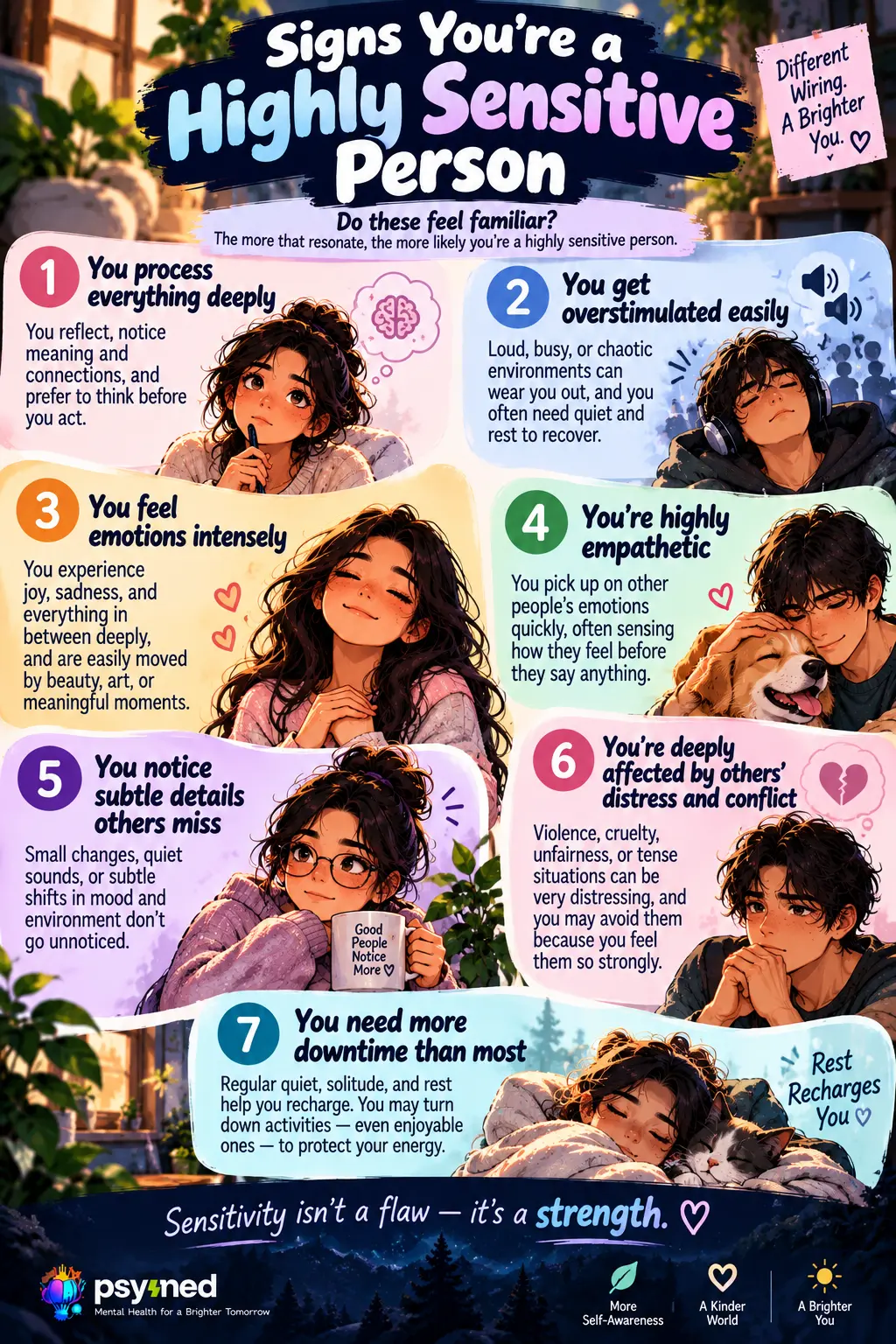
If many of these ring true, you’re likely a highly sensitive person — which is a genuinely valuable way to be. Understanding it lets you build a life that honors your wiring instead of fighting it.
How This Sensory Processing Sensitivity Test Works
This test has 15 statements about how you experience the world — across depth of processing, overstimulation, emotional reactivity and empathy, and noticing subtleties. For each, choose how much you agree, thinking about how you generally are rather than one unusual moment:
- Strongly Disagree = 0
- Disagree = 1
- Neutral = 2
- Agree = 3
- Strongly Agree = 4
Your answers add up to a score from 0 to 60, reflecting how high you are in Sensory Processing Sensitivity. A higher score means a more sensitive nervous system — which, again, is neither good nor bad, just a way of being wired. Answer honestly rather than how you think you “should”; there are no wrong answers here. Your result is private.
Understanding Your Results
Your score reflects how high you are in Sensory Processing Sensitivity — but read every level as a description of your temperament, not a grade. Sensitivity is a spectrum, and each point on it comes with its own strengths and needs.
| Score | Level | What It Means |
|---|---|---|
| 46 – 60 | Very Highly Sensitive | You’re very high in the trait — you process deeply, feel intensely, and need real downtime. |
| 31 – 45 | Highly Sensitive | You’re a highly sensitive person, with the depth, empathy, and overstimulation that come with it. |
| 16 – 30 | Moderately Sensitive | You have some sensitive traits but aren’t strongly highly sensitive — a common middle ground. |
| 0 – 15 | Low Sensitivity | You’re low in the trait — you tend to be less affected by stimulation and process more quickly. |
Thriving as a Highly Sensitive Person
If you scored high, the goal isn’t to change your sensitivity — it’s to work with it, since the trait itself is largely fixed but how you manage it makes all the difference. A few things help highly sensitive people flourish.
- Manage overstimulation proactively: Since overstimulation is the main challenge, build recovery into your life: regular quiet time, breaks during busy days, calmer environments where you can choose them, and limits on input (news, screens, noise) when you’re already full.
- Protect your downtime without guilt: Needing more rest and solitude than others isn’t a weakness or being antisocial — it’s how your nervous system restores, and honoring it prevents burnout.
- Set emotional boundaries: Because you absorb others’ feelings, learning to distinguish your emotions from theirs, and to say no, protects you from being drained.
- Reframe sensitivity as strength: Your depth, empathy, creativity, and perceptiveness are genuine gifts — many HSPs thrive in roles and relationships that value exactly these qualities.
- Care for your nervous system: Good sleep, time in nature, gentle movement, and managing stress all help a sensitive system stay regulated.
High sensitivity can be exhausting in a loud, fast world — but understood and supported, it’s a genuinely rich way to live. (Because chronic overstimulation can tip into stress or low mood, our Burnout Test and Anxiety Test may be worth a look if you’ve been feeling depleted.)
Frequently Asked Questions
Is being highly sensitive a disorder?
No. Sensory Processing Sensitivity is a normal personality trait, not a disorder, a mental illness, or something that needs to be diagnosed, treated, or cured. It’s a natural, inherited variation in how the nervous system works, found in an estimated 15 to 30% of people (and in many animal species). Highly sensitive people simply process stimuli more deeply and react more strongly, which brings both strengths (empathy, depth, perceptiveness) and challenges (overstimulation).
It’s important not to pathologize the trait — being highly sensitive isn’t a problem to be fixed. That said, because chronic overstimulation can contribute to stress, anxiety, or burnout, some HSPs do benefit from support in managing those effects, but that’s about managing the environment and self-care, not “curing” the sensitivity.
What’s the difference between SPS and Sensory Processing Disorder?
They sound alike but are genuinely different. Sensory Processing Sensitivity (SPS) — the trait behind the Highly Sensitive Person — is unusually good, deep sensory processing: a highly sensitive person notices subtleties and processes information thoroughly, and their sensitivity is a normal temperament trait. Sensory Processing Disorder (SPD) is a neurological difficulty in which the brain struggles to organize and respond appropriately to sensory input; it’s a genuine processing problem, most often discussed in children and in the context of autism.
In short, an HSP’s nervous system works well and just takes in more, while a person with SPD has real trouble processing what comes in. They can look similar from the outside (both may involve sensory overwhelm), but SPS is a trait and SPD is a disorder — two different things entirely.
Is being highly sensitive the same as being an introvert?
No, though they overlap and are often confused. Introversion is about where you get your energy (from solitude rather than social stimulation), while high sensitivity is about how deeply your nervous system processes all kinds of stimuli. They frequently occur together — and both involve needing downtime — but they’re distinct: research suggests around 30% of highly sensitive people are actually extraverts.
A highly sensitive extravert, for example, might love being around people yet still get overstimulated and need quiet to recover. You can be an introverted HSP, an extraverted HSP, a non-sensitive introvert, or a non-sensitive extravert. If you’d like to explore the energy dimension separately, our introvert test looks at that specifically.
Can you be highly sensitive and also have autism or ADHD?
Yes — and the relationship is genuinely nuanced. High sensitivity overlaps behaviorally with autism and ADHD (all three can involve overstimulation and strong reactions to sensory input), and a person can be a highly sensitive person and be autistic or have ADHD; the traits aren’t mutually exclusive. But SPS is a distinct temperament trait, not a neurodevelopmental condition, and the underlying mechanisms differ — high sensitivity involves deep processing of a well-functioning nervous system, whereas autism and ADHD involve different neurological differences.
Because they can look similar, it’s easy to mistake one for another, so if you suspect autism or ADHD specifically, those are worth exploring on their own. Our autism and ADHD tests can help you look at those separately from the sensitivity trait.
Related Tests
- Introvert Test — a related but separate trait (energy), often confused with sensitivity
- Autism Test — overlaps behaviorally with high sensitivity but is a distinct condition
- Emotional Intelligence (EQ) Test — empathy and emotional attunement, which HSPs are often strong in
- Burnout Test — HSPs are prone to overstimulation-related exhaustion
- Anxiety Test — overstimulation can feel a lot like anxiety; this helps tell the two apart
References
- Aron, E.N., & Aron, A. (1997). Sensory-processing sensitivity and its relation to introversion and emotionality. Journal of Personality and Social Psychology, 73(2), 345–368. [The original SPS construct and HSP Scale] pubmed.ncbi.nlm.nih.gov
- Aron, E.N., Aron, A., & Jagiellowicz, J. (2012). Sensory processing sensitivity: A review in the light of the evolution of biological responsivity. Personality and Social Psychology Review, 16(3), 262–282. [The DOES framework and evidence] pubmed.ncbi.nlm.nih.gov
- Greven, C.U., et al. (2019). Sensory Processing Sensitivity in the context of Environmental Sensitivity: A critical review and development of research agenda. Neuroscience & Biobehavioral Reviews, 98, 287–305. pubmed.ncbi.nlm.nih.gov
- Aron, E.N. The Highly Sensitive Person — SPS vs. SPD and the DOES framework. hsperson.com
Related Tests
See All Quiz →
Emotional and Trait Assessments · Personality
Introvert Test: Are You an Introvert, Extrovert, or Ambivert?
→
You may also like
See All Quiz →

Addiction and Impulse Control
Is Gambling Becoming a Problem? Take This Free Gambling Addiction Test (PGSI)
→