
Emotions & Self-Regulation · Self-reflection
Emotional Regulation Test: understand feelings and responses
This Emotional Regulation Test offers 15 original questions about noticing strong feelings, choosing a response and recovering afterward. Explore practical next steps without a diagnosis or a label about being good or bad with emotions.
This original educational questionnaire and its ranges have not been clinically validated. The total is not a diagnosis, probability, measure of personal worth, or a way to rule out a health concern.
-
YOUR EXPERIENCE15 original questionsReflect on the past two weeks, not your whole identity.
-
A BROADER VIEWMore than angerConsider sadness, worry, frustration and other strong feelings.
-
CLEAR LIMITSEducational feedbackNo diagnosis, validated cutoff or clinical skill score.
The self-check
Take the Emotional Regulation Test
For adults aged 18 and over. Think about the past two weeks and how often each statement described you. Consider situations that actually occurred rather than imagining how you should respond. Choose the closest answer. You may stop at any time. This is an educational self-check, not a clinical assessment.
Your result
How the reflection ranges work
- 0–15 Fewer difficulties reported
- 16–30 Some difficulties reported
- 31–45 Frequent difficulties reported
- 46–60 Many difficulties reported
This original educational questionnaire and its ranges have not been clinically validated. The total is not a diagnosis, probability, measure of personal worth, or a way to rule out a health concern.
A count of reflection questions, not a diagnostic threshold.
The short answer
What is emotional regulation?
Emotional regulation means influencing how an emotion unfolds and how you respond to it. It includes noticing feelings, making sense of them and choosing actions that fit the situation. Regulation is broader than suppressing emotion or trying never to feel upset.
Someone might notice disappointment, pause before sending a message and explain a need later. Another person may need quiet, movement or support before a difficult conversation. What helps depends on the person and setting; a single technique is not always the right choice. This self-check looks at reported difficulties across these experiences, not at a validated level of emotional skill.
An emotion can be understandable while an action still needs to change. You can acknowledge anger and set a boundary without using the feeling to excuse hurting another person. In an unsafe situation, prioritize safety rather than trying to regulate your way through it.
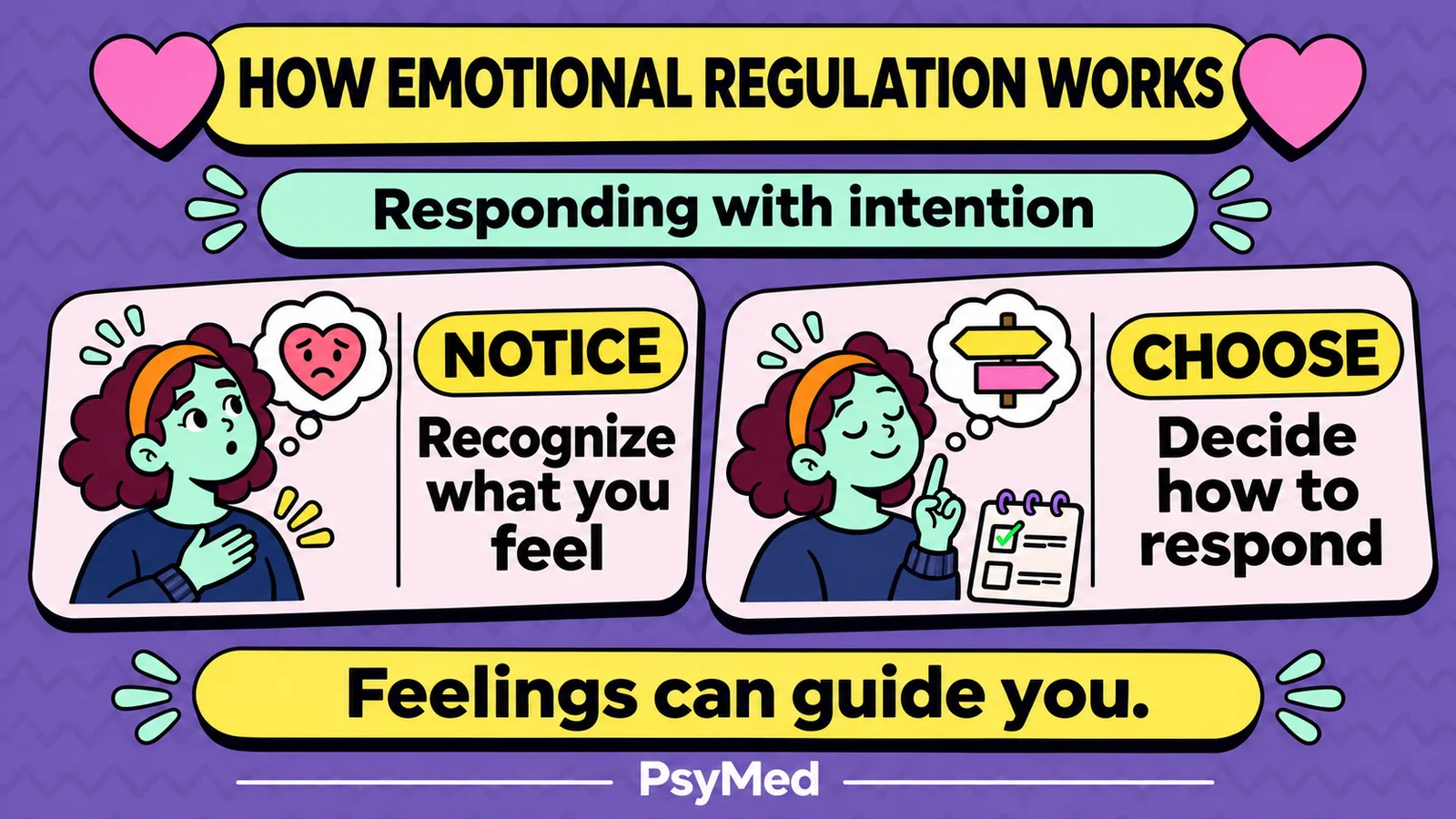
The American Psychological Association describes emotion regulation in terms of modulating emotions, including their intensity or duration. That definition does not mean eliminating feelings.
View sourceUnderstand the themes
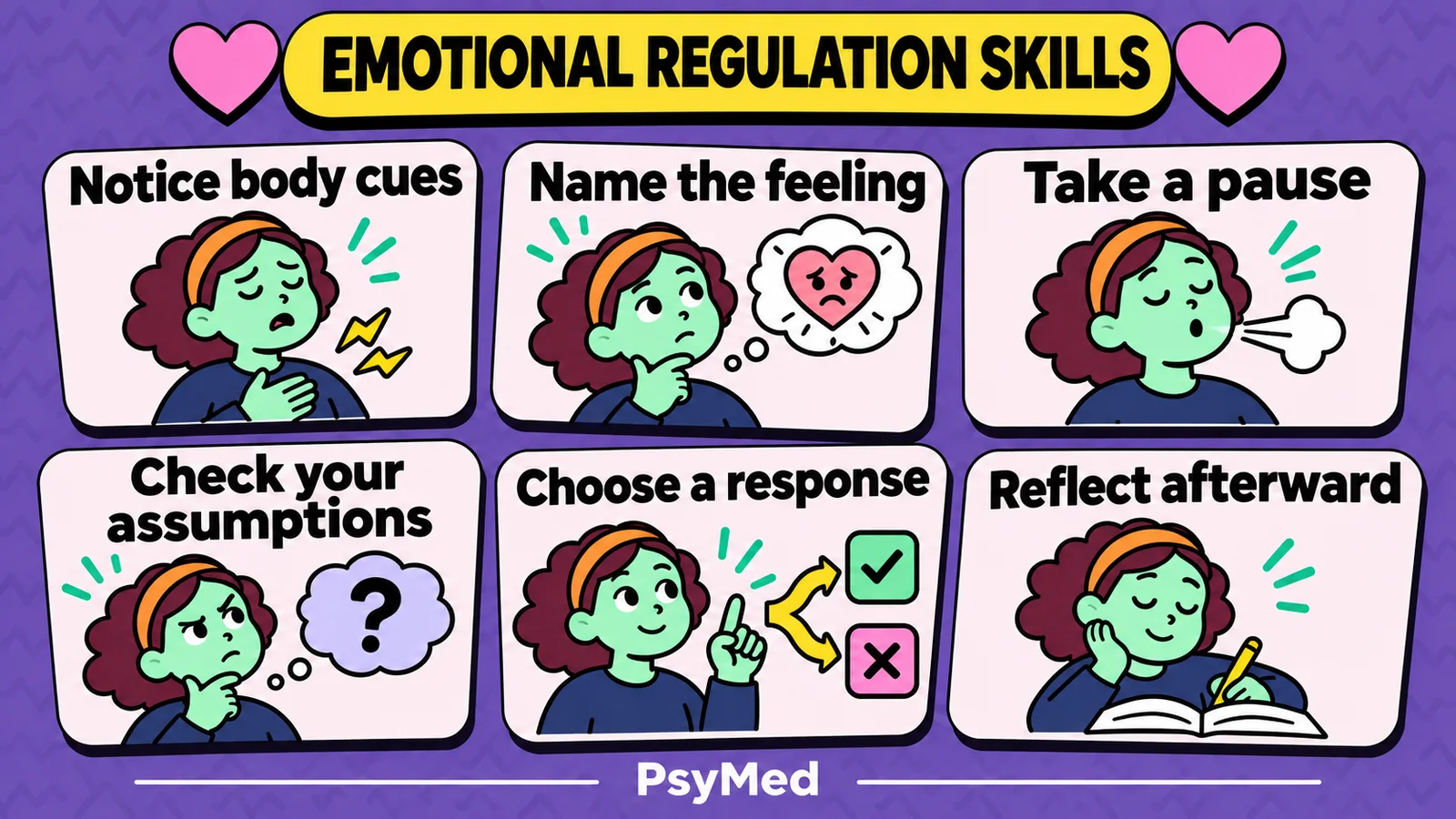
Six reflection themes behind the questions
These are teaching themes for organizing the items, not separate validated scales or a checklist of disorders.
Recognizing the feeling
You may notice distress before you have words for it. Describe a recent moment when you knew something felt wrong but could not identify the feeling. The Alexithymia Test explores that narrower question.
Making room for emotion
A feeling may bring a second reaction: judging yourself for having it. Reflect on whether that judgment makes it harder to choose what to do next, rather than treating emotion itself as failure.
Pausing before responding
Consider whether you can create a workable pause before a message, decision or conversation. This is an observation prompt, not a promise that pausing will solve every situation.
Responding flexibly
One response can help in one setting and get in the way in another. Notice whether you can change approach when your first attempt is not helping.
Returning to what matters
Strong feelings may interrupt ordinary tasks. Describe which activities become difficult and what support makes it possible to return, without demanding instant productivity.
Recovering after a difficult moment
How an experience settles matters alongside its intensity. Notice what happens afterward: whether attention returns, a conversation can be repaired or support is still needed.
Emotional regulation, suppression and anger compared
These concepts overlap, but they ask different questions. None can be established from a total on this page.
| Concept | What it concerns | A useful reflection |
|---|---|---|
| Emotional regulation | How feelings unfold and how a person responds across emotions. | What response fits this situation and my needs? |
| Expressive suppression | Holding back the outward expression of a feeling. | Is holding back useful or necessary here, and what happens afterward? |
| Irritability | Becoming frustrated or annoyed readily. | How easily am I bothered in everyday situations? |
| Anger patterns | The frequency, intensity, expression and aftermath of anger. | Would a focused anger reflection address my concern better? |
Interpretation and context
How to interpret your emotional regulation result
Use the result to organize a conversation about real situations. A score cannot establish the cause, duration, diagnosis, or support you need.
- 01 01
Read the situations behind the number
Choose a statement you endorsed and describe an actual example. The total cannot show whether several difficulties happened in one stressful setting or across much of your week.
- 02 02
Consider both demands and responses
Look at workload, safety, sleep, health and available support. A difficulty is not automatically a lack of effort or a fixed feature of your personality.
- 03 03
Use impact to guide support
If emotions or reactions repeatedly disrupt work, relationships or basic care, discuss that impact with a qualified professional. You do not need a high score to ask for help.
The four ranges are editorial summaries of this item set. They divide the reachable totals for readability; there is no established clinical boundary between them. Two people with the same total may have very different experiences. No subscale, percentile or diagnostic probability is calculated.
Context matters
What can make responses harder to manage?
These are areas to discuss, not causes assigned by this test. The questions do not determine whether any medical or mental health condition is present.
Daily demands and recovery
A packed schedule can leave little room to recover. NIMH self-care guidance includes sleep, priorities and supportive contact. The Insomnia Test addresses sleep concerns separately.
Learning and environment
What feels safe to express can vary between families, cultures, workplaces and relationships. Reflect on your actual options; do not assume that visible emotion or a quiet response has one meaning.
Health and ongoing distress
When difficulties persist or worsen, a clinician can consider your wider health and circumstances. This page cannot distinguish stress, a health problem or a longer-standing emotional difficulty.
Useful support
Support for working with strong feelings
Support can focus on a particular situation or a broader pattern. A score cannot select a therapy or tell you whether medication is needed.
- 01 / START SMALL
Notice and describe one moment
Write the situation, the feeling you noticed and the action you took. Keep the note brief and optional; stop if recording experiences becomes unhelpful or increases distress.
- 02 / PRACTICE
Try a safe response deliberately
You might pause before replying, name a need or arrange a time to return to a conversation. Choose something possible in your setting and judge it by whether it helps daily life, not whether it removes all emotion.
- 03 / ASK FOR HELP
Work with a qualified professional
NIMH describes psychotherapy as helping people work with troubling emotions, thoughts and behaviors. A professional can tailor support to your needs and assess concerns a self-check cannot explain.
NIMH information about psychotherapy explains why support is tailored to a person rather than a questionnaire total.
Practical next steps
Turn one observation into a practical next step
Choose a small, safe action based on daily life rather than a target quiz score.
- 01
Choose one example
Pick a recent situation you would like to handle differently. Write what happened without turning it into a verdict about your character.
- 02
Plan one workable response
Identify a pause, practical change or person you can contact. If another person is involved, make the plan respectful and realistic for both of you.
- 03
Review the effect
Ask whether your chosen response improved the situation or helped you act safely. If distress continues or worsens, seek support instead of repeatedly retaking the quiz.
If you feel unable to keep yourself or someone else safe, treat that as the urgent thing rather than finishing this page. In the US, call or text 988 for the Suicide & Crisis Lifeline, free, confidential and available 24/7. In the UK, Samaritans are free on 116 123, 24/7. Anywhere else, findahelpline.com lists verified crisis lines by country. If anyone is in immediate danger, call your local emergency number. Sudden confusion or a marked change in alertness needs urgent medical attention. Do not wait for a particular quiz score.
Good questions to ask
Emotional Regulation Test FAQs
Direct answers about the purpose, scoring, limits and next steps.
It summarizes how often you reported 15 original experiences involving feelings and responses over the past two weeks. The themes are educational; the questionnaire has not been validated as a measure of regulatory ability.
No. A high total means more frequent endorsement of this particular set of statements. It cannot establish a diagnosis, the cause of your responses or whether the same pattern occurs outside the chosen time frame.
No. Holding back expression is one possible response. Regulation is broader and can include noticing, expressing, adjusting or allowing a feeling according to the situation. There is no demand to appear cheerful or calm all the time.
No. This page uses original PsyMed educational items, not the Emotion Regulation Questionnaire or Difficulties in Emotion Regulation Scale. Their scores, research findings and interpretation rules do not transfer to this self-check.
It gives respondents a consistent, recent period to think about. It is an editorial choice for these items, not a diagnostic duration criterion or evidence that this version is validated.
Anger tests focus on anger. This page asks about responses to a wider range of strong emotions. You can have difficulties with worry or sadness without having frequent anger outbursts.
This draft was written for adults reflecting on themselves. It is not a child assessment or a way to label somebody else from outside observations.
The test is not validated for monitoring clinical change. If you repeat it, changes may reflect context, memory or how you read the questions. Use a clinician-agreed plan and real-life goals to judge progress.
Seek professional support for persistent, worsening or disruptive difficulties, or if something important was not captured by the questions. Seek urgent local help when safety is at risk; sudden confusion or a marked change in alertness needs urgent medical attention.
Editorial transparency
Sources and review information
Prepared by the PsyMed Editorial Team. This is an educational page, not a clinical assessment, and no licensed clinical reviewer is claimed. Sources checked: November 17, 2026. The stored questions are original PsyMed educational items; the score ranges are editorial summaries. This questionnaire does not establish validation. Read how we build our tests and who we are.
One useful observation
Start with one feeling you can describe.
You do not need to solve every reaction at once. Start with a concrete example, a safe next step and support that respects your circumstances.
Take the self-check