

Multidimensional Anger Test: What’s Your Anger Style?
Free 18-question Multidimensional Anger Test. Profiles five dimensions of anger: trait, state, expression, suppression and control. Instant results.
Published Updated
Anger is not a single thing. The person who explodes and immediately feels relief experiences anger very differently from the person who swallows it for days and carries the tension in their shoulders. Someone who replays every slight at 2 AM has a different anger pattern from someone who reacts intensely in the moment and forgets about it an hour later. What you do with your anger, where it goes, and how much control you have over it — these vary significantly from person to person.
This is what the Multidimensional Anger Test measures. Not simply “how angry are you” — but how anger shows up across five distinct psychological dimensions: how easily you become angry (trait anger), how intensely you react in triggering situations (state anger), how your anger comes out toward others (expression), whether you hold it in (suppression), and how well you can regulate and calm it (control).
Understanding your anger profile across all five dimensions gives you something more useful than a single number — it gives you a map of where your anger pattern is working and where it isn’t. 18 questions. Based on how you typically are. Results are instant and private.
What Is Multidimensional Anger?
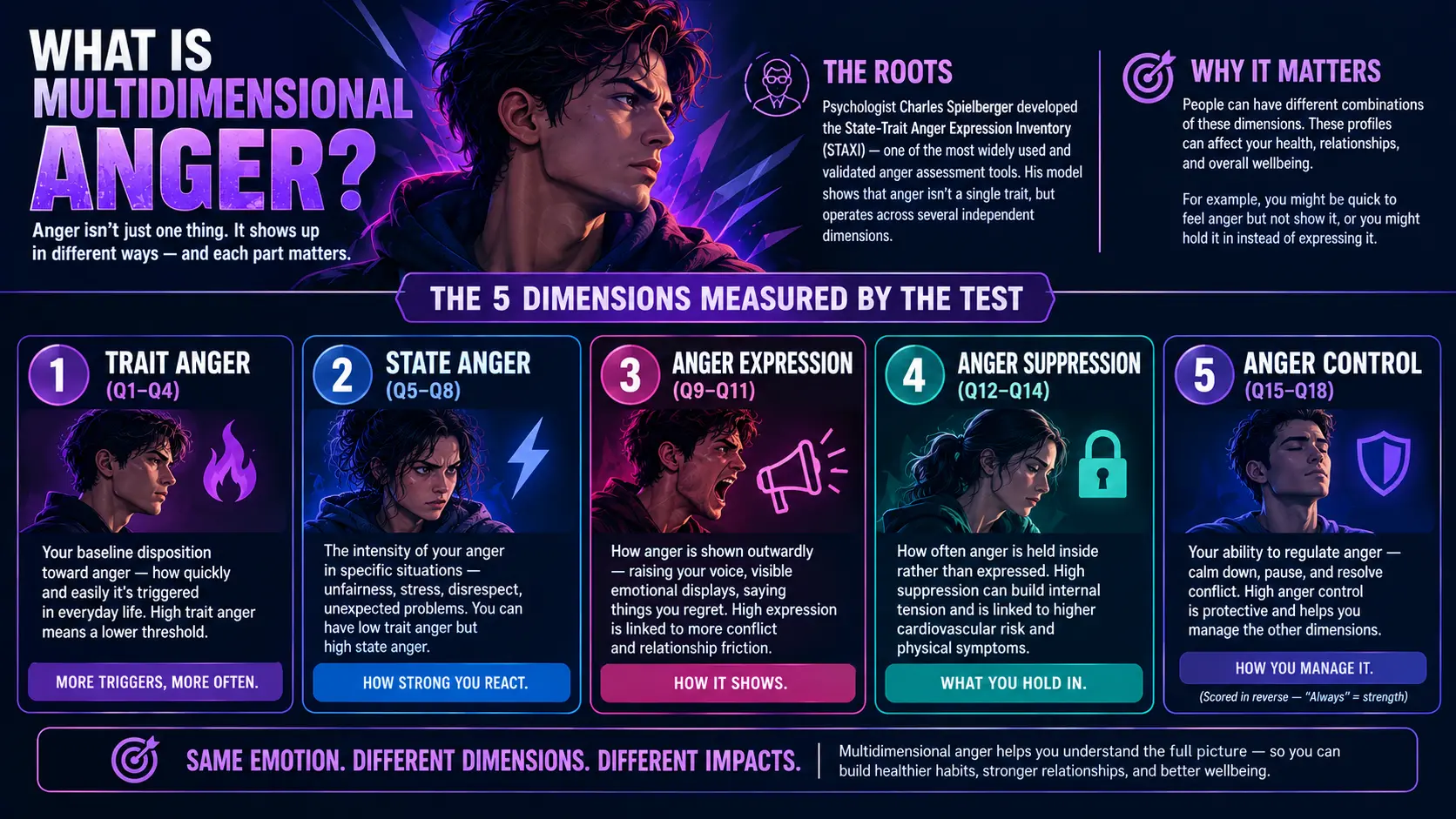
The concept of multidimensional anger comes from psychologist Charles Spielberger, who developed the State-Trait Anger Expression Inventory (STAXI) — one of the most widely used and validated anger assessment tools in clinical psychology. Spielberger’s model challenged the assumption that anger is a single trait, demonstrating instead that it operates across several distinct dimensions that can function independently.
A person might score high on trait anger (irritating easily) but low on anger expression (they don’t show it). Another person might have low trait anger but high anger suppression (when anger does arise, they swallow it completely). A third might have strong anger control skills that consistently offset high state reactivity. These combinations produce meaningfully different anger profiles — and meaningfully different patterns of impact on health, relationships, and wellbeing.
The five dimensions this test measures are:
Trait Anger (Q1–Q4)
Your baseline disposition toward anger — how quickly and easily anger is triggered in everyday life, regardless of the specific situation. High trait anger means a lower threshold: more things provoke anger, more often, in more contexts. It reflects how anger-prone you are as a general personality characteristic rather than a response to specific events.
State Anger (Q5–Q8)
The intensity of your anger response in specific triggering situations — unfairness, stress, disrespect, unexpected problems. State anger captures how strongly you react when provocation occurs, as distinct from how often provocation finds you. You can have low trait anger (generally slow to anger) but intense state anger (very strong when triggered).
Anger Expression (Q9–Q11)
How anger is shown outwardly toward others — raising your voice, visible emotional displays, saying things you regret. High anger expression means anger comes out directly and is observable. This dimension is associated with interpersonal conflict and relationship friction, but it also means anger is not being suppressed, which has its own clinical implications.
Anger Suppression (Q12–Q14)
How often is anger held inside rather than expressed? High suppression means anger is felt but consistently not disclosed or addressed — it builds as internal tension, resentment, and rumination. Research consistently links chronic anger suppression to elevated cardiovascular risk, passive-aggressive behavior, and psychosomatic symptoms, including headaches, jaw tension, and fatigue.
Anger Control (Q15–Q18)
Your ability to regulate anger — to calm down, pause before reacting, and resolve conflict without being driven by the emotional state. High anger control is protective across all other dimensions. It is the skill set that determines whether trait anger, state anger, and expression produce damage or are managed effectively. In this test, the anger control questions are scored in reverse — answering “Always” to these questions reflects strength, not concern.
Why Your Anger Style Matters
Most people understand that explosive anger is a problem. What gets less attention is that the other patterns — suppression, rumination, chronic low-level irritability — carry their own significant costs.
Research from the American Psychological Association and multiple clinical studies shows that chronic anger suppression is associated with elevated blood pressure and cardiovascular risk, persistent muscle tension, depression and anxiety, and passive-aggressive patterns in relationships. The person who never expresses anger is not necessarily the emotionally healthy one — they may simply be paying for it differently.
Chronic trait anger (the low-threshold, always-on-edge pattern) is associated with higher cortisol levels, impaired immune function, and significantly elevated risk of heart disease — independent of whether anger is expressed or suppressed. The physiological cost of sustained anger arousal is real, regardless of how the anger manifests behaviorally.
Understanding which dimensions are driving your pattern is the foundation for changing it. Someone with high suppression needs different strategies from someone with high expression. Someone with low anger control benefits from different interventions than someone who already controls well but suppresses instead. This test gives you that profile.
How This Quiz Works
This Multidimensional Anger Test measures your anger pattern across all five STAXI-inspired dimensions using 18 questions. The first 14 questions (trait anger, state anger, expression, and suppression) are scored from Never (0) to Very Often (4) — higher scores reflect more of that pattern. The final four questions (anger control, Q15–Q18) are reverse-scored — answering “Very Often” to these questions means better anger control, which lowers your overall score.
Answer based on how you typically are — not your best day or your worst episode, but your consistent pattern across different situations and settings.
Never = 0 | Rarely = 1 | Sometimes = 2 | Often = 3 | Very Often = 4
Total range: 0–72. A lower score indicates better anger regulation overall. Your total measures how much difficulty anger is causing, not which kind — two people with the same total can have very different patterns, one quick to show anger and one holding it in. To read the kind, compare your five dimension blocks below. The results include your overall pattern plus specific insight into which of the five dimensions is most prominent for you.
Understanding Your Multidimensional Anger Test Score
| Score Range | Category | What It Suggests |
|---|---|---|
| 0 – 20 | Balanced Anger Regulation | Anger is generally well managed across dimensions. You experience normal frustration without significant pattern problems in expression, suppression, or control. |
| 21 – 40 | Mild Anger Difficulty | Anger is showing up more often than is comfortable, but is not yet disrupting daily life. Which dimensions are elevated determines the pattern — read your dimension profile below. Awareness and skill-building make a real difference at this level. |
| 41 – 55 | Moderate Anger Difficulty | Anger is taking up real space and is likely affecting relationships, physical health, or both. Your dimension profile shows whether the driver is quick triggering, outward expression, suppression, or difficulty calming down. |
| 56 – 72 | Significant Anger Difficulty | Anger is a strong and frequent force across multiple dimensions. Expression, intensity, and frequency are all elevated. Professional support is strongly recommended. |
What Your Anger Dimension Profile Means
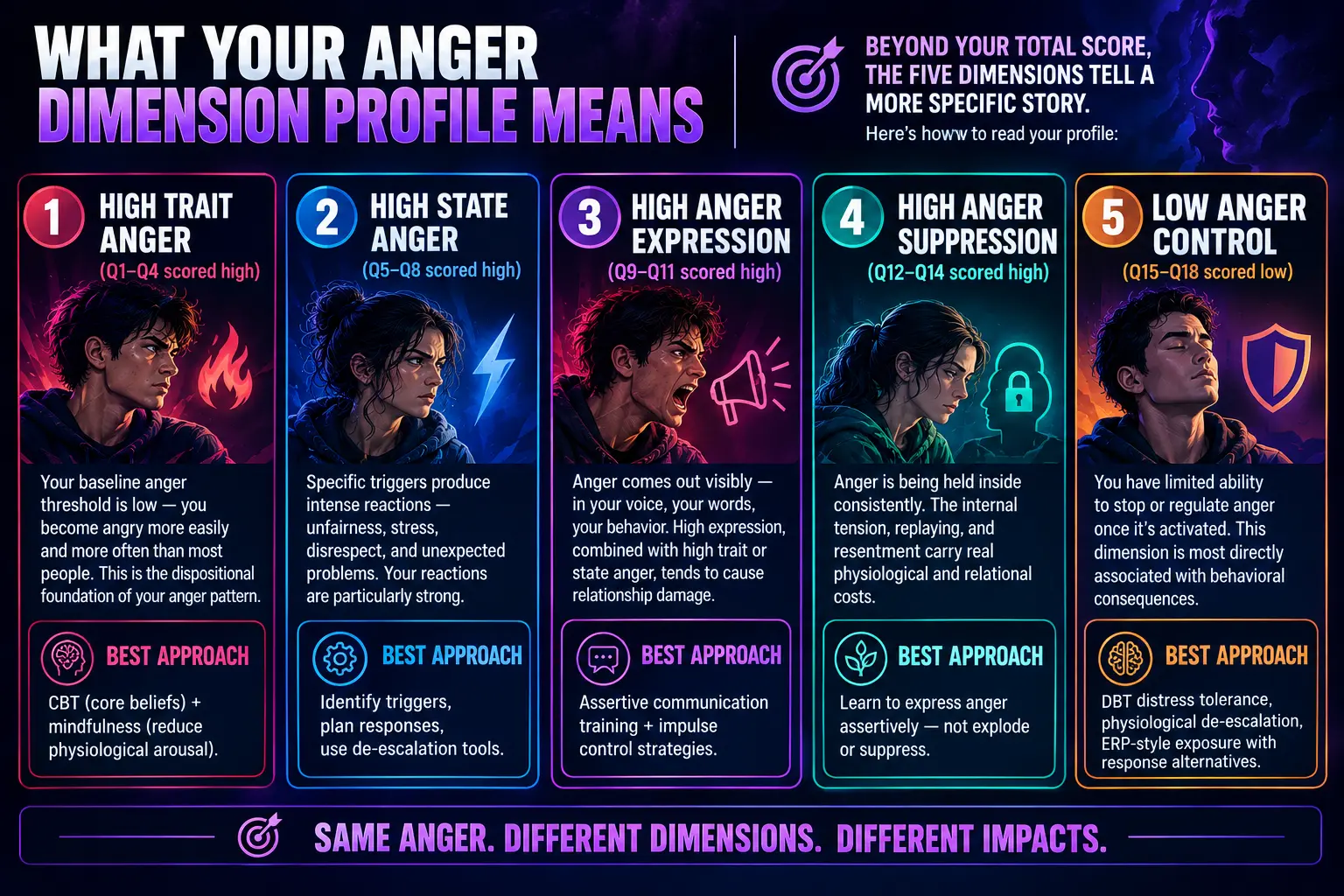
Beyond your total score, the five dimensions themselves tell a more specific story. Here is how to read your profile:
High Trait Anger (Q1–Q4 scored high)
Your baseline anger threshold is low — you become angry more easily and more often than most people. This is the dispositional foundation of your anger pattern. Trait anger responds particularly well to CBT approaches that address core beliefs about fairness, control, and entitlement, as well as to mindfulness practices that reduce baseline physiological arousal.
High State Anger (Q5–Q8 scored high)
Specific triggering situations produce intense reactions — unfairness, stress, disrespect, and unexpected problems. Your reactions in these situations are particularly strong. This dimension responds well to situation-specific coping strategies: identifying your personal high-risk triggers, developing planned responses for those situations, and using physiological de-escalation tools when those situations arise.
High Anger Expression (Q9–Q11 scored high)
Anger comes out visibly — in your voice, your words, your behavior. Expression isn’t inherently problematic — unexpressed anger has its own costs — but high expression, combined with high trait or state anger, tends to cause relationship damage. Assertive communication training and impulse control strategies are the most effective targeted interventions.
High Anger Suppression (Q12–Q14 scored high)
Anger is being held inside consistently. The internal tension, replaying, and resentment that come with this pattern carry real physiological and relational costs. The most effective intervention is learning to express anger assertively rather than either exploding or suppressing — building the capacity to communicate what you feel without it feeling dangerous.
Low Anger Control (Q15–Q18 scored low, meaning you answered Never/Rarely to control questions)
You have limited ability to stop or regulate anger once it’s activated. This is the dimension most directly associated with behavioral consequences of anger. DBT distress tolerance skills, physiological de-escalation techniques, and structured ERP-style exposure to triggering situations with practiced response alternatives are the most effective interventions.
Treatment for Anger — What Actually Works
Cognitive Behavioral Therapy (CBT) for anger
The gold standard. CBT targets the thought distortions that amplify anger — catastrophizing (“this is completely unacceptable”), mind-reading (“they did that on purpose”), and rigid rules (“things must be fair”). It also addresses behavioral patterns that maintain anger and replaces them with more effective responses. A 2022 clinical trial found that CBT significantly reduces anger frequency and intensity in adults with anger disorders.
Dialectical Behavior Therapy (DBT)
Particularly effective for the suppression of high-intensity patterns. DBT’s TIPP skills (Temperature, Intense exercise, Paced breathing, Progressive muscle relaxation) provide immediate physiological de-escalation. The emotion regulation module directly addresses the difficulty of calming down that characterizes high-state anger profiles.
Mindfulness-based approaches
Work specifically on the gap between stimulus and response — building the capacity to observe anger as it arises without immediately acting on it. Particularly effective for the rumination pattern associated with high suppression scores.
Medication was indicated
SSRIs have shown efficacy for impulsive aggression. Mood stabilizers are effective where anger patterns are driven by bipolar disorder or other mood conditions. Medication should always be considered alongside, not instead of, therapy.
Frequently Asked Questions
What does the Multidimensional Anger Test measure?
The Multidimensional Anger Test measures your anger pattern across five distinct psychological dimensions inspired by Spielberger’s State-Trait Anger Expression Inventory (STAXI): trait anger (your baseline disposition to become angry), state anger (intensity of anger in specific situations), anger expression (how anger is shown outwardly), anger suppression (how often anger is held inside), and anger control (ability to regulate and calm anger). The test produces an overall score from 0–72, with lower scores indicating better anger regulation overall.
What is the difference between the Multidimensional Anger Test and the Anger Management Test?
The Multidimensional Anger Test answers “What is my anger style?” — it maps how you experience and express anger across five psychological dimensions and identifies which specific patterns are most prominent for you. The Anger Management Test answers the question “Is my anger a problem?” — it assesses whether anger occurs at a frequency, intensity, or level of control that warrants professional attention. Many people find it useful to take both: this test tells you the pattern, and the Anger Management Test tells you the severity.
Is anger suppression worse than anger expression?
Both patterns carry costs — they’re just different costs. Anger expression (particularly aggressive expression) directly damages relationships and can have legal and professional consequences. Anger suppression maintains physiological arousal, is associated with elevated cardiovascular risk, produces passive-aggressive behavior in relationships, and eventually tends to leak out in disproportionate ways. Neither is inherently healthier. The goal — which anger-control skills support — is assertive expression: communicating anger in ways that are honest and direct, without being aggressive or suppressed.
Can my anger style change?
Yes — significantly, with the right approach. The five STAXI dimensions are relatively stable personality traits in the absence of intervention, but they are meaningfully modified by treatment. CBT has strong evidence for reducing trait anger and improving anger control. DBT skills reduce the intensity and duration of state anger reactions. Mindfulness practice reduces rumination associated with suppression. Anger style is not fixed — it develops through experience and changes with new experiences.
When should I be concerned about my anger score?
A score of 41 or above warrants taking your results to a mental health professional, particularly if the high scores are on the trait anger, state anger, or expression dimensions, alongside low anger control. A score of 56 or above indicates that anger is a significant feature of your emotional life with real impact across multiple areas — professional support is strongly recommended. If your anger has resulted in damaged relationships, professional consequences, or any incidents of physical aggression or property damage, please seek a professional evaluation regardless of your score.
Further reading
Anger style is shaped heavily by two broader traits — agreeableness and neuroticism. The free personality test measures both, alongside the other three dimensions. Your anger style reflects how you regulate emotion generally, which is one strand of emotional intelligence — measured there alongside self-awareness, motivation, empathy and social skills.
Related Tests
Your anger pattern rarely exists in isolation. These tests cover the conditions most commonly associated with anger or the dimensions measured here:
-
- Intermittent Explosive Disorder Test — if explosive outbursts are your primary pattern, and you want a DSM-5-TR-based screening for IED specifically
- Anxiety Test — elevated baseline anxiety significantly lowers anger threshold and amplifies state anger reactions
- Depression Test — irritability and low-level anger are underrecognized symptoms of depression, particularly in men
- PTSD Test — PTSD hypervigilance directly amplifies trait anger and state anger intensity
- ADHD Test — low frustration tolerance is a core ADHD feature that directly affects trait anger scores
- BPD Test — intense, rapidly shifting anger is a hallmark BPD feature that shows up across all five dimensions
- This test maps your anger profile — the style and dimensions of how you
experience anger. If instead you’re wondering whether your anger has become a
problem worth managing, our Anger Management Test looks at that specifically.
For more emotional regulation and impulse-control screenings, visit our Emotional and Trait Assessments collection.
References
- Spielberger, C.D. (1999). State-Trait Anger Expression Inventory-2 (STAXI-2): Professional Manual. Psychological Assessment Resources.
- Spielberger, C.D., et al. (1983). The State-Trait Anger Scale. Academic Press.
- American Psychological Association. (2023). Strategies for Controlling Your Anger. apa.org
- Harburg, E., et al. (2003). Expressive/suppressive anger-coping responses, gender, and types of mortality. Psychosomatic Medicine, 65(4), 588–597. PMID: 12883109
- McCloskey, M.S., et al. (2022). Cognitive behavioral therapy for intermittent explosive disorder: A randomized controlled trial. Journal of Consulting and Clinical Psychology, 90(2), 119–128. PMID: 34914451
- Positive Psychology. (2021). 15 Best Anger Management Assessments and Scales. positivepsychology.com
Related Tests
See All Quiz →

You may also like
See All Quiz →

Dissociation and Psychosis
Free Depersonalization Disorder Test (DPDR) – Do I Have Depersonalization-Derealization Disorder?
→