

Emotional and Trait Assessments
Are You a Psychopath? Take This Free Psychopath Test (PCL-R Based)
→
How emotionally intelligent am I? Take this free EQ test to measure your emotional intelligence across self-awareness, empathy, and social skills. Instant results.
Published Updated
Wondering “how emotionally intelligent am I?” is a great question to ask — and this free EQ test helps you answer it. Emotional intelligence (often called EQ) is your ability to recognize, understand, and manage emotions, both your own and other people’s, and it shapes your relationships, your decisions, and your well-being at least as much as raw IQ does. This quiz measures where you stand across the core skills of emotional intelligence and gives you an instant, private result.
Here’s the encouraging part, and it’s worth knowing before you start: unlike IQ, emotional intelligence is not fixed. It’s a set of skills that can be learned and strengthened at any age with practice and self-awareness. So wherever you land, your result is a snapshot of where you are now and a map of where you can grow — not a verdict. There’s no “bad” score here, only useful information.
Emotional intelligence is the capacity to perceive, understand, use, and manage emotions effectively — in yourself and in your interactions with others. The term was coined by psychologists Peter Salovey and John Mayer in 1990, who defined it as the ability to monitor your own and others’ feelings, tell them apart, and use that information to guide your thinking and actions. It was later popularized by psychologist Daniel Goleman, whose 1995 book argued that these emotional skills can matter as much as IQ for success and happiness in life.
What makes EQ so important is how broadly it shapes life. People with strong emotional intelligence tend to have healthier relationships, communicate and handle conflict more effectively, cope better with stress, make more balanced decisions, and lead more successfully — because so much of what happens between and within people is emotional. And crucially, emotional intelligence is distinct from both IQ and personality: it’s not about how smart you are or whether you’re introverted or extraverted, but about a specific set of skills for working with emotions. Those skills can be built, which is what makes measuring them worthwhile.
Goleman’s influential model breaks emotional intelligence into five core components — and this EQ test measures all five. Together they span the personal skills of understanding and managing yourself and the social skills of understanding and working with others.
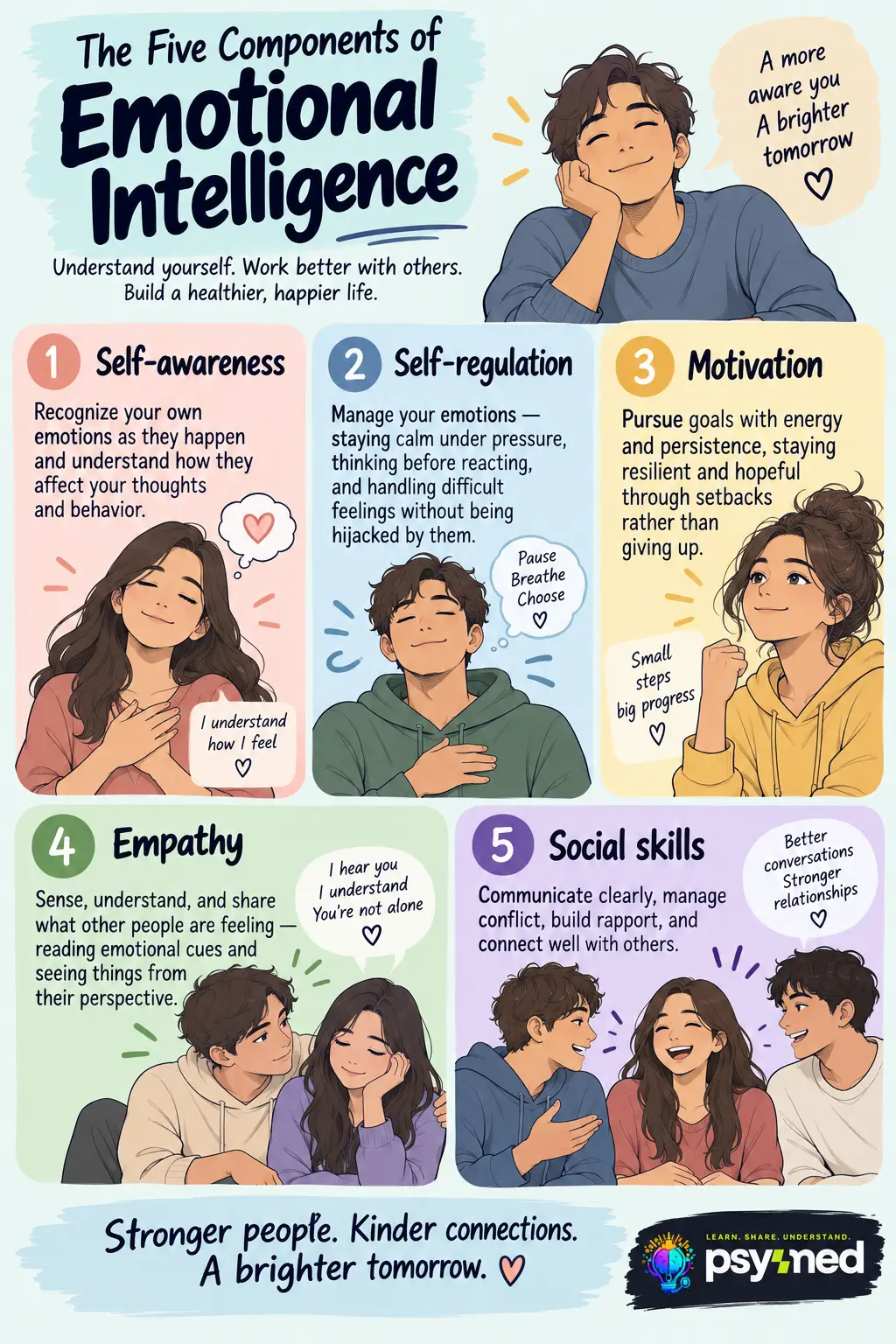
Strength in these five is what emotional intelligence looks like in practice.
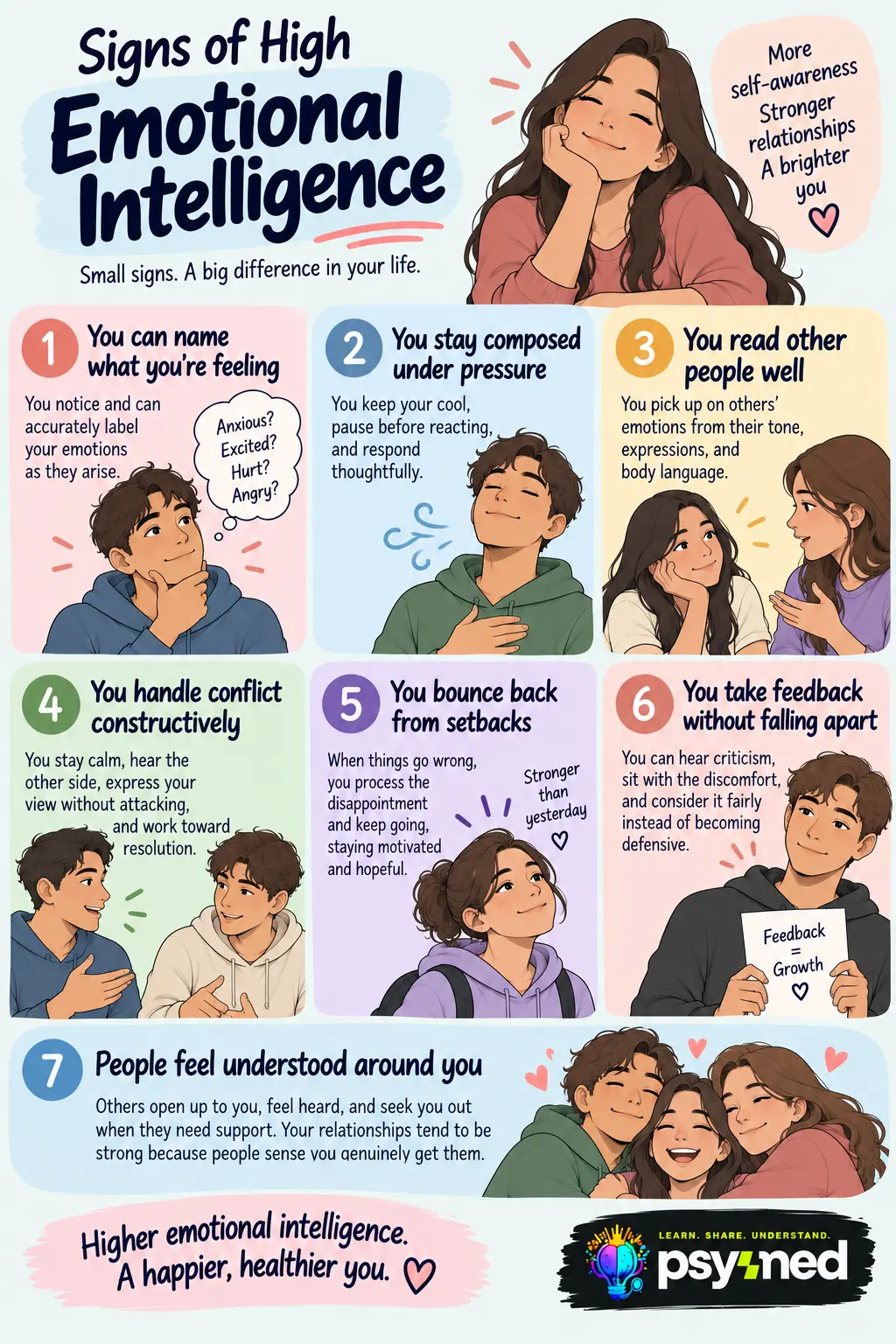
High emotional intelligence shows up in recognizable, everyday ways — in how you handle your own feelings and how you connect with others. As you read these signs, notice how many feel true for you; the more that resonate, the more emotionally intelligent you likely are. And remember, any of these can be strengthened with practice.
You notice and can accurately label your emotions as they arise — recognizing the difference between, say, anxiety and excitement, or hurt and anger. This self-awareness is the foundation of EQ, because you can’t manage or learn from an emotion you can’t identify.
When emotions run high, you can keep your cool, pause before reacting, and respond thoughtfully rather than being swept away by the feeling. You handle stress, frustration, and disappointment without letting them control your behavior.
You pick up on others’ emotions from their tone, expressions, and body language, often sensing how someone feels before they say it. This empathy lets you respond to what people actually need, not just what they explicitly ask for.
Disagreements don’t derail you. You can stay calm, hear the other side, express your own view without attacking, and work toward resolution — managing the emotional temperature of a tense conversation rather than escalating it.
When things go wrong, you can process the disappointment and keep going, staying motivated and hopeful rather than getting stuck. Emotional resilience helps you learn from difficulty instead of being defeated by it.
You can hear criticism, sit with the discomfort, and consider it fairly instead of becoming defensive or crushed. This reflects both self-regulation and a stable sense of self.
Others open up to you, feel heard by you, and seek you out when they need support. Your relationships tend to be strong because people sense you genuinely get them — the social payoff of empathy and good social skills combined.
If many of these ring true, you likely have well-developed emotional intelligence. If only some do, that’s completely normal — everyone is stronger in some areas than others, and every one of these skills can grow.
This test has 15 statements about how you typically experience and handle emotions — your own and other people’s — across all five components of emotional intelligence. For each, choose how much you agree, thinking about how you generally are rather than one unusual moment:
Strongly Disagree = 0 | Disagree = 1 | Neutral = 2 | Agree = 3 | Strongly Agree = 4
Your answers add up to a score from 0 to 60, reflecting your overall emotional intelligence across self-awareness, self-regulation, motivation, empathy, and social skills. A higher score indicates stronger EQ skills. Answer honestly rather than how you think you “should” — the point is a genuine picture you can actually grow from. Your result is private.
Your score places you in one of four levels of emotional intelligence — but read every one as a starting point, not a ceiling. Because EQ is a set of learnable skills, your result describes where you are now and points to where you can grow.
| Score | Level | What It Means |
|---|---|---|
| 46 – 60 | Exceptional EQ | Very strong emotional intelligence across the board — a real asset in life and relationships. |
| 31 – 45 | Strong EQ | Well-developed emotional intelligence, with clear strengths and a few areas to keep growing. |
| 16 – 30 | Growing EQ | A solid foundation with real room to develop — and EQ grows readily with practice. |
| 0 – 15 | Developing EQ | Early in developing these skills — the good news is every one of them can be built. |
Emotional intelligence grows through deliberate practice — and small, consistent habits build it more than any single big effort. Because it’s made of learnable skills, anyone can improve at any age. Here’s where to focus, following the five components.
Progress is gradual, but it compounds — and it improves your relationships, your resilience, and your wellbeing across the board.
On this test, higher scores reflect stronger emotional intelligence skills, with scores of 46 and above indicating exceptionally strong EQ and 31 to 45 indicating well-developed EQ. But it’s worth holding “good” loosely here. Unlike IQ, emotional intelligence isn’t ranked against a fixed population norm in everyday use, and because it’s made of learnable skills, your score is better understood as a picture of your current skills than a permanent grade. Most people have a mix — strong in some components, still developing in others. A “good” result is really one that gives you honest, useful insight into where your emotional strengths lie and where a bit of practice would help. Wherever you score, the skills can grow.
Yes — and this is one of the most encouraging things about EQ. Unlike IQ, which is relatively fixed, emotional intelligence is a set of skills that can be developed and strengthened throughout life with deliberate practice. Research supports this: people can meaningfully improve their self-awareness, emotional regulation, empathy, and social skills at any age. Improvement usually comes from small, consistent habits rather than dramatic change — things like noticing and naming your emotions, pausing before reacting, actively listening, and reflecting on your interactions.
Some people also work on EQ with a therapist or coach. So a lower score is never a life sentence; it simply reflects skills you haven’t practiced much yet, and those are exactly the skills that respond well to attention.
Neither is simply “more important” — they matter in different ways — but emotional intelligence is often underrated relative to IQ. Daniel Goleman popularized the idea that EQ can be at least as important as IQ for success and well-being, particularly in areas involving relationships, leadership, and personal happiness, where understanding and managing emotions is central. IQ tends to predict certain kinds of academic and technical performance, while EQ predicts how well people navigate the emotional and social dimensions of life and work.
The two are largely independent, so a person can be high in one and average in the other. For most people’s day-to-day happiness and relationships, developing emotional intelligence offers a lot of value — and unlike IQ, it’s something you can actively build.
Lower emotional intelligence tends to show up as difficulty in a few recognizable areas: struggling to identify or describe one’s own feelings, being easily overwhelmed or hijacked by emotions, reacting impulsively or defensively, having trouble reading how others feel, frequent misunderstandings or conflict in relationships, and difficulty taking feedback without becoming defensive or crushed.
It’s important to frame this without judgment, though — low EQ in some area usually just means those particular skills haven’t been developed yet, often for understandable reasons like upbringing or lack of practice. It isn’t a character flaw, and it’s very changeable. If identifying your own emotions is a specific and persistent struggle, that can relate to a trait called alexithymia, which our alexithymia test explores.
Not quite — empathy and sensitivity are part of emotional intelligence, but EQ is broader. Empathy (sensing and understanding others’ emotions) is one of the five components, but full emotional intelligence also includes self-awareness, self-regulation, motivation, and social skills. So you can be a very sensitive or empathetic person and still have areas of EQ that are less developed — for example, being deeply attuned to others but easily overwhelmed by your own emotions, or caring intensely but struggling to handle conflict. True emotional intelligence is the combination: not just feeling emotions strongly, but understanding and managing them effectively, in yourself and in your relationships. That balance is what the five components together capture.
Emotional intelligence shows up most clearly in your closest relationships. If you want to see how you show up as a friend specifically, that self-reflection covers dependability, listening, repair and celebrating other people’s wins.
Emotional and Trait Assessments
Are You a Psychopath? Take This Free Psychopath Test (PCL-R Based)

Here you'll find all collections you've created before.