
Emotions & Self-Regulation · Self-reflection
Irritability Test: reflect on patience and frustration
This Irritability Test offers 12 original questions about feeling easily bothered, impatient or frustrated in everyday situations. Use the feedback to describe your recent experience and plan support; it cannot explain the cause or diagnose a condition.
This original educational questionnaire and its ranges have not been clinically validated. The total is not a diagnosis, probability, measure of personal worth, or a way to rule out a health concern.
-
RECENT EXPERIENCE12 original questionsThink about everyday situations in the past two weeks.
-
A DISTINCT QUESTIONIrritability is not violenceFeeling easily bothered does not establish aggression or a disorder.
-
CLEAR LIMITSNo clinical cutoffFeedback describes these answers, not your personality or diagnosis.
The self-check
Take the Irritability Test
For adults aged 18 and over, answering about themselves. Think about the past two weeks and how often each statement described your actual experience. Choose the closest response rather than an ideal answer. You may stop at any time. These original questions cannot diagnose a condition or establish why you feel irritable.
Your result
Read the ranges as answer summaries
- 0–12 Fewer difficulties reported
- 13–24 Some difficulties reported
- 25–36 Frequent difficulties reported
- 37–48 Many difficulties reported
This original educational questionnaire and its ranges have not been clinically validated. The total is not a diagnosis, probability, measure of personal worth, or a way to rule out a health concern.
A count of reflection questions, not a diagnostic threshold.
The short answer
What is irritability?
Irritability is a tendency to feel frustrated, annoyed or upset readily, sometimes with a lower threshold for everyday frustrations. It is an experience that can occur in different circumstances, not a diagnosis by itself. Feeling irritable is not the same as acting aggressively.
You may notice impatience in a queue, an unusually sharp response to an interruption or difficulty letting a small annoyance go. Those examples help describe a pattern; none identifies its cause. This 12-question self-check focuses on the recent frequency of feeling easily bothered and its everyday impact. It is not an assessment of violence, a mood-disorder screen or a test of somebody else.
A short-tempered week does not define your identity. What changed, how often it happens, whether it reaches several settings and what it costs you are more useful starting points than calling yourself an irritable person.
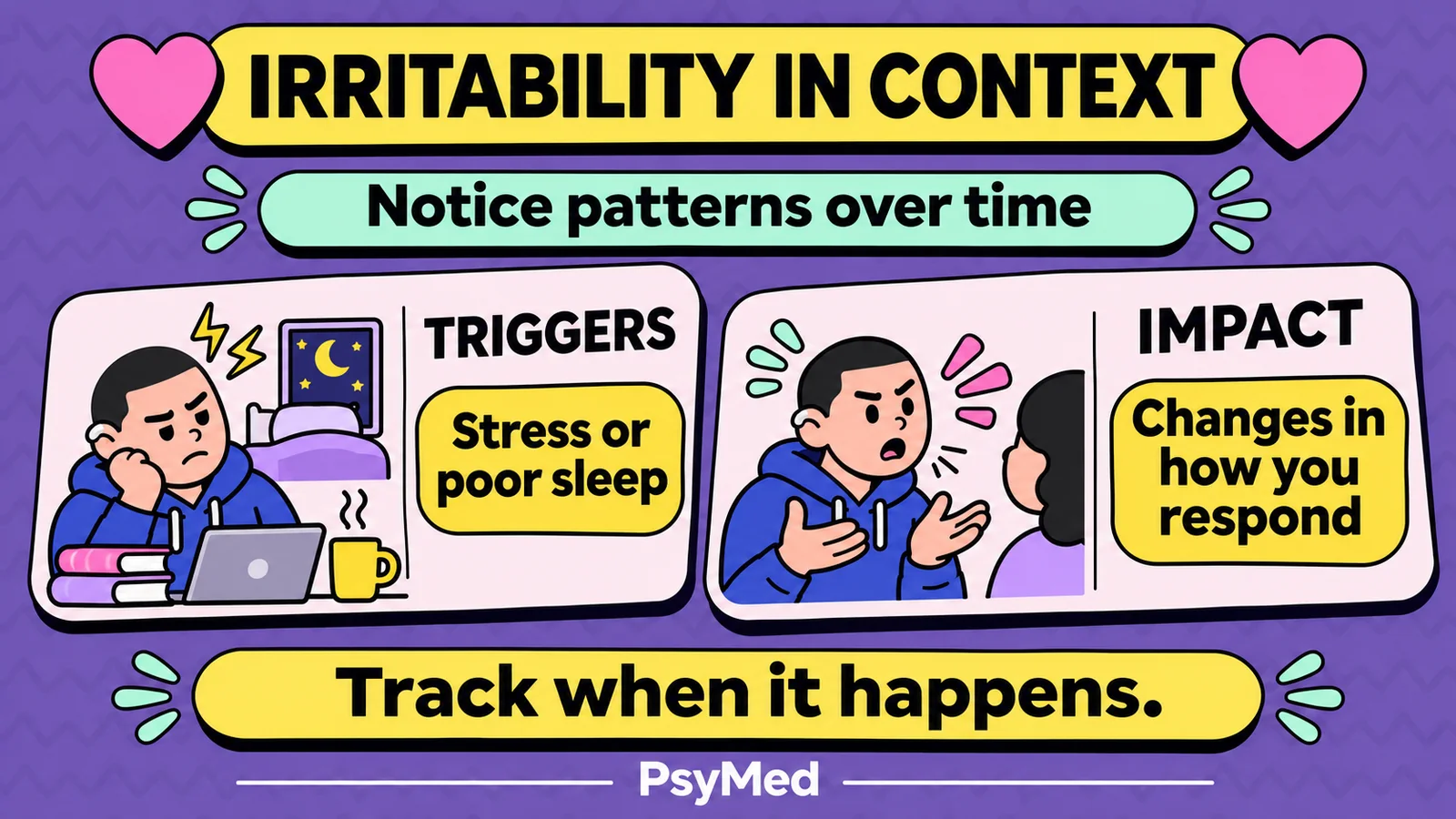
NCBI MedGen describes irritability in terms of frustration, annoyance and a lowered threshold for emotional reactivity. It lists a feature, not a diagnosis established by a self-report total.
View sourceUnderstand the themes
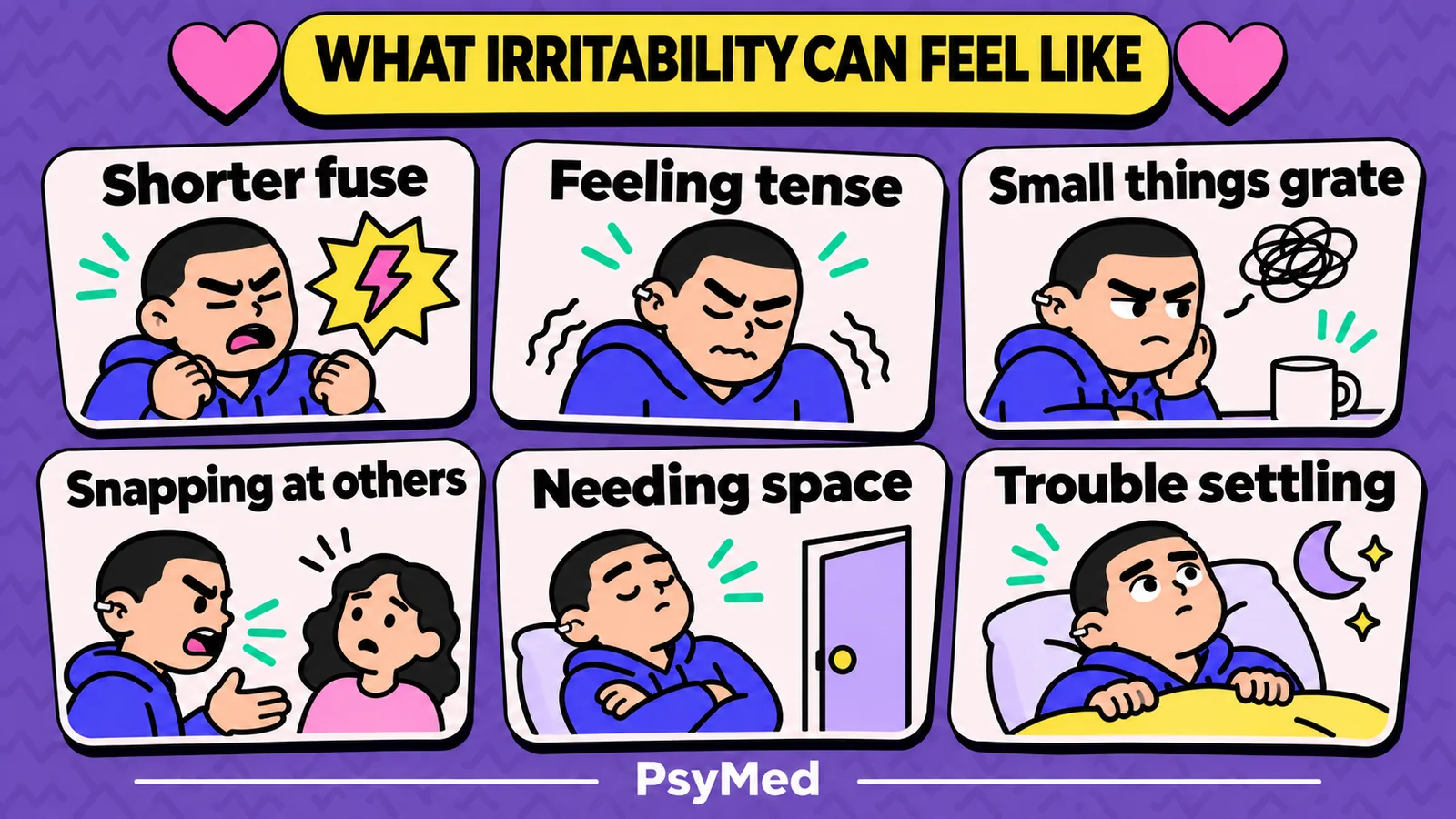
Six ways to describe being easily bothered
These reflection themes organize 12 original questions. They are not validated subscales or diagnostic criteria.
Small frustrations feel bigger
A minor delay or inconvenience may feel harder to tolerate than you expected. Note the situation without assuming that one reaction proves a lasting problem.
Interruptions take more effort
Consider how it feels when a routine task is interrupted. Is the difficult part the change itself, having too much to do, or something else you want to discuss?
Patience feels in short supply
Notice the urge to rush other people, leave a queue or get a conversation over with. A description of the moment is more useful than a global character judgment.
Your tone carries the feeling
You may speak more sharply than intended. Separate the feeling from the action: both can be discussed, but a feeling does not excuse harmful treatment of someone else.
Irritation lingers
Consider whether an ordinary annoyance follows you into another activity. This prompts reflection on recovery; the quiz cannot explain why a feeling remains.
Ordinary life is affected
It may take more effort to work alongside others or stay present in a conversation. Record the impact and any recent change, rather than using the total as reassurance or a verdict.
Irritability, anger, aggression and agitation
Use these distinctions to explain your concern. A person can experience overlap, and this questionnaire cannot sort conditions apart.
| Term | What it describes | What this test cannot establish |
|---|---|---|
| Irritability | Feeling bothered or frustrated readily. | Why the threshold feels lower, or whether a condition is present. |
| Anger | An emotional response that may vary in intensity and expression. | Your full anger pattern; the Multidimensional Anger Test asks a separate question. |
| Aggressive behavior | Actions that can threaten or harm others. | Dangerousness, safety or an excuse for harm from a mood score. |
| Agitation | A state of heightened arousal that may include tension, confusion or irritability. | A medical cause; sudden confusion or changed alertness needs urgent assessment. |
Interpretation and context
How to make sense of your irritability result
Use the result to organize a conversation about real situations. A score cannot establish the cause, duration, diagnosis, or support you need.
- 01 01
Compare with your own usual experience
Is this new or noticeably different for you? Think about timing and settings, without treating one difficult fortnight as your permanent temperament.
- 02 02
Read the item-level impact
A total can hide a single concern that matters a great deal. Bring a concrete example of what happened, what you felt and how daily life was affected.
- 03 03
Ask for a wider assessment when needed
Persistent, worsening or disruptive irritability is worth discussing with a health professional. Medical history, medicines, sleep and other experiences may matter; the score cannot choose an explanation.
The four ranges are editorial summaries of this item set. They divide the reachable totals for readability; there is no established clinical boundary between them. Two people with the same total may have very different experiences. No subscale, percentile or diagnostic probability is calculated.
Context matters
What else may be relevant to a short fuse?
These are discussion areas rather than causes assigned to you. Feeling irritable does not establish depression, bipolar disorder, a hormonal issue or any other diagnosis.
Rest and daily demands
NIMH includes sleep, priorities and supportive contact in mental-health self-care guidance. Consider whether the sleep question or work-related strain question deserves its own conversation.
Other feelings and changes
Mention worry, low mood or a change in your usual activity if relevant. Irritability alone cannot tell you which, if any, health condition is involved.
Physical health and medicines
NIMH notes the importance of checking physical health when mood or concentration changes. Bring a current medicine list to an appointment; do not start, stop or change treatment because of an online result.
Useful support
Finding support for frequent irritability
Focus on the situation and the impact, not on becoming a person who never feels annoyed. Support should fit your wider circumstances.
- 01 / NOTICE
Record the pattern briefly
Write down an everyday example, when it happened and what made it harder or easier. Include context you actually observed rather than guessing a hidden cause.
- 02 / RESPOND
Create a respectful pause
If safe and practical, allow time before replying or returning to a difficult conversation. NHS anger guidance supports giving yourself thinking time and speaking with a trusted person; the goal is workable behavior, not silencing every feeling.
- 03 / ASSESS
Discuss persistent change
A primary-care or mental-health appointment can explore concerns beyond this questionnaire. Seek help when distress or impairment matters to you, even if the total is low.
NIMH self-care and help-seeking guidance emphasizes daily functioning and persistent distress rather than a consumer quiz threshold.
Practical next steps
Bring one clear example into the next week
Choose a small, safe action based on daily life rather than a target quiz score.
- 01
Choose a recent example
Describe one situation where you felt unusually bothered. Separate what you observed from what you assumed about someone else’s intention.
- 02
Plan a small practical change
Identify a pause, a clearer request or a manageable adjustment. A plan should respect everyone’s safety and boundaries.
- 03
Decide what needs a conversation
If the change persists, worsens or affects daily life, arrange professional support. Bring the example and any relevant health or medication changes; do not rely on repeated totals.
If you feel unable to keep yourself or someone else safe, treat that as the urgent thing rather than finishing this page. In the US, call or text 988 for the Suicide & Crisis Lifeline, free, confidential and available 24/7. In the UK, Samaritans are free on 116 123, 24/7. Anywhere else, findahelpline.com lists verified crisis lines by country. If anyone is in immediate danger, call your local emergency number. Sudden confusion or a marked change in alertness needs urgent medical attention. Do not wait for a particular quiz score.
Good questions to ask
Irritability Test FAQs
Direct answers about the purpose, scoring, limits and next steps.
It is an adult educational self-check about the recent frequency of feeling easily bothered and its everyday impact. It uses 12 original questions and has no clinical validation or diagnostic cutoff.
No. A high total means more frequent endorsement of these statements. It does not establish aggression, intermittent explosive disorder or any mood condition. A professional considers history, context and other possible explanations.
Yes. Feeling readily frustrated and acting outwardly are different. These questions include internal annoyance as well as everyday effects; they are not a test of whether someone is violent.
No. This is an original PsyMed educational questionnaire, not the Brief Irritability Test, Affective Reactivity Index or another published instrument. Their validation, scoring and thresholds do not apply here.
The recent window makes the instructions consistent. It is an editorial recall period for these original items, not a diagnostic rule or evidence that two weeks of irritation establishes a disorder.
No. The same answer can have different contexts. A clinician may ask about sleep, health, medicines, stress and other changes. Do not use the result to choose a diagnosis or change medication.
No. These are self-report questions for adults. They are not designed to assess a partner, diagnose a child or settle a disagreement.
No. Persistent, worsening or disruptive difficulties can deserve care at any total. A low result does not establish that you are well or safe, and one important concern can be missed by a summary.
Seek urgent local help if anyone is at risk of harm. Sudden confusion, a change in alertness or a severe abrupt change with concerning symptoms needs urgent medical attention rather than another online questionnaire.
Editorial transparency
Sources and review information
Prepared by the PsyMed Editorial Team. This is an educational page, not a clinical assessment, and no licensed clinical reviewer is claimed. Sources checked: November 17, 2026. The stored questions are original PsyMed educational items; the score ranges are editorial summaries. This questionnaire does not establish validation. Read how we build our tests and who we are.
One useful observation
Describe the change before choosing a label.
A clear example of what changed can be more useful than a label. Make one manageable plan and ask for support when the impact deserves it.
Take the self-check