Sexual Orientation & Gender Identity
Coming Out Readiness Test: Am I Ready to Come Out?
Wherever you are in this, you don’t have to figure it out alone.
📞 The Trevor Project (LGBTQ+ support, 24/7) — 1-866-488-7386 | text START to 678-678
💬 Peer community: TrevorSpace.org | QChatSpace.org
Your safety comes first. If coming out could put you at risk of violence or losing your home, it’s okay — and wise — to wait until you’re safe. There is no wrong choice here, and no deadline.
Deciding whether to come out is one of the more personal decisions a person can face, and it’s rarely simple. It can bring real relief, freedom, and closeness — and, depending on your situation, real risk. This coming out readiness test isn’t here to tell you what to do, and it certainly isn’t here to push you in either direction. It’s here to help you think through the things that actually matter: whether you feel ready in yourself, whether you have support, and — most importantly — whether it’s safe.
One thing to be completely clear about before you begin: this is not a test of whether your identity is “real” or valid. Who you are is a given, and it doesn’t need proving. This is only about timing and circumstances — the practical, human question of whether now, and here, and with these people, is the right and safe moment. And whatever your result, please hold onto this: you never owe anyone your coming out, staying private is a completely valid choice, and there is no deadline. 15 questions, completely private.
What Does “Coming Out Readiness” Actually Mean?
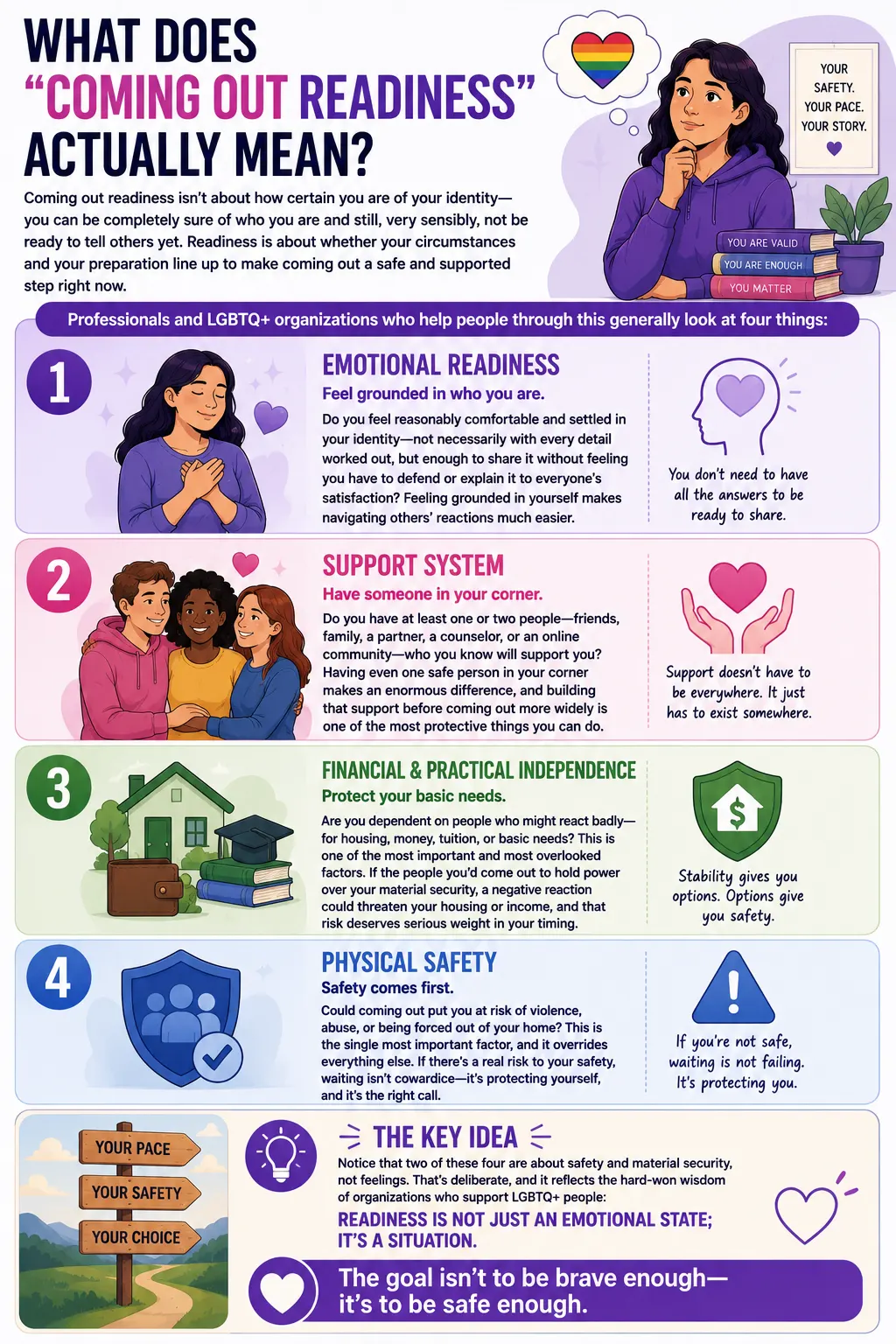
Coming out readiness isn’t about how certain you are of your identity — you can be completely sure of who you are and still, very sensibly, not be ready to tell others yet. Readiness is about whether your circumstances and your preparation line up to make coming out a safe and supported step right now. Professionals and LGBTQ+ organizations who help people through this generally look at four things:
-
Emotional readiness
Do you feel reasonably comfortable and settled in your identity — not necessarily with every detail worked out, but enough to share it without feeling you have to defend or explain it to everyone’s satisfaction? Feeling grounded in yourself makes navigating others’ reactions much easier.
-
Support system
Do you have at least one or two people — friends, family, a partner, a counselor, or an online community — who you know will support you? Having even one safe person in your corner makes an enormous difference, and building that support before coming out more widely is one of the most protective things you can do.
-
Financial and practical independence
Are you dependent on people who might react badly — for housing, money, tuition, or basic needs? This is one of the most important and most overlooked factors. If the people you’d come out to hold power over your material security, a negative reaction could threaten your housing or income, and that risk deserves serious weight in your timing.
-
Physical safety
Could coming out put you at risk of violence, abuse, or being forced out of your home? This is the single most important factor, and it overrides everything else. If there’s a real risk to your safety, waiting isn’t cowardice — it’s protecting yourself, and it’s the right call.
Notice that two of these four are about safety and material security, not feelings. That’s deliberate, and it reflects the hard-won wisdom of organizations who support LGBTQ+ people: readiness is not just an emotional state; it’s a situation. The goal isn’t to be brave enough — it’s to be safe enough.
Signs You Might Be Ready to Come Out
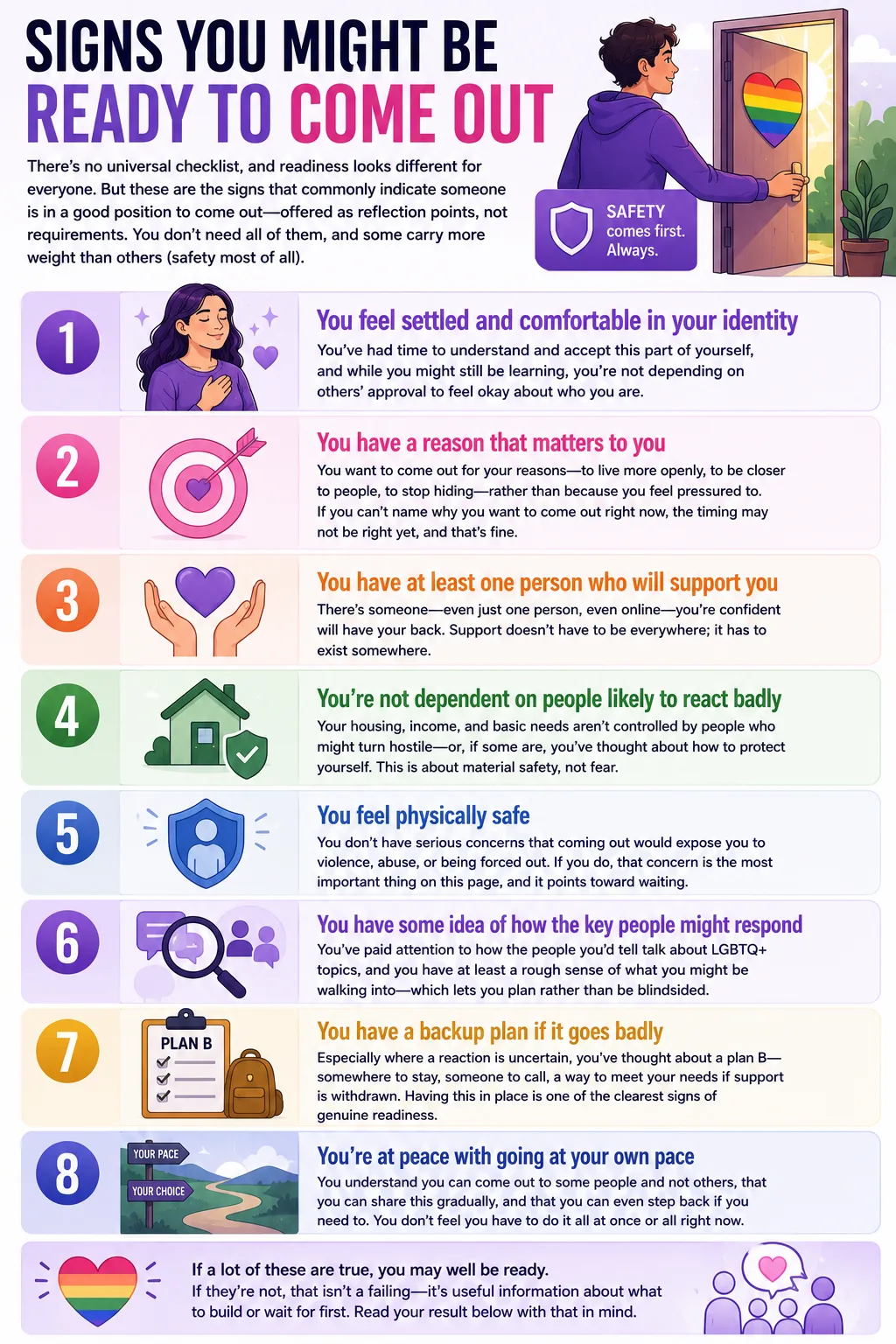
There’s no universal checklist, and readiness looks different for everyone. But these are the signs that commonly indicate someone is in a good position to come out — offered as reflection points, not requirements. You don’t need all of them, and some carry more weight than others (safety most of all).
-
You feel settled and comfortable in your identity
You’ve had time to understand and accept this part of yourself, and while you might still be learning, you’re not depending on others’ approval to feel okay about who you are.
-
You have a reason that matters to you
You want to come out for your reasons — to live more openly, to be closer to people, to stop hiding — rather than because you feel pressured to. The Trevor Project suggests a useful gut-check: if you can’t name why you want to come out right now, the timing may not be right yet, and that’s fine.
-
You have at least one person who will support you
There’s someone — even just one person, even online — you’re confident will have your back. Support doesn’t have to be everywhere; it has to exist somewhere.
-
You’re not dependent on people likely to react badly
Your housing, income, and basic needs aren’t controlled by people who might turn hostile — or, if some are, you’ve thought about how to protect yourself. This is about material safety, not fear.
-
You feel physically safe
You don’t have serious concerns that coming out would expose you to violence, abuse, or being forced out. If you do, that concern is the most important thing on this page, and it points toward waiting.
-
You have some idea of how the key people might respond
You’ve paid attention to how the people you’d tell talk about LGBTQ+ topics, and you have at least a rough sense of what you might be walking into — which lets you plan rather than be blindsided.
-
You have a backup plan if it goes badly
Especially where a reaction is uncertain, you’ve thought about a plan B — somewhere to stay, someone to call, a way to meet your needs if support is withdrawn. Having this in place is one of the clearest signs of genuine readiness.
-
You’re at peace with going at your own pace
You understand you can come out to some people and not others, that you can share this gradually, and that you can even step back if you need to. You don’t feel you have to do it all at once or all right now.
If a lot of these are true, you may well be ready. If they’re not, that isn’t a failing — it’s useful information about what to build or wait for first. Read your result below with that in mind.
How This Coming Out Readiness Test Works
This test asks 15 questions across the areas that matter for coming out readiness — how you feel in yourself, your support, your independence and safety, and your preparation. For each, choose how true it is for you right now:
Not at all = 0 | A little = 1 | Somewhat = 2 | Mostly = 3 | Completely = 4
Your answers add up to a score from 0 to 60, placing you in one of four supportive bands. Please read your result as a thinking aid, not an instruction — it can’t know your full situation, and it will never tell you to come out. Above all: if your answers about safety and financial dependence were low, that matters more than your total score. No overall number outweighs a genuine risk to your safety or your home. Answer honestly and privately; your results are yours alone.
Your Results
One thing to hold as you read your band: a lower score here is not a bad result. Often it means the tool is doing its job — helping you see that a little more support, security, or safety planning would serve you before you take this step. There is no failing this Coming Out Readiness test, and there is no deadline for coming out.
| Score Range | Where You Are | What It Suggests |
|---|---|---|
| 0 – 15 | Focus on Safety First | Now may not be the safest time. Building security and support comes first — and that’s wise, not weak. |
| 16 – 30 | Building Toward It | Some pieces are in place. Strengthening support and a safety plan first would serve you well. |
| 31 – 45 | Getting There | You’re in a reasonably good position. Consider starting small and going at your own pace. |
| 46 – 60 | Sounds Like You’re Ready | Strong readiness across the board. If and when you choose to, you seem well-prepared — on your terms. |
Whatever your result, if a conversation goes badly and you find yourself in crisis, or you’re ever having thoughts of harming yourself, please reach out right away — The Trevor Project is at 1-866-488-7386 (or text START to 678-678), and the 988 Suicide & Crisis Lifeline is available 24/7. A hard reaction from someone else is never a reflection of your worth or the truth of who you are.
Making a Coming Out Safety Plan
If there’s any chance a coming out conversation could go badly — especially with people you depend on — a little planning beforehand can make an enormous difference. This isn’t pessimism; it’s the same sensible preparation you’d want for anything high-stakes. LGBTQ+ organizations consistently recommend thinking through:
-
Somewhere safe to go
If a reaction turned hostile or you needed to leave, where could you stay — a friend, a relative, a partner? Having even a tentative option in mind matters.
-
Someone to call
A trusted person who knows what you’re planning and can support you during or after, whether that’s a friend, an affirming adult, or a helpline like The Trevor Project.
-
Your essentials covered
If you’re dependent on the people you’re telling, think through housing, money, food, transport, and (if you’re a student) school — and how you’d manage if support were withdrawn, even temporarily. Building a little independence or a small safety net first is completely reasonable.
-
Support lined up for afterward
Coming out takes emotional energy, however it goes. Having people or communities ready to support you afterward — online or in person — helps you land softly.
If you’re a minor and financially dependent on family whose reaction you’re unsure of, this planning matters most of all, and there’s no shame in deciding the safest thing is to wait until you have more independence. A school counselor or The Trevor Project can help you think it through confidentially.
Remember: There’s No Wrong Way, and No Obligation
However this Coming Out Readiness test came out, a few truths are worth carrying with you. Coming out is not a single event but an ongoing, personal process — most people do it many times over their lives, in different contexts, at their own pace. You can be out to some people and private with others, and that’s not hiding — it’s discernment. You can come out and later choose to step back in certain settings if you need to. And you are never, under any circumstances, obligated to come out to anyone; it is your information to share or keep as you see fit.
Above all: staying in the closet for your safety or wellbeing is not weakness or dishonesty — it’s a valid, sometimes wise, choice. The realness of who you are doesn’t depend on who knows. There is no deadline, no test to pass, and no one whose approval you need in order to be exactly who you are. Whenever and however you navigate this, your safety and your wellbeing come first.
Frequently Asked Questions
How do I know if I’m ready to come out?
Readiness generally comes down to four things: feeling reasonably settled in your identity, having at least some support you can rely on, being safe from violence or being forced out, and not being dependent on people who might react in ways that threaten your security. Notice that two of those four are about safety and material independence rather than feelings — that’s important, because you can feel emotionally ready while your circumstances still make it risky.
A useful gut-check from The Trevor Project: ask yourself why you want to come out right now; if you can’t name a reason that’s for you, the timing may not be right yet. And remember there’s no threshold you must reach and no deadline — readiness is about safety and support lining up, not about being brave enough.
Is it okay to not come out?
Yes, completely. Not coming out — to some people, or to anyone, or ever — is a valid and respected choice, and it says nothing about the realness of your identity. LGBTQ+ organizations including The Trevor Project are explicit about this: there’s no right or wrong way to come out, and choosing to keep your identity private is entirely legitimate. Some people stay private for safety, some because they simply prefer to, and some for reasons that change over time. You never owe anyone your coming out, and who you are doesn’t depend on who knows about it. If you’re staying private because it isn’t safe to be open, that’s not hiding — it’s protecting yourself, which is wise.
What if I’m not safe to come out?
Then your safety comes first, without question — and waiting is the right choice, not a failure. If coming out could put you at risk of violence, abuse, or losing your home, or if you’re financially dependent on people who might react by cutting off your support, it is completely reasonable and wise to wait until you’re safer or more independent. In the meantime, you can build support in ways that don’t expose you to risk: online communities like TrevorSpace, an affirming counselor, or trusted people outside the risky situation.
If you’re a young person in an unsafe home, The Trevor Project (1-866-488-7386) and school counselors can help you think through your options confidentially. Your identity is just as real whether or not you’re able to be open about it right now.
Should I come out to my parents?
That depends entirely on your situation, and only you can weigh it — but the key factors are safety and dependence. If you have reason to believe your parents would respond with acceptance, or at least without endangering you, and you want to share this with them, coming out can deepen those relationships.
If you’re financially dependent on them and unsure how they’d react, or if there’s any risk they’d respond with hostility, rejection, or by threatening your housing or safety, it’s completely reasonable to wait — especially if you’re a minor or still dependent on them. Many people wait until they have more independence, and that’s a sensible, common choice. If you do decide to, having a safety plan in place first (somewhere to go, someone to call) is wise where the reaction is uncertain. There’s no rush, and no obligation.
Can I come out to some people but not others?
Absolutely — and many people do exactly this. It’s sometimes called selective disclosure, and it’s a smart, common approach: you might come out to a trusted friend or two first, build up your support and confidence, and only later (if ever) share more widely. You get to decide who knows and who doesn’t, and being out in one part of your life while private in another isn’t dishonest — it’s a reasonable response to the reality that different people and different environments carry different levels of safety and acceptance. This gradual approach also lets you build a support base before any higher-stakes conversations. Your coming out is yours to direct, person by person, at whatever pace feels right.
What if coming out goes badly?
Sometimes, despite our hopes, people don’t react the way we want — and it’s worth saying clearly: if that happens, it is not your fault, and it doesn’t reflect on the realness or validity of who you are. If you can, prepare beforehand for the possibility: have somewhere safe you could go, someone supportive to call, and your essentials covered if you’re dependent on the people you’re telling.
Afterward, lean on your support — chosen family, friends, affirming communities, or a counselor. Some relationships that react badly at first do shift with time as people process and learn, though that’s never guaranteed and never something you’re obligated to wait around for. And if a bad reaction ever leaves you in crisis or having thoughts of harming yourself, please reach out immediately — The Trevor Project (1-866-488-7386) and the 988 Lifeline are there 24/7. You deserve support, and you don’t have to face a hard reaction alone.
Related Tests & Resources
- LGBTQ+ Identity Test — if you’re still exploring your orientation or identity itself, a broader place to reflect
- Bisexual Test — for reflecting specifically on attraction to more than one gender
- Gender Identity Test — for exploring gender identity, a distinct question from coming out timing
- Anxiety Test — the coming out process can bring real anxiety; this checks in on how you’re coping
- Self-Esteem Test — a supportive relationship with yourself is a foundation for navigating this on your terms
- The Trevor Project — 1-866-488-7386, text START to 678-678, or TrevorSpace.org for peer community (LGBTQ+ young people)
- PFLAG — support for LGBTQ+ people and their families, including help preparing for family conversations
References
- The Trevor Project. Coming Out: A Handbook for LGBTQ Young People. [Readiness, safety planning, “why” gut-check, no wrong way including not coming out] thetrevorproject.org
- Human Rights Campaign. Coming Out: Living Authentically resource guides. [Safety, timing, and coming out on your own terms] hrc.org
- PFLAG. Our Trans Loved Ones & Coming Out resources. [Family reactions, support, and preparation] pflag.org
- The Trevor Project. National Survey on LGBTQ Youth Mental Health. [Family rejection, safety, and youth wellbeing] thetrevorproject.org
- American Psychological Association. Sexual Orientation and Gender Identity resources. [Affirming, non-pathologizing framework for identity] apa.org
Further reading
If you are still working out which words fit, LGBTQ+ Identities Explained covers the vocabulary. And if travel is part of your thinking, Safest Countries for LGBTQ+ Travelers ranks where the legal and social picture is most — and least — forgiving.
Related Tests
See All Quiz →
Sexual Orientation & Gender Identity
What’s Your Sexual Orientation or Gender Identity? Take This Free LGBTQ+ Test
→


You may also like
See All Quiz →