
Self-reflection · Self & Identity
Asexuality Spectrum Test: explore attraction on your terms
This 15-question self-reflection exercise explores attraction, romantic feelings and relationship preferences. It cannot tell you that you are asexual, graysexual, demisexual or allosexual. You choose which words, if any, describe you.
An educational reflection, not a diagnosis, identity classification or relationship recommendation.
-
THE REFLECTION15 questionsExplore the questions at your own pace.
-
YOUR CHOICEYou can stop at any timeAnswer only while you feel comfortable continuing.
-
CLEAR BOUNDARIESA reflection, not a labelYour result cannot decide your identity or choices.
The reflection
Take the asexuality spectrum test
Read each question and every answer option: wording varies between items. Choose the closest description of your own experience, not what you think someone expects. Several questions mix attraction with romantic feelings, behavior or relationship preferences, so the total cannot classify an orientation. You can stop at any time.
Your answers
What the ranges mean
- 0–15 Lower combined total
- 16–30 Lower-middle combined total
- 31–45 Upper-middle combined total
- 46–60 Higher combined total
All 15 items contribute 0–4 points. The questions combine several different domains, including sexual and romantic attraction, behavior, preferences and social pressure. A total cannot separate these domains or determine an orientation. The four ranges are descriptive only.
A mixed reflection exercise, not an orientation classifier or the AIS-12.
The short answer
What is asexuality and the ace spectrum?
Asexuality generally describes experiencing little or no sexual attraction, or identifying as asexual. The ace spectrum includes varied experiences, and only you decide whether its language fits.
Sexual attraction, romantic attraction, libido, behavior and attitudes toward sex are related topics but not interchangeable. The preserved questions ask about several of them. A single total cannot resolve those differences or assign asexual, graysexual, demisexual or allosexual identities. The LGBTQ+ Test is another educational reflection, not an identity verdict.
You do not have to reach a cutoff, have sex, avoid sex or disclose personal experiences to justify the language you choose.
AASECT states that asexuality and ace-spectrum identities are not mental, developmental or sexual disorders. Support should respect a person’s orientation rather than try to change it.
View sourceReflection prompts
Six distinctions that make reflection more useful
These are concepts to explore, not criteria you must satisfy or signs that prove an identity.
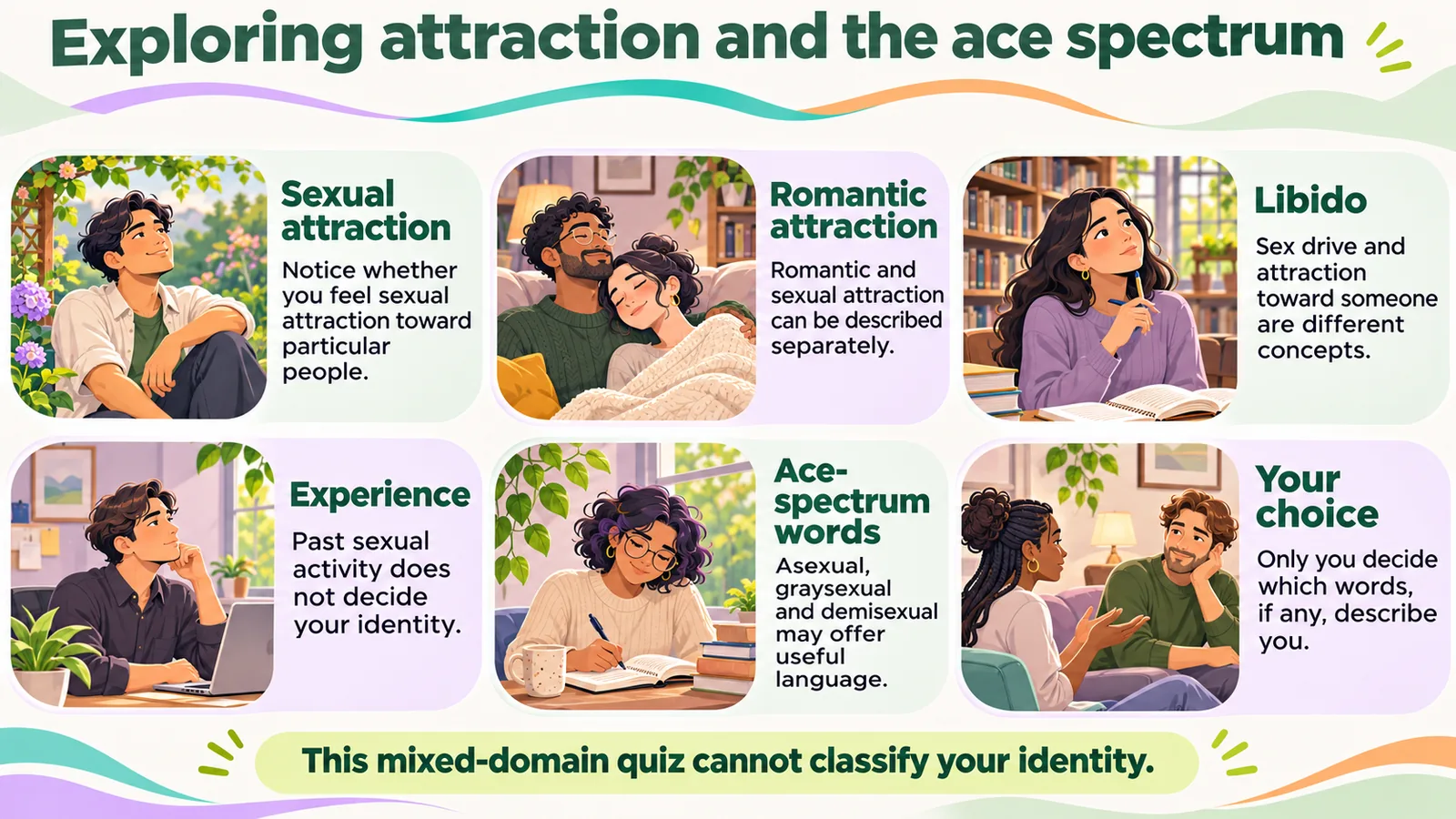
Sexual attraction
Consider whether you feel a sexual pull toward a particular person. Finding someone beautiful is not automatically the same experience.
Romantic attraction
Wanting a romantic relationship can be different from wanting sexual contact. Some people find separate words for these experiences useful.
Libido
A general sexual drive is not identical to sexual attraction toward another person. Describe what you experience without assuming one settles the other.
Context and connection
Some people use demisexual language when attraction arises after an emotional bond. A decision to wait before sex does not by itself establish that experience.
Behavior and consent
Having or not having sex does not by itself determine an orientation. What matters in any interaction includes what you freely want and agree to.
Identity language
Asexual, graysexual, demisexual, allosexual and questioning are words people may use. You are not required to choose one, and the score cannot choose for you.
Attraction, behavior and a label are different questions
Keeping them separate is more informative than treating this mixed total as a position on a single spectrum.
| Concept | What it describes | What it cannot establish |
|---|---|---|
| Sexual attraction | A sexual pull toward someone. | A person’s preferred label from one answer or one experience. |
| Romantic attraction | Romantic interest or a wish for romantic connection. | Whether someone experiences sexual attraction. |
| Sexual behavior | What someone does or does not do. | An orientation, consent to future activity or a duty to repeat it. |
| An identity label | Language someone chooses for their experience. | Permission for other people to demand proof or override boundaries. |
Understanding the result
What can this asexuality spectrum test tell you?
Use it to notice questions you want to explore. The total is not a clinical finding or an identity assessment.
- 01 Attraction
Look at the actual experience
Ask which questions describe attraction and whether they fit your experience. A total loses information about which answers produced it.
- 02 Context
Keep different domains apart
An answer about romance, physical affection or social pressure is not interchangeable with an answer about sexual attraction.
- 03 Agency
Choose your own language
Descriptions from ace communities may help you reflect. No questionnaire can require you to adopt, abandon or disclose a label.
The preserved 15-item questionnaire is not the AIS-12 and has not been validated to distinguish asexual, graysexual, demisexual or allosexual identities. Its score ranges must not be read as those four categories. Item wording and numerical boundaries are preserved in this layout migration. The Kinsey Scale Test also needs context: its historical scale does not decide an identity.
Your context
Why experiences may need more than one word
Asexuality is not something this page aims to explain away or treat. The practical question is which distinctions help you describe yourself.
Attraction and relationships
A person can have preferences about romance or closeness without those preferences settling their sexual orientation.
Expectations and pressure
Separate what you want from what you feel expected to want. You do not have to participate in sex or a relationship to prove an identity.
Change and continuity
Some people experience their orientation as stable and others describe change. Neither pattern gives a quiz authority over your self-description.
Support and information
What does affirming support look like?
The purpose of support is to help you understand your experience and feel respected, not to move you toward a particular score or orientation.
- 01 / INFORMATION
Read ace-led explanations
AVEN offers educational material and community perspectives. Compare descriptions with your own experience without treating any story as a requirement.
- 02 / COMMUNICATION
Talk about your boundaries
If you want to discuss this with a partner, separate affection, romance, sex and consent. You can say what you want without making a final identity announcement.
- 03 / AFFIRMING CARE
Ask for respectful care
If you seek counseling, ask whether the provider understands ace-spectrum identities. Concerns about distress or an unwanted change deserve attention without assuming your orientation is the problem.
AASECT opposes attempts to change or pathologize ace-spectrum orientations. You can ask for help with a concern while expecting your identity and choices to be respected.
Practical next steps
What to do after this reflection
A useful next step can be small, private and entirely optional.
- 01
Keep one useful observation
Write a sentence about what you learned from an individual question. You do not need to keep the total or retake the quiz to reach a different category.
- 02
Choose your own pace
Read definitions or community stories if that helps. You can stay questioning, use a temporary label or use no label.
- 03
Share only what you want
If you choose to talk with someone, decide what you want from that conversation: understanding, a boundary or simply someone to listen. If disclosure is on your mind, the Coming Out Readiness Test focuses on support and circumstances, without imposing a deadline.
You do not owe anyone sexual activity, experimentation or personal disclosure to prove an orientation. If a conversation feels pressuring, pause it and seek support from someone who respects your choices.
Your questions
Asexuality Spectrum Test FAQs
Clear answers about the terms, this questionnaire and the limits of a score.
Only you can decide whether asexual language describes your experience. Asexuality generally concerns little or no sexual attraction; the quiz mixes that with other topics and cannot assign a label.
No. Those experiences are not validated score bands on this questionnaire. In particular, demisexuality describes a context for attraction, not a numerical midpoint between asexuality and allosexuality.
AASECT states that asexuality and ace-spectrum identities are not mental, developmental or sexual disorders. If you want help with distress or an unwanted change, support should consider your concern without treating an orientation as something to fix.
Yes. Romantic interest and preferences for physical closeness do not have to match sexual attraction. A person may find it useful to describe these separately.
No. Behavior alone does not settle orientation. Having sex, choosing not to have sex and changing a boundary do not each provide a test of whether a label is valid.
Demisexual language concerns attraction arising after an emotional connection. Choosing when to have sex concerns behavior and boundaries. Someone can choose to wait regardless of when they experience attraction.
The preserved questions cover different experiences, so they have item-specific answer descriptions. Read every option rather than assuming the first question’s wording applies throughout.
No. This page uses an inherited 15-item educational questionnaire, not the 12-item Asexuality Identification Scale. No AIS-12 score, validation claim or cutoff applies to this total.
Your own account takes priority over the quiz’s descriptive total. You do not need to retake the test or change a label to make them agree. Consider whether particular questions were unclear or described a different domain.
Editorial transparency
Sources and review information
Prepared by the PsyMed Editorial Team using the resources listed here. No clinician or validated assessment is claimed. Updated 2026-11-15. Independent review status is recorded in the package notes. Read how we build our tests and who we are.
Definitions and educational references
- AASECT: Position on the Dignity and Rights of Asexual Individuals
- Asexual Visibility and Education Network: General FAQ
- Duke Student Affairs: Asexuality Information and Resources
- The Trevor Project: Understanding Asexuality
- Yule MA, Brotto LA, Gorzalka BB. (2015). A validated measure of no sexual attraction: The Asexuality Identification Scale. Psychological Assessment, 27(1), 148–160.
Your experience matters
You choose the words and the next step.
Use the questions for reflection. Your boundaries and self-description do not need a quiz’s approval.
Take the reflection