
Self-check · Mood
High-Functioning Depression Test: functioning was never the threshold
The phrase is not a diagnosis and no manual lists it — but the pattern it describes usually is one. These 20 questions ask about low mood carried underneath a working life, and about the belief that keeps people from raising it: that still managing means not qualifying.

Not a diagnosis. The questions ask how often, never how long — and duration is the thing a clinician will ask you first.
-
IT IS NOT A DIAGNOSISBut the pattern is realNo manual lists it. The nearest diagnosis is persistent depressive disorder.
-
FUNCTIONING IS NOT THE TESTNothing requires you to collapseThe criteria are about symptoms, not about whether you got to work.
-
PRIVATENo account neededFree, no sign-up. See what a completion records.
A 20-question self-check
Take the self-check
Twenty statements about the gap between how you are doing and how you are feeling. About three minutes.
Your result
What the ranges mean
- 0–20 Few signs of this pattern
- 21–45 A persistent low-grade pattern
- 46–80 A strong and costly pattern
Twenty statements scored 0 to 4 give a total of 0–80. The questions ask about low mood you carry while still performing: the flatness, the effort it takes, the self-criticism, and the sense of surviving rather than living.
Of US adults with a major depressive episode in a year. Close to two in five received none.
The short answer
What is high-functioning depression?
An informal phrase for depression carried by someone who is still meeting their obligations: working, parenting, turning up, while feeling flat, tired and joyless underneath. It is a description, not a diagnosis. The clinical picture it most often corresponds to is persistent depressive disorder (dysthymia) — NIMH describes it as less severe depression symptoms lasting much longer, usually at least two years. It can also be a major depressive episode in someone whose circumstances or temperament keep them performing.
The four parts are worth separating because they do not arrive together. Some people feel almost nothing and function perfectly; others feel a great deal and have started to slip at work. The combination is what a clinician would want to hear about.
The question is not whether you are coping. It is how long you have been coping like this.
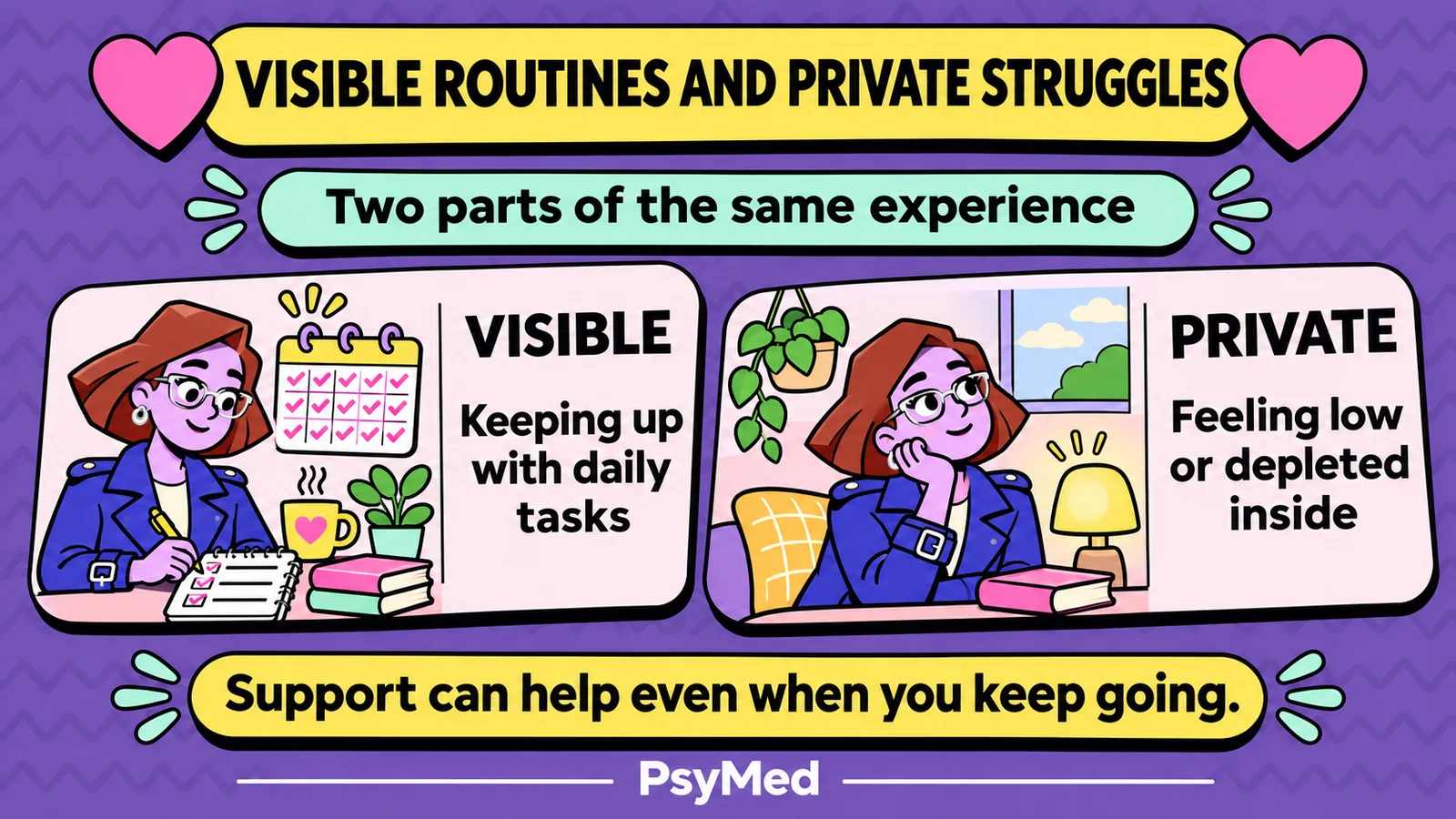
NIMH, Major Depression is the source for the figures on this page: 21.0 million US adults — 8.3 per cent — had at least one major depressive episode in a year, 10.3 per cent of women and 6.2 per cent of men, rising to 18.6 per cent among 18 to 25 year olds, with 61.0 per cent receiving treatment.
View sourceThe four parts
What the twenty questions ask about
Four separate things, and they do not arrive together.
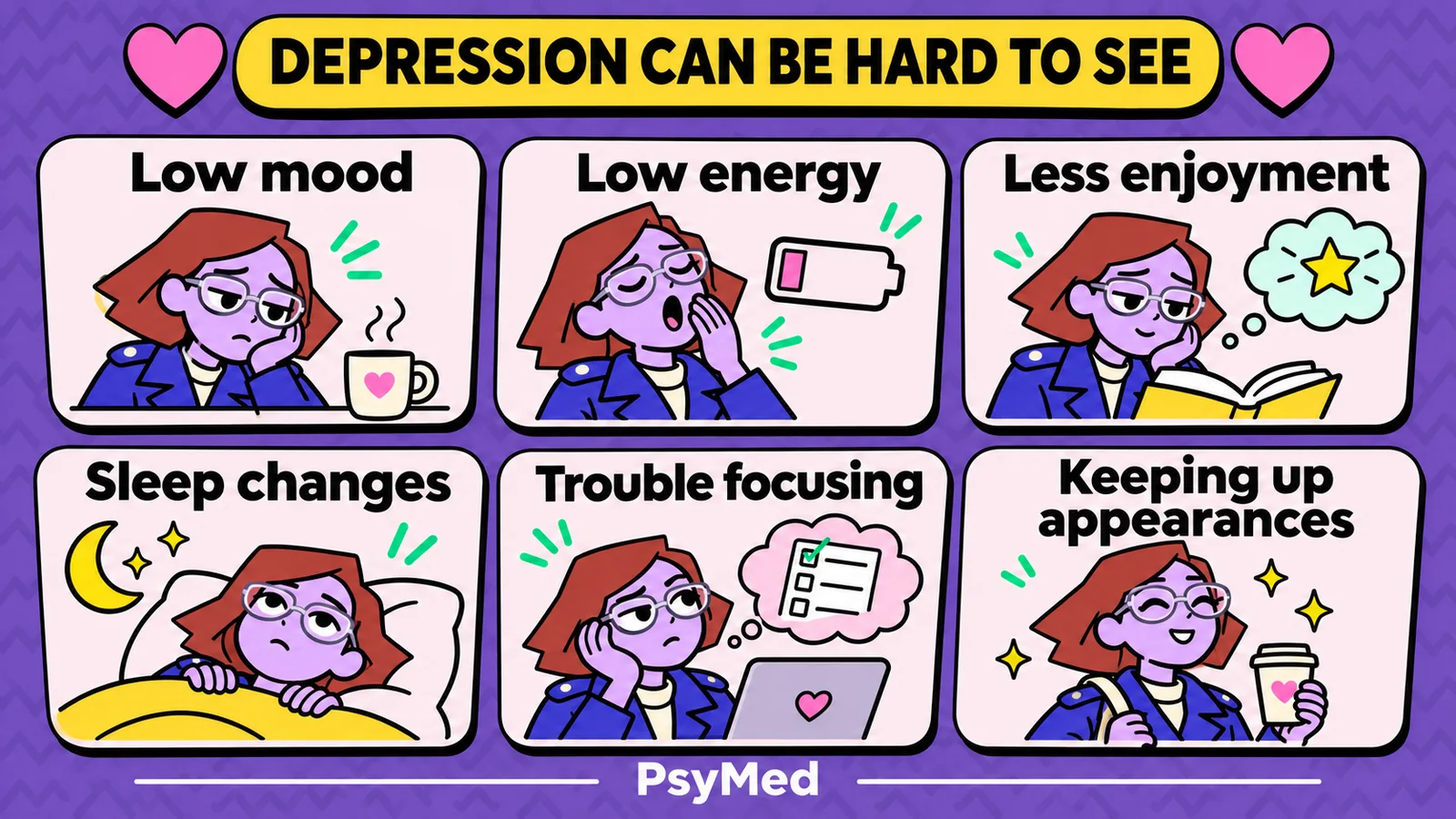
The flatness itself (questions 13, 17, 19, 20)
A sadness that does not fully lift, difficulty enjoying what you used to, going through the day empty, and being tired on waking after a full night. This cluster is closest to what a clinician would recognise as depression regardless of how well you are functioning.
The performance (questions 10, 11, 14, 18)
Pushing through when mentally exhausted, feeling you have to pretend everything is fine, keeping busy to outrun it, and smiling in company while flat underneath. This is the part the phrase is named after, and on its own it is a coping style rather than an illness.
The self-assessment (questions 1, 2, 8, 12)
Thinking you should be happier than this, feeling behind even when others say you are doing well, persistent self-criticism, and guilt for feeling low when life looks fine. The guilt is worth noticing: it is a common reason people do not raise this with anyone.
The body and the machinery (questions 3, 4, 5, 6, 9, 15, 16)
Concentration and decisions, mood swings or numbness, physical heaviness, procrastination from flat motivation, difficulty relaxing, a sense that something is off without knowing what, and surviving rather than living.
Why duration is not a question here
The twenty statements ask how often, not how long, and duration is the single most useful thing a clinician will ask you. If what you have described has been running for two years or more, that is the detail that turns this from a difficult period into something with a name and a treatment.
Why there is no “high-functioning depression” to diagnose
The phrase is not in any diagnostic manual, so nothing corresponds to it clinically. It is useful shorthand for a real experience and it is unhelpful as a category, because it invites the conclusion that your version is a milder species of the thing rather than the thing itself at a level you have learned to carry.
Dysthymia, depression and burnout
Three things that produce flatness while you keep going, for different reasons.
| Pattern | What it looks like | What it means |
|---|---|---|
| Persistent depressive disorder | Less severe symptoms, two years or more, carried while functioning. | A diagnosis, and treatable. The closest fit for the phrase. |
| Major depressive episode | Symptoms most of the day nearly every day for at least two weeks. | Also a diagnosis, and functioning does not rule it out. |
| Burnout | Exhaustion and cynicism tied specifically to work, easing when away from it. | Not a mood disorder. Different cause, different fix. |
| How do I tell this from burnout? | By whether it follows you. Burnout is tied to a context, usually work, and tends to ease on a long break or after changing jobs. Depression travels: the flatness is there on holiday, at the weekend and with people you like. If a fortnight away made almost no difference to how you felt, that points away from burnout. | |
Reading your result
What should you take from the number?
Three things more useful than the total.
- 01 How long it has been like this
The question the test does not ask
Two years or more at this intensity is the threshold NIMH uses for persistent depressive disorder. The questions here measure how often, not how long, so the duration is yours to add and it is the first thing a doctor will want. more useful than the total and it is the detail that gets you taken seriously.
- 02 Whether anything still lifts it
A good day, or no good days
If genuinely good things still register, even briefly, that is different from a flatness nothing reaches. The second is the one to raise soonest, and question 17 is the one that asks it.
- 03 What it is costing to keep going
The measure that counts
If the performance is holding but the cost of holding it has been rising for months, that is the finding that matters most and it does not show up in anything other people can see.
It cannot diagnose anything, and it cannot measure “high-functioning depression” because no such category exists. It does not ask how long this has gone on, which is the decisive question. And it cannot distinguish depression from burnout, thyroid problems, anaemia, sleep disorders or the ordinary aftermath of a hard year — all of which produce a similar flatness and several of which a blood test settles.
Things people ask early
The questions that come up first
Three worth answering before the detail.
Can you be depressed and still functioning?
Yes, and the criteria have never said otherwise. NIMH defines a major depressive episode by symptoms most of the day nearly every day for at least two weeks, which says nothing about whether you kept working.
Is high-functioning depression a real diagnosis?
No. The phrase appears in no diagnostic manual. The pattern it describes usually corresponds to persistent depressive disorder or to a major depressive episode.
Do I need to be worse before I ask for help?
No, and waiting is the specific risk this pattern carries. Close to two in five US adults with a major depressive episode in a year received no treatment for it.
What works
What actually helps
The treatments are the ones for depression, because this is depression. The obstacle is usually not the treatment; it is the belief that you do not qualify for it.
- 01 / START HERE
Say how long, not how bad
The single most useful sentence you can take to a GP is a duration, not a severity rating: “I have felt flat most days for about two years.” Severity is what you are least able to judge from inside it, and duration is what separates a hard stretch from persistent depressive disorder, which NIMH defines as less severe symptoms lasting usually at least two years. Bring the duration and let them do the scoring. raise arousal came out at −0.02. That is nothing.
- 02 / RULE OUT THE PHYSICAL
Ask for the blood tests
Thyroid function, iron and B12 and vitamin D all produce flatness, heaviness and poor concentration that read exactly like low mood, and all are settled with a blood test. It is not a substitute for the mental health conversation. It is the cheapest thing to eliminate first, and worth asking for in the same appointment.
- 03 / TREAT IT AS DEPRESSION
Because that is what it is
Talking therapy, medication, or both, are what the evidence supports for depression, and nothing about functioning well changes which treatments work. If a previous attempt to raise this was brushed off because you seemed fine, that is a reason to go back with a duration rather than a reason to conclude you were wrong.
Background: NIMH, Depression. This page is educational and is not medical advice.
What to do next
What should you do with your result?
Three things, whatever the number said.
- 01
Work out the duration
Weeks, months or years. One number. It is the thing the test did not ask and the first thing a clinician will.
- 02
Book the appointment anyway
Not when it gets worse. The pattern on this page is specifically the one that waits, and close to two in five people with an episode get no treatment at all.
- 03
Tell one person the real answer
Not “fine”. The gap between what you say when asked and what you put in this test is the whole subject of the page.
None of the twenty questions asks about this, so your score does not reflect it, and a modest total does not mean it does not count. Please treat it as the most important thing on the page rather than something to mention later. Talk to a doctor, and if it is urgent use one of the lines below now. 988 in the US for the Suicide and Crisis Lifeline, by call or text, or 116 123 for Samaritans in the UK. Elsewhere, find a line at findahelpline.com. Being able to function is not a reason to wait, and it has never been a reason to be taken less seriously.
Good questions to ask
High-functioning depression test — FAQs
What people actually ask about functioning while depressed.
Not as a diagnosis. The phrase appears in no diagnostic manual and no clinician will write it in your notes. What it describes is real and usually corresponds to persistent depressive disorder — which NIMH defines as less severe depression symptoms lasting much longer, usually at least two years — or to a major depressive episode in someone who has kept performing.
Yes. NIMH’s criterion for a major depressive episode is symptoms most of the day, nearly every day, for at least two weeks. There is no clause about whether you managed your responsibilities, and plenty of people meet the criteria while nobody around them notices.
NIMH estimates that 21.0 million US adults — 8.3 per cent — had at least one major depressive episode in a year: 10.3 per cent of women and 6.2 per cent of men, rising to 18.6 per cent of 18 to 25 year olds. An estimated 14.5 million adults had an episode with severe impairment.
Because the reasoning sounds sensible and is wrong. Depression is not a proportional response to circumstances, and a life that looks fine on paper does not inoculate anyone. The guilt is common enough to be one of the questions here, and it is one of the main reasons people do not mention it to a doctor.
Lead with duration rather than severity, because duration is the thing you can report accurately and it is what the diagnosis turns on. “I have felt flat most days for two years” is a clinical statement. “I think I might be a bit depressed” invites reassurance. Dysthymia Test is the closer fit if that duration applies to you.
It may be, and the test for it is whether distance helps. Burnout is tied to a context and usually eases away from it; depression follows you to the holiday. If a fortnight off changed almost nothing, that points away from burnout.
Possibly, and it is cheap to check. Thyroid problems, low iron, low B12 and low vitamin D all cause flatness, heaviness and poor concentration, and all are settled with a blood test. Ask for it alongside the conversation rather than instead of it.
The test is free, no account or sign-up is needed, and nobody else sees your result on screen. Each completion is logged (the test, your score, the time taken and your IP address) but not your name; see what is recorded.
It means you are performing well, which is a different measurement and the one this page is about. The people around you are reading your output. You are the only one with access to what it costs to produce it.
Editorial transparency
Sources and review information
The twenty statements cover flatness, performance, self-assessment and the physical side, and were written for this site. They are not a clinical instrument and no score here is diagnostic — nor could it be, since “high-functioning depression” is not a diagnosis. Every figure on this page comes from NIMH and is attributed in the text. Written and reviewed by the PsyMed Editorial Team. We are writers and researchers, not clinicians, and this page is educational rather than diagnostic. Read how we build our tests and who we are.
Research and editorial references
- National Institute of Mental Health. Major Depression — statistics. 21.0 million US adults (8.3 per cent) had at least one major depressive episode in the past year; 10.3 per cent of women and 6.2 per cent of men; 18.6 per cent of those aged 18 to 25; 61.0 per cent received treatment; 14.5 million (5.7 per cent of adults) had an episode with severe impairment. The source for every prevalence and treatment figure here. nimh.nih.gov/health/statistics/major-depression
- National Institute of Mental Health. Depression. — the source for the definition of persistent depressive disorder (dysthymia) as less severe symptoms lasting usually at least two years, and for the major depressive episode criterion of symptoms most of the day, nearly every day, for at least two weeks. nimh.nih.gov/health/publications/depression
- This page publishes no prevalence figure for “high-functioning depression”, because it is not a diagnosis and no such figure exists. It publishes no figure for persistent depressive disorder prevalence either, because NIMH does not give one on the pages cited. The previous version of this page carried no sourced figure at all.
- One limitation worth stating plainly: this test asks how often, never how long, and duration is what the diagnosis turns on. A high score over three bad weeks and a high score over three years are different situations, and only you can tell us which you are in.
A questionnaire, not a verdict
Functioning has never been the threshold. The criteria are about symptoms, and they say nothing about whether you got to work.
If your result pointed that way, the useful next steps are working out how long it has been like this, booking the appointment rather than waiting to get worse, and telling one person the real answer instead of “fine”.
Take the test