

Emotional and Trait Assessments · Personality
Big Five Personality Test: Discover Your OCEAN Traits
→
Feeling like a fraud despite your success? This free Imposter Syndrome Test is based on Clance's CIPS framework. 20 questions. Instant results.
Published Updated
You got the job, the promotion, the admission letter, the recognition — and then something shifted. Not relief, not pride, but a quiet, persistent dread: they’re going to figure out I don’t belong here. You look around the room at people who seem to simply know what they’re doing, and you wonder how you’ve managed to fool everyone for this long. You work harder than almost anyone, but you attribute your results to luck, timing, help from others — anything but your own ability. And you live with a low-level fear that one day, someone will finally notice what you’ve always suspected about yourself.
This is what imposter syndrome feels like from the inside. And it is extraordinarily common — estimated to affect up to 70% of people at some point in their lives, cutting across gender, profession, ethnicity, and achievement level, according to research published in the Journal of General Internal Medicine (Bravata et al., 2020).
This free Imposter Syndrome Test is modeled on the Clance Imposter Phenomenon Scale (CIPS) — developed by Dr. Pauline R. Clance and Dr. Suzanne A. Imes, the psychologists who first defined and named the imposter phenomenon in 1978. It is the most widely validated assessment instrument for impostor feelings in clinical and research use.
Imposter syndrome — also called the imposter phenomenon, fraud syndrome, perceived fraudulence, or impostor experience — was first described in 1978 by psychologists Dr. Pauline Rose Clance and Dr. Suzanne A. Imes in their landmark paper “The Impostor Phenomenon in High Achieving Women: Dynamics and Therapeutic Intervention.” They defined it as “an internal experience of intellectual phoniness” — a persistent sense that one’s success is undeserved and that exposure as a fraud is only a matter of time (Clance & Imes, 1978).
Clance and Imes originally identified the phenomenon among high-achieving professional women. Subsequent decades of research have shown it affects men and women at roughly equal rates — though expression and disclosure differ by gender — and is particularly prevalent in high-performance environments: academia, medicine, law, competitive business, creative fields, and anywhere achievement is externally evaluated and comparison is constant.
Imposter syndrome is not a formal DSM-5 diagnosis — it is a psychological pattern, not a clinical disorder. This matters because it means the experience is not inherently pathological, but it also means it frequently exists alongside — and is sometimes mistaken for — clinical conditions including anxiety disorders, depression, and ADHD. At significant levels, impostor feelings cause real distress, impair decision-making, drive overwork, and prevent people from pursuing opportunities they are genuinely qualified for.
Imposter syndrome is one of the most consistently misidentified experiences in high-achieving people — precisely because it feels like accurate self-assessment rather than distorted thinking. These are the patterns that most reliably indicate impostor feelings are operating:
You got the position because they were desperate, not because you were qualified. You passed the exam because the questions happened to align with what you studied. You got the client because they didn’t have other options. There is always an explanation for why the success doesn’t actually reflect your competence — and the explanation never credits you.
A persistent, low-level dread that someone in authority will eventually realize you’ve been operating above your actual level. That the praise, the trust, the opportunities have all been extended under a mistaken impression of who you are — and that it is only a matter of time before the illusion collapses. This fear is present even when there is no actual evidence of performance problems.
Criticism lands and sticks — it confirms what you already suspect. Praise and recognition arrive and dissolve — you can’t quite hold onto them, or you assume the person complimenting you is either mistaken or being polite. Your internal record of your own performance is systematically weighted toward your failures and systematically discounts your successes.
Working longer, harder, and more thoroughly than the situation may strictly require — not from passion but from fear. If you’re discovered, it won’t be because you didn’t try hard enough. The overwork functions as both protection against exposure and, paradoxically, as evidence to yourself that the success required more than genuine competence would have needed.
Turning down opportunities, downplaying qualifications in applications, or choosing assignments where you are well within your comfort zone — because taking on something larger would risk revealing that you can’t actually perform at the level everyone assumes. The avoidance is disguised as modesty, appropriate caution, or reasonable prioritization.
Looking at colleagues, peers, or competitors and observing that they seem to move through their work with a confidence and ease that you don’t feel internally — and concluding that they have something you lack, rather than recognizing that their internal experience may be similar to yours and that their competence and yours may be equivalent.
Things you are genuinely skilled at become redefined as not actually requiring skill. “Anyone could do this.” “This isn’t that impressive.” “The bar here is low.” The imposter pattern requires constant recalibration to ensure that whatever you succeed at doesn’t count as real evidence of ability.
Setting standards for your work that are significantly higher than the situation requires — not from genuine commitment to excellence but from the belief that any visible imperfection will be the thing that finally exposes you as inadequate. The perfectionism is exhausting, often counterproductive, and never actually resolves the underlying fear.
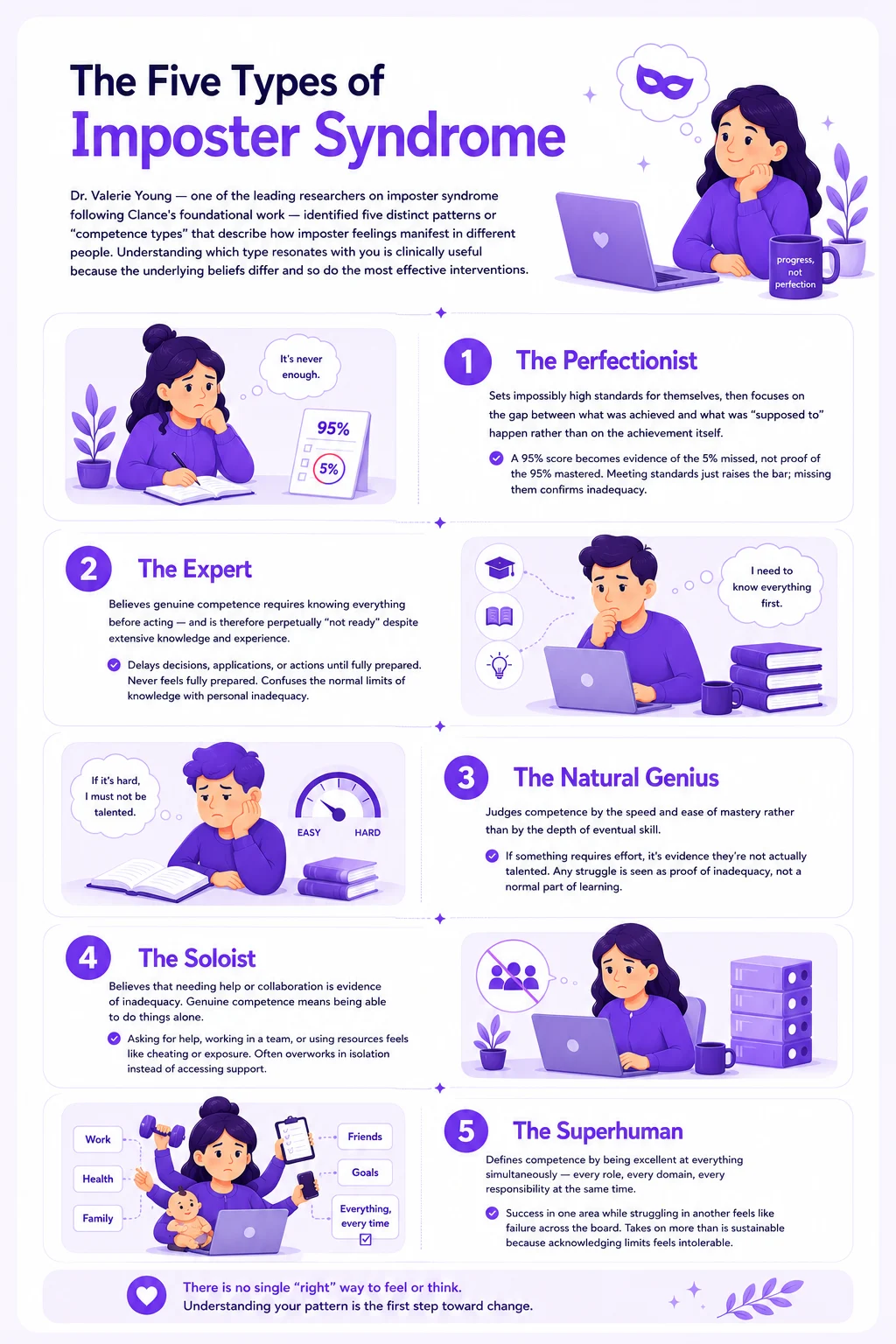
Dr. Valerie Young — one of the leading researchers on imposter syndrome following Clance’s foundational work — identified five distinct patterns or “competence types” that describe how imposter feelings manifest in different people. Understanding which type resonates with you is clinically useful because the underlying beliefs differ and so do the most effective interventions.
Sets impossibly high standards for themselves, then focuses on the gap between what was achieved and what was “supposed to” happen rather than on the achievement itself. A 95% score becomes evidence of the 5% missed, not proof of the 95% mastered. Failure to meet self-imposed standards is experienced as confirmation of inadequacy, while meeting them simply raises the bar.
Believes genuine competence requires knowing everything before acting — and is therefore perpetually “not ready” despite extensive knowledge and experience. Will delay decisions, applications, or actions until they feel fully prepared. Never feels fully prepared. Confuses the normal limits of any individual’s knowledge with personal inadequacy, rather than recognizing that expertise is always partial and contextual.
Judges competence by the speed and ease of mastery rather than by the depth of eventual skill. If something requires effort to learn, it’s evidence that they’re not actually talented at it — real ability, in this framework, means things should come effortlessly. Any struggle is experienced as proof of inadequacy rather than as evidence of the normal learning process.
Believes that needing help or collaboration is evidence of inadequacy. Genuine competence, in this framework, means being able to do things alone. Asking for assistance, working in a team, or using available resources feels like cheating or exposure. Often overworks in isolation rather than accessing support that would make the work easier and better.
Defines competence by being excellent at everything simultaneously — every role, every domain, every responsibility at the same time. Success in one area while struggling in another is experienced as failure across the board. Often takes on more than is sustainable because the alternative — acknowledging any limits — feels intolerable.
This Imposter Syndrome Test is modeled on the Clance Imposter Phenomenon Scale (CIPS), published by Dr. Pauline R. Clance in 1985. The CIPS is a 20-item self-report instrument using a 5-point Likert scale, with scores ranging from 20 to 100. It is the most widely used and validated measure of impostor feelings in both clinical and research contexts, with validated factor structure confirmed across multiple studies and cultural contexts.
The CIPS measures three empirically validated factors (Chrisman et al., 1995):
Anxiety about being “found out” as incompetent; persistent self-doubt despite objective evidence of competence. The belief that one is fooling others about one’s true level of ability.
The consistent pattern of dismissing, minimizing, or explaining away positive outcomes — attributing achievements to luck, timing, help from others, or low bar-setting rather than to one’s own skills and effort.
Attributing success specifically to chance, fortunate circumstances, or factors outside one’s control — and anticipating that the luck will eventually run out, at which point the “real” (inadequate) self will be revealed.
Answer each question based on what is most honestly true for you — not how you think you “should” feel, or how you felt on your best or worst day, but what generally and consistently applies.
Total range: 20–100. This is a screening tool — it cannot diagnose imposter syndrome and imposter syndrome is not a clinical diagnosis. A significant score reflects meaningful impostor feelings that are worth taking seriously, understanding more deeply, and potentially working through with professional support.
| Score Range | Category | What It Suggests |
|---|---|---|
| 20 – 40 | Very Low — Few Imposter Indicators | Little to no consistent impostor feelings. You generally attribute your success to your own competence and don’t experience significant fear of exposure. |
| 41 – 60 | Occasional — Mild Imposter Feelings | Mild impostor feelings present in some contexts. You may occasionally doubt yourself or attribute success to luck but this is not pervasive or severely distressing. |
| 61 – 80 | Moderate — Significant Imposter Feelings | Significant impostor feelings across multiple domains. Self-doubt, fear of exposure, and difficulty internalizing success are consistent features of your experience. |
| 81 – 100 | High — Intense Imposter Feelings | Intense and pervasive impostor feelings. These patterns are very likely affecting your career decisions, relationships, wellbeing, and sense of self in significant ways. |
Imposter syndrome does not have a single cause — it develops from an interaction of family dynamics, personality factors, environmental context, and cultural pressures. Research has identified several consistent contributors.
Clance and Imes (1978) identified two family dynamic patterns that frequently produce impostor feelings. In one, the child is labeled as the “smart one” or “exceptional” within the family — creating a performance pressure and an identity that feels like it must be constantly maintained rather than genuinely deserved. In the other, the child receives contradictory messages: told they are capable but receiving responses that suggest otherwise, creating a chronic uncertainty about which version of themselves is accurate.
Imposter syndrome is particularly prevalent among people with strong perfectionist tendencies — for whom any gap between performance and a self-imposed ideal becomes evidence of inadequacy rather than evidence of the normal distance between aspiration and execution. High achievement motivation combined with perfectionism creates a set-up: the standards are always just ahead of the performance, so the performance never quite proves competence.
Imposter syndrome is significantly elevated in people from groups that are underrepresented in their field — by gender, ethnicity, socioeconomic background, or first-generation status. When the environment provides few people who look like you in positions of authority, when there are genuine external messages that you don’t fully belong, the internal impostor narrative has environmental support. The critical distinction: imposter syndrome is an internal distortion, but it is not always entirely internally generated. Sometimes the environment is actually sending messages that amplify it.
Academic institutions, competitive professional settings, and high-visibility creative industries are environments that structurally produce comparison and external evaluation — the conditions under which impostor feelings thrive. The more visible the evaluation, the more opportunities the impostor pattern has to activate.
Research has documented a strong overlap between ADHD and impostor syndrome, particularly in people who have compensated for executive function challenges through significant overwork and effort. The experience of working much harder than peers to achieve similar or comparable results — without understanding why — produces exactly the internal narrative that imposter syndrome describes: “I’m not really as capable as people think; I’ve just been trying harder than anyone realizes.” For people in this situation, addressing the ADHD produces significant improvement in the impostor feelings as a downstream effect.
Anxiety amplifies the fear-of-exposure component of imposter syndrome; depression amplifies the self-devaluation component. Both frequently co-occur with significant imposter feelings, and research confirms moderate correlations between CIPS scores and measures of anxiety (r = 0.472) and depression (r = 0.486) (MDPI Behavioral Sciences, 2025).
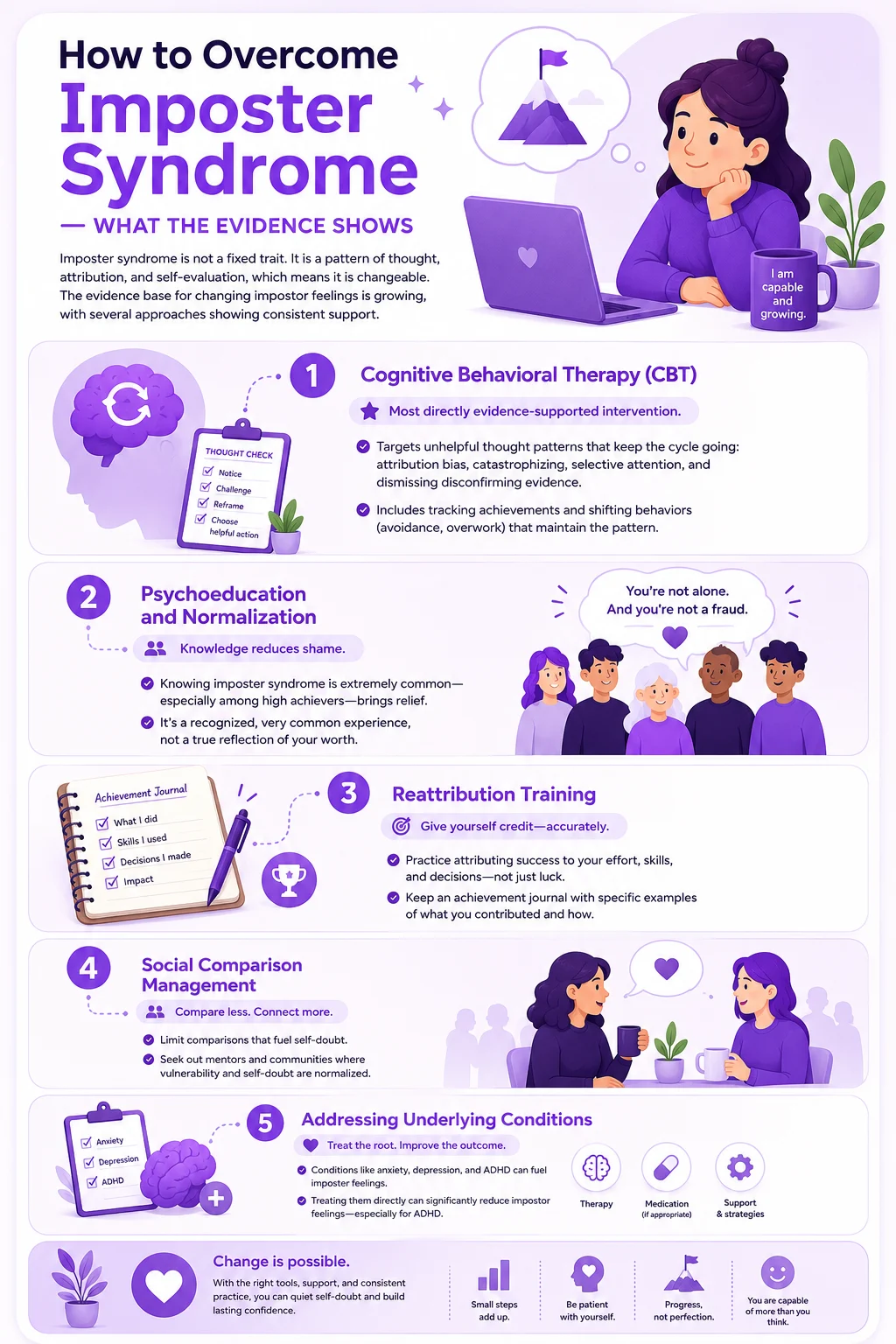
Imposter syndrome is not a fixed trait. It is a pattern of thought, attribution, and self-evaluation, which means it is changeable. The evidence base for changing impostor feelings is growing, with several approaches showing consistent support.
The most directly evidence-supported intervention for impostor syndrome. CBT for impostorism targets the specific thought patterns that maintain the cycle: the attribution bias (success = luck; failure = inadequacy), the catastrophizing about exposure, the selective attention to confirming evidence, and the dismissal of disconfirming evidence. Behavioral components include deliberately tracking achievements and the skills they required, and gradually changing the behaviors (avoidance, overwork) that maintain the pattern.
Simply knowing that impostor syndrome is extraordinarily common — and that its prevalence among high achievers specifically suggests it may be a byproduct of achievement orientation rather than evidence of actual inadequacy — is clinically useful. Many people experience significant relief from understanding that what they are experiencing is a recognized, named, very common phenomenon rather than accurate self-knowledge.
Deliberately practicing attributing success to internal factors — not as self-congratulation but as accurate accounting. Keeping an achievement journal with specific, concrete documentation of what you contributed, what skills you used, and what decisions you made is one of the most evidence-supported behavioral tools. The goal is not positive affirmation but accurate attribution.
Actively reducing the comparisons that the imposter pattern uses as evidence of inadequacy — and, where possible, seeking out evidence that others experience similar self-doubt. Mentorship relationships and communities where vulnerability about self-doubt is normalized are particularly effective environmental interventions.
Where anxiety, depression, or ADHD are contributing to imposter feelings, treating those conditions directly often produces significant improvement in impostor feelings as a downstream effect. This is particularly relevant for ADHD, where medication and/or behavioral supports that reduce the compensatory overwork can fundamentally shift the internal narrative.
Imposter syndrome — also called the imposter phenomenon, fraud syndrome, or perceived fraudulence — is a psychological pattern characterized by persistent self-doubt, inability to internalize success, and chronic fear of being “exposed” as less competent than others believe, despite objective evidence of achievement and competence. First identified by psychologists Dr. Pauline Rose Clance and Dr. Suzanne A. Imes in 1978, it is estimated to affect up to 70% of people at some point in their lives and is particularly prevalent in high-achieving, high-performance environments. It is not a formal DSM-5 diagnosis but a recognized psychological pattern that causes real distress and functional limitation at significant levels.
Not quite — the distinction is important. Low self-esteem is a generalized negative evaluation of one’s worth and value as a person. Imposter syndrome is more domain-specific and achievement-oriented: people with imposter syndrome often have adequate or even high self-esteem in general but experience acute self-doubt specifically around their competence and achievement. They feel fraudulent not about who they are as a person but about whether their accomplishments and the position they’ve achieved are genuinely deserved. Someone with low self-esteem may not pursue achievement at all; someone with imposter syndrome typically does pursue and achieve but can’t quite believe the achievement is real.
Imposter syndrome affects men and women at roughly equal rates, though men may be less likely to disclose impostor feelings due to social expectations around expressing vulnerability. It is particularly prevalent in high-performance environments — academia, medicine, law, competitive business, and creative industries — and is significantly elevated among first-generation professionals, people from underrepresented groups in their field, and people with perfectionist or high-achievement-oriented personality styles. It is also documented among people with ADHD who have compensated through overwork without understanding why they need to work so much harder than peers.
Yes — imposter syndrome is not a fixed trait but a pattern of thought and attribution that responds to intervention. Cognitive Behavioral Therapy (CBT) is the most evidence-supported approach, targeting the specific attribution biases (success = luck; failure = inadequacy), catastrophizing, and behavioral patterns (overwork, avoidance) that maintain the imposter cycle. Psychoeducation, reattribution practice, and social comparison management are also effective. Where anxiety, depression, or ADHD are contributing factors, treating those conditions directly often reduces impostor feelings significantly as a downstream effect.
Yes — and this is one of the most important things to understand about imposter syndrome. Its prevalence is specifically elevated among high-achieving individuals in competitive environments. This is not a coincidence: the achievement orientation, perfectionism, and external evaluation that characterize high-performance environments are precisely the conditions that produce and maintain impostor feelings. The pattern is most intense precisely in the people who, objectively, have the least reason to doubt their competence — which is part of what makes it so insidious and so painful.
Healthy self-doubt is proportionate, evidence-responsive, and motivating — it identifies real gaps and drives genuine improvement. Imposter syndrome is disproportionate, evidence-resistant, and draining — it persists despite contradicting evidence, reframes success as irrelevant or lucky, and produces anxiety and avoidance rather than directed growth. The test is whether positive evidence changes the feeling: genuine self-assessment updates when you succeed or receive feedback; imposter syndrome explains away the evidence and maintains the doubt regardless. If you’ve been working hard, achieving results, and receiving recognition — and you still can’t shake the feeling that it’s all about to collapse — that gap between external evidence and internal experience is the signature of imposter syndrome.
Both spellings are correct and both are widely used. The original clinical term coined by Clance and Imes (1978) uses “impostor” — the traditional Latin-derived spelling. “Imposter” is the more common modern spelling in general English usage. Both appear in clinical literature and everyday use. This test uses both interchangeably — they refer to exactly the same phenomenon.
Imposter feelings sometimes say more about the environment than the person in it. Should I Quit My Job? helps separate a role that is a poor fit from self-doubt that would follow you anywhere.
Imposter syndrome frequently co-occurs with or is influenced by other psychological patterns. These are the most clinically relevant companion assessments:
For more emotional and trait assessments, visit our Emotional and Trait Assessments collection.
Emotional and Trait Assessments · Personality
Big Five Personality Test: Discover Your OCEAN Traits


Emotional and Trait Assessments · Personality
Introvert Test: Are You an Introvert, Extrovert, or Ambivert?
Sexual Orientation & Gender Identity
Am I Straight? Take This 15-Item Quiz and Explore Your Identity

Here you'll find all collections you've created before.