

Big Five Personality Test: Discover Your OCEAN Traits
A 25-item adult personality measure scoring all five OCEAN traits: openness, conscientiousness, extraversion, agreeableness and neuroticism. See where you sit on each trait, rather than being sorted into a single type.
Published Updated
This free Big Five personality test measures your personality across the five dimensions that decades of research have identified as the most scientifically robust way to describe who we are: Openness, Conscientiousness, Extraversion, Agreeableness, and Neuroticism — together known by the acronym OCEAN. Unlike tests that sort you into a single “type,” the Big Five gives you a position on all five traits, because that’s how personality actually works. You’ll get an instant, private result showing where you fall on each one.
The Big Five (also called the Five-Factor Model) is the framework most personality psychologists trust — and this test is built on the public-domain International Personality Item Pool (IPIP), the same research-grade foundation used in hundreds of academic studies. There are no “good” or “bad” results here: every trait is a spectrum, and both ends of each one come with real strengths. This is simply a way to understand your natural tendencies.
What Is the Big Five Personality Test?
The Big Five personality test is a scientifically validated assessment that measures five broad, independent dimensions of personality — openness, conscientiousness, extraversion, agreeableness, and neuroticism. It emerged from decades of research (notably the work of Lewis Goldberg, who popularized the “Big Five” label, and Paul Costa and Robert McCrae, who developed the Five-Factor Model), and it’s considered the gold standard in personality science because the same five dimensions keep appearing across cultures, languages, and studies.
The crucial thing that sets the Big Five apart from popular “type” tests is that it describes you along five continuous spectrums rather than sorting you into one of a handful of boxes. You’re not simply “an introvert” or “a type” — you have a level of each of the five traits, anywhere from low to high, and your unique combination is what makes up your personality profile. This is why the Big Five is more precise and more stable than type-based systems, and why it predicts real-life outcomes (like wellbeing, relationships, and work performance) better than most alternatives. This test uses items drawn from the public-domain IPIP Big Five markers to estimate where you fall on each dimension.
The Five Big Five Traits (OCEAN)
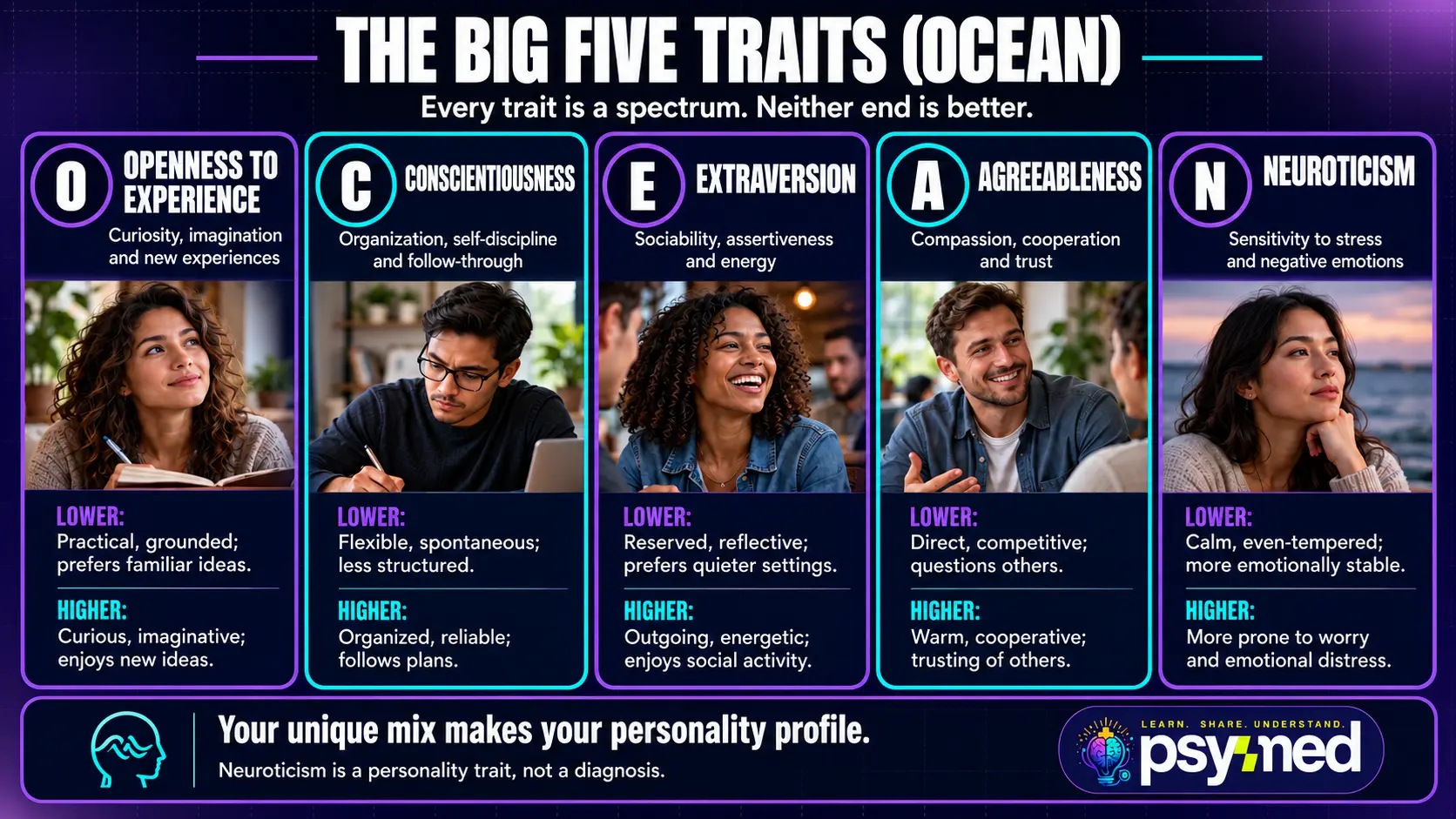
Each of the five dimensions is a spectrum from low to high, and — importantly — neither end is better than the other; they simply suit different situations. Here’s what each one captures.
Openness to Experience
Openness reflects curiosity, imagination, and appetite for new ideas, art, and experiences.
- People high in openness tend to be inventive, curious, and drawn to novelty, variety, and abstract ideas.
- People low in openness tend to be practical, conventional, and grounded, preferring the familiar and concrete — a strength when consistency and realism matter.
Conscientiousness
Conscientiousness reflects organization, self-discipline, and goal-directed behavior.
- People high in conscientiousness are organized, reliable, and hardworking (this trait is the strongest Big Five predictor of job performance and even longevity).
- People low in conscientiousness are more flexible, spontaneous, and relaxed about structure — which can bring adaptability and ease, though sometimes at the cost of follow-through.
Extraversion
Extraversion reflects where you get your energy and how you engage socially — its facets include sociability, assertiveness, and energy level.
- People high in extraversion are outgoing, energetic, and stimulated by social interaction.
- People low in extraversion (more introverted) are reserved and reflective, drawing energy from quieter settings and smaller groups — which supports depth, focus, and independence.
Agreeableness
Agreeableness reflects how you treat and relate to others — its facets include compassion, respectfulness, and trust.
- People high in agreeableness are warm, cooperative, empathetic, and trusting.
- People low in agreeableness are more direct, competitive, and skeptical — which can be a real strength in negotiation, critical analysis, and standing firm, even if it reads as blunt.
Neuroticism (Emotional Stability)
Neuroticism reflects how strongly and often you experience negative emotions like anxiety, sadness, and stress; its opposite pole is called emotional stability.
- People high in neuroticism feel emotions intensely and are more sensitive to stress (which can also mean deep emotional awareness and empathy).
- People low in neuroticism (high in emotional stability) tend to be calm, even-keeled, and resilient under pressure.
Note: this is a normal personality dimension, not a measure of mental illness.
Why the Big Five Is the Most Scientific Personality Test
The Big Five earns its “most scientific” reputation because it was discovered in the data rather than invented by a theorist — and that origin is why it holds up where popular type tests don’t. Researchers analyzed the words people across many languages use to describe personality, and the same five dimensions kept emerging statistically, again and again.
That gives the Big Five three big advantages.
- Validity and reliability: the five traits are stable over time and have been replicated across cultures, with the public-domain IPIP scales correlating strongly with gold-standard commercial instruments.
- Predictive power: Big Five traits meaningfully predict real outcomes — conscientiousness predicts job performance and health, neuroticism predicts mental-health vulnerability, and so on.
- Precision: because it measures continuous traits rather than sorting you into a type, it captures the full range of human personality instead of forcing people into boxes.
By contrast, popular type-based tests (like the 16-type/MBTI-style systems) are more intuitive and fun but less scientifically reliable, partly because splitting continuous traits into either/or categories means a small change can flip your whole “type.” If you enjoy the readable type format, our broader personality test presents Big Five traits in that style — while this page gives you the pure, trait-by-trait scientific picture.
How This Test Works
This test has 25 statements — five for each of the five traits. For each, choose how much you agree, thinking about how you generally are rather than how you’d like to be:
- Strongly Disagree = 0
- Disagree = 1
- Neutral = 2
- Agree = 3
- Strongly Agree = 4
Unlike most quizzes, the Big Five isn’t a single total — you get five separate scores, one per trait, each from 0 to 20. You answer all 25 statements once, and your results are reported as five separate trait scores rather than one combined number — because a single total would tell you nothing about your personality. A score of 0–7 is Low, 8–12 is Moderate, and 13–20 is High on that trait. Answer honestly; your results are private, and there are no right answers.
For reference, here are all 25 statements grouped by the trait each one measures:
Openness (questions 1–5):
- I enjoy exploring new ideas, concepts, and ways of thinking.
- I have a vivid imagination and a rich inner world.
- I’m drawn to art, music, beauty, or creative expression.
- I like variety, novelty, and trying things I haven’t done before.
- I enjoy thinking about abstract or philosophical questions.
Conscientiousness (questions 6–10):
- I like to keep things organized and in order.
- I follow through on my plans and finish what I start.
- I pay attention to details and do things thoroughly.
- I’m self-disciplined and can make myself do what needs to be done.
- I work steadily toward my goals.
Extraversion (questions 11–15):
- I feel energized by being around other people.
- I enjoy being the center of attention or starting conversations.
- I’m talkative and comfortable speaking up in groups.
- I seek out social gatherings and lively activities.
- I’m generally enthusiastic, upbeat, and full of energy around others.
Agreeableness (questions 16–20):
- I feel genuine compassion and concern for other people.
- I tend to trust others and assume good intentions.
- I go out of my way to be considerate and helpful.
- I prefer cooperation and harmony over competition and conflict.
- I’m warm and sympathetic toward people’s feelings.
Neuroticism (questions 21–25):
- I often feel anxious, worried, or tense.
- My mood can change quickly or feel intense.
- I get stressed or overwhelmed more easily than most people.
- I tend to dwell on things that go wrong or worry about the future.
- I often feel self-critical, insecure, or down.
Understanding Your Results
Your result isn’t a single score or a “type” — it’s a profile across all five traits, each read on its own. Your result gives each trait its own score out of 20, and the ranges below tell you how to read it. Remember: there is no best profile. Every combination has strengths, and your mix is simply you.
| Trait Score (per trait) | Level | What It Means |
|---|---|---|
| 13 – 20 | High | You express this trait clearly more than most people. |
| 8 – 12 | Moderate | You’re around average — you show this trait in some situations but not others. |
| 0 – 7 | Low | You express this trait clearly less than most people (which has its own strengths). |
Openness — High (13–20): You’re curious, imaginative, and drawn to new ideas, creativity, and variety. Low (0–7): You’re practical, grounded, and prefer the familiar and proven — a strength when realism and consistency matter.
Conscientiousness — High (13–20): You’re organized, disciplined, and reliable, and you follow through — the trait most linked to achievement and health. Low (0–7): You’re flexible, spontaneous, and easygoing about structure, which brings adaptability.
Extraversion — High (13–20): You’re outgoing and energized by people and activity. Low (0–7): You’re more reserved and reflective, recharging in quieter settings — which supports focus and depth. (Our Introvert Test explores this trait in depth.)
Agreeableness — High (13–20): You’re warm, trusting, cooperative, and empathetic. Low (0–7): You’re direct, competitive, and skeptical — valuable for negotiation, critical thinking, and standing your ground.
Neuroticism — High (13–20): You feel emotions intensely and are sensitive to stress (often with deep emotional awareness). Low (0–7): You’re calm, even-keeled, and resilient under pressure (high emotional stability). This is a normal trait, not a measure of mental illness — though if stress or low mood is affecting your life, our Anxiety Test may be worth taking.
What Your Big Five Profile Says About You
The real insight of the Big Five comes from your combination of traits, not any single score — because the five dimensions interact to shape how you think, work, and relate. A person high in openness and low in extraversion might be a creative who works best alone; someone high in conscientiousness and high in agreeableness tends to thrive in collaborative, dependable roles. There’s no “ideal” profile, and every combination brings its own strengths and challenges.
It’s also worth knowing that your Big Five traits are relatively stable but not fixed — they tend to shift gradually across the lifespan (people often become more conscientious and agreeable, and less neurotic, with age), and deliberate effort and life experience can move them over time. So your profile is a snapshot of who you are now, and a useful map for understanding your tendencies — not a cage. Use it to lean into your strengths, understand your growth edges, and appreciate how your particular mix shapes the way you move through the world. If you’d like to explore related facets of yourself, our Emotional Intelligence Test and Attachment Style Test add further angles.
Frequently Asked Questions
What are the Big Five personality traits?
The Big Five personality traits are five broad dimensions that psychologists use to describe personality, remembered by the acronym OCEAN: Openness (curiosity and imagination), Conscientiousness (organization and self-discipline), Extraversion (sociability and energy), Agreeableness (warmth and cooperation), and Neuroticism (how strongly you experience negative emotions; its opposite is emotional stability).
Each is a continuous spectrum from low to high, and everyone has a position on all five rather than belonging to a single “type.” The combination of your five levels makes up your personality profile. The Big Five is the most scientifically validated model of personality, which is why it’s used in research and why this test is built on it.
Is the Big Five test scientifically accurate?
Yes — the Big Five is the most scientifically validated and widely used model of personality in psychology. Unlike tests that were invented from a theory, the five traits were discovered statistically, emerging repeatedly from analyses of how people across many languages and cultures describe personality. The traits are stable over time, replicate across populations, and predict meaningful real-world outcomes like job performance, relationship satisfaction, and health.
This test uses items based on the public-domain International Personality Item Pool (IPIP), a research-grade resource used in hundreds of peer-reviewed studies that correlates strongly with the leading commercial instruments. That said, any self-report test reflects how you see yourself on a given day, so treat your result as a well-informed snapshot rather than an absolute measurement.
What’s the difference between the Big Five and the 16 personalities / MBTI?
Both describe personality, but they work very differently. The Big Five measures five continuous traits, giving you a level (low to high) on each — so it captures the full range and nuance of personality. The 16-type / Myers-Briggs-style systems sort you into one of sixteen categories by splitting traits into either/or pairs. The type format is intuitive, memorable, and fun, which is why it’s so popular — but it’s considered less scientifically reliable, largely because forcing continuous traits into either/or boxes means a small difference can flip your whole “type,” and most people fall near the middle rather than clearly at one end.
The Big Five is favored in research for its stability and predictive power; the 16-type model is favored for its readability. Many people enjoy both — the Big Five for accuracy, the type format for a shareable summary.
Can your Big Five personality change over time?
To some degree, yes. The Big Five traits are relatively stable — your rank relative to other people tends to stay fairly consistent — but they’re not fixed, and they do shift gradually across life. Research shows predictable trends with age: people generally become more conscientious and agreeable, and less neurotic, as they move through adulthood (a pattern sometimes called the “maturity principle”).
Significant life experiences, relationships, roles, and deliberate personal effort can also move your traits over time. So while you won’t transform overnight, your personality is better understood as a slowly evolving profile than a permanent fixed type. This is encouraging: if there’s a trait you’d like to develop, change is gradual but genuinely possible.
Related Tests
- Personality Test (16 Types) — Big Five traits presented in the popular, readable four-letter type format
- Introvert Test — a deep dive into the Extraversion dimension
- Emotional Intelligence (EQ) Test — emotional skills, distinct from but related to personality traits
- Attachment Style Test — how you relate in close relationships
- Self-Esteem Test — how you feel about yourself, which interacts with your traits
- Empathy Test — measures empathy directly, a core component of the Agreeableness dimension
- Dark Triad Test — narcissism, Machiavellianism and psychopathy, which sit at the low end of Agreeableness and Conscientiousness
References
- Goldberg, L.R. (1992). The development of markers for the Big-Five factor structure. Psychological Assessment, 4(1), 26–42. [The Big Five markers behind the public-domain IPIP] doi.org
- McCrae, R.R., & Costa, P.T. (1987). Validation of the five-factor model of personality across instruments and observers. Journal of Personality and Social Psychology, 52(1), 81–90. [The Five-Factor Model] pubmed.ncbi.nlm.nih.gov
- John, O.P., & Srivastava, S. (1999). The Big Five trait taxonomy: History, measurement, and theoretical perspectives. In Handbook of Personality: Theory and Research (2nd ed., pp. 102–138). Guilford Press. [Standard overview of the OCEAN model] ocf.berkeley.edu
- International Personality Item Pool (IPIP). Public-domain Big Five markers and scales. [The item pool these statements are informed by] ipip.ori.org
- International Personality Item Pool (IPIP). Big-Five Factor Markers scoring key. [Per-trait scoring used as the model for the 0–20 trait bands] ipip.ori.org
Related Tests
See All Quiz →


You may also like
See All Quiz →