



Emotional and Trait Assessments
Are You a Psychopath? Take This Free Psychopath Test (PCL-R Based)
→
Take the free Dark Triad test to measure your levels of narcissism, Machiavellianism, and psychopathy across all three traits. Instant, private results.
Published Updated
This free dark triad test measures narcissism, Machiavellianism and psychopathy across 15 questions, scoring each trait out of 20 for a combined total out of 60. It is informed by the Short Dark Triad (SD3) framework and is a tool for reflection, not a diagnosis.
Most personality tests measure what is admirable. The Dark Triad measures something different: three traits that are socially aversive — associated with manipulation, callousness, and self-serving behavior — but that exist on a measurable spectrum in the general population. Most people have some degree of these traits. A minority have them in pronounced, consequential amounts. Where you fall on each dimension is a precise piece of self-knowledge with real implications for how you operate in relationships, workplaces, and competitive environments.
The term “Dark Triad” was coined by Dr. Delroy L. Paulhus and Dr. Kevin M. Williams at the University of British Columbia in their landmark 2002 paper in Personality and Individual Differences — the first empirical demonstration that narcissism, Machiavellianism, and subclinical psychopathy cluster together as an overlapping constellation of socially aversive traits while remaining meaningfully distinct from one another (Paulhus & Williams, 2002).
This dark triad test is inspired by the Short Dark Triad (SD3), developed and validated by Dr. Daniel N. Jones and Dr. Delroy L. Paulhus across four studies (total N = 1,063) and published in Assessment in 2014. 15 questions. Three result profiles. Instant, private results.
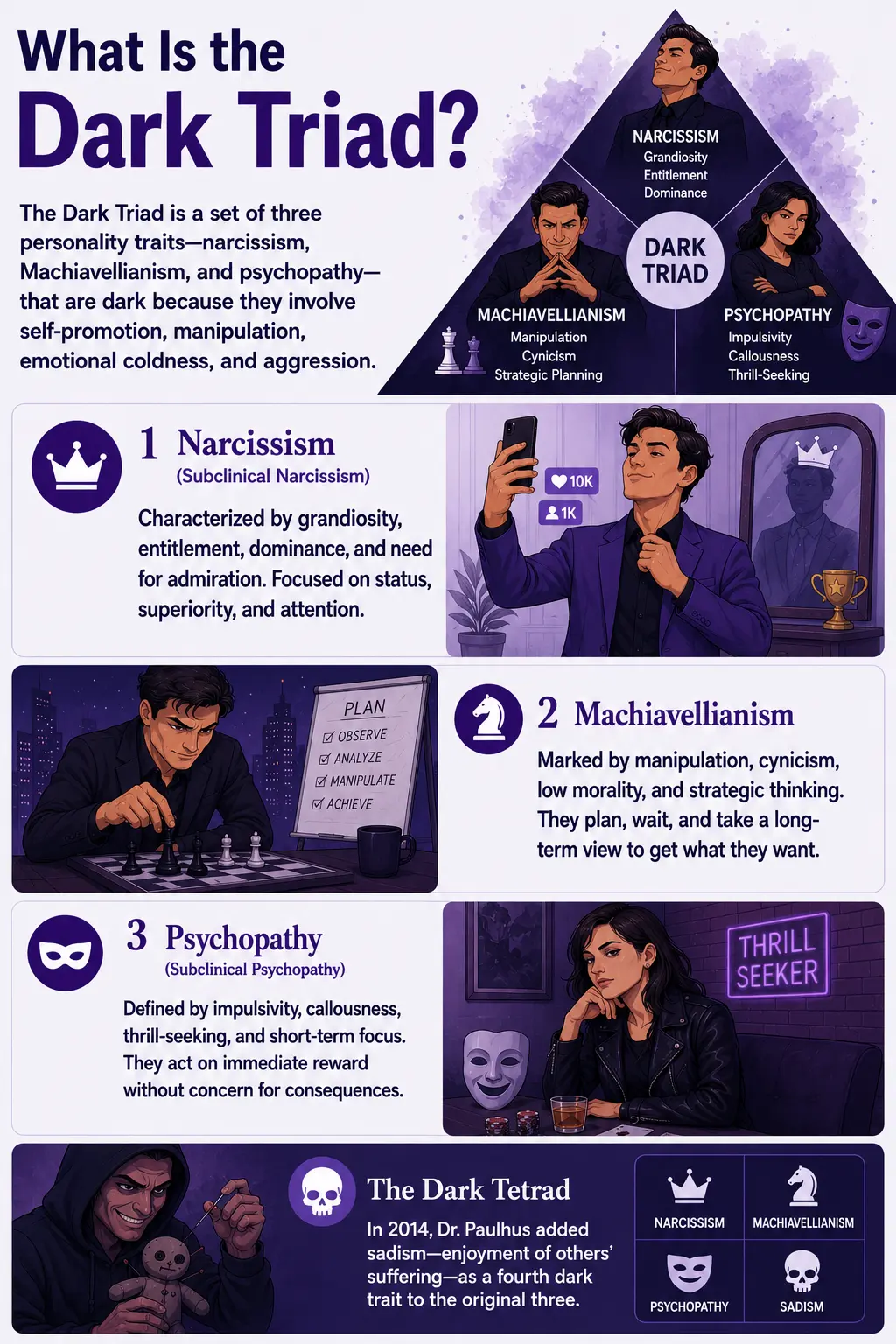
The Dark Triad refers to three overlapping but distinct personality traits that exist in the general (non-clinical) population as dimensions rather than categories. They are “dark” because all three share a socially malevolent character — to varying degrees, all involve self-promotion, emotional coldness, duplicity, and aggressiveness (Paulhus & Williams, 2002). They are a “triad” because they reliably co-occur: people who score elevated on one tend to score above average on the others, though each retains its own distinct features, correlates, and behavioral patterns.
Narcissism — grandiosity, entitlement, dominance, and an attention-seeking self-promotional orientation. The subclinical narcissism construct emerged from Raskin and Hall’s (1979) non-clinical version of Narcissistic Personality Disorder. In the SD3, narcissists are conceptualized as self-promoters who prioritize status and dominance. Unlike the other two Dark Triad traits, subclinical narcissism shows a small positive association with cognitive ability and is less consistently linked to antisocial behavior in non-competitive contexts (Paulhus & Williams, 2002).
Machiavellianism — named after Niccolò Machiavelli’s The Prince — describes strategic manipulation, a cynical worldview, low morality, and a long-term planning orientation. Machiavellians are the strategists of the Dark Triad: patient, calculating, information-managing, and oriented toward long-term advantage. The key distinction from psychopathy is impulse control — Machiavellians plan; psychopaths act. Both share low conscientiousness as a Big Five correlate (Paulhus & Williams, 2002).
Psychopathy (subclinical) — impulsivity, callousness, thrill-seeking, and short-term reward orientation. The key distinguishing feature from Machiavellianism is impulsivity: psychopaths act on immediate reward even when it undermines long-term interests; Machiavellians strategize. Subclinical psychopathy is distinguished in the Big Five by low neuroticism — a relative absence of the anxiety and worry that govern most people’s behavior. Published SD3 norms show psychopathy scores are systematically lower than the other two traits across community samples (Jones & Paulhus, 2014).
In 2014, Dr. Paulhus proposed extending the framework to a Dark Tetrad by adding everyday sadism — the disposition to derive pleasure from cruelty or others’ suffering — as a fourth trait. The Dark Tetrad remains an active research area.
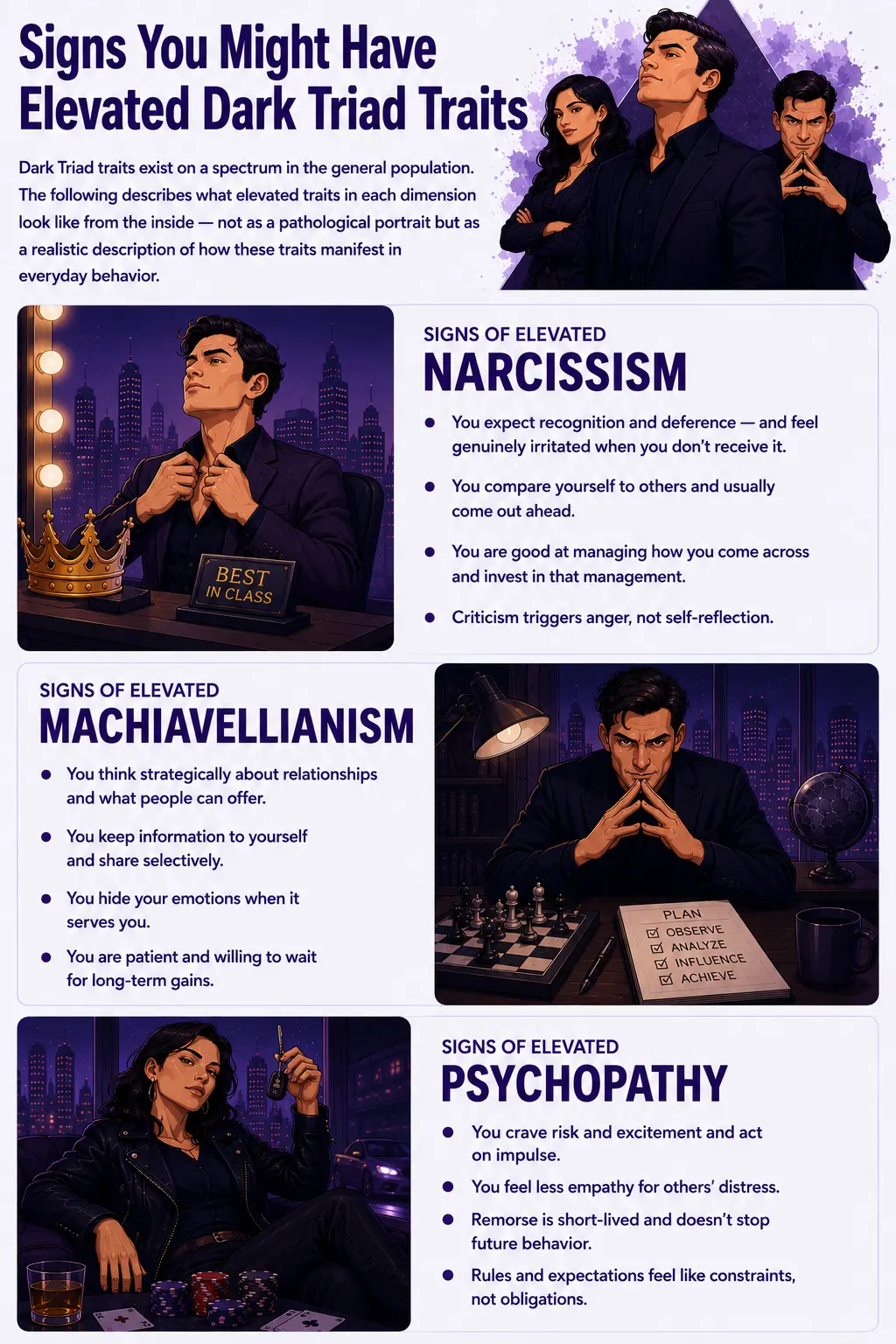
Dark Triad traits — narcissism, Machiavellianism, and psychopathy — exist on a spectrum that everyone falls somewhere on, not as all-or-nothing categories. Below are the behavioral and experiential patterns that most consistently signal elevated traits in each of the three dimensions. Recognizing several within one dimension suggests that trait may run high for you; this is self-reflection, not a diagnosis, and these are subclinical personality traits rather than mental illnesses.
Narcissism centers on grandiosity, a sense of superiority, and a persistent need for admiration and recognition.
Machiavellianism centers on strategic manipulation, a cynical view of others, and cool, goal-driven self-interest.
Psychopathy centers on impulsivity, thrill-seeking, low empathy, and shallow remorse.
| Feature | Narcissism | Machiavellianism | Psychopathy |
|---|---|---|---|
| Core drive | Status, dominance, recognition, grandiosity | Strategic advantage, long-term positioning, control | Immediate reward, stimulation, impulsive action |
| Manipulation style | Charm and impression management; aggression when ego is threatened | Calculated and patient; information managed strategically for long-term gain | Impulsive; lies for immediate reward even at the cost of long-term interests |
| Time orientation | Present — status and recognition are ongoing concerns | Long-term — can delay gratification for strategic advantage | Short-term — immediate reward takes priority over future consequences |
| Empathy profile | Selectively deployed; low in practice; egocentric processing | Cognitive empathy functional (used as a tool); affective empathy low | Both cognitive and affective empathy are reduced; callousness is the core feature |
| Key Big Five correlate | Low agreeableness; small positive link to cognitive ability | Low agreeableness; low conscientiousness | Low agreeableness; low conscientiousness; low neuroticism |
| Clinical spectrum | Subclinical to Narcissistic Personality Disorder | No formal DSM equivalent; overlaps with ASPD features | Subclinical to clinical psychopathy (PCL-R) / ASPD |
This Dark Triad personality test covers all three traits — narcissism, Machiavellianism, and psychopathy — across 15 questions, informed by the Short Dark Triad (SD3) framework developed by Jones and Paulhus (2014). Five questions address each trait: self-promotion and entitlement (narcissism), strategic manipulation and cynicism (Machiavellianism), and callousness and impulsivity (psychopathy).
For each question, choose how often the statement describes you:
Never = 0 | Rarely = 1 | Sometimes = 2 | Often = 3 | Always = 4
Your answers produce a combined score from 0 to 60, reflecting your overall elevation across the three Dark Triad dimensions. Your result also shows you how to identify which of the three traits drove your score — the pattern matters more than the number.
Answer honestly based on how you actually think and behave — not how you think you should. Answering defensively will produce a result that reflects what you wish were true rather than what is. The value of this assessment is in accurate self-knowledge, and it is private.
Your score reflects your combined elevation across all three Dark Triad dimensions, on a scale of 0 to 60. Before you read your band, one important framing point: these traits exist on a spectrum in the general population. Most people have some degree of them. A score is not a diagnosis, and the Dark Triad is not a personality disorder — it describes subclinical dimensions, not clinical categories.
| Score Range | Level | What It Suggests |
|---|---|---|
| 0 – 15 | Low Dark Triad Traits | Dark Triad traits are not prominent in how you operate. You tend toward empathy, cooperation, and straightforward dealing. |
| 16 – 30 | Moderate Dark Triad Traits | Some Dark Triad traits present at levels common in the general population — ordinary self-interest and situational strategy. |
| 31 – 45 | Elevated Dark Triad Traits | Dark Triad traits are meaningfully above average and likely shaping your relationships and working style. |
| 46 – 60 | High Dark Triad Traits | Dark Triad traits are pronounced across multiple dimensions, with predictable long-term costs to relationships and work. |
The combined number tells you your overall elevation. The pattern tells you far more. Look back at which questions you scored highest on — the three traits map onto specific items:
Narcissism — Questions 1, 4, 7, 10, 13 (superiority, entitlement, attention, image management, reaction to criticism).
Machiavellianism — Questions 2, 5, 8, 11, 14 (strategic manipulation, cynicism, information control, long-term positioning).
Psychopathy — Questions 3, 6, 9, 12, 15 (callousness, impulsivity, low remorse, risk-taking, emotional detachment).
Each dimension carries a maximum of 20 points. If most of your score came from one cluster, that trait is your dominant dimension — and the distinction genuinely matters. A person elevated primarily on Machiavellianism operates very differently from one elevated primarily on psychopathy: the first plans, the second acts. Our companion tests offer a more detailed picture of each dimension: the Narcissism Test, the Psychopathy Test, and the Antisocial Personality Disorder Test.
Dark Triad research is consistent about where these traits produce the most significant impact — and where their costs are most predictable.
Research by Jonason, Li, and Buss (2010) found that Dark Triad traits — particularly narcissism and psychopathy — are associated with short-term mating strategies, reduced commitment, and unhappy long-term relationships. Narcissism produces initial attraction and short-term social success, followed by long-term social detriments as entitlement and ego-threat reactivity erode relationship quality. Psychopathy’s callousness makes genuine intimacy structurally difficult. Machiavellianism’s information management means the partner of a highly Machiavellian individual never receives their authentic self.
A landmark meta-analysis by O’Boyle and colleagues (2012) of 245 independent samples (N = 43,907) found that Machiavellianism and psychopathy are consistently associated with reduced job performance quality, and all three Dark Triad traits are associated with counterproductive work behavior — including information hoarding, mistreatment of colleagues, and unethical conduct. A 2025 systematic review (Bueno-de la Fuente et al., Behavioral Sciences) found that leaders with high Dark Triad traits experience reduced performance, particularly in lower hierarchical roles.
The Dark Triad is a constellation of three socially aversive personality traits — narcissism, Machiavellianism, and psychopathy — identified by Dr. Delroy L. Paulhus and Dr. Kevin M. Williams at the University of British Columbia in their 2002 paper in Personality and Individual Differences. The three traits share a common core of disagreeableness, self-serving behavior, emotional coldness, and manipulation — but are distinct in their origins, Big Five profiles, and behavioral expressions. The term “Dark Triad” was coined to encourage researchers to study the three traits together, because each trait’s correlates are inflated when studied alone due to their overlap.
No. The Dark Triad describes subclinical personality dimensions — traits that exist on a spectrum in the general, non-clinical population. They are not diagnoses. At the extreme end of the narcissism dimension, there is Narcissistic Personality Disorder; at the extreme end of psychopathy, there is Antisocial Personality Disorder / clinical psychopathy — but those are clinically distinct thresholds. Most people who score high on the Dark Triad test do not meet the criteria for any personality disorder. This test cannot diagnose any condition.
The three traits overlap significantly — they all share low agreeableness as a Big Five correlate — but each is distinct. Narcissism is about grandiosity, entitlement, and dominance-seeking. Machiavellianism is about strategic manipulation, cynicism, and long-term planning. Psychopathy is about impulsivity, callousness, and short-term reward orientation. The critical distinction between Machiavellianism and psychopathy is time orientation: Machiavellians plan strategically across long time horizons; psychopaths act impulsively on immediate reward. Both are manipulative but in fundamentally different ways (Paulhus & Williams, 2002).
Research suggests they can be adaptive in narrow contexts. Narcissism is associated with leadership emergence and short-term social success in competitive environments. Machiavellianism can confer advantage where strategic information management is rewarded. Psychopathy’s low neuroticism and risk tolerance may be adaptive in high-stakes performance contexts. However, the consistent finding across the research is that all three traits are maladaptive in the long run — producing relationship instability, counterproductive work behavior, and social detriments that compound over time regardless of the short-term advantages they can produce (Paulhus & Williams, 2002; O’Boyle et al., 2012).
The Dark Tetrad adds a fourth trait — everyday sadism (taking pleasure in cruelty or others’ suffering) — to the original three Dark Triad traits. First proposed by Chabrol and colleagues in 2009 and developed further by Paulhus and colleagues, the Dark Tetrad is supported by research showing that sadism has incremental predictive validity beyond the original three traits in explaining harmful behavior (Buckels et al., 2013). The Dark Tetrad remains an active research area and is less standardized than the original Dark Triad.
This test is inspired by the Short Dark Triad (SD3), developed and validated by Jones and Paulhus (2014) across four studies (total N = 1,063). The SD3 is the most widely validated brief measure of Dark Triad traits, with Cronbach’s alpha coefficients of .70–.80 per subscale. This test is a screening tool — it provides a directional profile rather than a precise clinical measurement. The value is in the patterns it reveals, not in treating a specific score as a definitive characterization. For a more detailed assessment of specific traits, the individual companion tests provide greater depth.
Personality traits are relatively stable but are not fixed. Research on personality change shows that traits can shift with major life experiences, sustained therapeutic work, and natural maturation across the lifespan. Narcissism, in particular, tends to moderate with age. Schema Therapy — which addresses the developmental schemas underlying Dark Triad trait expression — has the strongest evidence base for meaningful change. The primary challenge is motivational: Dark Triad traits are typically ego-syntonic, experienced as assets rather than problems. The recognition produced by accurate self-assessment — including through instruments like this test — is frequently the starting point for the reflection that precedes meaningful change.
All three Dark Triad traits share low agreeableness as their only common Big Five correlate — the core feature of social antagonism that underlies all three (Paulhus & Williams, 2002). Beyond this shared core, each trait has a distinct Big Five profile: narcissism shows a small positive association with extraversion and cognitive ability; Machiavellianism and psychopathy both correlate with low conscientiousness; subclinical psychopathy is uniquely distinguished by low neuroticism — an absence of the anxiety and worry that characterize most personality profiles. This distinct pattern of Big Five correlates was one of the key findings that established the three traits as meaningfully distinct despite their overlap.
The Dark Triad describes traits at one end of the spectrum. For the mainstream profile most people are asking about, the free personality test measures the five broad dimensions instead, with no sign-up and a full result across 16 types. Low empathy is a defining marker of the Dark Triad. The emotional intelligence test measures the opposite end of that dimension, along with the four other components of EQ. This test measures all three dark traits together. If it is the strategic, calculating one you want to look at closely, the Machiavellian Test covers Machiavellianism on its own — the manipulative tactics, the cynical view of people, and the flexible approach to ethics that define it.
Emotional and Trait Assessments
Are You a Psychopath? Take This Free Psychopath Test (PCL-R Based)






Here you'll find all collections you've created before.