
Self-check · Identity
Coming Out Readiness: this measures your circumstances, not your courage
Five of these fifteen questions are about safety, housing and money. If those come back low, nothing is wrong with you — something is wrong with the situation, and the answer to that is a plan rather than more bravery. There is no deadline here and no way to fail.

Not a diagnosis, and not a verdict. Nobody is entitled to this information about you, whatever your score says.
-
IT IS ABOUT THEM, NOT YOUSafety, support, circumstancesA low score here describes the people around you, not your courage.
-
BEING OUT IS GOOD ON AVERAGEThe harm comes from the reactionOut at school predicted better adult adjustment once victimisation was accounted for.
-
PRIVATENothing is saved or sentFree, no account, no sign-up. Your result stays in your browser.
A 15-question self-check
Take the readiness check
Fifteen statements about your footing, your support and your safety. About two minutes.
Your result
What the ranges mean
- 0–15 Not a safe moment yet
- 16–30 Some footing, important gaps
- 31–45 Largely ready, worth planning
- 46–60 Well placed, if you want to
Fifteen statements scored 0 to 4 give a total of 0–60. Here the high end is the ready end: a higher score means more support and more safety, not more of a problem. The questions cover four things, and most of them are about your circumstances rather than about you.
LGB young adults reporting high family rejection were 8.4 times more likely to report a suicide attempt.
The short answer
What does coming out readiness actually mean?
Having enough support and enough safety that telling someone is unlikely to cost you your housing, your income or your physical wellbeing — and feeling settled enough in yourself that you are not relying on their reaction to tell you who you are. It is not a clinical concept and there is no validated scale for it. What there is good evidence about is what happens afterwards, and that evidence points in two directions at once, which is why this page is organised the way it is.
The four parts are worth separating because they move independently. A person can be entirely settled in their identity and completely dependent on a parent who would react badly; another can have total material security and no one they trust.
The question is not whether you are brave enough. It is whether the people around you have made it safe.
Ryan and colleagues, 2009 is the source for what this page says about family rejection: 224 LGB young adults aged 21 to 25, of whom those reporting high levels of family rejection in adolescence were 8.4 times more likely to report having attempted suicide, 5.9 times more likely to report high depression, and 3.4 times more likely to report illegal drug use, than peers from families with no or low rejection.
View sourceThe four parts
What the fifteen questions ask about
Four separate things, and most of them are about other people.
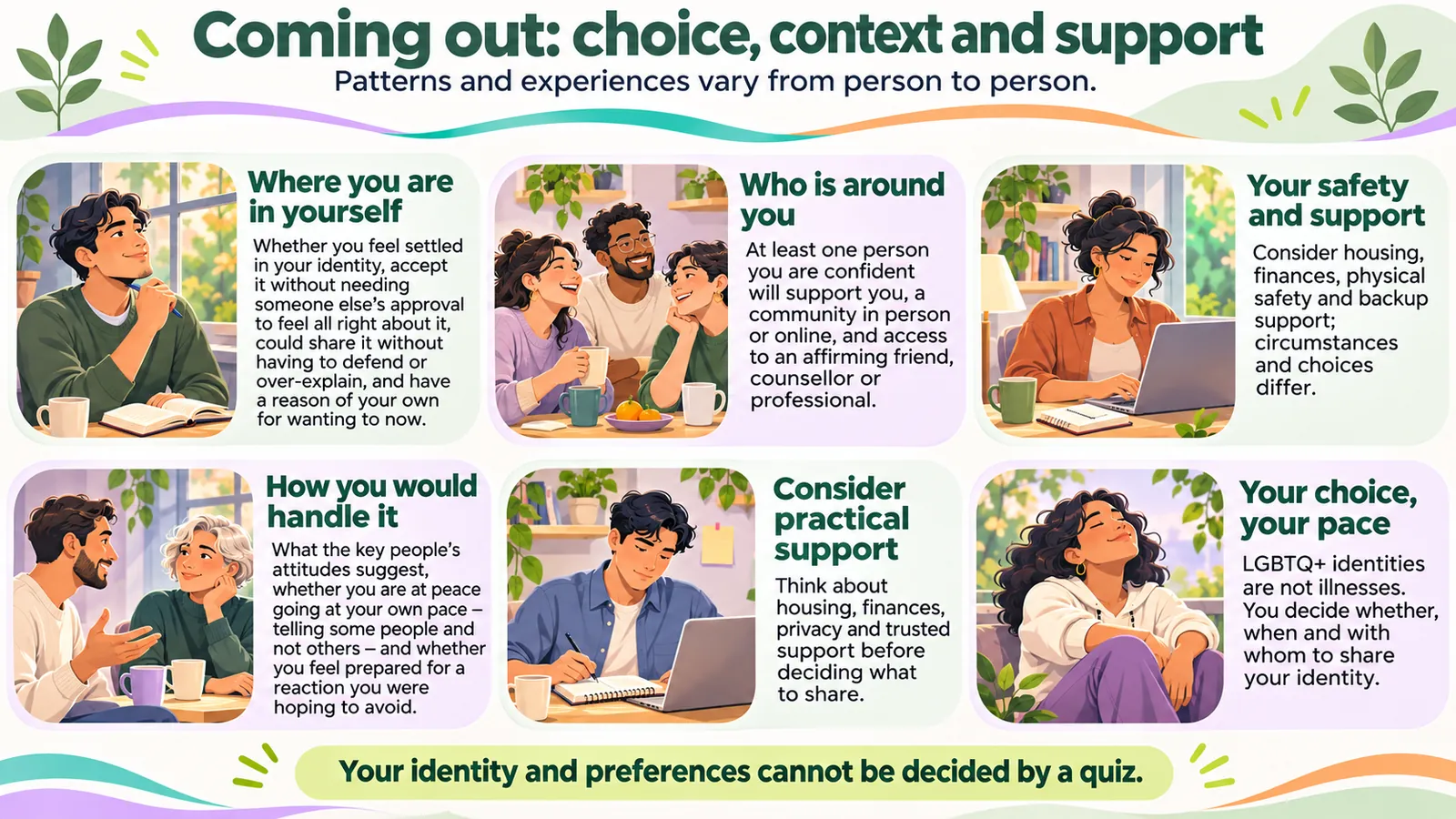
Where you are in yourself (questions 1–4)
Whether you feel settled in your identity, accept it without needing someone else’s approval to feel all right about it, could share it without having to defend or over-explain, and have a reason of your own for wanting to now.
Who is around you (questions 5–7)
At least one person you are confident will support you, a community in person or online, and access to an affirming friend, counsellor or professional. One reliable person is the single most protective thing on this list.
Whether you are safe (questions 8–12)
Financial independence from anyone who might react badly, housing and basic needs secure, physical safety from violence or abuse, no risk of being forced out of your home, and a backup plan. These five are the ones that can make “not yet” the correct answer.
How you would handle it (questions 13–15)
What the key people’s attitudes suggest, whether you are at peace going at your own pace — telling some people and not others — and whether you feel prepared for a reaction you were hoping to avoid.
Why safety is five of the fifteen
Because the evidence on what happens after a bad reaction is stark. Ryan and colleagues found LGB young adults who reported high family rejection in adolescence were 8.4 times more likely to report having attempted suicide than those from families with no or low rejection. That is a retrospective, self-reported association in 224 people rather than a prediction about you — but it is the reason a questionnaire about readiness has to ask about housing and violence rather than only about feelings.
Why there is no diagnosis here, and nothing to be ready for
Being lesbian, gay, bisexual, trans or anything else is not a condition and this is not a screening test. The only thing being assessed is your circumstances at this moment. There is no clinical threshold to cross and no one who gets to decide you have crossed it.
Out, not out, and partly out
Three positions, all of them legitimate.
| Position | What it looks like | What it means |
|---|---|---|
| Out where it is safe | Some people know, chosen deliberately. Others do not. | The commonest position, and a stable one. Not a half-measure. |
| Waiting on circumstances | Settled in yourself; housing, money or safety not yet in place. | A plan, not a failure. The gaps are specific and addressable. |
| Still working it out | The identity itself is the open question, not the telling. | A different stage. Readiness to disclose is not the question yet. |
| Is it bad for me to stay closeted? | Not as a moral matter, and the research does not support guilt about it. What it supports is that being out is associated with better adjustment later — Russell and colleagues found that once the effect of school victimisation was accounted for, being out at high school predicted positive psychosocial adjustment in young adulthood. Read carefully, that finding is about the benefit of being out in a setting where you are not being victimised. It is not an argument for coming out into a situation that is unsafe, and nobody is owed your disclosure. | |
Reading your result
What should you take from the number?
Three things more useful than the total.
- 01 Which part is low
Self, support, safety or handling
A high total with one safety question at zero is not a high score in any way that matters. Look at questions 8 to 12 on their own first; if any of them is low, that part comes before the rest regardless of the total. more useful than the total and it tells you what to work on.
- 02 Whether you need everyone, or one person
Coming out is not all-or-nothing
Telling one safe person is a complete and sufficient act. Many people stay in that position for years and are entirely well. Question 14 asks whether you are at peace going at your own pace, and a yes there is worth more than a high total.
- 03 What would actually happen
The measure that counts
Not how they might feel about it — what they would do. Where you would sleep, what money you would have, whether you would be safe. If you cannot answer those three, the finding that matters most is that the plan comes before the conversation.
It cannot tell you how anyone will react, which is the thing you actually want to know and the thing nobody can give you. It cannot measure your identity or confirm it, and it does not try. It has only your own read of the people around you, which may be too pessimistic or too hopeful. And it knows nothing about where you live — the legal and physical risk of being out varies enormously by country, and a score here does not account for that at all.
Things people ask early
The questions that come up first
Three worth answering before the detail.
Is there a right age or right time?
No. There is no deadline and no developmental window you are missing. The only timing that matters is whether the supports and the safety are in place.
Do I have to tell my family?
No. Family is often the hardest audience and the one with the most material power over a young person’s housing and money. Many people tell friends first, for years, and that is a complete position rather than a rehearsal.
What if I score low?
Then the test has done its job. It has told you which specific thing is missing, and every item on the list — one safe person, a backup plan, financial independence — is something that can be worked on.
What works
What actually helps before you tell anyone
Concrete and unromantic. The readiness that matters is logistical as much as emotional.
- 01 / START HERE
Find one safe person
Not the hardest person — the safest. One reliable supportive person changes everything that follows, and it does not have to be family. It can be a friend, a sibling, a counsellor or an online community. Ryan and colleagues’ work is about what happens when a family rejects; the counterpart finding across this literature is that support is what buffers it. If question 5 is low, that is the first thing to change, and it is the one most within your control. raise arousal came out at −0.02. That is nothing.
- 02 / IF SAFETY IS THE GAP
Make the plan before the conversation
If you are financially dependent on someone who might react badly, or your housing depends on them, the honest advice is to wait until that is not true, and to spend the waiting building the exit rather than the courage. Somewhere to go for a fortnight. Someone to call. Documents and money you can reach. This is not pessimism; it is the same planning anyone would do before a conversation with real stakes.
- 03 / WHATEVER YOUR SCORE
Decide what you want, not what you owe
Nobody is entitled to this information about you, and there is no obligation to be out to anyone. Disclosure is a tool for living more freely, not a debt or a test of integrity. If the only reason you are considering it is that someone has implied you owe them honesty, that is worth examining before anything else.
Background: Russell and colleagues, 2014. This page is educational and is not medical advice.
What to do next
What should you do with your result?
Three things, whatever the number said.
- 01
Look at questions 8 to 12 alone
Safety and money. If any of those is low, it comes first, whatever your total said.
- 02
Name one safe person
One. Not family unless family is safe. If you cannot name one, finding one is the whole task for now, and online counts.
- 03
Write the practical plan
Where you would sleep, what money you could reach, who you would call. Three lines. Then the conversation is a choice rather than a risk.
If coming out has put you at risk of violence or of losing your home, or if a conversation has already gone badly and you are struggling, please use one of these now rather than waiting. These lines exist specifically for this and the people answering them have heard it before. The Trevor Project is free, confidential and open 24/7 for LGBTQ+ young people: call 1-866-488-7386, text START to 678-678, or use the chat on their site. In the US you can also call or text 988 for the Suicide & Crisis Lifeline. Elsewhere, find a line at findahelpline.com. Needing help with this is not evidence that you were not ready. It is evidence that someone reacted badly, which is theirs and not yours.
Good questions to ask
Coming out readiness test — FAQs
What people actually ask before telling someone.
Readiness here is mostly circumstantial rather than emotional: one person you trust to support you, somewhere to live and money that does not depend on anyone who might react badly, physical safety, and a plan if a conversation goes wrong. If those are in place, the remaining question is only whether you want to. If they are not, “not yet” is the correct answer and not a failure of nerve.
Where housing, income or physical safety depend on someone who might react badly, yes, and the research is the reason this page says so rather than cheering you on. Ryan and colleagues found that LGB young adults reporting high family rejection in adolescence were 8.4 times more likely to report having attempted suicide. Waiting until you are not dependent on such a person is a reasonable plan rather than cowardice.
On average the evidence points that way, with an important qualification. Russell and colleagues found that after accounting for the association between school victimisation and later adjustment, being out at high school was associated with positive psychosocial adjustment in young adulthood. The benefit is real; so is the victimisation it has to be weighed against.
No, and the idea that you do is one of the more damaging things attached to the subject. Selective disclosure — some people, not others, in an order you choose — is a stable, common and entirely legitimate position, not a halfway house you are obliged to leave.
Then the material questions come first: whether you can be made homeless, whether your income depends on them, whether you would be physically safe. Build the practical answer before the conversation, and pick your first audience from outside that circle. An affirming friend or counsellor is worth more at that point than an honest conversation with someone who may react badly. LGBTQ+ Test is the place to start if the identity is still the open question.
You cannot get your own identity wrong, and it is allowed to change. People come out as one thing and later describe themselves as another; that is ordinary rather than embarrassing, and it is not evidence that the first disclosure was a mistake.
That turns on your legal protections and your workplace, which vary enormously by country and employer, and neither is something this test knows anything about. Treat it as a separate decision with its own safety questions rather than part of the same event.
Yes. The test is free, needs no account or sign-up, and your result appears only in your browser. Nothing is sent to us. Nothing you answer here is stored anywhere.
No. Plenty of people are out in some parts of their life and not others for decades, often for good reasons tied to family, culture, work or country. There is no schedule, and no one gets to tell you that you are behind on it.
Editorial transparency
Sources and review information
The fifteen statements cover where you are in yourself, who is around you, whether you are safe, and how you would handle a reaction. They were written for this site. They are not a clinical instrument and no score here is diagnostic — nor could it be, since being LGBTQ+ is not a condition and readiness is not a clinical concept. What this page states about family rejection and about being out comes from the two studies below. Written and reviewed by the PsyMed Editorial Team. We are writers and researchers, not clinicians, and this page is educational rather than diagnostic. Read how we build our tests and who we are.
Research and editorial references
- Ryan C, Huebner D, Diaz RM & Sanchez J (2009). Family rejection as a predictor of negative health outcomes in white and Latino lesbian, gay, and bisexual young adults. Pediatrics 123(1):346–352 — 224 LGB young adults aged 21 to 25. Those reporting high levels of family rejection during adolescence were 8.4 times more likely to report having attempted suicide, 5.9 times more likely to report high levels of depression, and 3.4 times more likely to report illegal drug use, compared with peers from families reporting no or low rejection. doi.org/10.1542/peds.2007-3524
- Russell ST, Toomey RB, Ryan C & Diaz RM (2014). Being out at school: the implications for school victimization and young adult adjustment. — American Journal of Orthopsychiatry 84(6):635–643. 245 LGBT young adults aged 21 to 25 in California. After accounting for the association between school victimisation and later adjustment, being out at high school was associated with positive psychosocial adjustment in young adulthood. doi.org/10.1037/ort0000037
- This page publishes no figure for how often coming out goes badly, because neither source measures that and no reliable general figure exists. It also publishes no country-by-country safety information, which matters enormously and which a questionnaire cannot supply.
- Both studies are retrospective, self-reported and small — 224 and 245 people, recruited in specific places. The odds ratios above are associations in those samples, not predictions about you. They are quoted because they justify asking about housing and safety at all, not because any number here forecasts what will happen in your family.
A questionnaire, not a verdict
Readiness is mostly about circumstances, and circumstances change. A low score describes this month, not you.
If your result pointed that way, the useful next steps are looking at the safety questions on their own, naming one safe person, and writing the three-line practical plan before any conversation.
Take the test