
Self-check · Temperament
Sensory Processing Sensitivity Test: how highly sensitive are you?
Fifteen statements across the four facets of the trait — depth, overstimulation, emotional reactivity and noticing subtleties. Free, private and nothing saved. A temperament trait, not a disorder.

Sensory processing sensitivity is normal variation in temperament, not a clinical condition. This is a self-reflection tool and does not reproduce the 27-item HSP Scale.
-
A TEMPERAMENT TRAIT15 statementsOn depth, overwhelm, emotion and noticing.
-
NOT A DISORDERNormal variationSensory processing sensitivity is a studied temperament trait, not a condition.
-
PRIVATENothing is saved or sentFree, no account, no sign-up. Your result stays in your browser.
Where you sit
Take the sensory processing sensitivity test
Answer for how you usually are rather than how you are on an unusual day. Fifteen statements, about two minutes, and the result appears only in your browser.
Your result
What the ranges mean
- 0–15 Low sensitivity — less affected by stimulation, steady under sensory pressure
- 16–30 Moderately sensitive — sensitive in some areas, not across the board
- 31–45 Highly sensitive — the depth and the overstimulation both clearly present
- 46–60 Very highly sensitive — strongly across all four facets
Each statement scores 0 (Strongly disagree) to 4 (Strongly agree), for a total of 0–60. These ranges are deliberately uncoloured, because no end of this scale is the good end: high sensitivity is not a problem and low sensitivity is not a deficit. They are four descriptive bands on a trait the research treats as continuous.
Share of 906 adults falling in the high-sensitivity group in a latent class analysis — alongside 40% medium and 29% low.
The short answer
What is sensory processing sensitivity?
A temperament trait describing how deeply a person processes what happens to them, and how easily that processing tips into overwhelm. It was identified by Elaine and Arthur Aron in 1997 across seven studies, which found a single underlying sensitivity variable and produced the 27-item Highly Sensitive Person Scale. The same work showed the trait is only partly related to introversion and emotionality, the two it had previously been confused with. “Highly sensitive person”, or HSP, is the popular name for scoring high on it.
The crucial point is that it is a two-sided trait rather than a vulnerability. Aron, Aron and Jagiellowicz describe crossover interactions, where the same trait produces better or worse outcomes depending on the environment it meets. Greven and colleagues put it plainly: sensitivity raises the risk of stress-related problems in negative environments and delivers greater benefit from positive and supportive ones. Whether it reads as a burden or an advantage depends heavily on circumstances.
Being highly sensitive is normal variation in temperament. It is not sensory processing disorder, not autism, and not anxiety.
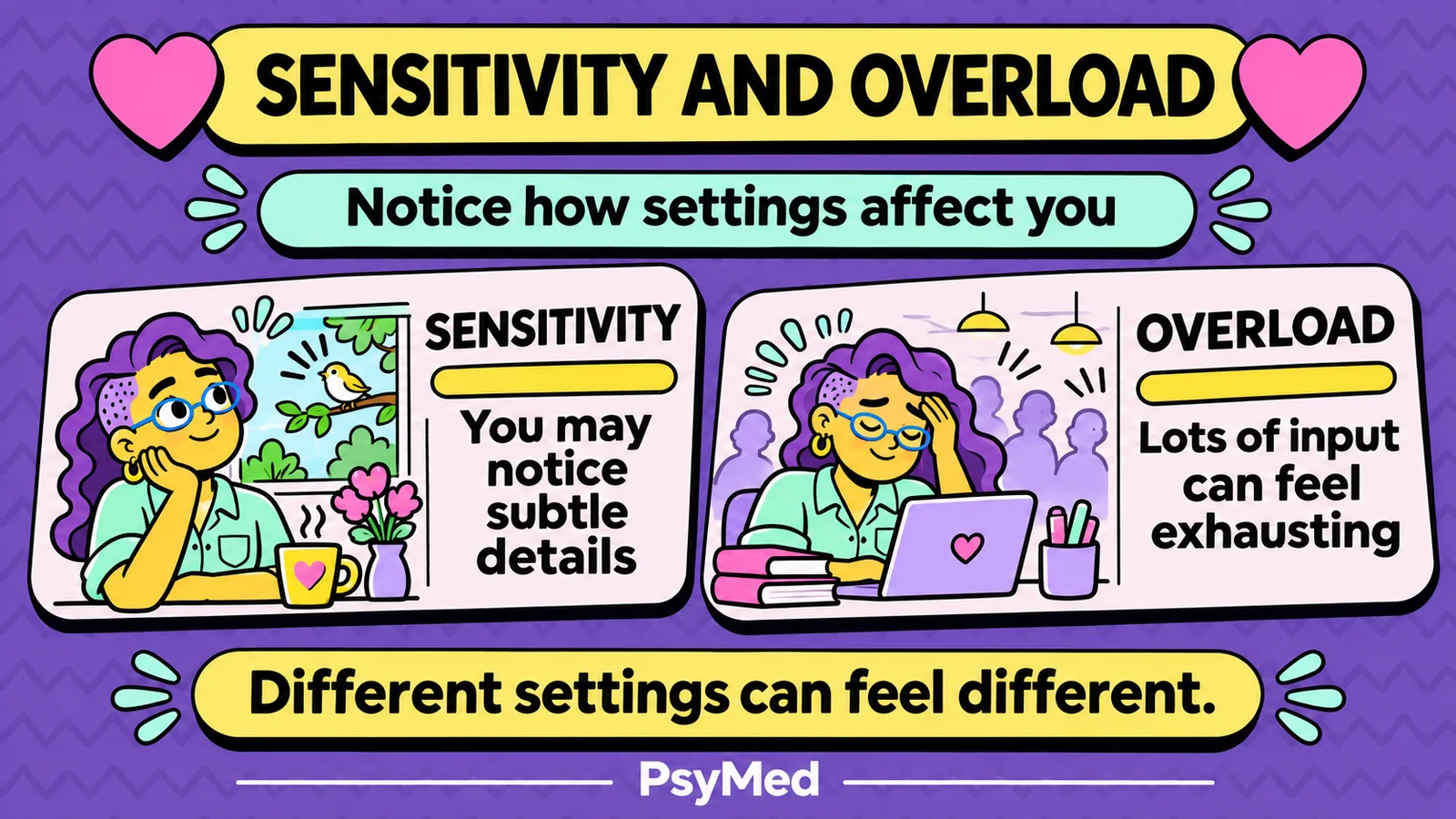
Greven and colleagues (2019) describe sensory processing sensitivity as a common, heritable and evolutionarily conserved trait reflecting differences in sensitivity to both negative and positive environments. The same review is candid about what is unsettled: whether sensitivity is best treated as continuous or categorical remains an open question, and the field still needs more reliable and objective ways to measure it.
View sourceThe four facets
What the questions are actually measuring
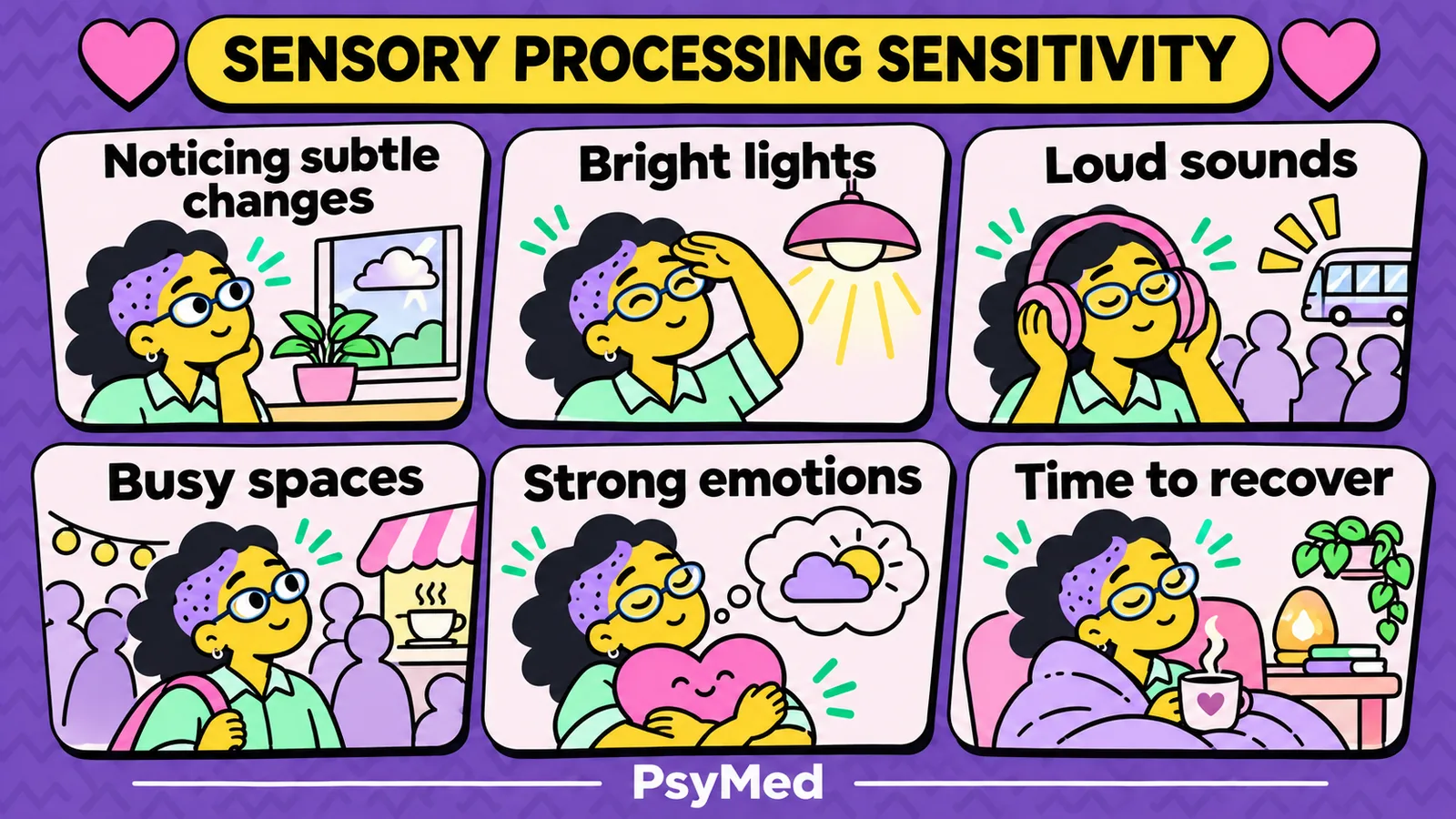
The trait is usually described through four facets, and they do not have to arrive together. Plenty of people are strong on two and unremarkable on the others, which is why the facet pattern tells you more than the total.
Depth of processing
Reflecting thoroughly, noticing layers and meanings others pass over, and disliking being rushed into decisions. This is the quiet, least visible facet and often the one people recognise last.
Overstimulation
Getting worn out by loud, busy or chaotic environments sooner than others do, feeling rattled under time pressure, and needing to retreat somewhere quiet to recover afterwards.
Emotional reactivity and empathy
Feeling things intensely, being moved easily by beauty or by other people’s situations, and absorbing the moods in a room. Often the facet people identify with most readily.
Sensing subtleties
Picking up small details and faint shifts — a change in someone’s tone, a difference in a room. Not sharper senses so much as closer attention to what the senses deliver.
What the research actually names
The 2012 review frames the hypothesised components as depth of processing, sensitivity to stimuli, emotional and physiological reactivity, and inhibition of behaviour. The four-facet phrasing above is the popular rendering of broadly the same ground.
Why the pattern beats the total
A person high on depth and empathy but untroubled by noise has a very different experience from one who is easily overwhelmed but not especially moved. Both can total the same score. Look at which statements you agreed with.
Sensitivity, introversion and overwhelm
Three things that look alike from outside and are not the same from inside.
| Trait | What it describes | What gives it away |
|---|---|---|
| Sensitivity | Depth of processing and ease of overstimulation. | You need quiet to recover, but you may still want company. |
| Introversion | Where you draw and spend social energy. | Company itself is the cost, regardless of noise or pace. |
| Overwhelm | A state, not a trait — it comes and goes. | It is new, or it tracks a stressful period rather than your whole life. |
| Can you be a sensitive extravert? | Yes, and a substantial minority of highly sensitive people are. The two traits were shown to be only partly related in the original 1997 research, which is the whole reason sensitivity needed a name of its own. | |
Or is it something else?
What this questionnaire cannot separate
Several quite different things produce answers that look alike here. This is the main limitation of a short self-report, and it is worth being concrete about.
- 01 Sensory conditions
Autism and sensory differences
Sensory sensitivity is also a feature of autism and of clinical sensory difficulties. The Greven review treats the relationship to atypical development as live research, not a settled boundary, and this questionnaire cannot tell them apart.
- 02 Burnout
Depletion that looks like sensitivity
If your overwhelm is recent, or tracks a demanding period rather than your whole life, exhaustion is the more likely explanation. Sensitivity is stable; burnout has a start date.
- 03 Anxiety
Reactivity with a different engine
Anxiety also produces heightened reactivity and a wish to withdraw, and it can sit alongside sensitivity. The difference is that sensitivity includes positive reactivity too — being deeply moved, not only unsettled — and anxiety is treatable where temperament is not a target.
The largest data-driven study of this found the trait to be continuous and normally distributed, and any threshold therefore depends entirely on where you choose to draw the line. Lionetti and colleagues used latent class analysis on 906 adults and found three groups rather than the two the popular account assumes: 31% highly sensitive, 40% medium and 29% low. The four ranges on this page are descriptive conveniences for reading your result, not those groups and not a diagnostic boundary.
Living with it
What people say actually helps
The practical advice is consistent and unglamorous, and it is about arranging recovery rather than becoming less sensitive.
Can sensitivity be reduced?
Not really, and that is not the goal. It is a stable, heritable trait. What changes is how much recovery you build in and how much avoidable stimulation you are carrying.
Is downtime self-indulgent?
No — for this trait it is maintenance. If stimulation costs you more to process, recovery is the cost of operating, not a reward for having coped.
Does the environment really matter that much?
More than for most traits. The evidence points both ways from the same wiring: worse outcomes in harsh environments, better outcomes in supportive ones. Choosing your conditions is unusually high-leverage here.
Living with it
Three things worth arranging
None of this is about fixing a trait. It is about not fighting it, which is mostly a matter of logistics.
- 01 / RECOVERY
Schedule the quiet, do not wait for it
Downtime taken only once you are already frayed arrives too late to work well. People who do best with this trait book recovery in before the stimulating thing, not after it.
- 02 / INPUT
Reduce the stimulation you did not choose
Much of the load is incidental — background noise, harsh light, notifications, an unnecessarily busy route. Removing avoidable input leaves more capacity for the input you actually want.
- 03 / OTHER PEOPLE
Boundaries around absorbing moods
If you take on the emotional weather around you, distance is a skill rather than a coldness. Noticing what someone feels and carrying it for them are two different things, and the second is optional.
Background: Aron, Aron & Jagiellowicz (2012), Sensory processing sensitivity: a review. This page is educational and is not medical or psychological advice.
What to do next
What should you do with your result?
The facet pattern is the useful part. The total mostly tells you how many of these fifteen statements happened to match your wording.
- 01
Read the facets, not the number
Which of the four you scored high on is what tells you something. Depth without overstimulation is a different life from overstimulation without depth.
- 02
Check the timeline
If this is recent rather than lifelong, look at burnout or a current stressor before temperament. Sensitivity does not have a start date; depletion does.
- 03
Change the conditions, not yourself
Because this trait responds so strongly to environment in both directions, adjusting your surroundings and recovery pays off more than trying to toughen up does.
A high score here is not a reason to seek help. But if sensory issues are significantly interfering with work, relationships or daily functioning — or if the overwhelm is recent and worsening — that deserves a proper conversation rather than a questionnaire, because autism, clinical sensory difficulties, anxiety and burnout all produce similar answers and this cannot tell them apart. If the overwhelm arrived with a demanding period, the burnout question is usually the more useful one to ask first — our burnout self-checkcovers it. Temperament does not need treating; exhaustion does.
Good questions to ask
Sensory processing sensitivity — FAQs
What people actually ask about being highly sensitive.
No. Sensory processing sensitivity is a temperament trait studied as normal human variation — Greven and colleagues describe it as common, heritable and evolutionarily conserved. It is not in any diagnostic manual, there is no treatment for it because there is nothing to treat, and scoring high identifies no condition. What it does carry is a practical implication: the same wiring does worse in harsh environments and better in supportive ones than average, which makes your circumstances matter more than they would otherwise.
It depends entirely on where the line is drawn, which is the honest answer. The trait is continuous and roughly normally distributed, so any percentage is a consequence of the chosen cut-off rather than a fact about the population. The largest data-driven attempt — a latent class analysis of 906 adults by Lionetti and colleagues — found three groups rather than two, with 31% in the highly sensitive group, 40% medium and 29% low. So the commonly quoted figure is lower than what that analysis produced, and neither number is a hard boundary.
No, and separating the two was the point of the original research. Aron and Aron showed sensory processing sensitivity to be only partly related to social introversion and to emotionality — it had previously been confused with or folded into both. A meaningful share of highly sensitive people are extraverted. Needing quiet to recover from stimulation is a different thing from finding company itself costly.
No, though they overlap in what you notice from outside, and a fifteen-statement questionnaire cannot distinguish them. Sensory sensitivity is a feature of autism and of clinical sensory difficulties, and the Greven review treats the relationship to atypical development as an open research question rather than a settled boundary. The practical test is interference: sensitivity is a temperament you arrange your life around, while difficulties that significantly disrupt work, relationships or daily functioning warrant a professional assessment, and the autism and sensory-processing self-checks below are the better starting points for that.
Quite possibly, and it is the most common confusion worth ruling out. Sensitivity is lifelong and stable; burnout has a start date and tracks a demanding period. Anxiety also produces heightened reactivity and withdrawal, and it can coexist with sensitivity. One distinguishing feature is that sensitivity includes positive reactivity — being deeply moved by beauty or music, not only unsettled by noise. If your answers here are recent rather than familiar, start with the Autism Test and the burnout and anxiety self-checks rather than with temperament.
The research supports neither framing on its own. Aron, Aron and Jagiellowicz describe crossover interactions, where one trait produces better or worse outcomes depending on the environment, and Greven and colleagues found that sensitivity both raises the risk of stress-related problems in negative environments and produces greater benefit from positive ones. So it is genuinely conditional. That is more useful than either the gift or the burden story, because conditions are the part you can sometimes change.
Not at all, and this is why the ranges on this page are not coloured from good to bad. Low sensitivity means being less affected by stimulation, staying steadier under sensory pressure, and moving through decisions efficiently. It is a different temperament with its own advantages, not a shortfall of an ideal. Roughly 29% of adults in the Lionetti analysis fell in the low group.
No. Aron and Aron’s 27-item Highly Sensitive Person Scale is not reproduced here. These fifteen statements were written by our team to cover the same four facets the trait is usually described through. That means your total here is not comparable to a published HSP Scale score, and no research cut-off applies to it.
Yes. The quiz is free, needs no account or sign-up, and your result appears only in your browser. Nothing is sent to us.
Editorial transparency
Sources and review information
This is a self-reflection questionnaire, not an assessment. Its fifteen statements are original statements written by our team to cover the four facets described in the literature below; the 27-item Highly Sensitive Person Scale is not reproduced. Content is written and reviewed by the PsyMed Editorial Team from the peer-reviewed sources listed here. We are writers and researchers, not clinicians, and this page is educational rather than diagnostic. Read how we build our tests and who we are.
Research and editorial references
- Lionetti, F., Aron, A., Aron, E.N., Burns, G.L., Jagiellowicz, J., & Pluess, M. (2018). Dandelions, tulips and orchids: evidence for the existence of low-sensitive, medium-sensitive and high-sensitive individuals. Translational Psychiatry, 8(1), 24 — latent class analysis of 906 adults; three groups, 31% high, 40% medium, 29% low; trait continuous and normally distributed. doi.org/10.1038/s41398-017-0090-6
- Aron, E.N., & Aron, A. (1997). Sensory-processing sensitivity and its relation to introversion and emotionality. Journal of Personality and Social Psychology, 73(2), 345–368 — seven studies; a unidimensional core sensitivity variable, partly independent of social introversion and emotionality; the 27-item HSP Scale. doi.org/10.1037/0022-3514.73.2.345
- Aron, E.N., Aron, A., & Jagiellowicz, J. (2012). Sensory processing sensitivity: a review in the light of the evolution of biological responsivity. Personality and Social Psychology Review, 16(3), 262–282 — on crossover interactions, and on depth of processing, sensitivity to stimuli, emotional and physiological reactivity, and inhibition of behaviour. Linked above.
- Greven, C.U., Lionetti, F., Booth, C., Aron, E.N., Fox, E., Schendan, H.E., Pluess, M., Bruining, H., Acevedo, B., Bijttebier, P., & Homberg, J. (2019). Sensory Processing Sensitivity in the context of Environmental Sensitivity: A critical review and development of research agenda. Neuroscience & Biobehavioral Reviews, 98, 287–305 — a common, heritable and evolutionarily conserved trait; raises risk in negative environments and brings greater benefit from positive ones; continuous vs categorical remains open. Linked above.
A trait, not a verdict
Neither end of this scale is the good end.
Read your result as a description of how you are wired and what conditions suit you, rather than as a score to improve. The research is clear that the same sensitivity does better or worse depending mostly on circumstances.
Take the test