
Self-check · Personality
Machiavellian Test: how strategic are you with people?
Fifteen statements on strategic influence, cynicism about people and how flexible morality feels — free, private and nothing saved. A subclinical trait everyone has to some degree, not a diagnosis.

Machiavellianism is normal personality variation and the only Dark Triad trait that is explicitly non-clinical. This scale is our own and is not comparable to MACH-IV scores.
-
A NORMAL TRAIT15 statementsOn strategy, cynicism and how flexible morality is.
-
SUBCLINICALNot a disorderThe only Dark Triad trait that is explicitly non-clinical. Everyone sits somewhere on it.
-
PRIVATENothing is saved or sentFree, no account, no sign-up. Your result stays in your browser.
Where you land
Take the Machiavellian test
Answer for how you generally think and act rather than how you would like to come across. Fifteen statements, about two minutes, and the result appears only in your browser.
Your result
What the ranges mean
- 0–15 Low — trusting, sincere and principle-led rather than strategic
- 16–30 Moderate — pragmatic in places, not a dominant style
- 31–45 Notable — a clear strategic streak balanced with other ways of relating
- 46–60 High — strategic, guarded and consistently outcome-focused
Each statement scores 0 (Strongly disagree) to 4 (Strongly agree), for a total of 0–60. This is our own scale. The research instrument, the MACH-IV, runs from 20 to 100 with roughly 60 and above treated as “high Mach”, so the two sets of numbers are not comparable and a score here cannot be read against published cut-offs.
Manipulative tactics, a cynical view of human nature, and a flexible approach to morality — the three the trait is usually described through.
The short answer
What is Machiavellianism?
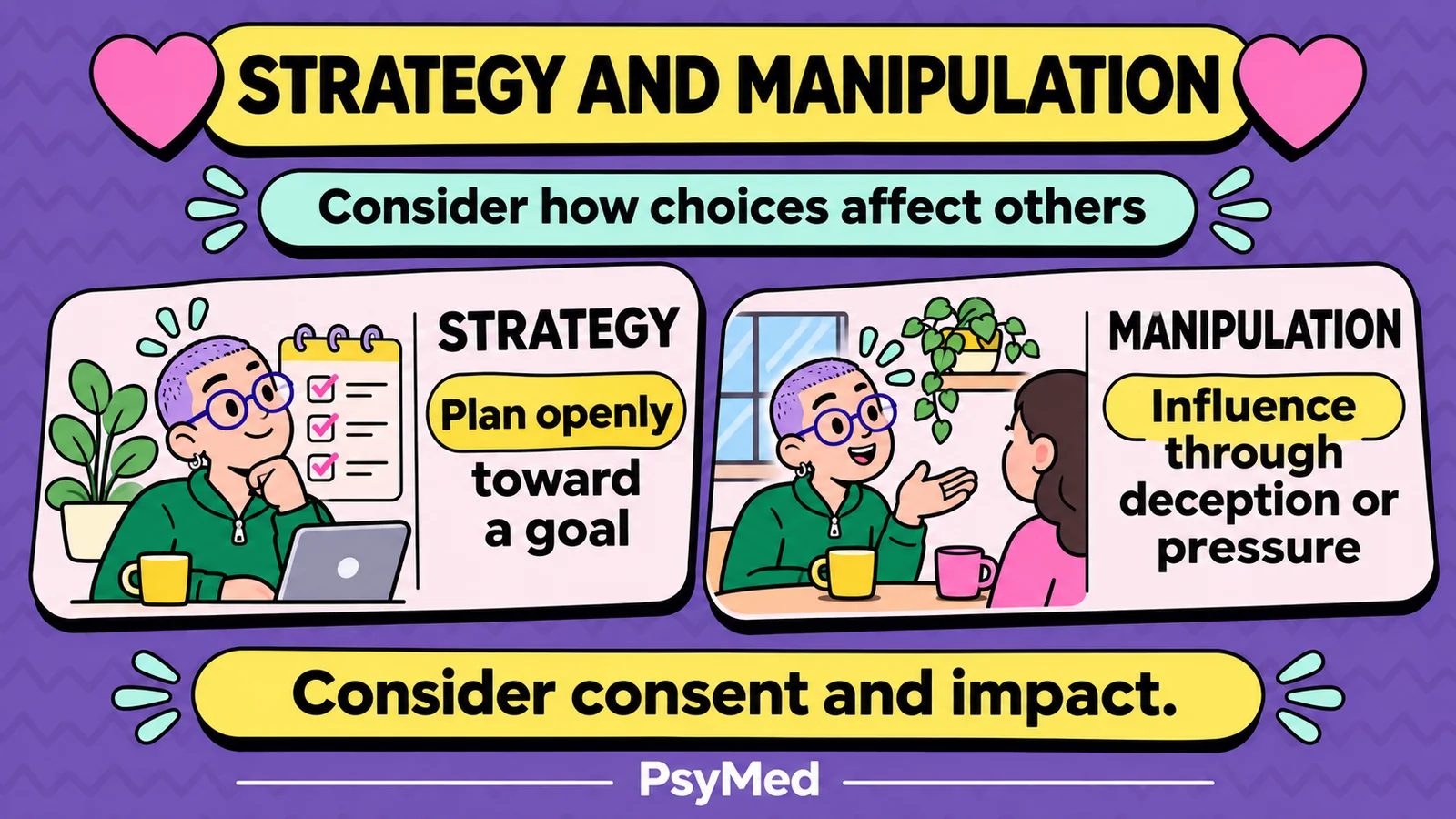
A personality trait combining strategic manipulation, a cynical view of other people, and a willingness to put self-interest ahead of principle. It was defined by Richard Christie and Florence Geis in 1970, who named it after Niccolò Machiavelli, the 16th-century author of The Prince, and built the MACH-IV scale to measure it. Paulhus and Williams later grouped it with narcissism and psychopathy as the Dark Triad — three traits that overlap in manipulativeness and low empathy while remaining distinguishable from one another.
The crucial qualifier is that it is subclinical. It is the only Dark Triad member explicitly described that way, meaning it maps ordinary variation in personality rather than any disorder. Everyone sits somewhere on it. What marks out high scorers is an instrumental approach to other people: strategic rather than warm, guarded rather than trusting, focused on outcomes rather than on principles.
A high score describes a style of operating. It is not a diagnosis, and there is no clinical threshold on this trait to cross.
Paulhus and Williams (2002) introduced the Dark Triad as a set of three overlapping but separable traits, which is the framing still used today. Jones and Paulhus later built the Short Dark Triad (SD3) as a brief measure, validated across four studies with 1,063 participants and checked against informant ratings — that is, against what other people said about the participants, not only self-report.
View sourceSigns
What does it look like in practice?
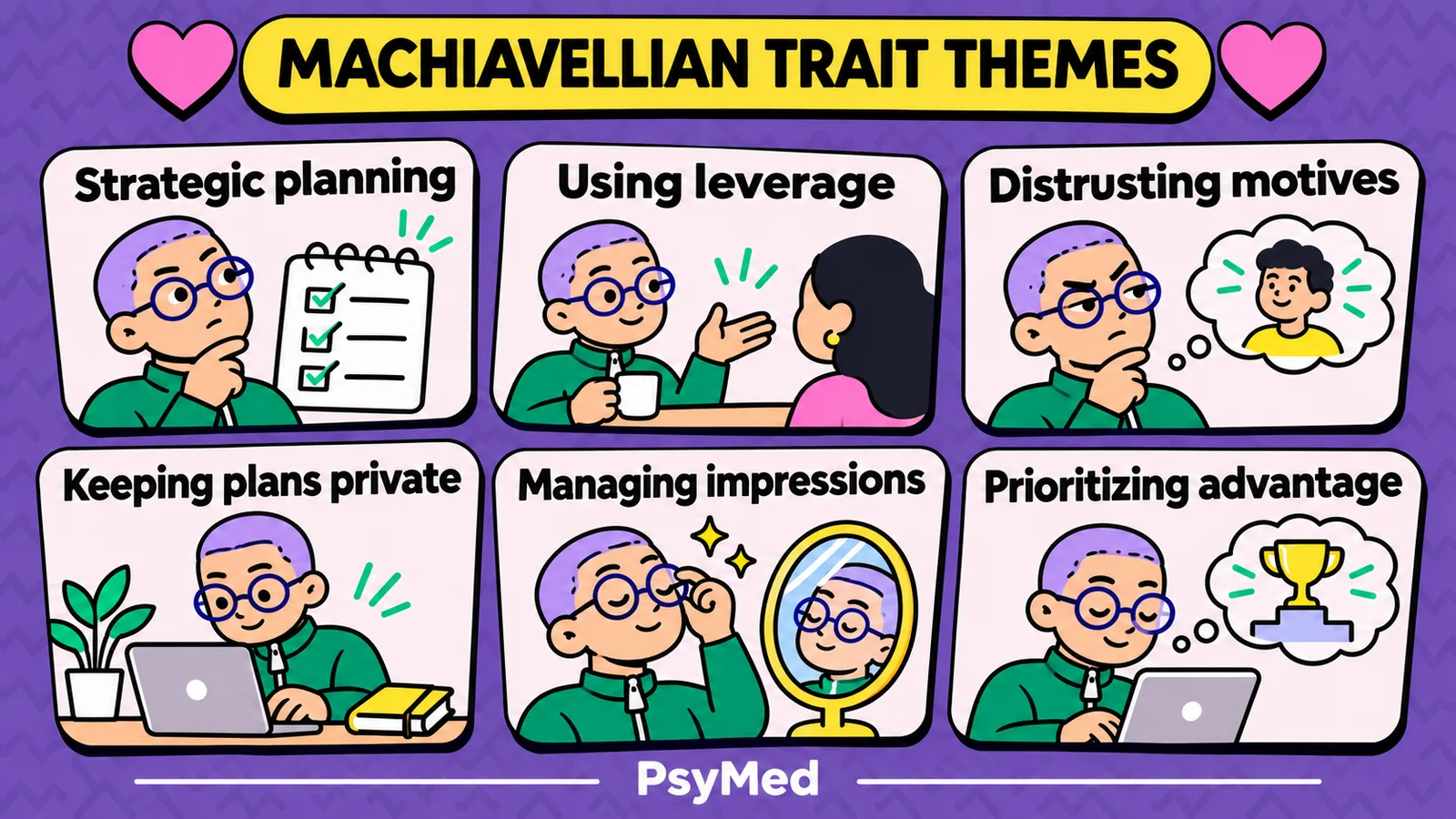
A recognisable and fairly consistent pattern in how someone approaches goals, relationships and other people. Everyone shows some of these; the question is how many fit as an ongoing style.
You approach people strategically
Interactions get thought about in terms of advantage — what can be gained, how to be positioned, who is useful. Relationships can feel more like moves than ends in themselves.
Influence feels like a skill, not a transgression
Flattery, charm, selective honesty and telling people what they want to hear come easily when they serve the goal, and produce little guilt. Managing people reads as competence.
You assume self-interest in others
Trusting people freely strikes you as naive, because you expect that most would exploit an advantage if they had one. Guardedness follows logically from that premise.
You stay cool when others heat up
Feelings rarely drive your decisions in charged moments. This is a real strength: the composure that lets you think clearly is the same composure that makes the strategy possible.
The ends can justify the means
When a goal matters enough, principles become negotiable. Morality reads as a flexible guideline rather than a fixed boundary, and pragmatism tends to beat idealism.
You hold your intentions back
You do not show all your cards. Real motives stay private, only what is useful gets revealed, and being underestimated is often an advantage rather than an insult.
The three Dark Triad traits side by side
They overlap in manipulation and low empathy, and differ in motive and style.
| Trait | Core | Style |
|---|---|---|
| Machiavellianism | Strategic manipulation, cynicism, self-interest. | Deliberate, patient, calculated, emotionally controlled. |
| Narcissism | Grandiosity and a need for admiration. | Ego-driven, attention-seeking, needs an audience. |
| Psychopathy | Callousness, low remorse, thrill-seeking. | Impulsive, reckless, emotionally flat. |
| Can you be high on one and low on the others? | Yes — that is precisely why they are measured separately. The three correlate without collapsing into one thing, which is the finding that made the Dark Triad a useful framework rather than a single label. | |
What this test looks at
The three strands these statements ask about
The fifteen statements group into the three dimensions the trait is usually described through. None is a diagnostic criterion.
- 01 Tactics
How you get what you want
Willingness to use deceit, flattery, charm or strategic influence, treating an interaction as something to be managed rather than shared. This is the behavioural core, and it is a skill as much as a disposition.
- 02 Cynicism
What you assume about people
The belief that people are fundamentally self-interested and that assuming otherwise is naive. In the original scale this strand carries much of the weight, because the worldview is what makes the tactics feel reasonable.
- 03 Flexible morality
Where principles sit
The sense that ethics bend to circumstances and that results matter more than rules. This is the strand people find hardest to admit to, so it is the one most often under-reported.
This is a house scale running 0–60. The MACH-IV, the instrument the research uses, runs 20–100 with roughly 60 and above conventionally treated as high Mach. The two are not interchangeable and no published cut-off applies to a score from this page. It also cannot distinguish a genuinely strategic disposition from a bad week, a competitive job, or an honest self-assessment made in a cynical mood.
Things people ask early
The questions that come up first
Three worth answering before the detail.
Does a high score mean I am a bad person?
No. It describes a style, not a moral verdict. Strategic thinking, composure under pressure and a realistic view of other people are useful capacities; what the score cannot see is what you actually do with them.
Is this trait fixed?
Personality traits are relatively stable, but the behaviour is not fixed. Plenty of people high on this trait choose not to act on much of it, which the score has no way of registering.
Can I be high on this and still have close relationships?
Yes, and many people do. The trade-off this trait carries is specifically to trust and closeness, so the cost tends to show up there first if it shows up anywhere.
Living with it
What to do with a high score
The aim here is not to become less capable. Strategic thinking and emotional composure are genuinely valuable. It is to notice the specific places where the style costs you something you wanted.
- 01 / THE ACTUAL COST
Watch what happens to closeness
This trait does not usually damage performance; it damages intimacy. Guardedness is efficient and it is also the thing that stops people getting close to you. If that is a trade you are making knowingly, fine. Most people are not making it knowingly.
- 02 / TEST THE PREMISE
Check the cynicism against evidence
The belief that people would exploit you given the chance is self-confirming, because guarded people rarely get the chance to be proved wrong. Try extending trust somewhere low-stakes and see what actually happens, rather than what you predict will.
- 03 / IF IT IS COSTING YOU
Empathy is trainable in a way the trait is not
The usual fulcrum is not becoming less strategic but becoming more accurate about other people’s inner states — which is a skill that improves with attention. Our empathy and emotional-intelligence self-checks give a separate reading on that.
Background: American Psychological Association, Machiavellianism. This page is educational and is not psychological advice.
What to do next
What should you do with your result?
Read it as a description of a style. The informative part is which of the three strands your score came from.
- 01
Separate the strands
Tactics, cynicism and flexible morality are three different things. High cynicism with low tactics is a wary person, not a manipulative one, and the total cannot tell them apart.
- 02
Consider who the cost lands on
The trade-off here is borne by the people around you before it is borne by you, which is why it can run for years without feeling like a problem.
- 03
See it beside the other two
This trait means something different depending on what it sits with. Alongside high empathy it often reads as shrewdness; alongside low empathy and low remorse it reads very differently.
People often arrive at a page like this thinking about someone in their life rather than themselves. If that is you, the useful question is not what their score would be but what the relationship is costing you — and whether what you are experiencing is strategy, or something closer to sustained manipulation. Our self-check on being manipulated is written for that question: am I being manipulated?. If someone is frightening you, or controlling your money, movements or contact with other people, that is a safety matter rather than a personality one and deserves proper support.
Good questions to ask
Machiavellian test — FAQs
What people actually ask about the trait.
No. It is a subclinical personality trait — the only Dark Triad member explicitly described that way — which means it maps ordinary variation rather than a disorder. It appears in no diagnostic manual, there is no threshold at which it becomes a condition, and everyone sits somewhere on the range. A high score describes how someone operates, not something wrong with them.
Motive and style. Machiavellianism is instrumental and patient: manipulation serves a goal, and the person is content to be underestimated if that helps. Narcissism is ego-driven: it needs admiration and an audience, and the grandiosity is the point rather than a means to one. The two correlate, and plenty of people score high on one and ordinarily on the other, which is exactly why they are measured separately.
Yes, and it is a real limitation of any self-report scale. The statements measure disposition and belief — whether you think people are self-interested, whether you find influence comfortable — and not what you actually do. Someone can hold a thoroughly cynical view of human nature and still behave with complete integrity, because beliefs and conduct are different things. The score cannot see conduct.
The trait is often associated with those fields, but this page will not claim a performance advantage, because the evidence on whether high scorers actually do better is mixed rather than settled. What can be said is narrower: the composure and forward planning that come with the trait are genuinely useful capacities, and the guardedness that comes with them has a cost in trust that tends to arrive later.
It does not, directly. This is a house scale running 0–60 and the MACH-IV runs 20–100, with roughly 60 and above conventionally called high Mach. The ranges simply are not the same instrument and converting between them would be invented arithmetic. If you want to see this trait beside the other two on a single consistent scale, the Dark Triad Test is the better place to do that.
Not better, though it is easier on the people around you. Low scorers tend to be trusting, sincere and cooperative, and to value honesty over strategy. The one thing worth watching at that end is that assuming good intentions universally leaves you less prepared for the minority of people who will take advantage, and noticing that is not the same as becoming cynical.
Because it is a genuine problem specific to this trait. Someone high on it has both the inclination and the skill to manage how they are perceived, including by a questionnaire, and there is no way for a self-report scale to detect that. The result is only as honest as the answering was.
No. Assertiveness is stating your needs and holding boundaries openly. Machiavellianism is characterised by indirectness — influence through managing what other people know and believe, rather than through stating what you want. Someone can be highly assertive and score low here, and the reverse is equally common.
Yes. The test is free, needs no account or sign-up, and your result appears only in your browser. Nothing is sent to us.
Editorial transparency
Sources and review information
This is a self-reflection questionnaire, not an assessment. Its fifteen statements are original statements written by our team around the three dimensions described in the sources below; the MACH-IV and the SD3 are cited and are not reproduced. Content is written and reviewed by the PsyMed Editorial Team from the sources listed here. We are writers and researchers, not clinicians, and this page is educational rather than diagnostic. Read how we build our tests and who we are.
Research and editorial references
- Paulhus, D.L., & Williams, K.M. (2002). The Dark Triad of personality: narcissism, Machiavellianism, and psychopathy. Journal of Research in Personality, 36(6), 556–563 — the paper that grouped the three traits and showed them to be overlapping but separable. doi.org/10.1016/S0092-6566(02)00505-6
- American Psychological Association. Machiavellianism. APA Dictionary of Psychology — for the standard definition of the trait as manipulativeness, cynicism and a pragmatic view of morality. dictionary.apa.org/machiavellianism
- Jones, D.N., & Paulhus, D.L. (2014). Introducing the Short Dark Triad (SD3): a brief measure of dark personality traits. Assessment, 21(1), 28–41. doi:10.1177/1073191113514105 — four studies, total N = 1,063; three factors, validated against informant ratings as well as self-report. Cited as text because the publisher blocks automated access to the article page.
- Christie, R., & Geis, F.L. (1970). Studies in Machiavellianism — the source text that defined the trait and introduced the MACH-IV scale. Not reproduced here.
A style, not a verdict
The question is what the strategy costs you.
Strategic thinking and composure are real capacities, and this trait carries both. What it also carries is a price paid in trust and closeness — usually by other people first, and usually before you notice.
Take the test