

Free Dark Core Personality Test (D-Factor)
A 15-item self-reflection scale estimating your D-factor - the dark core of personality defined by Moshagen, Hilbig and Zettler: the tendency to maximise your own utility at others' expense, with beliefs that justify it. The common root beneath all nine dark traits. Not a diagnosis.
Published Updated
This free Dark Core Personality Test measures your D-factor—the single underlying trait psychologists have identified as the common core behind every dark side of human personality. Narcissism, psychopathy, Machiavellianism, sadism, spitefulness, and the rest all turn out to share one root, and this test estimates how strong that root runs in you. In 15 questions, you’ll get an instant, private read on where your dark core sits, from very low to high.
The “dark factor of personality” (abbreviated D) is a genuine scientific discovery, defined in 2018 by researchers Morten Moshagen, Benjamin Hilbig, and Ingo Zettler. Just as intelligence researchers found a single “g factor” underlying all mental abilities, these psychologists found a single dark factor underlying all the malevolent traits. A quick, honest note before you begin: this is a self-reflection tool, not a diagnosis, and a high score doesn’t make you evil. D is dimensional — everyone has some — and knowing where you stand is simply self-awareness, not a verdict.
What Is the Dark Core (D-Factor)?
The dark core, or dark factor of personality (D), is the basic tendency to maximize your own benefit at others’ expense, while holding beliefs that justify it. Moshagen, Hilbig, and Zettler defined it in their 2018 paper, “The dark core of personality,” published in Psychological Review, based on four studies involving more than 2,500 people. Their formal definition has three parts: a drive to maximize your own utility (your gain, pleasure, or advantage); a willingness to disregard, accept, or even deliberately cause harm to others in the process; and a set of justifying beliefs — rationalizations that keep guilt and shame at bay.
The breakthrough idea is that D is a single underlying factor, much like the “g factor” of general intelligence. About a century ago, Charles Spearman noticed that people who did well on one mental test tended to do well on others, pointing to a general intelligence underneath them all. Moshagen and colleagues found the same structure in the dark side of personality: someone who enjoys humiliating others is also more likely to cheat, lie, manipulate, or steal. The specific dark trait a person expresses — narcissism, psychopathy, sadism, or any other — is like a flavor; D is the shared ingredient underneath. The higher your D, the more likely you are to engage in any of these behaviors.
The 9 Dark Traits Behind the D-Factor
The dark factor was derived by studying nine distinct “dark traits” and finding the common core they all share. Each is a different expression of the same underlying D, which is why they tend to cluster together in the same people. Here are the nine:
- Egoism — an excessive concern with your own advantage at others’ expense and to the detriment of the community.
- Machiavellianism — a manipulative, strategic, “ends justify the means” approach to people. (See our Machiavellian Test.)
- Moral disengagement — a cognitive style that lets you behave unethically without feeling distress.
- Narcissism — grandiosity, entitlement, and a need for admiration. (See our Narcissistic Personality Disorder Quiz.)
- Psychological entitlement — a stable belief that you deserve more than others.
- Psychopathy — low empathy, low remorse, impulsivity, and callousness. (See our Psychopath Test.)
- Sadism — deriving pleasure from causing or watching others’ suffering.
- Self-interest — a drive to advance your own social and financial status above all.
- Spitefulness — a willingness to harm others even when it costs you something too.
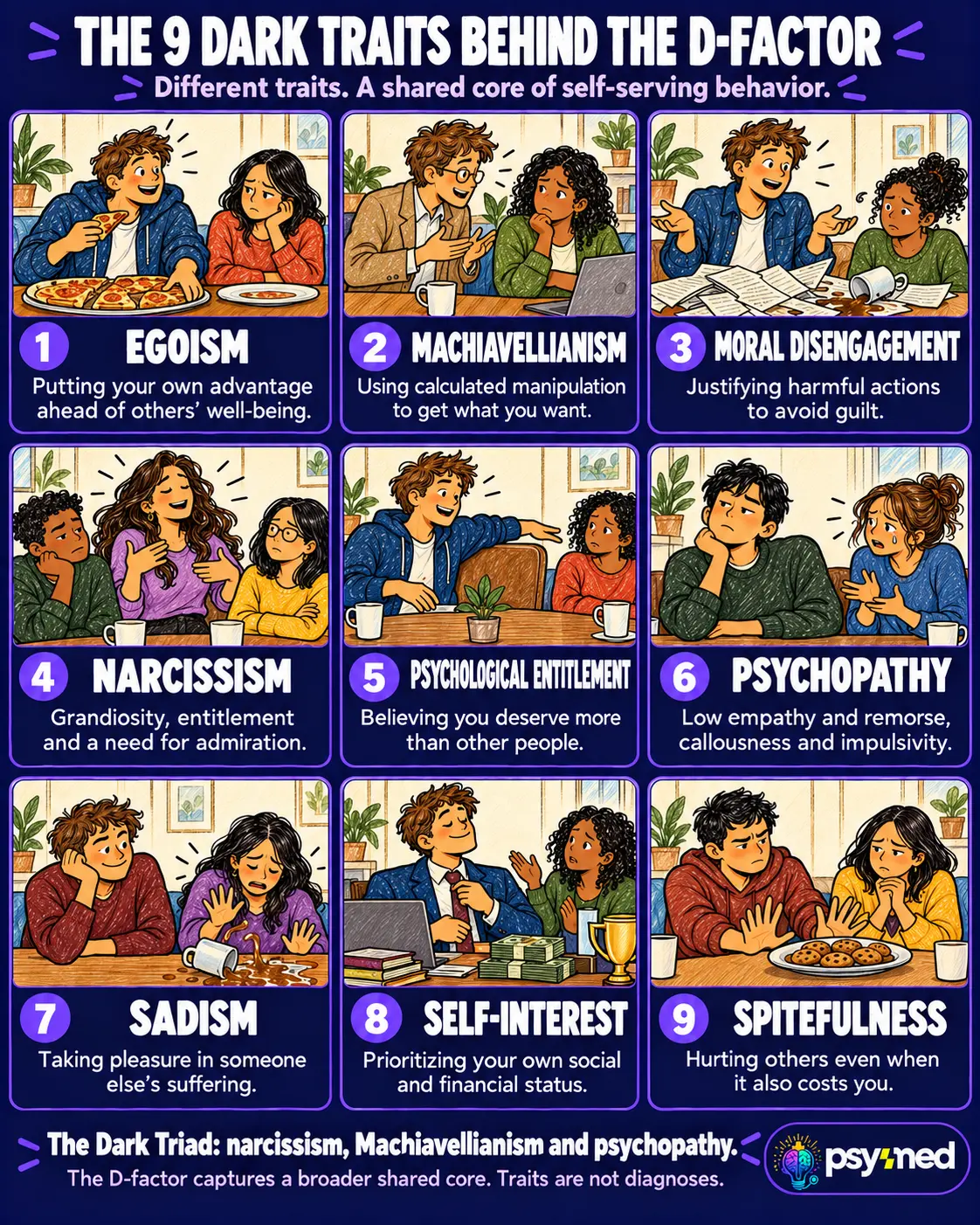
Three of these — narcissism, Machiavellianism, and psychopathy — make up the better-known “Dark Triad.” The D-factor is essentially the broader, deeper version of that idea: the one core they and all the others share. Our Dark Triad Test focuses on those three specifically.
Signs of a High Dark Core
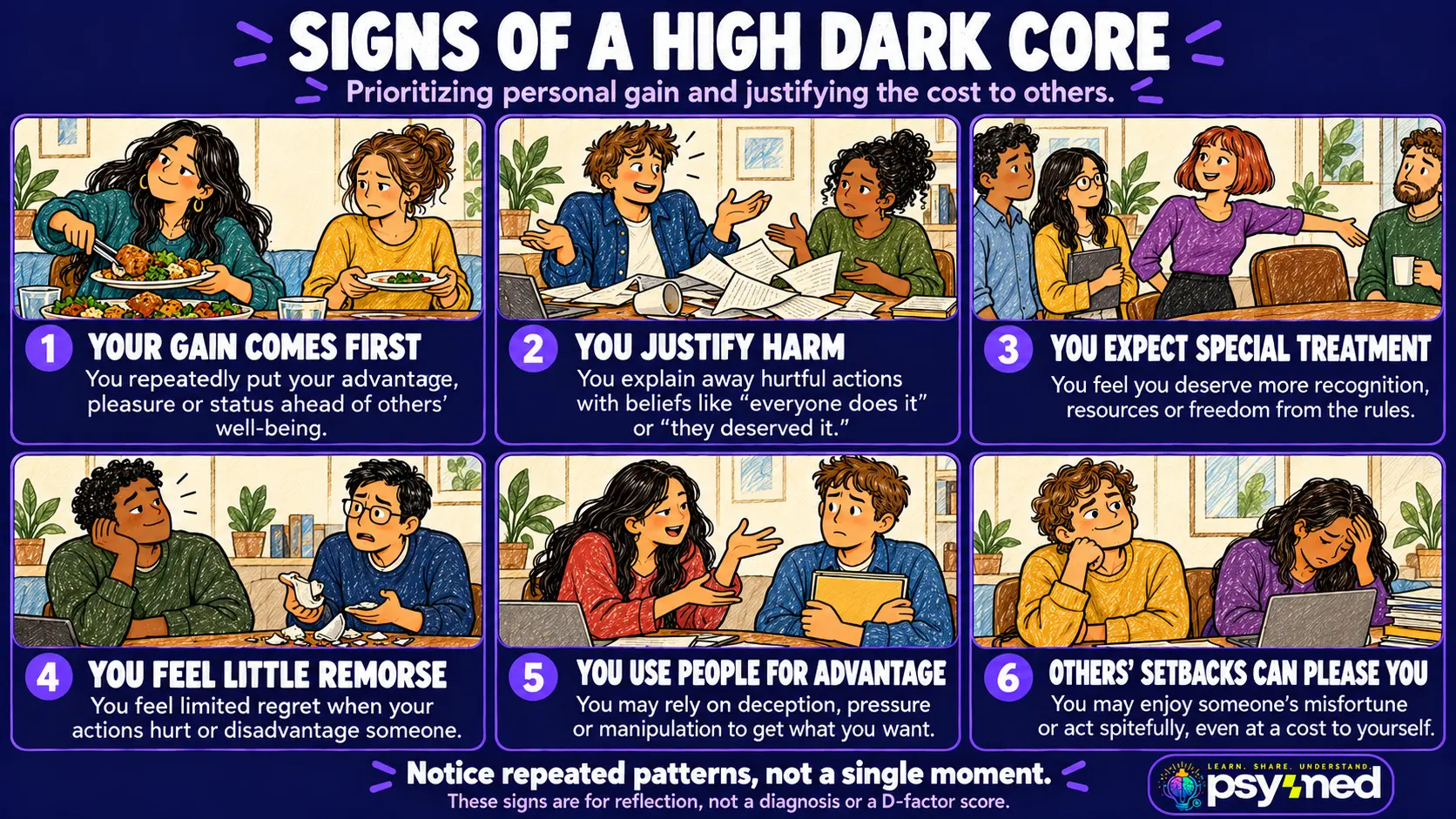
A high dark core shows up as a recognizable set of attitudes and behaviors, all tracing back to the same root: putting your own utility first and justifying the cost to others. You don’t need all of these, but the more that feel true, the stronger your D likely runs. Read these as the “signs you have it.”
You put your own gain first, even when it costs others
The core of D is utility maximization for yourself. If you consistently prioritize your own advantage, pleasure, or status over other people’s wellbeing — and that pattern holds even when someone clearly loses out — that’s the central marker.
You justify behavior that harms others
This is the “justifying beliefs” component, and it’s what separates D from simple selfishness. You have ready rationalizations — “they had it coming,” “everyone does it,” “the rules don’t apply to someone like me” — that let you act against others’ interests without feeling guilt or shame.
You feel entitled to more than other people
A stable sense that you deserve more — more recognition, more resources, more leeway — than those around you is a hallmark of high D, drawing on entitlement and narcissism. The rules and limits that apply to others can feel like they shouldn’t apply to you.
You feel little guilt or remorse when you hurt someone
High D comes with a muted conscience. When your actions harm or disadvantage someone, you tend not to dwell on it or feel much regret — the discomfort that would stop most people simply doesn’t land as hard.
You’re willing to manipulate or exploit people
Using people strategically — through manipulation, deception, or pressure — and seeing relationships partly as opportunities for advantage reflects the Machiavellian and self-interested side of D.
You sometimes take pleasure in others’ setbacks
At the higher end, D includes spiteful and sadistic elements: feeling satisfaction when someone you dislike fails or suffers, or being willing to harm someone even when it costs you too. This is the darkest expression of the core.
How This Dark Core Test Works
This test contains 15 statements drawn from the three components of the dark factor — self-serving utility maximization, disregard for others’ well-being, and justifying beliefs — sampled across the nine dark traits. For each, choose how much you agree, thinking about how you generally are rather than your best or worst moment:
Strongly Disagree = 0 | Disagree = 1 | Neutral = 2 | Agree = 3 | Strongly Agree = 4
Your answers add up to a single D-factor score from 0 to 60, placing you in one of four ranges from very low to high. Because D is a single underlying factor by design, one overall score is the meaningful result — it reflects how strong the common dark core runs in you. Answer honestly; your results are completely private, and there are no right answers.
Understanding Your D-Factor Results
Your score places you in one of four ranges. Read it as a dimensional snapshot — a position on a spectrum everyone is on — not a label or a diagnosis. No score here makes you a good or bad person.
| Score | D-Factor Level | What It Suggests |
|---|---|---|
| 0 – 15 | Very Low | A strongly prosocial, ethical orientation — you rarely put your gain above others. |
| 16 – 30 | Low–Moderate | A typical, everyday level — ordinary self-interest balanced with care for others. |
| 31 – 45 | Elevated | Notable dark-core tendencies; self-interest more often wins out over others’ well-being. |
| 46 – 60 | High | A strong dark core; a consistent pattern of maximizing your own utility at others’ expense. |
Dark Core vs Dark Triad: What’s the Difference?
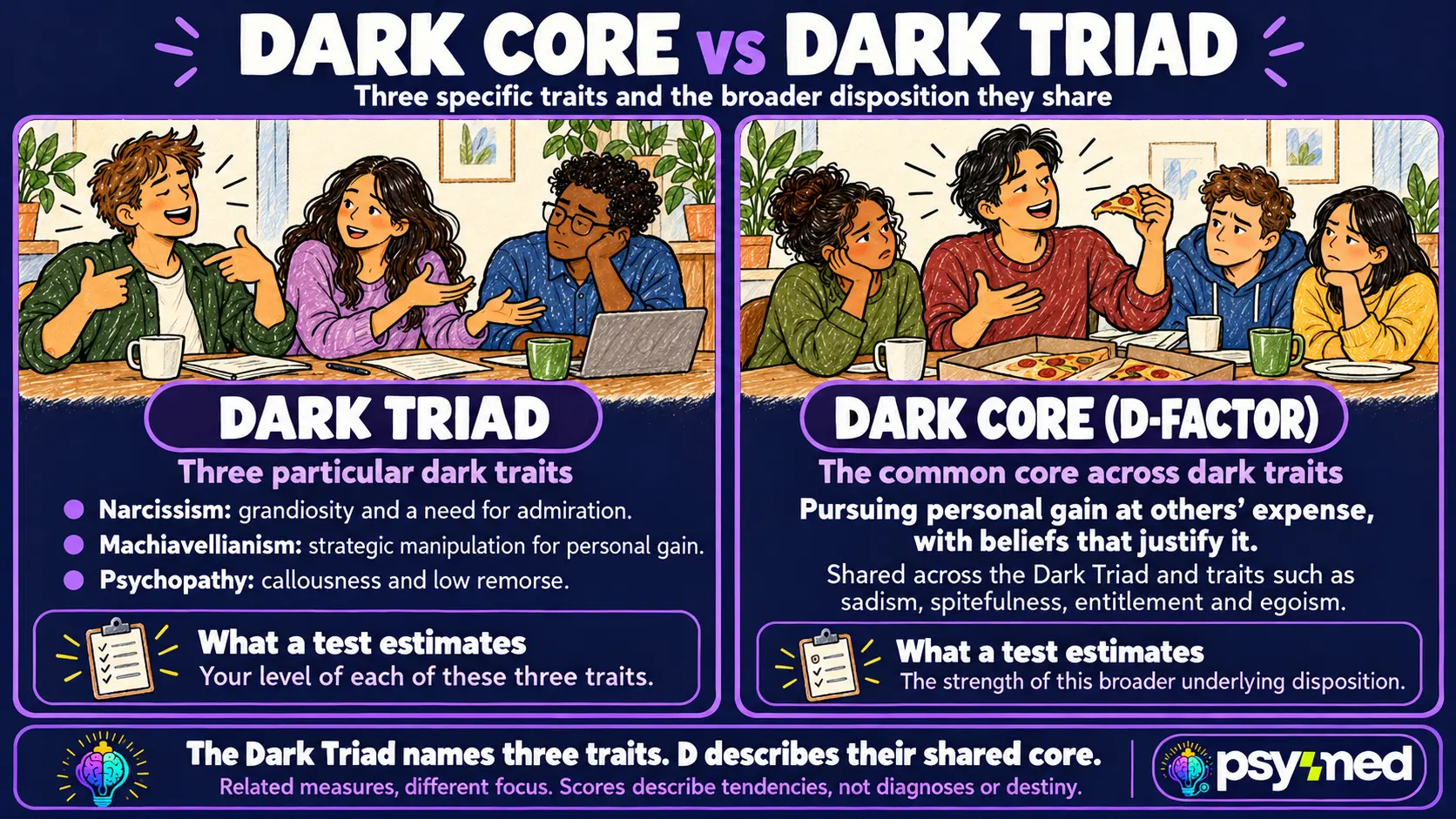
The dark core (D-factor) and the Dark Triad are closely related, and understanding how they differ clarifies both. The Dark Triad is a specific trio of dark traits — narcissism, Machiavellianism, and psychopathy — studied together since 2002. The dark core (D) is broader and deeper: it’s the single common factor underlying all dark traits, including those three, plus sadism, spitefulness, entitlement, egoism, moral disengagement, and self-interest. In other words, the Dark Triad names three of the “flavors,” while D identifies the shared ingredient beneath every flavor.
The practical difference is what each one tells you. A Dark Triad test shows you how you score on three particular traits. A dark core test estimates how strong the underlying disposition is—the root that makes all the dark traits more likely. The research suggests that if you know someone’s D, you already know a great deal about their likelihood of narcissistic, psychopathic, or sadistic behavior, because they all flow from the same source. For most people, the two tests tell a consistent story; the dark core is simply the more fundamental lens. For the bright-side contrast, see the Light Triad Test, and for the unusual mix of dark traits with empathy, the Dark Empath Test.
Methodology & Sources
This Dark Core Personality test is based on the dark factor of personality (D) as defined by Morten Moshagen, Benjamin E. Hilbig, and Ingo Zettler in their 2018 paper in Psychological Review. Its 15 items are original statements reflecting the three defining components of D—self-serving utility maximization, disregard for others’ disutility, and justifying beliefs—sampled across the nine dark traits the construct unifies. The original researchers developed validated measures of D (the D70, D35, and D16 scales), freely available for research at darkfactor.org; this test is an accessible, educational screen built on the same conceptual framework, not a reproduction of those scales. It is a self-reflection tool, not a diagnostic instrument, and it cannot diagnose any condition.
References
- Moshagen, M., Hilbig, B.E., & Zettler, I. (2018). The dark core of personality. Psychological Review, 125(5), 656–688. doi.org/10.1037/rev0000111
- Moshagen, M., Zettler, I., & Hilbig, B.E. (2020). Measuring the dark core of personality. Psychological Assessment, 32(2), 182–196. doi.org/10.1037/pas0000778 [The D70, D35 and D16 scales]
- Paulhus, D.L., & Williams, K.M. (2002). The Dark Triad of personality: Narcissism, Machiavellianism, and psychopathy. Journal of Research in Personality, 36(6), 556–563. doi.org/10.1016/S0092-6566(02)00505-6 [The related three-trait model]
Cite This Page
PsyMed. (2026). Dark Core Personality Test (D-Factor). PsyMed.info. Retrieved from https://psymed.info/all_quiz/dark-core-personality-test/
Frequently Asked Questions
What is the dark core of personality (D-factor)?
The dark core, or dark factor of personality (D), is the basic psychological tendency to maximize your own benefit at others’ expense, along with beliefs that justify it. Defined by Moshagen, Hilbig, and Zettler in 2018, it’s understood as the single common factor underlying all dark personality traits — narcissism, psychopathy, Machiavellianism, sadism, spitefulness, and more. Just as a general intelligence factor (g) underlies all mental abilities, D underlies all the malevolent ones. Someone high in D is more likely to display any and all of the dark traits, because they share this common root.
What’s the difference between the dark core and the Dark Triad?
The Dark Triad is a specific set of three dark traits — narcissism, Machiavellianism, and psychopathy. The dark core (D) is broader: it’s the single underlying factor common to all dark traits, including those three plus sadism, spitefulness, entitlement, egoism, moral disengagement, and self-interest. Think of the Dark Triad as naming three of the “flavors” and D as the shared ingredient beneath every flavor. Because all dark traits flow from the same core, knowing someone’s D level tells you a lot about their likelihood of any specific dark behavior.
Does a high D-factor score mean I’m a bad person?
No. D is a dimension that everyone sits somewhere on — it’s not a category of “good” versus “bad” people, and this test can’t diagnose anything. A high score indicates stronger dark-core tendencies and a greater statistical likelihood of self-serving behavior at others’ expense, but it’s not a moral verdict or a life sentence. Personality can change, behavior is a choice, and self-awareness is what makes different choices possible. If a high score troubles you, that discomfort itself suggests a conscience at work — and it can be a starting point for reflection or for conversation with a therapist.
Can your dark core change?
Personality traits like D are relatively stable but not fixed. They tend to shift gradually across the lifespan, and deliberate effort — often with the help of therapy — can move them over time, especially the behaviors and justifying beliefs that express them. The “justifying beliefs” component in particular is a cognitive habit, and cognitive habits can be examined and changed. So while you won’t transform overnight, a high dark core is not a permanent identity. Noticing the pattern honestly, as this test invites, is the first step toward changing how it plays out.
Related Tests
- Dark Triad Test — the three best-known dark traits (narcissism, Machiavellianism, psychopathy)
- Dark Empath Test — dark traits combined with empathy
- Light Triad Test — the bright, prosocial counterpart to the dark core
- Psychopath Test — one of the nine dark traits in depth
- Narcissistic Personality Disorder Quiz — grandiosity and entitlement up close
- Machiavellian Test — the strategic, manipulative dark trait
Explore All Personality Disorder Tests
From narcissistic and borderline to avoidant, schizoid, and paranoid — browse our full hub of free, confidential personality disorder screenings, each based on recognized clinical criteria.
Related Tests
See All Quiz →

You may also like
See All Quiz →