

Pathological Liar Test: Am I a Compulsive Liar?
A 15-item adult self-reflection scale on compulsive lying: how automatic it is, whether it happens without a motive, and what it has cost you. Informed by the clinical literature on pseudologia fantastica, and not a diagnosis.
Published Updated
This free pathological liar test is a private, judgment-free way to reflect on your own relationship with the truth — to see whether your lying fits the pattern psychologists call compulsive or pathological lying, or whether it’s the ordinary, situational kind that nearly everyone does. In 15 quick questions, you’ll get an honest read on where your habits fall, along with context on what the pattern means and what actually helps.
A quick, important note before you start: this compulsive liar test is a self-reflection tool, not a diagnosis. Pathological lying isn’t a formal standalone diagnosis, and no online quiz can label you. What this test can do is help you notice a pattern honestly — and if there’s something worth looking at, point you toward help that works. There’s no shame built into this page. Lying is very often a coping mechanism, not a character flaw, and it’s something people change.
What Is Pathological Lying?
Pathological lying — known in clinical literature as pseudologia fantastica or mythomania, and often used interchangeably with compulsive lying — is a persistent, pervasive pattern of lying that continues even when the lies bring no clear benefit and cause real harm. It was first described by the German physician Anton Delbrück in 1891, and it’s been the subject of renewed clinical research in recent years, most notably by psychologists Drew Curtis and Christian Hart, whose 2020 work proposed defining it as a condition in its own right.
The key thing that separates pathological lying from the everyday kind is that it’s chronic, largely automatic, and frequently without a clear motive. Most people lie occasionally and strategically — to avoid conflict, spare someone’s feelings, or get out of trouble. Pathological lying is different: it’s a long-standing habit where the lies come reflexively, sometimes about things that don’t matter, sometimes even when the truth would serve just as well and the lie is easy to catch.
Importantly, this is not psychosis — people who lie compulsively are generally aware, on some level, that what they’re saying isn’t true. Curtis and Hart describe a pattern that’s persistent and pervasive, causes genuine distress or impairment, and tends to last six months or more.
Is Pathological Lying a Mental Illness?
Pathological lying is not a standalone diagnosis in the DSM-5-TR (the main diagnostic manual used in the United States) — and that’s an important thing to understand before you read your result. Instead, compulsive lying shows up as a feature of several recognized conditions rather than a disorder on its own. In the DSM-5’s dimensional model of personality, it falls under “Deceitfulness,” part of the broader Antagonism domain.
Clinically, persistent lying is associated with Cluster B personality patterns (including narcissistic, antisocial, and histrionic styles), with factitious disorder (historically called Munchausen syndrome), with borderline personality patterns where lying can be a way to avoid feared rejection, and sometimes with PTSD. That’s not a list of accusations — it’s simply why a professional assessment matters: the lying is usually the visible surface of something underneath, and understanding the why is where change starts. Pathological lying is treatable, and the fact that it isn’t its own diagnosis doesn’t make the distress around it any less real.
Signs You Might Be a Pathological Liar
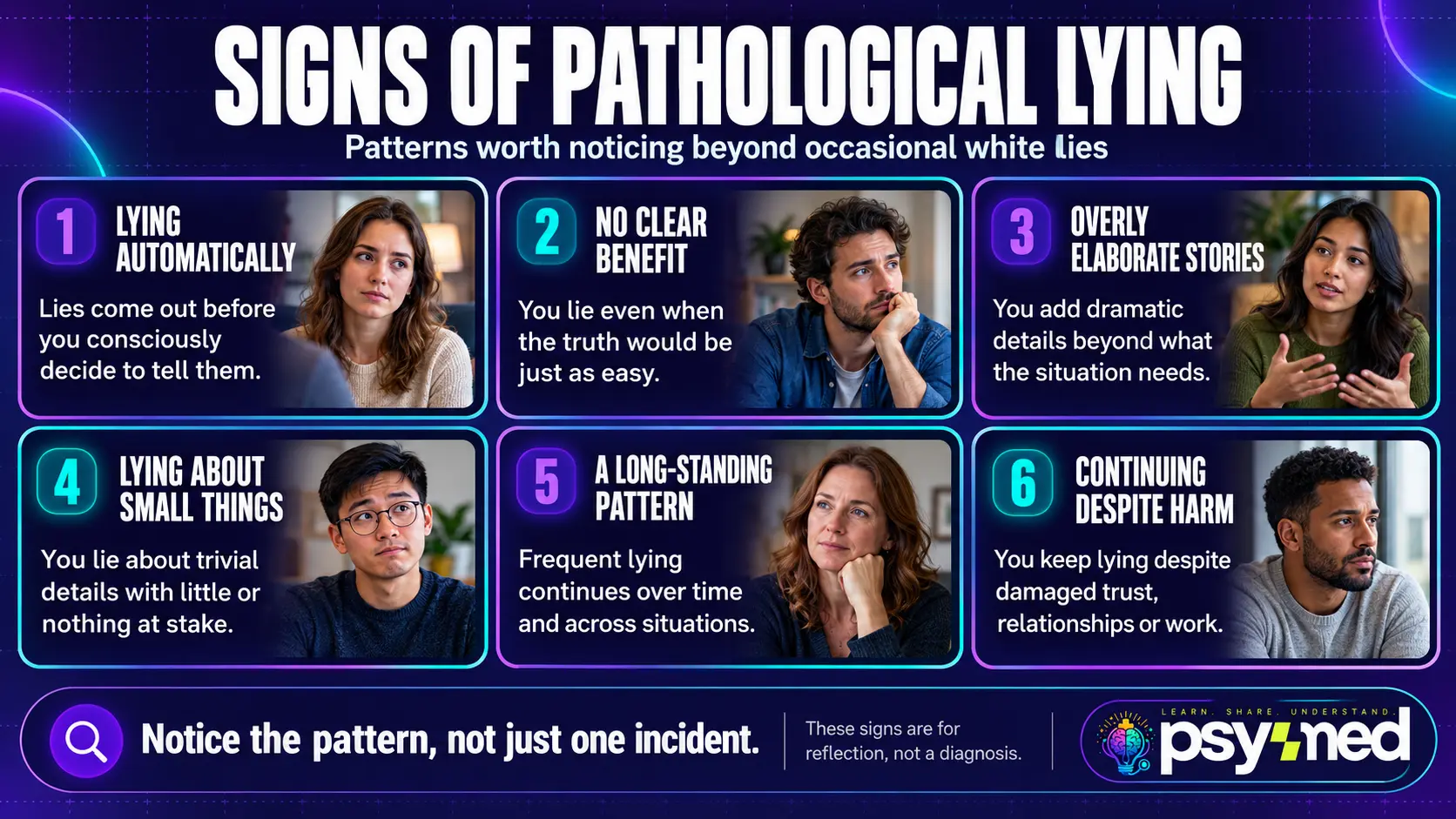
Pathological lying tends to show a recognizable cluster of signs that go beyond ordinary white lies. You don’t need every sign to have a pattern worth examining — but the more of these that feel familiar, the more it may be worth a closer look. These are the signs most consistently described in the clinical literature.
You lie automatically, before you’ve decided to
For many compulsive liars, the lie is out of your mouth before you’ve consciously chosen it. Curtis and Hart describe the behavior as often compulsive — it happens reflexively rather than through deliberate calculation, which is part of what distinguishes it from strategic, situational lying.
You lie even when the truth would do just fine
A hallmark sign is lying when there’s no clear benefit — and sometimes when the truth would actually be easier. Ordinary lies usually have a purpose (avoiding trouble, protecting someone). Pathological lying often continues in situations where there’s nothing to gain, which is one of its defining features.
Your stories grow more elaborate than the situation needs
Pseudologia fantastica is specifically associated with detailed, sometimes fantastical narratives — stories that are more colorful, dramatic, or far-reaching than the moment calls for. If you notice yourself embellishing well past what’s useful, often to appear more impressive or sympathetic, that’s a characteristic pattern.
You lie about small, pointless things
It’s not just the big stuff. A common sign is lying about trivial details that wouldn’t matter either way — where you ate lunch, a minor fact, something easily checked. When lying becomes the default response rather than a chosen one, it spreads to things that have no stakes at all.
The lying has been going on for a long time
Pathological lying is typically a long-standing pattern, not a recent phase. Research suggests it often begins in adolescence and persists for years. If you can trace the habit back a long way and it’s followed you across different parts of your life, that duration is itself part of the clinical picture.
Your lies have cost you — and you keep doing it
Perhaps the most important sign is that the lying causes real harm — damaged trust, lost relationships, problems at work — and continues anyway. Lying that persists despite clear, repeated negative consequences, and that causes you genuine distress, is central to how clinicians describe pathological lying.
How This Pathological Liar Test Works
This test contains 15 statements about your lying habits. For each one, choose how often it’s true of you, thinking about your general pattern over time rather than any single moment:
- Never = 0
- Rarely = 1
- Sometimes = 2
- Often = 3
- Always = 4
Your answers add up to a score from 0 to 60, which places you in one of four ranges from “typical” to “a pattern consistent with compulsive lying.” Answer as honestly as you can — this is the one place where being truthful with yourself is the entire point, and your results are completely private. There are no right answers and no one is watching.
Understanding Your Results
Your score places you in one of four ranges. Read it as a starting point for honest reflection, not a label — remember that pathological lying isn’t a formal diagnosis, and only a qualified professional can make sense of what’s underneath a pattern. Every range below includes what tends to help.
| Score | Range | What It Suggests |
|---|---|---|
| 0 – 15 | Typical | Your lying appears to be within the normal, situational range most people fall into. |
| 16 – 30 | Some Patterns | A few habits worth noticing, without necessarily pointing to a compulsive pattern. |
| 31 – 45 | Significant Pattern | A meaningful pattern of frequent lying that may be affecting your life and relationships. |
| 46 – 60 | Compulsive Pattern | A pattern consistent with what’s described as compulsive or pathological lying. |
What Causes Compulsive Lying?
Compulsive lying rarely comes from nowhere — it usually develops as a solution to a problem, even if it eventually becomes a bigger problem than the one it solved. Research and clinical experience point to a handful of common roots.
- Low self-esteem is one of the most consistent: lying can be a way to build a more impressive or lovable version of yourself when the real one feels inadequate.
- Childhood trauma, neglect, or an environment where honesty was punished can teach a developing mind that the truth is dangerous and fabrication is safer.
- Difficulty regulating emotions and underlying personality patterns also play a role, and sometimes lying becomes a genuinely compulsive habit, mirroring the automatic quality seen in other compulsive behaviors.
None of this means the lying is harmless or that the people hurt by it should simply accept it. It means that willpower alone usually isn’t the fix, because the behavior is doing a job — and lasting change comes from addressing the job, not just the symptom. That’s exactly the kind of work therapy is built for. If low self-worth feels like part of your picture, our Self-Esteem Test may be a useful companion to this one.
Worried About Someone Else’s Lying?
If you came to this page because of someone else — a partner, family member, friend, or ex whose lying has you questioning everything — this test won’t diagnose them, and honestly, no one can be diagnosed from the outside by someone they’ve been lying to. But your experience is real, and being on the receiving end of chronic dishonesty is genuinely disorienting and painful.
What you can assess clearly is your own experience: how this person’s behavior affects you, whether the relationship feels healthy, and whether manipulation is part of the picture. Those are the right questions to focus on, because they’re the ones you can actually answer. A few of our other tests are built for exactly that: our Am I Being Manipulated? Quiz, our Toxic Relationship Quiz, and our Is My Friend Toxic? Quiz each look at how someone’s behavior is landing on you — which is the thing that actually matters for your decisions.
Can a Pathological Liar Change?
Yes — compulsive lying can change, though it usually takes more than a resolution to “stop lying.” Because the behavior is typically rooted in something deeper and has often been practiced for years, the most effective route is professional support that gets at the underlying drivers. Psychotherapy — particularly approaches that build self-awareness, address shame and self-esteem, and strengthen emotional regulation — can help people interrupt the automatic habit and build tolerance for the vulnerability that honesty requires.
Treating any co-occurring condition (such as an anxiety, personality, or mood pattern) matters too. The honest truth is that change is gradual and takes real commitment, especially for a habit this ingrained — but people do it, and the reward is relationships that no longer rest on a story you have to maintain.
Frequently Asked Questions
What is the difference between a compulsive liar and a pathological liar?
In everyday use, the two terms are often treated as slightly different — “compulsive” emphasizing the automatic, habitual quality and “pathological” emphasizing elaborate or purposeless lies — but in the research literature they’re used largely interchangeably, and the medical literature doesn’t currently draw a firm line between them.
The researchers who’ve renewed clinical interest in the topic, Drew Curtis and Christian Hart, treat pathological lying as a single phenomenon: a persistent pattern of lying that continues even when it brings no benefit and causes harm. So for the purposes of this test, you can treat “compulsive liar” and “pathological liar” as describing the same underlying pattern.
Is pathological lying a mental illness?
Pathological lying is not a standalone mental illness in the DSM-5-TR — it isn’t listed as its own diagnosis. Instead, it appears as a feature of other recognized conditions, including Cluster B personality patterns (narcissistic, antisocial, histrionic), factitious disorder, borderline patterns, and sometimes PTSD, and it sits under “Deceitfulness” in the DSM-5’s dimensional model of personality.
Some researchers, notably Curtis and Hart, have argued it should be recognized as a condition in its own right, but that isn’t official yet. The practical takeaway: the distress and damage are real even though the label isn’t formal, and a professional can help identify what’s driving the pattern.
Do pathological liars know they are lying?
Generally, yes. Pathological lying is not a form of psychosis or a break from reality — people who lie compulsively are typically aware, at least on some level, that what they’re saying isn’t true. What makes the pattern feel out of control isn’t a loss of contact with reality; it’s that the lying has become automatic and compulsive, happening faster than deliberate choice.
Some people report that after repeating a lie many times it can start to feel true, but that’s different from genuinely being unable to tell fact from fiction. This awareness is actually hopeful, because it means the capacity for honesty is there — the work is about making it accessible and tolerable.
Is this pathological liar test accurate?
This test is an educational self-reflection tool, not a diagnostic instrument — and it’s important to be clear about that. It’s informed by the clinical literature on pathological lying (including the work of Curtis and Hart) and the signs most consistently described by researchers, but it is a house-designed screen, not a validated clinical scale, and pathological lying isn’t a condition that even has a formal diagnosis to test for.
What the test does well is help you reflect honestly on whether your lying fits a compulsive pattern and whether it’s worth seeking support. It can’t label you, and a high score isn’t a verdict — only a qualified professional can make sense of what’s underneath. Treat your result as a prompt for honest self-examination, not a conclusion.
Related Tests
- Self-Esteem Test — low self-worth is one of the most common roots of compulsive lying
- Narcissistic Personality Disorder Quiz — explores a personality pattern often linked to chronic deceit
- Am I Being Manipulated? Quiz — for assessing someone else’s behavior toward you
- Toxic Relationship Quiz — if chronic dishonesty is part of a relationship
- Gaslighting Test — a self-POV look at a related honesty pattern in relationships
- Machiavellian Test — measures strategic, calculated manipulation (distinct from compulsive lying)
References
- Curtis, D.A., & Hart, C.L. (2020). Pathological lying: Theoretical and empirical support for a diagnostic entity. Psychiatric Research and Clinical Practice, 2(2), 62–69. pubmed.ncbi.nlm.nih.gov
- American Psychiatric Association. (2022). Diagnostic and Statistical Manual of Mental Disorders (5th ed., text rev.). [Pathological lying as a feature of other conditions; “Deceitfulness” in the Antagonism domain]
- Kainth, T., & Gunturu, S. (2024). Pseudologia Fantastica. StatPearls (NCBI Bookshelf). [Clinical characteristics, DSM-5 status, associated conditions] pubmed.ncbi.nlm.nih.gov
- Dike, C.C., Baranoski, M., & Griffith, E.E.H. (2005). Pathological lying revisited. Journal of the American Academy of Psychiatry and the Law, 33(3), 342–349. [Historical overview, including Delbrück] pubmed.ncbi.nlm.nih.gov
Related Tests
See All Quiz →


You may also like
See All Quiz →