
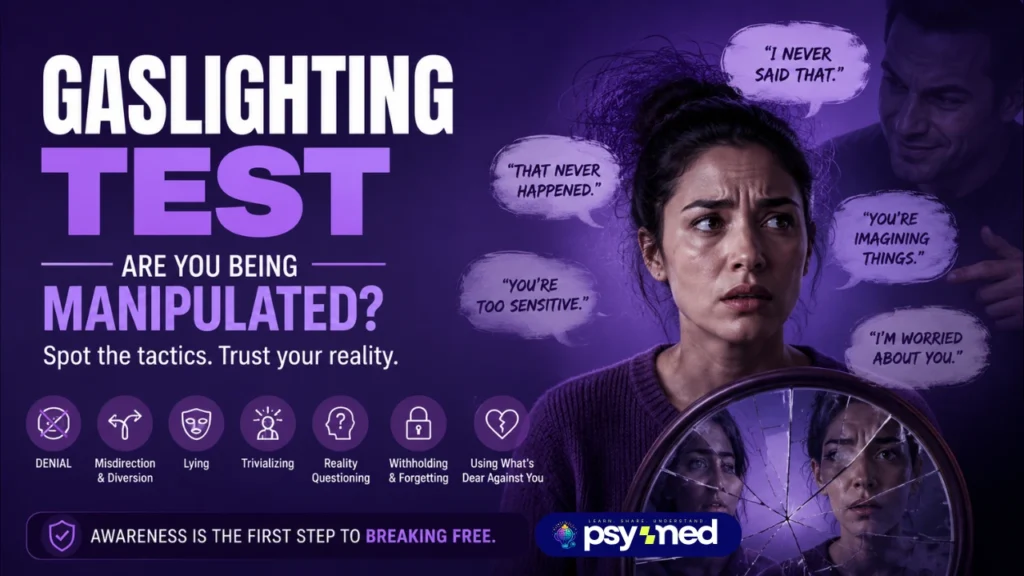

Free Gaslighting Test — Am I a Gaslighter?
Are you gaslighting someone — or being gaslighted? This free Gaslighting Test identifies manipulation patterns across 7 core tactics. 15 questions.
Published Updated
The word “gaslighting” has become one of the most widely used — and most frequently misapplied — terms in contemporary psychology. Before taking our Gaslighting test, a precise definition matters: gaslighting is not every frustrating argument, not every disagreement about what was said, and not ordinary manipulation or selfishness. Gaslighting is a specific, sustained pattern of psychological abuse in which one person systematically manipulates another’s perception of reality — their memories, their experiences, their sense of what is true — in order to maintain power and control over them (Sweet, American Sociological Review, 2019).
This Gaslighting Test is designed for two uses. If you are wondering whether you may be gaslighting someone — a partner, a family member, or a colleague — answer the questions about your own behavior. If you suspect you are being gaslighted — answer the questions about how the person you have in mind typically behaves toward you. Both uses produce a clinically valid and interpretable result.
15 questions. Based on the past 6 months. Instant, private results.
What Is Gaslighting?
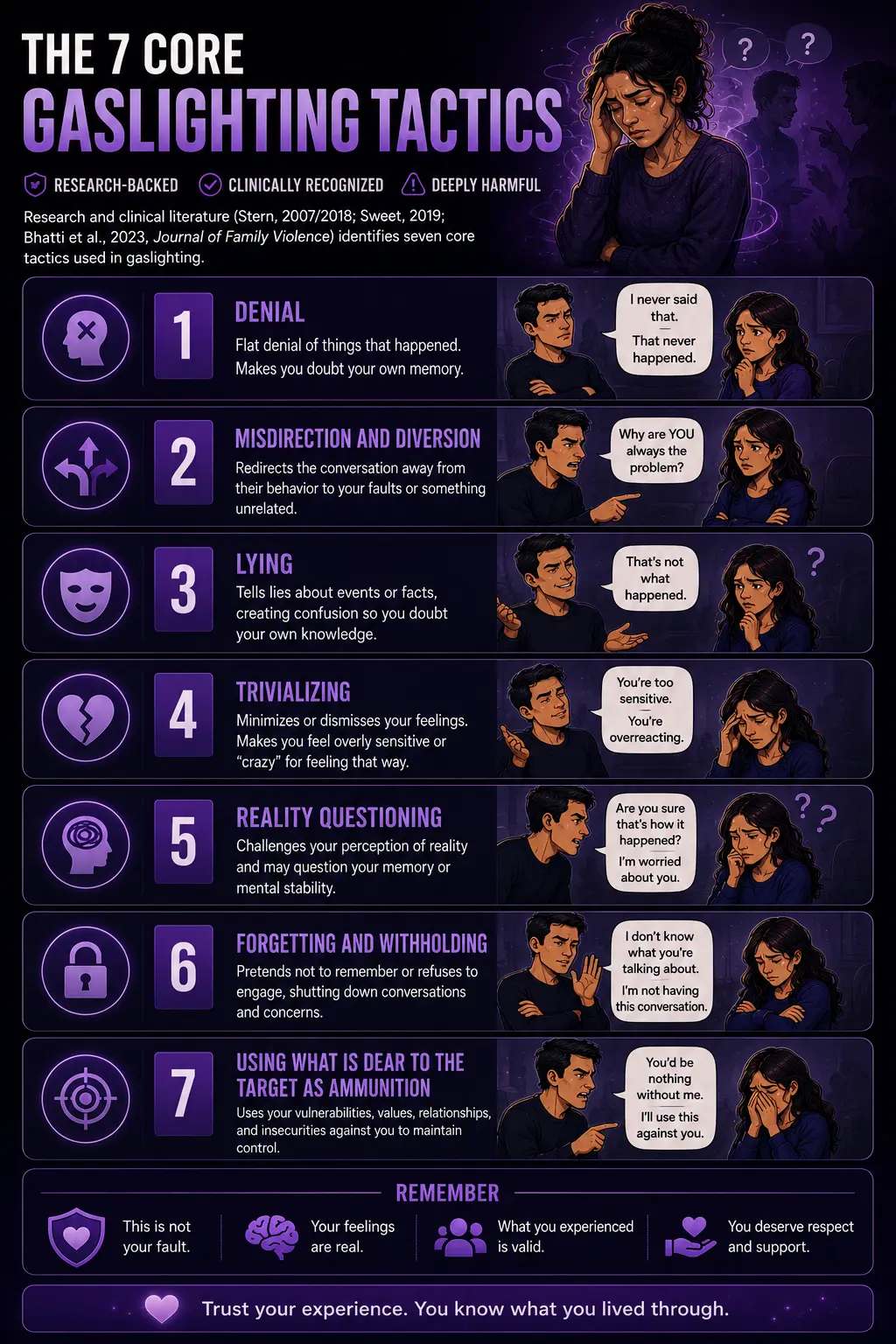
The term “gaslighting” derives from the 1938 play Gas Light by Patrick Hamilton, adapted into the 1944 film Gaslight directed by George Cukor, in which a husband systematically manipulates the gas lighting in their home — causing it to flicker — and then denies that it is happening, convincing his wife that she is imagining things and losing her sanity. The term entered psychological literature and popular vocabulary as a descriptor for this specific pattern of abuse.
The formal academic definition was established by sociologist Dr. Paige L. Sweet in her landmark 2019 paper in the American Sociological Review: gaslighting is “a type of psychological abuse aimed at making victims seem or feel ‘crazy,’ creating a ‘surreal’ interpersonal environment.” Sweet’s paper established that gaslighting is not merely a psychological tactic but a sociological phenomenon — rooted in social inequalities, particularly gender, and enacted in power-laden relationships in which the gaslighter mobilizes structural and institutional inequalities against the victim to erode their perception of reality (Sweet, 2019).
The clinical perspective on gaslighting was developed most comprehensively by Dr. Robin Stern in The Gaslight Effect (2007, revised 2018). Stern identified gaslighting as a recurring relational dynamic — not a single incident but a pattern — in which the gaslighter’s consistent denial, distortion, and dismissal of the victim’s perceptions gradually erodes the victim’s confidence in their own mind.
Critical note on usage: The Washington Post (2022) and multiple mental health researchers have flagged that “gaslighting” is now frequently used as a buzzword to describe ordinary disagreements, selective memory, or frustrating behavior that does not meet the clinical threshold. The key distinctions: gaslighting is intentional and sustained, not occasional; it aims to make the target doubt their reality, not just feel criticized; and it operates to maintain power and control, not merely to win an argument. This Gaslighting test screens for the clinical pattern, not isolated behaviors.
The 7 Core Gaslighting Tactics
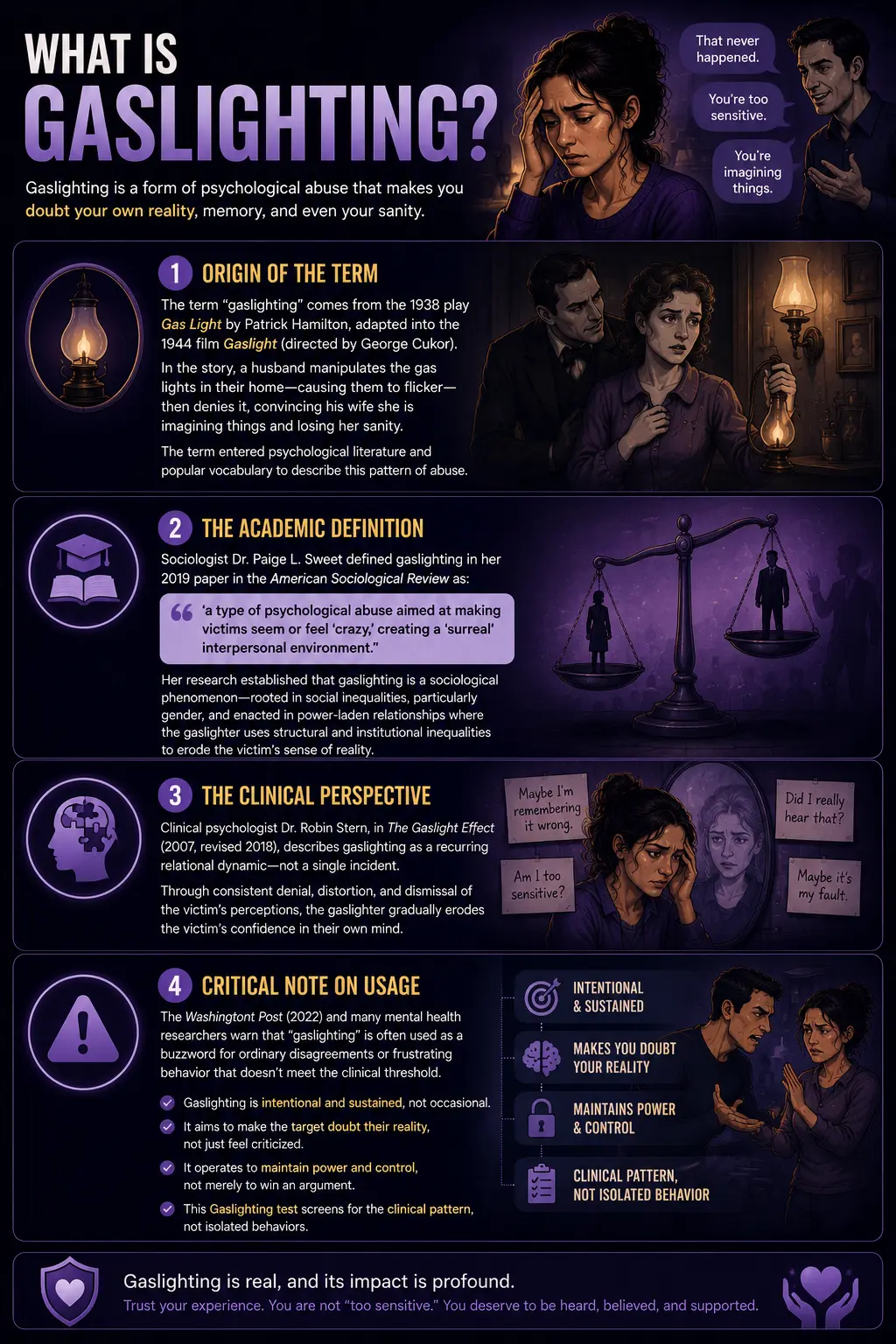
Research and clinical literature identify seven core tactics used in gaslighting, documented across Stern (2007/2018), Sweet (2019), and Bhatti and colleagues (2023, Journal of Family Violence):
-
Denial
Flat denial of events that occurred — “I never said that,” “That never happened,” “You’re imagining things” — delivered with enough confidence and consistency to make the target question their own memory, even when they know what they experienced.
-
Misdirection and diversion
When confronted about their behavior, the gaslighter redirects the conversation — to the target’s alleged faults, to unrelated grievances, or to questioning the target’s motives for raising the issue — making it impossible to have a direct conversation about the gaslighter’s behavior.
-
Lying
Telling falsehoods about shared events, the gaslighter’s behavior, or external facts — including blatant lies delivered with such conviction that the target begins to doubt their own knowledge. The goal is not just the individual lie but the cumulative confusion it produces.
-
Trivializing
Minimizing or dismissing the target’s emotional responses — “You’re too sensitive,” “You’re overreacting,” “You’re crazy to feel that way” — makes the target feel that their perceptions and emotions are unreliable, disproportionate, or a character flaw.
-
Reality questioning
Directly challenging the target’s perception of reality — suggesting they misremember events, mishear conversations, or are experiencing their feelings incorrectly. Often combined with concern for the target’s mental stability: “I’m worried about you.”
-
Forgetting and withholding
Pretending not to remember events the gaslighter clearly remembers, or refusing to engage with the target’s concerns by shutting down the conversation: “I don’t know what you’re talking about,” “I’m not having this conversation.”
-
Using what is dear to the target as ammunition
Weaponizing the target’s vulnerabilities, values, relationships, and emotional investments against them — attacking their identity, their relationships with others, or their deepest insecurities to maintain control.
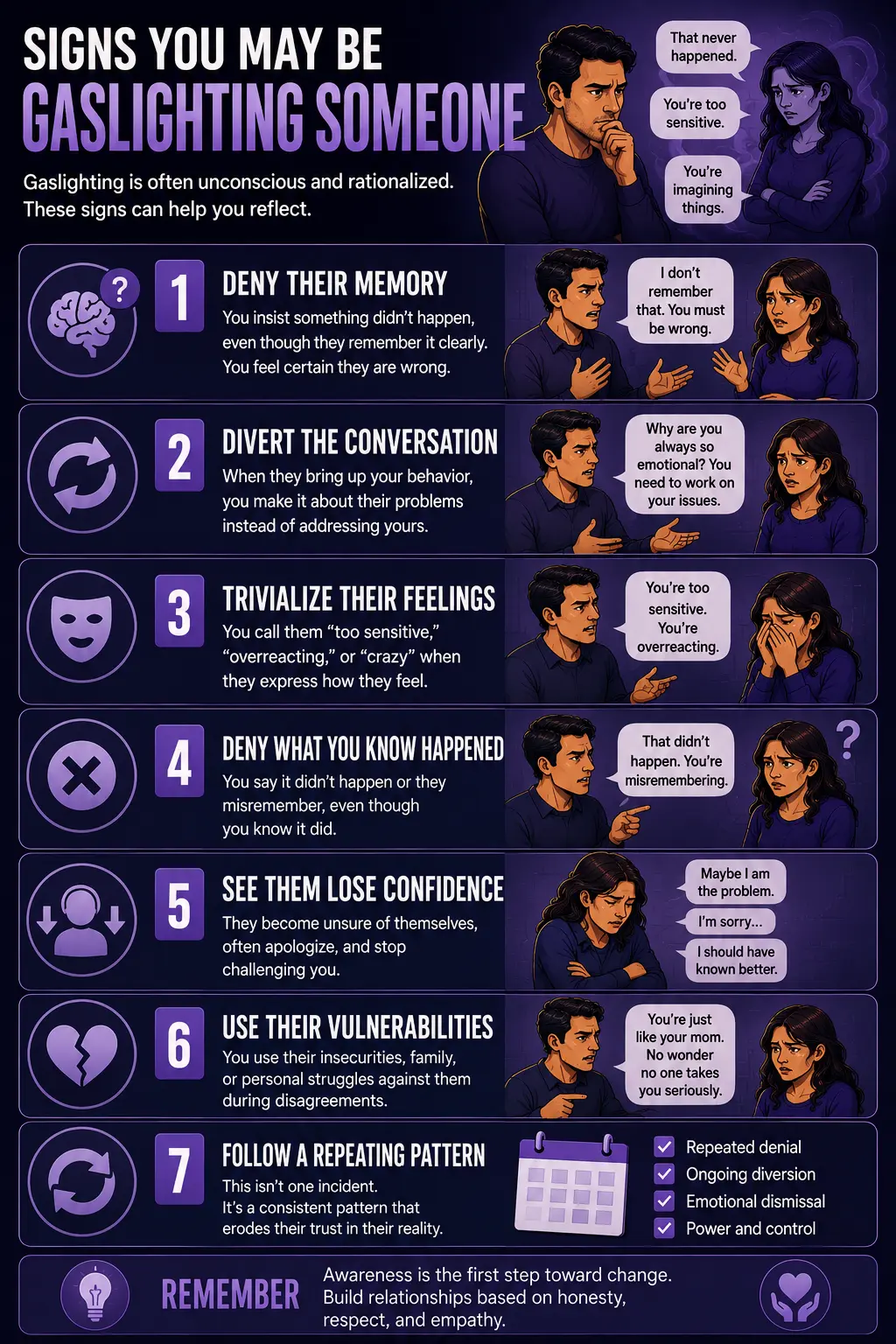
Signs You May Be Gaslighting Someone
Gaslighting is frequently unconscious — or at least rationalized as necessary, justified, or protective. The person doing the gaslighting often genuinely believes their version of events is accurate. The following signs indicate that gaslighting behavior may be present in how you relate to someone in your life.
- You consistently deny remembering things that the other person remembers clearly — and feel certain they are wrong.
Disagreements about memory are normal. But if you find yourself routinely and confidently insisting that events, conversations, or agreements did not happen in ways the other person clearly recalls — across different contexts and over a sustained period — the pattern warrants examination. The certainty is part of what makes gaslighting effective and hard to self-identify.
- When someone raises a concern about your behavior, the conversation consistently ends up being about their problems rather than yours.
This is the diversion tactic in action. If every attempt by another person to address your behavior results in a conversation about their sensitivity, their faults, their pattern of misinterpreting you, or their psychological issues — and you consistently avoid ever having a direct conversation about what you actually did — that pattern is gaslighting-adjacent regardless of how sincere each individual diversion feels.
- You tell the other person they are “too sensitive,” “overreacting,” or “crazy” when they express emotional responses to your behavior.
Trivializing is one of the most common gaslighting tactics and one of the easiest to rationalize. The feeling that someone else’s emotional response is disproportionate may be genuine. But the habitual dismissal of another person’s emotional reality as a character flaw — rather than as information about how your behavior is landing — is a form of reality distortion.
- You have told the other person something didn’t happen, or that they misremember, when you know it did happen.
This is the denial tactic at its most direct. It may be rationalized as protecting them, as a way to simplify a complicated situation, or as your own genuine belief. The effect on the target is the same: they learn not to trust their own memory.
- You notice that the person around you seems increasingly unsure of themselves, increasingly apologetic, and increasingly unlikely to challenge you.
This is the downstream effect of sustained gaslighting. If the person you are most concerned about has become progressively less confident in their own perceptions, more likely to blame themselves for problems between you, and less likely to raise issues — that pattern is worth examining honestly.
- You use their vulnerabilities, their family relationships, or their deepest insecurities against them during conflicts.
This is the most deliberately weaponized gaslighting tactic — using what the person has shared with you in trust as leverage against them when you need to destabilize or control them.
- The pattern is consistent and recurring — not one incident but a sustained relational dynamic.
This is the most important sign distinguishing gaslighting from ordinary conflict. A single incident of denial, diversion, or trivialization does not constitute gaslighting. A consistent, recurring pattern that systematically erodes another person’s trust in their own perception of reality — that is what meets the clinical threshold.
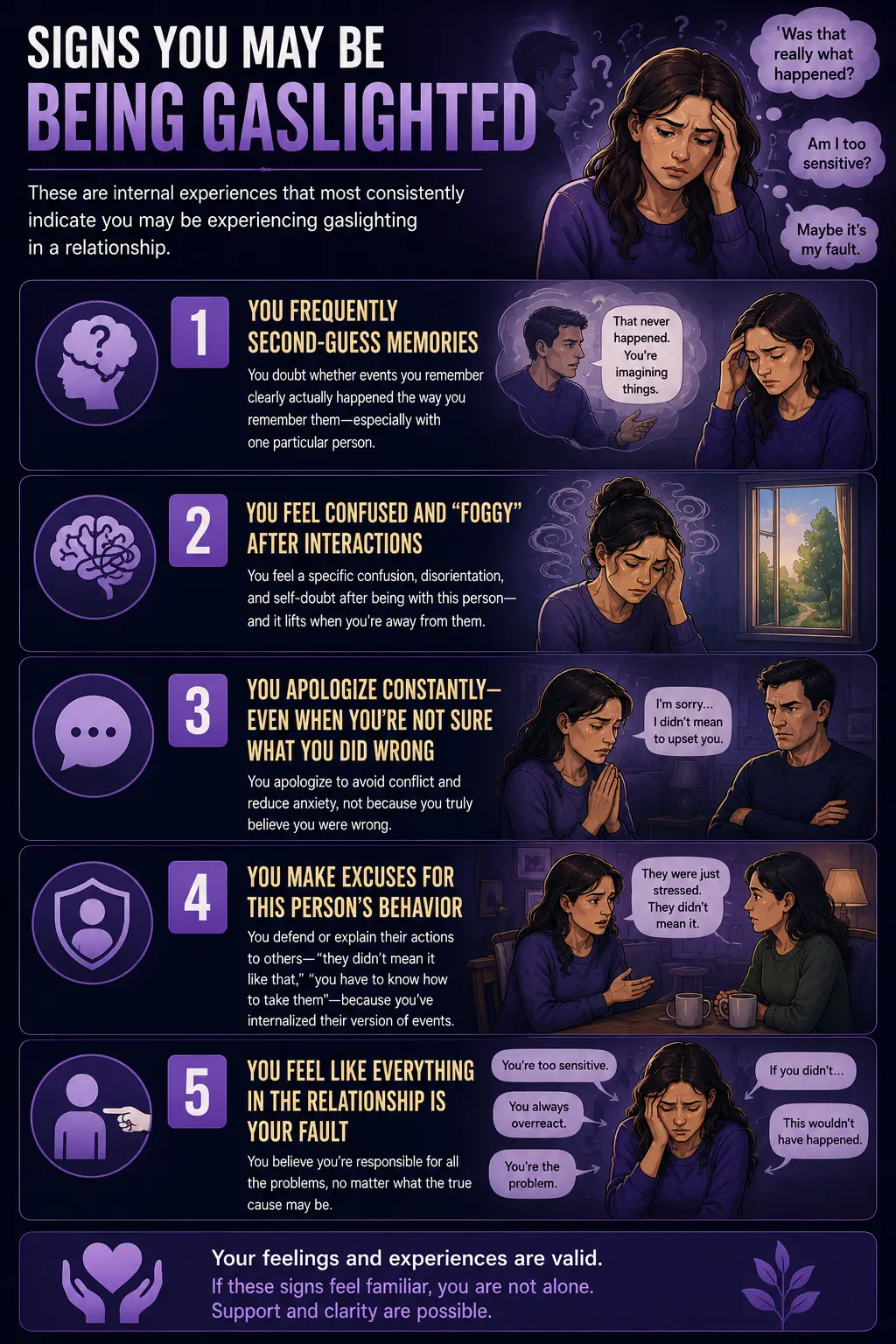
Signs You May Be Being Gaslighted
If you are taking this test about someone else — a partner, parent, family member, or colleague — these are the internal experiences that most consistently indicate you may be experiencing gaslighting.
- You frequently second-guess memories of events that you were confident about at the time.
Not occasional uncertainty about details, but a pervasive pattern of doubting whether events you remember clearly actually happened the way you remember them — specifically in relation to one particular person.
- You feel confused and “foggy” after interactions with this person in a way that doesn’t happen with others.
The “fog” is one of the most consistent gaslighting victim experiences — a specific confusion, disorientation, and self-doubt that follows interactions with the gaslighter and gradually lifts when you are away from them.
- You apologize constantly — even when you are not sure what you did wrong.
If you find yourself apologizing preemptively, reflexively, and chronically — not because you believe you were wrong but because it resolves conflict and reduces anxiety — that pattern of chronic appeasement is a strong indicator of a gaslighting dynamic.
- You make excuses for this person’s behavior to others.
Defending and explaining away the gaslighter’s behavior to people who have witnessed it — “they didn’t mean it like that,” “you have to know how to take them” — is a characteristic response to the reality distortion gaslighting produces. The target has internalized the gaslighter’s version of events.
- You feel like everything in the relationship is your fault.
One of the most predictable outcomes of sustained gaslighting is the target’s complete assumption of responsibility for all problems in the relationship. The diversion and denial tactics systematically redirect responsibility away from the gaslighter and toward the target.
Gaslighting, the Dark Triad, and Personality
Research consistently links gaslighting behavior to specific personality profiles. A 2023 study by Bhatti and colleagues in the Journal of Family Violence (N=315) found that all Dark Tetrad traits were associated with greater acceptance of gaslighting tactics in intimate relationships. The strongest predictors were primary psychopathy, Machiavellian tactics, and sadism — the combination of callousness, strategic manipulation, and pleasure in others’ distress that makes sustained gaslighting both possible and rewarding for the gaslighter (Bhatti et al., 2023).
Psychology Today’s clinical overview of gaslighting identifies Narcissistic Personality Disorder and psychopathy as the personality configurations most associated with sustained gaslighting behavior. The mechanisms differ: in NPD, gaslighting often serves to protect a fragile self-image and maintain the idealized self-concept; in psychopathy and high Machiavellianism, it is a calculated tool for control and dominance.
An important clinical nuance: not everyone who gaslights has NPD or psychopathy. Gaslighting behaviors can emerge from insecure attachment, learned patterns from the family of origin, intense shame, or fear of abandonment — without a diagnosable personality disorder. The behavior is the problem; the diagnosis is a separate question.
How This Test Works
This Gaslighting Test covers all 7 core gaslighting tactics — denial, misdirection, lying, trivializing, reality questioning, forgetting/withholding, and weaponizing vulnerabilities — across 15 questions, plus functional impact and chronicity.
Choose your framing before answering:
Option A — Am I a gaslighter? Answer each question about your own behavior toward the person you are most concerned about.
Option B — Am I being gaslighted? Answer each question about how the person you have in mind typically behaves toward you.
Base your answers on the past 6 months — the consistent, recurring pattern, not a single incident or the worst or best period.
- Never = 0
- Rarely = 1
- Sometimes = 2
- Often = 3
- Always = 4
Total range: 0–60. This is a screening tool, not a diagnostic instrument. Only a qualified therapist or mental health professional can properly assess gaslighting dynamics through comprehensive clinical evaluation.
Understanding Your Gaslighting Test Score
| Score Range | Category | What It Suggests |
|---|---|---|
| 0 – 15 | Low — Few Gaslighting Patterns | Few significant gaslighting behaviors detected. Ordinary conflict, selective memory, and frustrating behavior may be present without a pattern consistent with clinical gaslighting. |
| 16 – 30 | Mild — Some Gaslighting Patterns Present | Some gaslighting-related patterns are present — denial, trivializing, or reality questioning occur in this relationship with enough frequency to warrant honest reflection or professional discussion. |
| 31 – 45 | Moderate — Significant Gaslighting Pattern | Significant gaslighting pattern across multiple tactics. This relationship dynamic is likely causing meaningful harm. Professional support — for yourself or through couples/family therapy — is recommended. |
| 46 – 60 | High — Strong Gaslighting Indicators | Pervasive gaslighting pattern across most tactics. This dynamic is causing significant psychological harm. Professional evaluation and support are urgently recommended. |
Gaslighting vs Ordinary Manipulation vs Lying vs Narcissism
| Feature | Gaslighting | Ordinary Manipulation | Lying | Narcissistic Behavior |
|---|---|---|---|---|
| Primary goal | Undermine the target’s perception of reality — make them doubt their own mind | Influence behavior or decision toward the manipulator’s preferred outcome | Convey a false belief to obtain a specific advantage in a specific situation | Maintain grandiosity and secure admiration; protect fragile self-image |
| Sustained pattern vs isolated act | Sustained, cumulative pattern — individual incidents only become gaslighting in repeated combination | Can be isolated or repeated; doesn’t require systematically targeting the target’s reality | Can be isolated; a single significant lie doesn’t constitute gaslighting | Pervasive personality pattern — not primarily organized around reality distortion |
| Effect on target | Erodes confidence in own perceptions, memories, and sanity over time; self-doubt, confusion, chronic self-blame | May produce frustration or betrayal when discovered; doesn’t systematically erode reality-testing | Produces betrayal when discovered; doesn’t necessarily affect the target’s perception of their own mind | May produce self-doubt and diminishment but organized around serving the narcissist’s ego rather than specifically targeting reality |
| Awareness in the perpetrator | Often partly unconscious — the gaslighter frequently believes their version of events | Typically more conscious, the manipulator knows they are attempting to influence | Conscious — the liar knows the statement is false | Mixed — ego-syntonic; the narcissist experiences their behavior as justified, not as abuse |
| Research link | Strongly linked to Dark Tetrad traits — primary psychopathy, Machiavellianism, sadism (Bhatti et al. 2023) | Common human behavior, associated with Machiavellianism at elevated levels | Universal human behavior, associated with psychopathy at pathological levels | NPD can involve gaslighting as a tactic, but gaslighting is not a core NPD criterion |
| PsyMed test | This test | Dark Triad Test | Dark Triad Test | NPD Test |
Frequently Asked Questions
What is gaslighting?
Gaslighting is a form of psychological abuse in which one person systematically manipulates another’s perception of reality — their memories, their experiences, their emotional responses, and their sense of what is true — in order to maintain power and control. The term derives from the 1944 film Gaslight. The formal academic definition was established by sociologist Dr. Paige L. Sweet (2019, American Sociological Review) as “a type of psychological abuse aimed at making victims seem or feel ‘crazy,’ creating a ‘surreal’ interpersonal environment.” The clinical framework was developed by Dr. Robin Stern in The Gaslight Effect (2007/2018). Gaslighting is not a single incident but a sustained, cumulative pattern — individual tactics only become gaslighting in repeated combination over time.
Am I a gaslighter?
Gaslighting behavior is often partly unconscious — the person doing it frequently believes their version of events is accurate. Self-identification of gaslighting is genuinely difficult, which is why this test asks about specific behavioral patterns rather than intent.
The patterns most commonly associated with gaslighting behavior include:
- Consistently denying events that the other person clearly remembers
- Habitually redirecting conversations about your behavior back to the other person’s faults
- Regularly dismissing others’ emotional responses as overreactions or signs of instability.
- Selectively using others’ vulnerabilities against them during conflict.
Research links gaslighting to Dark Tetrad traits — particularly primary psychopathy, Machiavellian tactics, and sadism (Bhatti et al., Journal of Family Violence, 2023) — but gaslighting can also emerge from insecure attachment, shame, or learned relationship patterns without a personality disorder.
Is gaslighting always intentional?
No — this is one of the most important nuances in understanding gaslighting. Research and clinical literature document that gaslighting can operate without conscious intent. Many people who gaslight genuinely believe their version of events is accurate. The denial is not always a calculated lie — it is sometimes the product of a self-protective psychology that actually distorts the gaslighter’s own memory and perception. This does not reduce harm to the target; the effect on the victim’s reality testing is the same regardless of the gaslighter’s awareness. It does, however, mean that gaslighting is workable in therapy when the person is motivated to examine their patterns honestly — something that requires genuine self-reflection of the kind taking this test represents.
How is gaslighting different from ordinary lying or manipulation?
The distinction is in the primary goal and the cumulative effect. Ordinary lying aims to convey a false belief in a specific situation. Ordinary manipulation aims to influence behavior toward a preferred outcome. Gaslighting specifically targets the target’s perception of reality itself — their confidence in their own memories, their trust in their own emotional responses, their ability to know what is true. The goal is not just to win an argument or obtain a specific outcome; it is to maintain power and control by making the target dependent on the gaslighter’s version of reality. This is why gaslighting produces the characteristic confusion, self-doubt, and chronic self-blame that manipulation and lying typically do not (Stern, 2007; Sweet, 2019).
What are the psychological effects of being gaslighted?
Research and clinical documentation identify consistent downstream effects of sustained gaslighting: progressive self-doubt and erosion of confidence in one’s own perceptions; chronic confusion and a “foggy” mental state, especially after interactions with the gaslighter; chronic self-blame and assuming responsibility for all problems in the relationship; anxiety, depression, and a persistent sense of instability; and a progressive shrinking of the victim’s willingness to challenge, question, or seek external perspectives. Sustained gaslighting can produce effects that resemble trauma — and in long-term, severe cases, may qualify as complex trauma. If you are experiencing these effects, assessment for PTSD and depression alongside the gaslighting dynamic is important.
Can someone gaslight without being narcissistic or psychopathic?
Yes. While gaslighting is significantly more prevalent in people with Dark Tetrad personality features (Bhatti et al., 2023) and is associated with NPD and psychopathy (Psychology Today), gaslighting behaviors can emerge in people without a diagnosable personality disorder. Insecure attachment, intense shame, fear of abandonment, or learned patterns from the family of origin can produce gaslighting behaviors in people who are not psychopathic or narcissistic. The key difference is typically in motivational structure: personality-disordered gaslighting tends to be more consistent, more strategic, and harder to change; attachment-driven gaslighting tends to be more responsive to therapeutic intervention when the person is genuinely motivated to change.
What should I do if I think I’m being gaslighted?
The most important steps are: First, trust your own perception enough to take the question seriously — the self-doubt that makes you uncertain whether your perceptions are accurate is itself a documented effect of gaslighting. Second, seek external perspective — a trusted friend, family member, or therapist who can provide a reality check independent of the gaslighter’s influence. Third, speak with a therapist experienced in psychological abuse and trauma who can evaluate the relational dynamic thoroughly. If safety is a concern, contact the National Domestic Violence Hotline (1-800-799-7233) or text START to 88788 for confidential support. Document significant incidents — the date, what was said, and what you remember. Your records are an important anchor for your own reality-testing.
Further reading
Love Bombing to Devaluation: The Cycle Behind Manipulative Relationships — where gaslighting sits in the wider manipulation cycle, alongside DARVO, triangulation and withdrawal. Gaslighting is one specific tactic. The broader disposition behind strategic manipulation is Machiavellianism, and a short Machiavellianism quiz rates how strongly that trait shows up in you.
Related Tests
- Narcissistic Personality Disorder Test — NPD is one of the personality profiles most associated with gaslighting; if you are concerned about someone in your life, an NPD assessment provides important context
- Fake Friend Test — gaslighting turns up inside friendships too; this looks at whether a friend is genuine or using you
- Dark Triad Test — all Dark Tetrad traits are associated with accepting gaslighting tactics (Bhatti et al. 2023); the Dark Triad profile covers narcissism, Machiavellianism, and psychopathy together
- Covert Narcissism Test — covert narcissism is associated with gaslighting through shame-driven denial and reality distortion rather than overt domination
- Borderline Personality Disorder Test — BPD can involve some gaslighting-like behaviors driven by abandonment fear and emotional dysregulation rather than calculated control; important to distinguish
- Psychopath Test (PCL-R) — primary psychopathy is the strongest personality predictor of gaslighting acceptance in research (Bhatti et al. 2023)
- PTSD Test — sustained gaslighting can produce trauma responses; if you are experiencing gaslighting in a significant relationship, a PTSD assessment is important
- Clinical Depression Test — depression is a consistent downstream effect of sustained gaslighting; it often needs separate assessment and treatment
- Anxiety Test — anxiety is a documented psychological effect of sustained gaslighting; worth assessing alongside this test
- Passive Aggressive Test — passive aggression and gaslighting frequently co-occur as related manipulation patterns
- Intermittent Explosive Disorder Test — IED and gaslighting can coexist; unpredictable anger creates the fear and confusion that make gaslighting more effective
References
- Sweet, P.L. (2019). The Sociology of Gaslighting. American Sociological Review, 84(5), 851–875. [Formal academic definition; social inequality framework; gender] sagepub.com
- Bhatti, M.M., Monaghan, C., Bizumic, B., et al. (2023). “It’s All in Your Head”: Personality Traits and Gaslighting Tactics in Intimate Relationships. Journal of Family Violence. [N=315; Dark Tetrad; primary psychopathy, Machiavellianism, sadism as predictors] link.springer.com
- Stern, R. (2007/2018). The Gaslight Effect: How to Spot and Survive the Hidden Manipulation Others Use to Control Your Life. Harmony. [Clinical framework; 7 tactics; victim effects]
- Psychology Today. (2025). Gaslighting. [NPD and psychopathy as chief correlates; gaslighters repeat tactics across relationships] psychologytoday.com
- Cleveland Clinic. (2024). Are You Being Gaslighted? Take This Quiz. [Childs, C., PhD — tactics must be repeated over time; not isolated incidents] health.clevelandclinic.org
- Haupt, A. (2022). Gaslighting as “therapy speak.” The Washington Post. [Term overuse concern; not every disagreement is gaslighting]
- Wikipedia. (2025). Gaslighting. [Etymology; 1938 play; 1944 film; term popularity] en.wikipedia.org
- Psychcentral. (2025). Gaslighting Quiz: Am I Being Gaslighted? [VGQ; GRS; EAQ — validated instruments] psychcentral.com
Related Tests
See All Quiz →

Emotional and Trait Assessments · Personality
Big Five Personality Test: Discover Your OCEAN Traits
→
You may also like
See All Quiz →