

Toxic Relationship Quiz — Is My Relationship Healthy?
Is your relationship healthy or toxic? This free toxic relationship quiz looks at communication, control, and respect using research-based signs.
Published Updated
If you are afraid of your partner, you don’t need a quiz. Help is available now.
📞 National Domestic Violence Hotline — 1-800-799-7233 (SAFE) | TTY 1-800-787-3224
💬 Text START to 88788 | Chat at thehotline.org — free, confidential, 24/7
👦 Teen Dating Abuse Helpline — 1-866-331-9474
If you are in immediate danger, call 911. Please also know: internet use can be monitored. If you’re worried someone may be checking your device, consider calling from a phone they don’t have access to, and clearing your browser history after visiting.
Every relationship has hard days. Conflict, frustration, and the occasional bad week are normal and don’t mean a relationship is broken. But some relationships aren’t just difficult — they steadily wear you down. They leave you smaller, more anxious, less sure of yourself, and more isolated than when you started. That’s the difference between a relationship going through something hard and a relationship that is genuinely harmful.
This free toxic relationship quiz looks at the patterns that research consistently links to unhealthy relationships: how you and your partner communicate, whether respect flows both ways, whether control or fear has crept in, and what the relationship is doing to your sense of self. It draws on the work of Dr. John Gottman — whose research identified the communication patterns that most reliably predict relationship breakdown — and on the research literature on coercive control.
One thing to be clear about before you start: a quiz cannot tell you whether to stay or leave, and a low score cannot rule out abuse. If you are afraid of your partner, or being controlled, hurt, or coerced, that matters more than any number this page can give you. Please read the red flags section below — those override any score.
What Makes a Relationship “Toxic”?
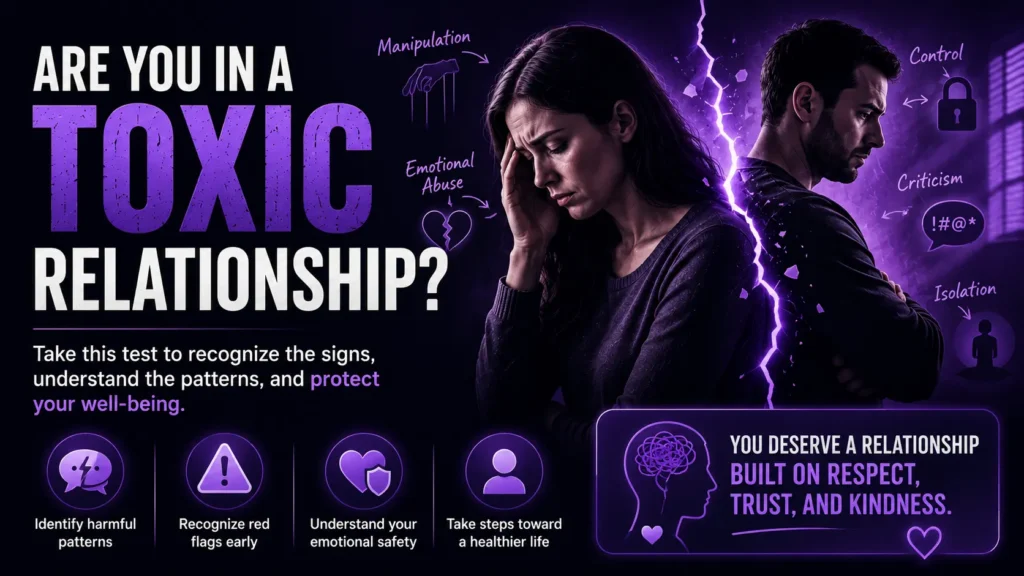
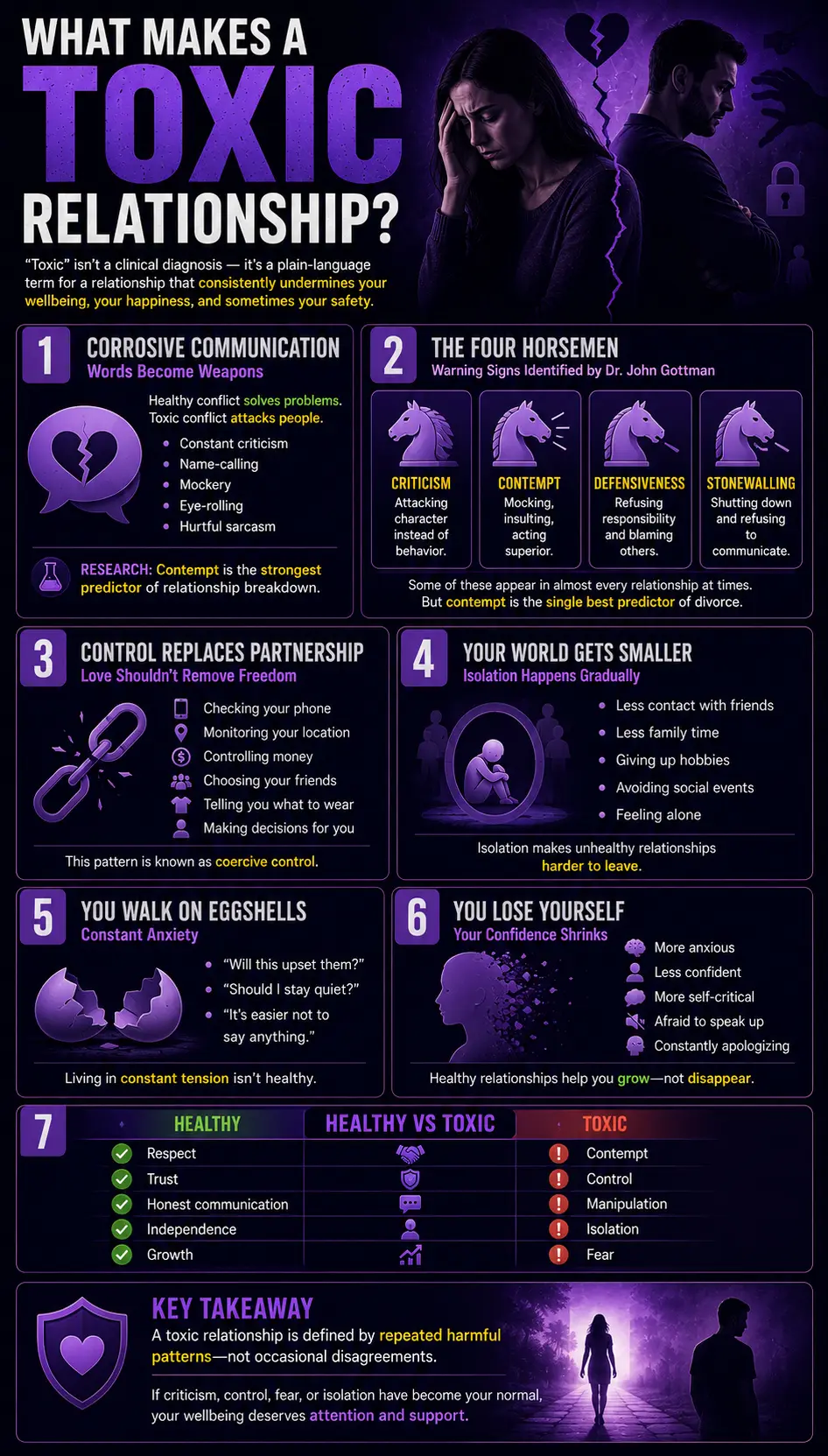
“Toxic” isn’t a clinical diagnosis — it’s a plain-language term for a relationship that consistently undermines your wellbeing, your happiness, and sometimes your safety. The research points to a few patterns that reliably distinguish a relationship that’s struggling from one that’s actively harmful.
The communication has turned corrosive. Dr. John Gottman’s research on thousands of couples identified four communication patterns — he calls them the “Four Horsemen” — that most reliably predict relationship breakdown: criticism (attacking your partner’s character rather than raising a specific issue), contempt (mockery, eye-rolling, sneering, name-calling — criticism delivered from a position of superiority), defensiveness (deflecting all responsibility, counterattacking), and stonewalling (shutting down and withdrawing entirely). Some of these appear in almost every relationship at times. But contempt is the single best predictor of divorce — it’s the most corrosive of the four, because it communicates disgust at who the person fundamentally is, not just what they did.
Control has replaced partnership. Healthy relationships involve two people with autonomy who choose each other. Unhealthy ones involve one person steadily reducing the other’s freedom — monitoring their whereabouts and messages, cutting them off from friends and family, controlling money, dictating what they wear or do, making decisions for them. Researchers call this coercive control, and it’s one of the most important concepts to understand here.
You’ve gotten smaller. One of the most telling signs of a toxic relationship is what it has done to you. Are you more anxious, more self-doubting, more isolated than you were before? Do you censor yourself, walk on eggshells, apologize reflexively for things that aren’t your fault? A relationship that consistently shrinks you — that erodes your confidence, your friendships, your sense of who you are — is doing real damage regardless of whether anyone has raised a hand.
Coercive Control: The Pattern Most People Miss
This deserves its own section, because it’s the thing people most often fail to recognize in their own relationship — and it’s the pattern most strongly linked to danger.
Coercive control was described by sociologist Evan Stark as a “condition of unfreedom” — a pattern in which one partner systematically restricts the other’s independence, isolating them from friends, family, and support; trapping them through financial, logistical, social, or emotional barriers; and instilling fear. It works through a thousand small restrictions rather than a single dramatic act.
Two things make coercive control critically important to recognize. First: it can instill fear even in the complete absence of physical violence. Many people in coercively controlling relationships tell themselves it “isn’t that bad” because they’ve never been hit. But the research is clear that the control itself is the harm, and the fear is real. Second, and more urgently: coercive control has been described in the research literature as the “golden thread” linking risk profiles to eventual violence. Women experiencing coercive control report higher levels of every form of intimate partner violence and, critically, higher levels of danger. It is not merely unpleasant — it is one of the strongest predictors that a relationship may become physically dangerous.
Coercive control can look like: checking your phone and messages; needing to know where you are at all times; controlling or restricting your access to money; making it difficult for you to see friends or family; deciding what you can wear, eat, or do; threatening to leave, to harm themselves, or to harm you if you don’t comply; making you feel you can’t cope without them. If several of these are present, please read the red flags section below, and consider contacting the National Domestic Violence Hotline — even if you’re not sure it “counts.”
Signs You Might Be in a Toxic Relationship
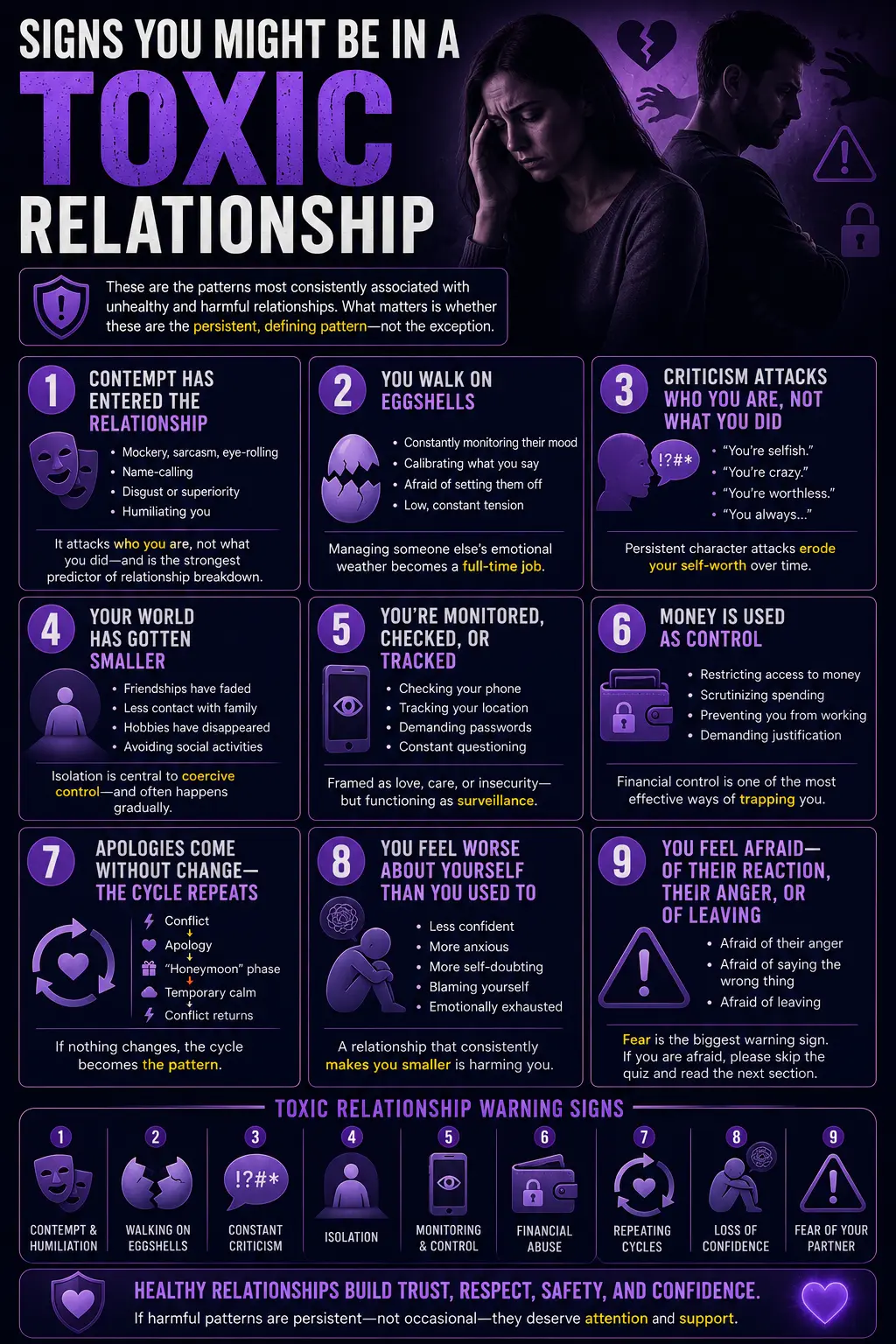
These are the patterns most consistently associated with unhealthy and harmful relationships. A single hard patch doesn’t make a relationship toxic — what matters is whether these are the persistent, defining pattern rather than the exception.
Contempt has entered the relationship. Mockery, sneering, eye-rolling, sarcasm aimed at hurting, name-calling, or a general air of disgust or superiority from your partner (or from you). Gottman’s research identifies this as the single most corrosive pattern and the strongest predictor of relationship breakdown — because it attacks who the person is, not what they did.
You walk on eggshells. You monitor your partner’s mood constantly, calibrate what you say to avoid setting them off, and feel a low background tension about how they’ll react. If you find yourself managing someone else’s emotional weather as a full-time job, that’s a significant sign.
Criticism attacks who you are, not what you did. There’s a real difference between “I felt hurt when you forgot” and “you’re selfish and you always have been.” Persistent character attacks — being told you’re worthless, crazy, stupid, or fundamentally deficient — erode the self over time, and they’re a hallmark of an unhealthy dynamic.
Your world has gotten smaller. Friendships have faded, family contact has reduced, hobbies have dropped away — whether through direct discouragement, through conflict every time you try, or just because it’s easier not to. Isolation is central to coercive control, and it’s often gradual enough that you don’t notice until you look back.
You’re monitored, checked, or tracked. Your phone, messages, location, spending, or whereabouts are checked or demanded. Framed as love, care, or insecurity — but functioning as surveillance.
Money is used as control. Your access to money is restricted, your spending is scrutinized, you have to justify purchases, you’re prevented from working or from controlling your own income. Financial control is one of the most effective ways of trapping someone in a relationship.
Apologies come without change — the cycle repeats. A blow-up, then remorse, then a honeymoon period, then it happens again. If you’ve been through this loop many times, and nothing actually changes, the loop is the pattern.
You feel worse about yourself than you used to. Less confident, more anxious, more self-doubting, more prone to thinking everything is your fault. A relationship that consistently makes you smaller is harming you, even if you can’t point to a single dramatic incident.
You feel afraid — of their reaction, their anger, or of leaving. Fear of any kind is the signal that matters most on this entire page. If you are afraid, please skip the quiz and read the next section.
Red Flags That Override Any Quiz Score
Read this even if you’re planning to take the toxic relationship quiz — especially if you’re planning to take the quiz.
No score on this page — or any page — can overrule the following. If any of these are present in your relationship, the number doesn’t matter. This is not “a rough patch,” it is not “just how they are,” and it is not something you need to score highly on a quiz to justify taking seriously:
- You are afraid of your partner. Not annoyed. Not frustrated. Afraid. Fear is not a normal feature of a healthy relationship, ever, and its presence is the most important signal on this page.
- You have been hurt physically — hit, shoved, grabbed, choked, restrained, or had objects thrown at you. Even once. Even if they were sorry. Even if you think you provoked it.
- You have been threatened — with harm to you, to your children, to your pets, or with them harming themselves if you leave.
- You have been pressured or forced into sexual activity you didn’t want. This is true regardless of whether you are married or in a long-term relationship. Consent doesn’t become permanent.
- You are being isolated, monitored, or financially controlled — the coercive control pattern described above.
- You are afraid of what would happen if you tried to leave.
If any of these apply, please reach out — you do not need to be certain, and you do not need it to be “bad enough.” The National Domestic Violence Hotline (1-800-799-7233, or text START to 88788) is free, confidential, and available 24/7. Advocates are there for exactly this — including for people who aren’t sure whether what they’re experiencing counts. It counts.
A note on safety: if you’re concerned your partner monitors your devices, consider calling from a phone they can’t access, and clearing your browser history after visiting sites like this one.
How This Toxic Relationship Quiz Works
This quiz contains 15 questions about the patterns in your relationship — communication, respect, control, and the effect the relationship is having on you. For each, choose how often it applies:
Never = 0 | Rarely = 1 | Sometimes = 2 | Often = 3 | Always = 4
Your answers add up to a score from 0 to 60. Answer based on the ongoing pattern in your relationship, not a single bad week.
This is a reflection tool, not a diagnosis, and it is not a substitute for talking to someone. It cannot tell you whether to stay or leave — that’s a decision only you can make, ideally with real support. And to repeat the most important point on this page: a low score does not rule out abuse. If the red flags above apply to you, they matter more than anything this quiz produces.
Understanding Your Result
| Score Range | Level | What It Suggests |
|---|---|---|
| 0 – 15 | Largely Healthy | Few signs of toxic patterns. Normal conflict may be present without the corrosive dynamics of an unhealthy relationship. |
| 16 – 30 | Some Concerns | Some unhealthy patterns are present. Worth addressing — many are fixable if both people are willing. |
| 31 – 45 | Significant Concerns | A meaningful pattern of toxic dynamics that is likely harming you. Support is strongly worth seeking. |
| 46 – 60 | Serious Concerns | A pervasive pattern of harmful dynamics. Please reach out for support — you deserve better than this. |
Can a Toxic Relationship Be Fixed?
Sometimes — and the honest answer depends entirely on what’s driving it.
Patterns that often can change: Poor communication, the Four Horsemen (criticism, contempt, defensiveness, stonewalling), conflict avoidance, resentment build-up, and drifting apart. These respond well to couples therapy when both partners genuinely want to change and both take responsibility. Gottman’s research is fundamentally hopeful on this point: the destructive patterns have learnable antidotes — gentle start-ups instead of criticism, building appreciation instead of contempt, taking responsibility instead of defending, self-soothing and returning instead of stonewalling.
Patterns that usually don’t change — and where couples therapy is not appropriate: Coercive control, abuse of any kind, and a partner who refuses to acknowledge any problem. This is important: couples counseling is generally not recommended where abuse or coercive control is present, and can actually make things more dangerous, because it can be used against the victim afterward and because it frames an abuse dynamic as a mutual problem. If control, fear, or abuse is in the picture, individual support and a domestic violence advocate are the right path — not joint therapy.
The single most useful question to ask: does your partner acknowledge there’s a problem and genuinely want to work on it? Change requires both people. If you are the only one trying, you’re not in a relationship that’s being repaired — you’re in one you’re carrying.
Frequently Asked Questions
What is a toxic relationship?
A toxic relationship is one that consistently undermines your wellbeing, happiness, and sometimes your safety — as opposed to a relationship that’s simply going through difficulty. It’s characterized by corrosive communication (particularly contempt, which Gottman’s research identifies as the strongest predictor of relationship breakdown), by control replacing partnership, by disrespect, and by the steady erosion of your confidence and sense of self. “Toxic” isn’t a clinical diagnosis, but it describes a real and recognizable pattern. The key distinction is persistence: every relationship has bad days, but a toxic relationship’s defining feature is that the harm is the pattern rather than the exception.
What is the difference between a toxic relationship and an abusive one?
There’s overlap, and the line isn’t always clean, but the distinction matters. “Toxic” typically describes patterns that are corrosive and harmful — contempt, chronic disrespect, emotional volatility, mutual destructiveness. “Abusive” describes a pattern where one person exerts power and control over another, through physical violence, sexual coercion, threats, financial control, isolation, or psychological manipulation. Crucially, abuse can exist without any physical violence — coercive control is abuse, and research shows it instills real fear and predicts escalating danger. Practically: if there is fear, control, coercion, or violence, treat it as abuse, not toxicity, and seek support from a domestic violence resource rather than couples counseling.
Is my relationship toxic or am I overreacting?
The instinct to ask this question is itself worth noticing — many people in genuinely harmful relationships spend years wondering if they’re overreacting, often because they’ve been told they are. Some useful questions: Has your world gotten smaller since this relationship started? Do you feel worse about yourself than you used to? Do you walk on eggshells around your partner’s moods? Do you censor yourself to avoid a reaction? Do you feel afraid? Trusting your own perception is genuinely hard in a relationship that’s been undermining it — that’s part of what makes these dynamics so effective. If you keep returning to this question, that persistence is data. And if you’re not sure, that’s exactly what the National Domestic Violence Hotline advocates are there for; you don’t need certainty to call.
What are the Four Horsemen in relationships?
The Four Horsemen are four communication patterns identified by Dr. John Gottman as the most reliable predictors of relationship breakdown: criticism (attacking your partner’s character rather than raising a specific behavior), contempt (mockery, sneering, name-calling, eye-rolling — criticism from a position of superiority), defensiveness (deflecting responsibility and counterattacking), and stonewalling (shutting down and withdrawing from the interaction entirely). All four appear occasionally in most relationships; what matters is whether they’ve become the dominant mode. Contempt is by far the most damaging and is the single best predictor of divorce, because it conveys disgust at who your partner fundamentally is. The encouraging part of Gottman’s research is that each has a learnable antidote.
What is coercive control?
Coercive control is a pattern of behavior in which one partner systematically restricts the other’s freedom and independence — isolating them from friends, family, and support; controlling their money, movements, and choices; monitoring them; and instilling fear. Sociologist Evan Stark described it as a “condition of unfreedom.” Two things make it critical to understand: first, it can create genuine fear without any physical violence at all, which is why so many people in coercively controlling relationships tell themselves it isn’t serious. Second, research identifies it as a strong predictor of danger — people experiencing coercive control report higher levels of every form of intimate partner violence and higher overall risk. If you recognize this pattern, please contact a domestic violence resource, even if you’ve never been physically hurt.
Can couples therapy fix a toxic relationship?
It depends on what’s driving the toxicity. Couples therapy can be genuinely effective for communication breakdown, the Four Horsemen, resentment, and disconnection — provided both partners acknowledge the problem and are willing to work on it. But couples therapy is generally not recommended where abuse or coercive control is present, and can make things more dangerous: it frames an imbalance of power as a mutual problem, and what the victim says in session can be used against them afterward. If control, coercion, fear, or violence are part of the picture, the right support is individual therapy and a domestic violence advocate — not joint counseling. The clarifying question is always whether your partner genuinely acknowledges a problem and wants to change; if you’re the only one trying, therapy can’t carry that alone.
Can men be in toxic or abusive relationships?
Yes. While intimate partner violence is disproportionately perpetrated by men against women, men are also victims — research finds male victimization rates ranging from roughly 3.4% to 20.3% for physical violence and 7.3% to 37% for psychological violence. Men in abusive relationships face additional barriers to seeking help, including stigma, disbelief, and a shortage of services. Abuse and toxicity occur in relationships of every gender configuration, including same-sex relationships. The National Domestic Violence Hotline supports people of all genders, and the patterns described on this page — contempt, coercive control, isolation, fear — apply regardless of who is experiencing them.
Further reading
Love Bombing to Devaluation: The Cycle Behind Manipulative Relationships — the idealisation-to-devaluation pattern that sits underneath many harmful relationships, and what it does to you over time. Controlling behaviour is one of the patterns this quiz picks up. To look at your own side of it rather than a partner’s, the Control Freak Quiz is a private self-check — and it treats control as anxiety-driven, not as villainy.
Related Tests
- Gaslighting Test — gaslighting is a specific manipulation tactic common in toxic relationships; screens for whether your reality is being systematically undermined
- Narcissistic Personality Disorder Quiz — many people arrive at this page wondering about a partner’s narcissistic traits; screens for the NPD pattern
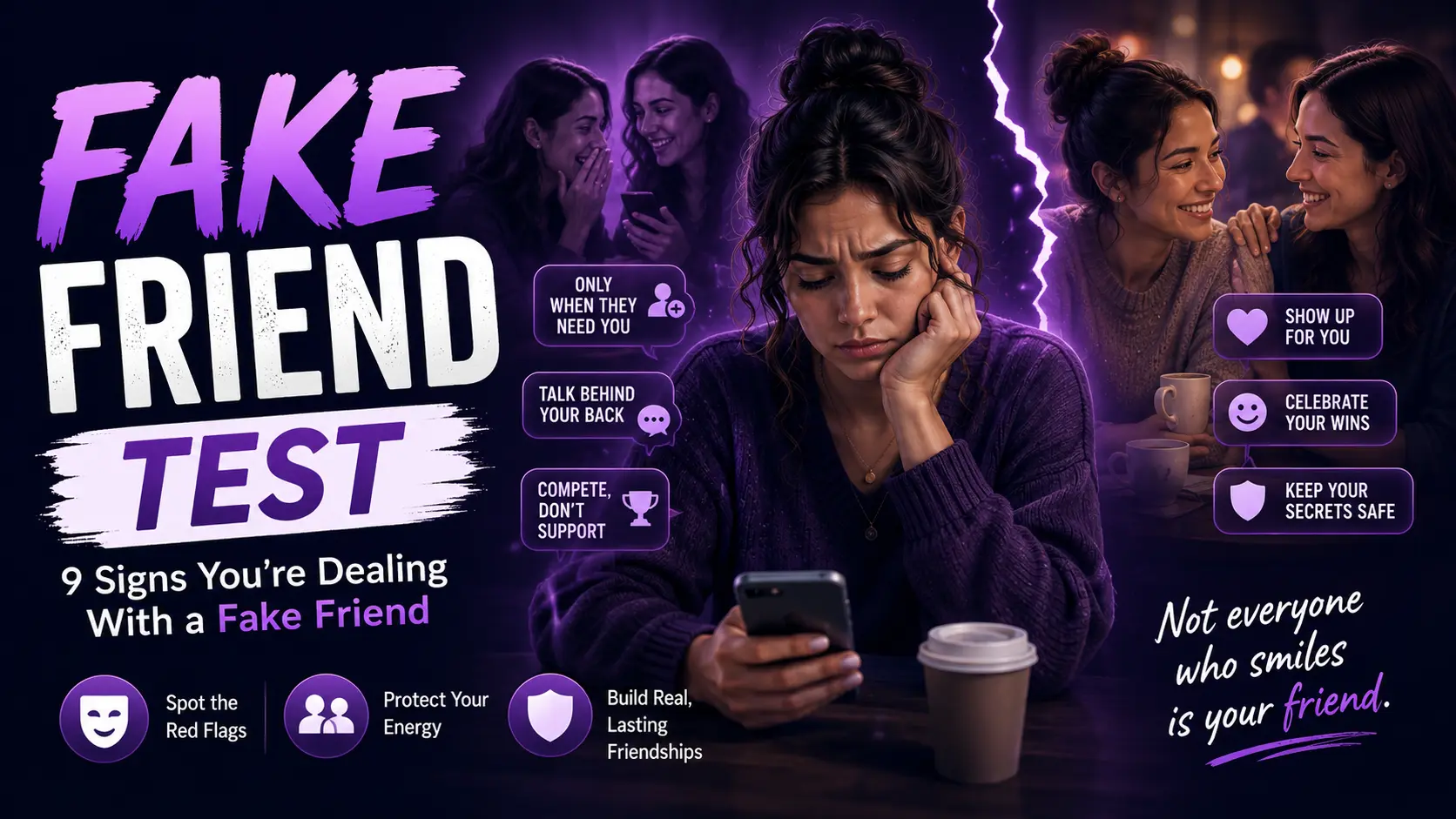
- Fake Friend Test — the same dynamics playing out in a friendship rather than a romantic relationship
- Self-Esteem Test — toxic relationships erode self-worth; the Rosenberg scale measures what the relationship may have taken from you
- Clinical Depression Test — depression is a common consequence of a harmful relationship and deserves its own attention
- Anxiety Test — chronic anxiety and hypervigilance (“walking on eggshells”) are common effects of a toxic relationship
- PTSD Test — prolonged relationship abuse can produce trauma symptoms; worth screening if you notice them
- Dark Triad Test — manipulation, callousness, and entitlement are the traits most associated with harmful relationship behavior
References
- The Gottman Institute. What Defines a Toxic Relationship? [Four Horsemen: criticism, contempt, defensiveness, stonewalling; contempt as the best predictor of divorce] gottman.com
- Stark, E. (2007). Coercive Control: How Men Entrap Women in Personal Life. Oxford University Press. [“Condition of unfreedom”; isolation, entrapment, fear]
- Beck, C.J.A., et al. (2019). Coercive Control in Intimate Partner Violence: Relationship with Women’s Experience of Violence, Use of Violence, and Danger. Psychology of Violence. PMC6291212. [Coercive control associated with higher levels of every form of IPV and higher danger] pmc.ncbi.nlm.nih.gov
- Day, N.J.S., et al. (2025). Coercive Control and Intimate Partner Violence: Relationship With Personality Disorder Severity and Pathological Narcissism. Personality and Mental Health. [Coercive control as the “golden thread” linking risk to violence; male victimization rates] ncbi.nlm.nih.gov
- National Domestic Violence Hotline. Get Help. [1-800-799-7233; text START to 88788; safety and digital security guidance] thehotline.org
Related Tests
See All Quiz →
You may also like
See All Quiz →