
Difficult Person Test: Are You Hard to Deal With?
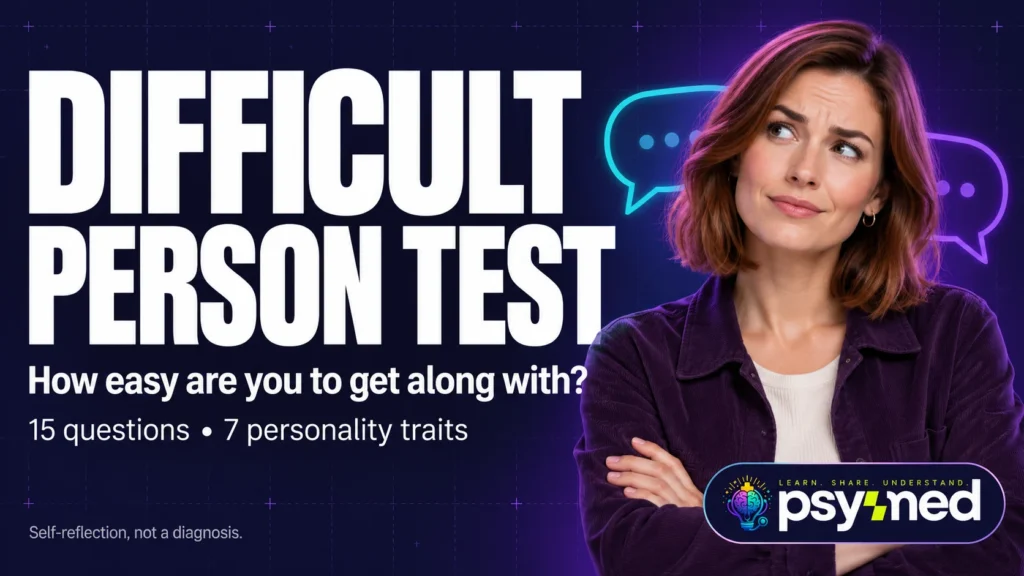
A 15-item adult self-reflection scale measuring the seven traits of antagonism: callousness, grandiosity, aggressiveness, suspicion, manipulativeness, dominance and risk-taking. See which ones drive your score.
Published Updated
This free Difficult Person Test measures how easy — or how hard — you are to get along with, based on the seven research-backed traits that psychologists link to being a “difficult” person. In 15 quick questions, you’ll get an honest, private read on where you fall, from easygoing to genuinely challenging, along with a breakdown of the specific traits driving your score.
The test is grounded in real personality science. The seven traits it draws on come from research into antagonism — the personality domain that sits at the opposite end of agreeableness — studied by Joshua Miller and colleagues at the University of Georgia. Before you start, one honest note: being “difficult” isn’t a disorder or a character sentence. These are ordinary personality traits that everyone has to some degree, and a high score is an invitation to self-awareness, not a verdict on your worth.
What Is the Difficult Person Test?
The Difficult Person Test is a personality assessment that measures antagonism — the cluster of traits that make someone hard to get along with. It went viral online (popularized by IDRlabs), but the science underneath it is serious: it’s based on research from the personality lab of Joshua Miller at the University of Georgia into the structure of antagonism, which psychologists understand as the low end of agreeableness in the Five-Factor Model of personality.
What makes the test useful rather than just a label is that it breaks “difficult” into seven specific, measurable traits — callousness, grandiosity, aggressiveness, suspicion, manipulativeness, dominance, and risk-taking. That specificity matters: “difficult” on its own is a vague insult, but knowing which traits run high in you turns it into something you can actually understand and work with. This test gives you an overall difficulty score and helps you see which of the seven traits are doing the most work behind it. It’s a self-reflection tool, not a clinical diagnosis — no quiz can diagnose a personality disorder, and difficulty isn’t one anyway.
The 7 Traits of a Difficult Person
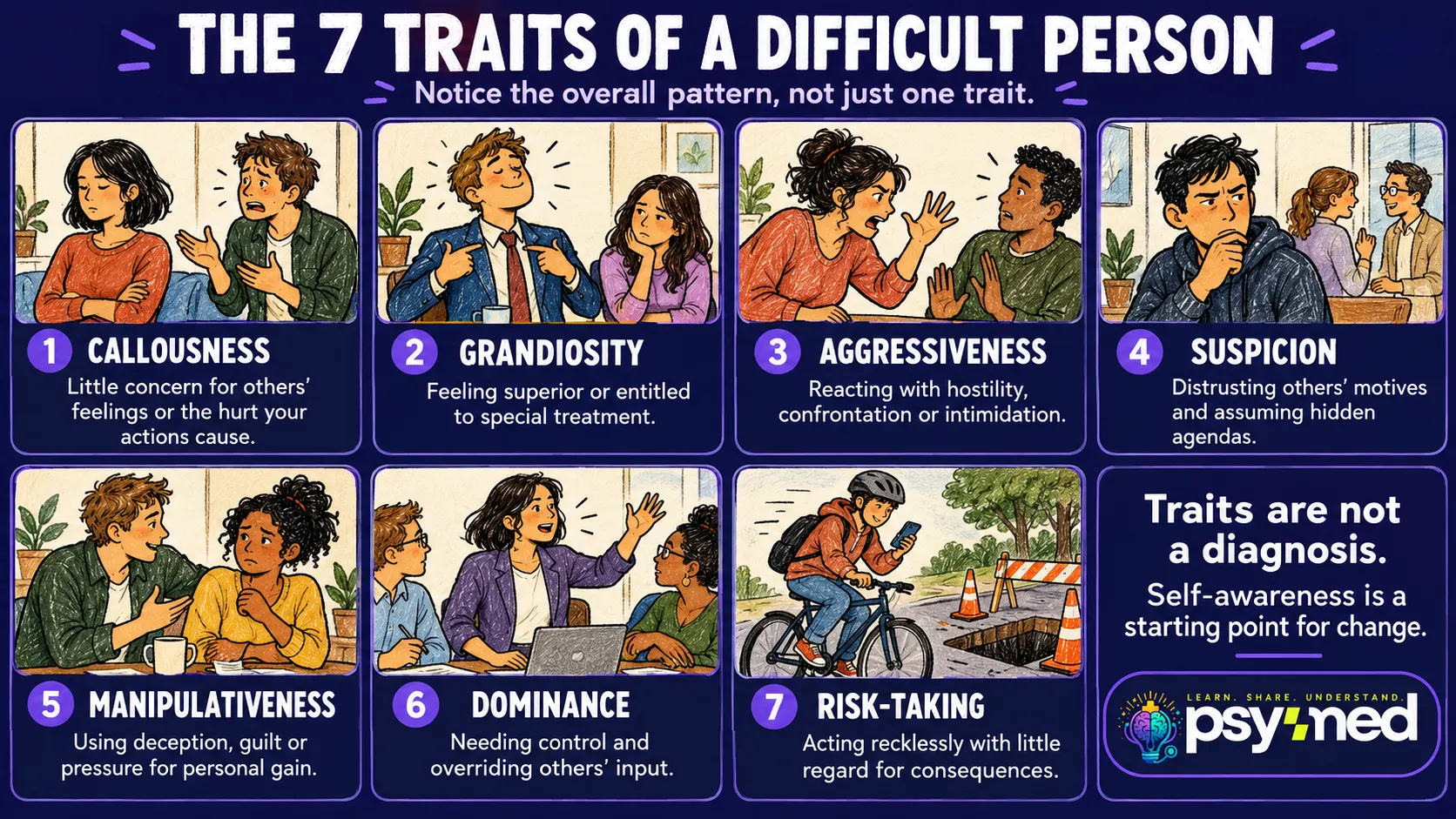
Difficult people tend to score high on seven specific traits of antagonism, according to the University of Georgia research behind this test. Most people have one or two of these more than the others; it’s the overall pattern, and how high the traits run, that makes someone genuinely hard to deal with. Here’s what each trait looks like — read them as the “signs,” and notice which feel familiar.
Callousness
Callousness is a lack of concern for other people’s feelings. It shows up as emotional coldness, difficulty empathizing, and indifference to how your actions land on others. Someone high in callousness can hurt people without feeling much about it, and may see empathy as weakness rather than a strength. This is widely considered the core trait of antagonism.
Grandiosity
Grandiosity is an inflated sense of your own importance. It looks like feeling superior, entitled to special treatment, or convinced your needs matter more than other people’s. A grandiose person expects admiration and can be dismissive of those they see as beneath them — which naturally creates friction in relationships built on equality.
Aggressiveness
Aggressiveness is a tendency toward hostile or combative behavior. It can be overt — anger, confrontation, intimidation — or simmering, as in a readiness to attack when challenged. People high in this trait are quick to go on the offensive, which makes conflict frequent and resolution hard. If anger specifically is your concern, our Anger Management Test looks at it directly.
Suspicion
Suspicion is a baseline distrust of other people’s motives. It shows up as assuming the worst, reading hidden agendas into neutral actions, and finding it hard to believe others mean well. Chronic suspicion keeps people at arm’s length and can turn ordinary interactions into something to be guarded against — exhausting for everyone involved, including you.
Manipulativeness
Manipulativeness is influencing others deceptively for your own benefit. It involves using charm, guilt, lies, or pressure to get what you want, treating people as means to an end rather than as equals. Manipulative behavior erodes trust fast once it’s noticed, because it reframes the relationship as a game to be won. Our Machiavellian Test explores this strategic trait in more depth.
Dominance
Dominance is a strong need to control or take charge of others. It looks like having to be in command, overriding other people’s input, and struggling to defer, collaborate, or let others lead. A degree of dominance can be effective in some settings, but when it’s a constant need, it crowds out everyone else and breeds resentment. Our Control Freak Quiz looks closely at this one.
Risk-taking
Risk-taking, in this context, is a willingness to engage in reckless or dangerous behavior with little regard for consequences — to yourself or others. It shows up as impulsivity, thrill-seeking, and disregarding safety or other people’s well-being. When combined with the other antagonistic traits, it makes a person unpredictable and hard to rely on.
How This Difficult Person Test Works
This test contains 15 statements that tap the seven traits of antagonism. For each, choose how much you agree, thinking about how you generally are rather than your best or worst day:
- Strongly Disagree = 0
- Disagree = 1
- Neutral = 2
- Agree = 3
- Strongly Agree = 4
Your answers add up to an overall difficulty score from 0 to 60, placing you in one of four ranges from “easygoing” to “strongly difficult.” Answer honestly — the value of this test is entirely in how truthful you’re willing to be with yourself, and your results are completely private. There are no right answers here, and self-awareness is the whole point.
Understanding Your Results
Your score places you in one of four ranges. Read it as a mirror for honest reflection, not a label — and look at which of the seven traits your highest answers clustered around, because that’s where the real insight is. Difficulty isn’t a diagnosis, and every range below includes what tends to help.
| Score | Range | What It Suggests |
|---|---|---|
| 0 – 15 | Easygoing | You’re low in antagonism and generally easy to get along with. |
| 16 – 30 | Mostly Agreeable | You’re generally agreeable, with a few difficult tendencies in specific areas. |
| 31 – 45 | Noticeably Difficult | Several antagonistic traits run high enough to create real friction in your relationships. |
| 46 – 60 | Strongly Difficult | High antagonism across most traits — you’re likely hard for many people to deal with. |
Can a Difficult Person Change?
Yes — difficult traits can soften, though it takes self-awareness and usually some deliberate effort. Personality traits are relatively stable but not fixed, and antagonism in particular tends to decrease naturally as people move through adulthood. More than that, the specific behaviors that make someone difficult — snapping when challenged, assuming the worst, needing to control — are learnable patterns, which means they can be unlearned and replaced.
The first and hardest step is the one you may have just taken: seeing the pattern honestly instead of blaming the friction entirely on other people. From there, therapy can be especially valuable, because antagonistic traits usually sit on top of something — old hurts, low trust, shame, or fear of being vulnerable — and addressing the root is what makes the change stick. If low self-worth is part of your picture, our Self-Esteem Test may be a useful companion.
Think Someone Else Is the Difficult One?
If you landed here because of someone else — a coworker, partner, family member, or friend who’s exhausting to deal with — it’s worth knowing that you can’t score another person accurately from the outside, and the people who are genuinely highest in these traits are the least likely to ever take a test like this.
What you can do is get clear on how their behavior affects you and whether the relationship is healthy for you. If the difficulty tips into manipulation, control, or feeling unsafe, those are the right things to assess — our Am I Being Manipulated? Quiz and Toxic Relationship Quiz focus on how someone’s behavior is landing on you, which is the thing you can actually judge and act on.
Frequently Asked Questions
What are the seven traits of a difficult person?
The seven traits are callousness (little concern for others’ feelings), grandiosity (an inflated sense of importance), aggressiveness (hostile or combative behavior), suspicion (distrust of others’ motives), manipulativeness (deceptively influencing others for personal gain), dominance (a need to control or take charge), and risk-taking (reckless or dangerous behavior).
Together they make up antagonism — the personality domain that sits opposite agreeableness — studied by Joshua Miller and colleagues at the University of Georgia. Most people are high in only one or two; it’s the overall pattern, and how extreme the traits are, that makes someone genuinely difficult to get along with.
Is the Difficult Person Test scientifically valid?
The seven traits it measures come from legitimate personality research into antagonism, so the underlying framework is sound and well-supported. That said, the various online versions of the “Difficult Person Test” (including this one) are self-report screens built on that framework, not formally validated clinical instruments, and a self-report measure always reflects how you see yourself rather than an objective assessment.
It also can’t diagnose anything — being difficult isn’t a mental health condition. So treat your result as an accurate-enough mirror for honest self-reflection and a prompt to look at specific traits, not as a clinical verdict. Used that way, it’s genuinely useful.
Does being a difficult person mean I’m a narcissist or have a personality disorder?
No — not on its own. The traits of antagonism overlap with features seen in some personality disorders (narcissistic, antisocial) and in the “dark triad,” which is why a very high score is worth exploring further. But antagonistic traits exist on a spectrum in the general population, and scoring high means you have more of these ordinary traits than most people — not that you have a disorder.
A personality disorder is a specific clinical diagnosis involving pervasive, long-standing patterns that cause significant impairment, and only a qualified professional can assess for one. If your score was high and you want to understand the patterns better, our Narcissistic Personality Disorder Quiz and Dark Triad Test are reasonable next steps, and a therapist is the best resource of all.
Related Tests
- Dark Triad Test — narcissism, Machiavellianism, and psychopathy, which overlap with high antagonism
- Narcissistic Personality Disorder Quiz — a focused look at grandiosity and entitlement
- Machiavellian Test — the manipulativeness trait in depth
- Control Freak Quiz — the dominance and control trait
- Anger Management Test — the aggressiveness trait
- Pathological Liar Test — compulsive lying, which overlaps with the manipulativeness trait
- Am I Being Manipulated? Quiz — for assessing someone else’s behavior toward you
References
- University of Georgia / Miller, J.D. Research on antagonism and the traits used to identify difficult people. UGA Today
- Lynam, D.R., & Miller, J.D. (2019). The basic trait of Antagonism: An unfortunately underappreciated construct. Journal of Research in Personality, 81, 118–126. [The structure of antagonism] doi.org
- Crowe, M.L., Lynam, D.R., & Miller, J.D. (2018). Uncovering the structure of agreeableness from self-report measures. Journal of Personality, 86(5), 771–787. [Antagonism as low agreeableness] doi.org
Related Tests
See All Quiz →

Emotional and Trait Assessments
Are You a Psychopath? Take This Free Psychopath Test (PCL-R Based)
→
You may also like
See All Quiz →