
Self-check · Habits and impulses
Pathological Liar Test: is it a compulsive pattern?
Fifteen statements on frequency, duration and consequences — the three dimensions researchers use to describe pathological lying. Free, private, scored 0–60.

Pathological lying is not a diagnosis in the DSM-5-TR or ICD. This is an educational self-check and cannot diagnose anything.
-
THE SELF-CHECK15 statementsOn frequency, motive and consequences.
-
PRIVACY FIRSTNo account neededFree to take, with no sign-up. Your result appears right away.
-
CLEAR BOUNDARIESNot a recognised diagnosisPathological lying is not in the DSM-5-TR. There is nothing here to diagnose.
The self-check
Take the pathological liar test
Answer for how things generally are, not for one bad stretch. There is an obvious irony in a lying questionnaire, and it is worth naming: the only person this can be accurate for is someone willing to be accurate with themselves.
Your score
What the bands mean
- 0–15 Typical — ordinary social lying, in the usual range
- 16–30 Some patterns — lying more than you would like, in places
- 31–45 Significant pattern — frequent, and starting to cost you
- 46–60 Compulsive pattern — closely matching how pathological lying is described
Each answer scores 0 (Never) to 4 (Always), for a total of 0–60. The bands describe how closely your answers match the clinical description. They are not diagnostic cutoffs, because there is no diagnosis to cut off.
The duration researchers have used: numerous lies, most days, for longer than six months.
The short answer
What is pathological lying?
Pathological lying describes a persistent pattern of frequent, often pointless lying that the person struggles to control and that causes real harm to their life. It is what people usually mean when they call someone a compulsive liar. It was first described in the medical literature more than a century ago, originally as “pseudologia phantastica”, and in some languages it is still called mythomania. Despite that history it has never been recognised as a disorder in the major diagnostic systems, and Dike and colleagues noted in 2005 that it remained a poorly understood concept surrounded by considerable vagueness.
That has started to change. Curtis and Hart argued in 2020 that pathological lying meets the standards for a diagnostic entity, using a working definition of numerous lies told most days for longer than six months, accompanied by distress or impairment. It is still not an official diagnosis — but it is now a researched pattern rather than only a clinical impression.
The marker is not how bad the lies are. It is that they continue after they have clearly started costing you.
In the study that tested it as a diagnostic entity, Curtis and Hart recruited 807 people and analysed 623 completed responses. 13% of that sample reported that they, or others, identified them as pathological liars, and that group reported greater distress and impairment than the rest. That 13% is not a general-population rate — participants were recruited partly from mental health forums and social media, so the sample is self-selected and the figure says nothing about how common this is overall.
View sourceKnow the signs
What does pathological lying look like?
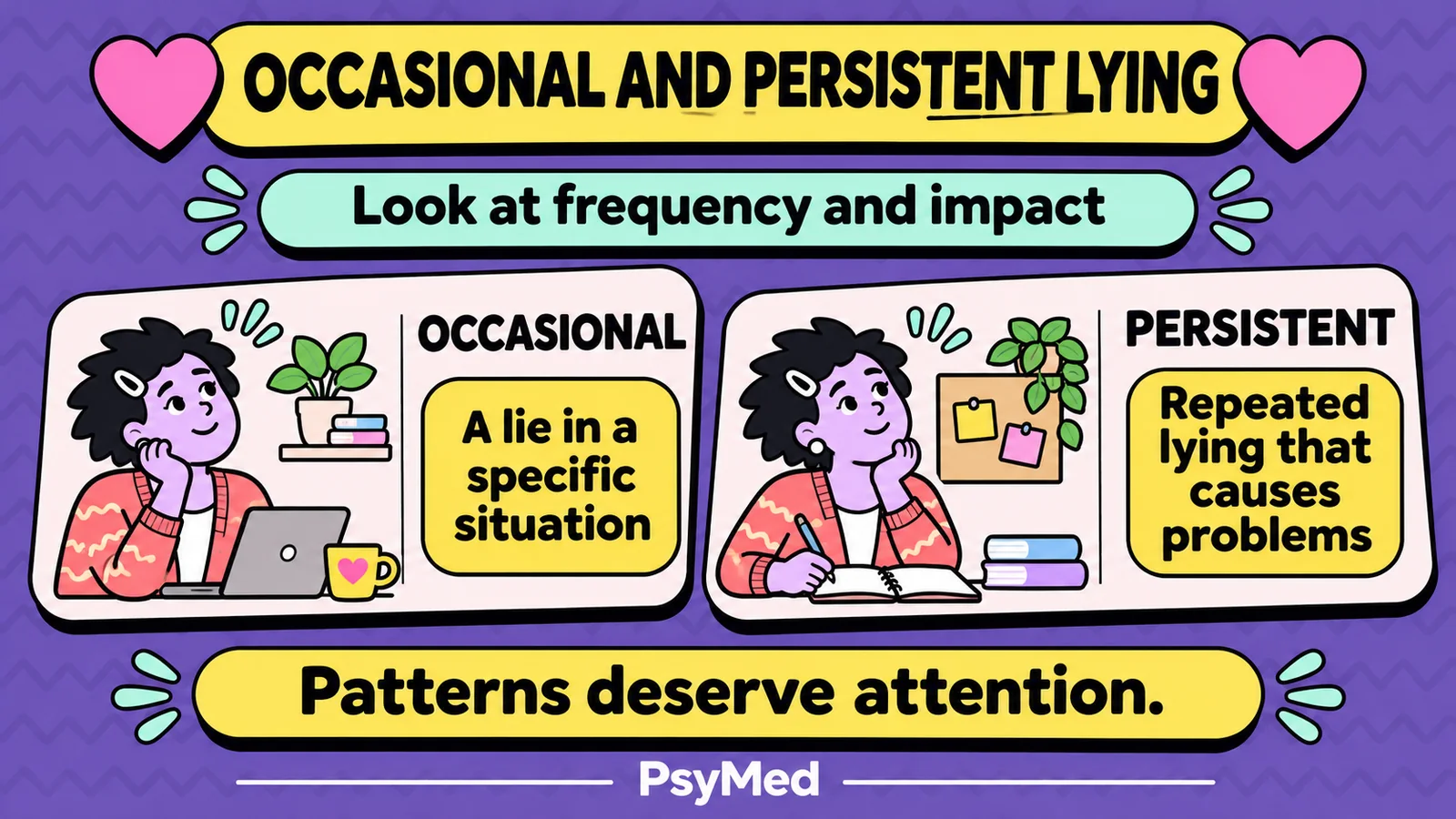
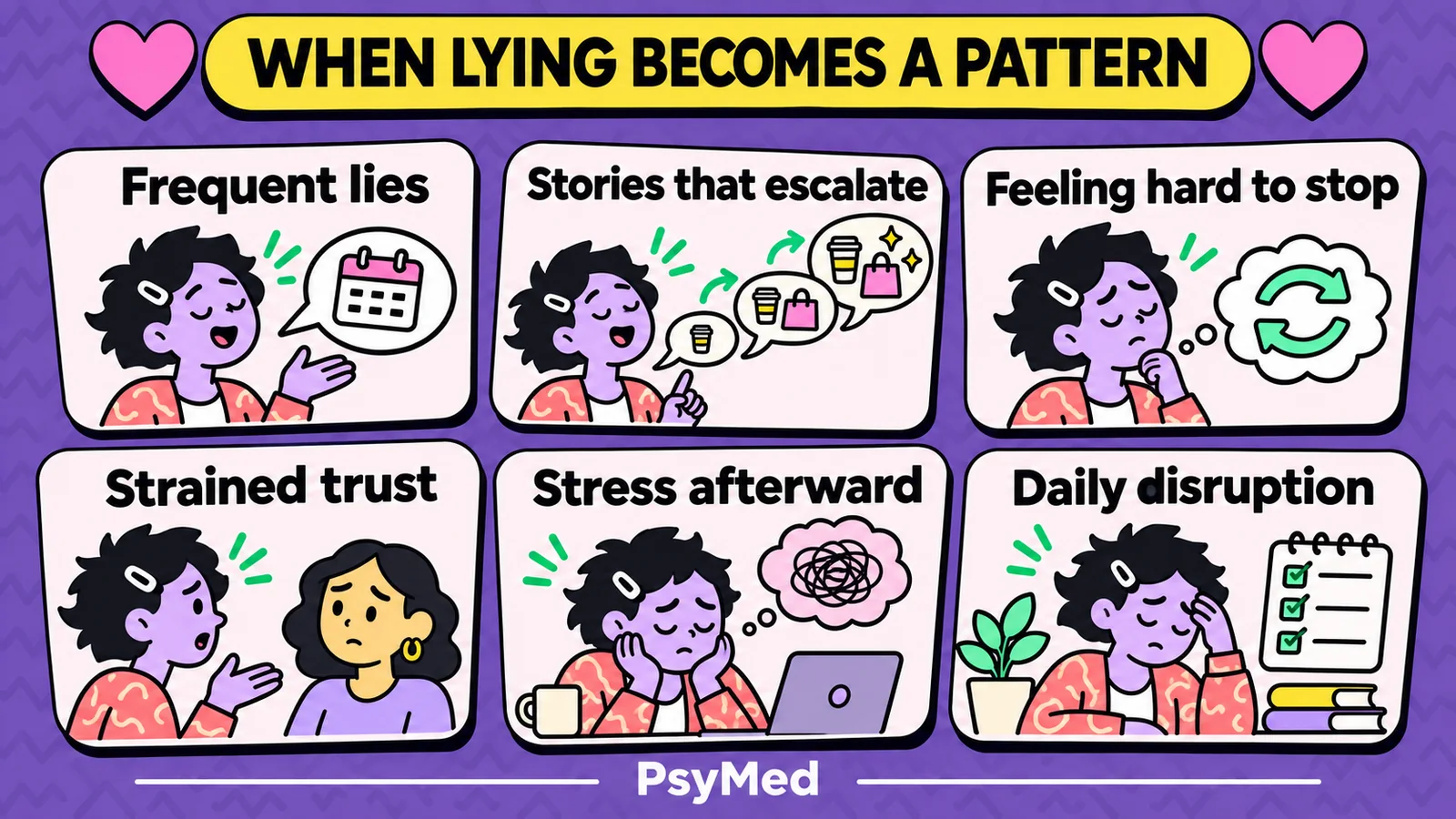
The described pattern is a cluster, not any single habit. Ordinary people do several of these occasionally; the pattern is about how often, for how long, and at what cost.
The lies arrive without a decision
The most distinctive marker. Rather than weighing whether to lie, you find the untruth already said — automatic rather than chosen, which is why willpower alone tends not to touch it.
You lie when the truth would do just as well
Lying about small, checkable, inconsequential things with nothing to gain. Goal-directed lying is ordinary; purposeless lying is the part that marks this pattern.
One lie grows into several
Once started, you add detail to make it convincing, then maintain the detail. The effort of upkeep is often what people describe as the most exhausting part.
It has cost you, and it continues
Relationships, jobs or reputation have already taken damage, and the lying has carried on anyway. In the literature this persistence-despite-harm is the central feature.
It has gone on for a long time
Not a difficult year but a long-running pattern — the working definition uses longer than six months, and many people describe it as being as far back as they can remember.
You feel distress about it
Guilt, shame or a sense of being unable to stop. Distress and impairment are part of how the pattern is defined, and their presence is a reason to seek help rather than evidence of bad character.
Ordinary lying vs. the described pattern
Nearly everyone lies. These are the dimensions on which the clinical description differs.
| Feature | Ordinary social lying | The pathological pattern |
|---|---|---|
| Why | To gain something or avoid a cost — there is a reason. | Often no discernible gain; the lie serves no clear purpose. |
| How often | Occasional, situational. | Numerous lies most days, sustained over months or years. |
| What it costs | Usually little, and it stops when the cost rises. | Continues after causing real damage to relationships, work or reputation. |
| How it feels | A choice, and usually forgettable. The described pattern feels closer to a pull that is hard to resist, and is often accompanied by distress. | |
How researchers describe it
How pathological lying is described
There are no official criteria, because this is not an official diagnosis. What follows is the working definition Curtis and Hart proposed and tested, which this test is written around.
- 01 Frequency
Numerous lies, most days
Not an occasional untruth but a daily pattern. This is the dimension people underestimate most when asked, which is one reason self-report has limits here.
- 02 Duration
Longer than six months
A sustained pattern rather than a bad period. Many people describing themselves this way report it going back as far as they can remember.
- 03 Impact
Distress or impairment
Real consequences, and real difficulty stopping. This is the dimension that separates the described pattern from simple dishonesty, and the strongest reason to seek help rather than to self-judge.
Pathological lying is not a disorder in the DSM-5-TR or the ICD, so no questionnaire can diagnose it — there is nothing defined to diagnose. The pattern is real, researched and treatable, but it is currently described rather than classified. In a 2022 survey of 295 psychotherapists, most had worked with patients who lie this way, usually starting in adolescence and lasting five years or more. They typically recorded a different diagnosis, such as a personality disorder, and most supported adding pathological lying to the DSM and ICD. This page cannot confirm or rule out anything about you.
Understanding the context
Where does compulsive lying come from?
There is no established cause, and the research base here is thin compared with most topics on this site. What follows is how clinicians describe it, not settled fact.
Protecting a fragile self-image
Lies that inflate achievements, hardship or importance are frequently described as managing how one is seen. Where that is the driver, the lying tends to track shame rather than opportunity.
Avoiding exposure
For some people the lie is a reflex against feeling found out, inadequate or rejected. The untruth arrives before the decision does, which is why it feels automatic.
It becomes self-sustaining
Each lie requires maintenance and makes the truth more expensive to tell. The pattern often continues less because it still works than because unwinding it now looks impossible.
What can actually change
Can compulsive lying be treated?
Yes, in the sense that matters: it is a behaviour pattern, and behaviour patterns respond to treatment even when they have no diagnostic code attached.
- 01 / THE RIGHT FRAME
Treat it as a pattern, not a character flaw
Shame sustains this. People who approach their lying as evidence of being a bad person tend to hide it, including from clinicians, which removes the only thing that helps.
- 02 / PROFESSIONAL SUPPORT
Therapy works on this
You do not need a diagnosis to be treated. Therapists work on compulsive behaviour, shame and self-image routinely, and pathological lying is an ordinary thing to bring to a first session.
- 03 / SPECIFICS, NOT RESOLUTIONS
Interrupt one situation
Deciding to stop lying rarely works. Identifying the specific situation where lies arrive most — and planning what you will say instead — is the version of that intention that does.
Research background: Curtis & Hart (2020), Pathological Lying: Theoretical and Empirical Support for a Diagnostic Entity. This page is educational and is not clinical advice.
Practical next steps
What should you do with your result?
Treat it as a description of a pattern you can work on, not as a label you now carry.
- 01
Check it against the three dimensions
Frequency, duration and impact. A high score driven by the impact statements is more significant than the same score driven by embellishment alone.
- 02
Tell one person the truth about it
The pattern survives on concealment. Telling one trusted person that this is a problem for you breaks the thing that keeps it going, and is often the hardest single step.
- 03
Bring it to a professional
If it is causing damage and you cannot stop, a therapist is the right destination. Say it plainly in the first session; they will have heard it before.
That is a good reason to speak to a mental health professional, and you do not need a diagnosis to start. If you are in distress or struggling to cope, in the US call or text 988 (Suicide & Crisis Lifeline, 24/7). Outside the US, find a helpline at findahelpline.com. A questionnaire is not the right tool for that conversation.
If it is not you
Think someone else is a pathological liar?
This test is written for the person doing the lying. Only they know how often the lies come and what drives them, so it cannot be taken on someone else’s behalf.
Look for the pattern, not one lie
From the outside, the signs follow the same three dimensions: lies that are frequent, that have gone on for a long time, and that keep causing harm. Stories that change between tellings, lies about things that are easy to check, and promises to stop that do not hold say more than any single lie.
It often comes with something else
In a 2026 systematic review of 55 published cases, cluster B personality disorders, depressive disorders and trauma-related disorders were frequent co-occurring diagnoses, and about three in ten cases involved substance use. Persistent lying alone does not tell you which, if any, applies. That takes a professional assessment.
Look after yourself first
You cannot make someone else get help, but you can decide what you need. If the lies leave you doubting your own memory, the gaslighting test may fit better. If the relationship itself feels harmful, try the toxic relationship quiz. If you feel unsafe, contact local emergency services.
Good questions to ask
Pathological liar test FAQs
Short, practical answers to the most common questions about compulsive lying and this test.
No questionnaire can tell you that, and strictly speaking neither can a clinician, because pathological lying is not a recognised diagnosis. What this test can tell you is how closely your answers match the pattern described in the research: frequent lies, sustained over time, often purposeless, continuing despite real harm.
Three things: frequency, duration and cost. Ordinary lying is occasional and stops when it starts to hurt. The described pattern involves numerous lies most days for longer than six months, often with nothing to gain, and continues after causing real damage.
Not officially. It is not in the DSM-5-TR or the ICD. Curtis and Hart argued in 2020 that it meets the standards for a diagnostic entity and tested that empirically, but it remains a researched pattern rather than a classified disorder.
That is the fair objection, and the honest answer is that self-report is the weak point. People who lie compulsively often describe knowing exactly what they are doing, so accuracy here is possible — but a low score from someone whose life says otherwise should not be trusted over the evidence.
That is the part that makes the pattern distinctive rather than simply dishonest. Clinicians commonly describe it as managing self-image or avoiding feeling exposed, with the lie arriving automatically rather than being chosen. The research base on causes is thin, and we are not going to overstate it. Pathological lying revisited reviews how vague the concept has remained and why forensic settings in particular need better answers.
No. There is no diagnosis for it to find, and this page cannot confirm or rule out anything about you. It is an educational self-check.
Yes. You do not need a diagnosis to be treated, and therapists work on compulsive behaviour, shame and self-image as a matter of routine. The most useful thing you can do in a first session is name it plainly.
This test is written for the person doing the lying, and it cannot be taken on someone else’s behalf. If you are trying to make sense of someone else’s dishonesty, look for the same pattern from the outside: frequent lies, over a long time, that keep causing harm. The section on someone else’s lying covers this, and the gaslighting and toxic relationship self-checks may fit your situation better.
Yes. The test is free, needs no account or sign-up, and your result appears immediately in your browser.
Editorial transparency
Sources and review information
This test is based on the clinical and research literature on pathological lying, in particular the working definition proposed and tested by Curtis and Hart. Its 15 statements are original statements written to cover the frequency, duration and impact dimensions of that definition; no validated instrument for pathological lying exists to reproduce. Content is written and reviewed by the PsyMed Editorial Team from the public sources listed here. We are writers and researchers, not clinicians, and this page is educational rather than diagnostic. Read how we build our tests and who we are.
Research and editorial references
- Curtis, D.A., & Hart, C.L. (2020). Pathological Lying: Theoretical and Empirical Support for a Diagnostic Entity. Psychiatric Research and Clinical Practice, 2(2), 62–69. 807 recruited, 623 analysed. pubmed.ncbi.nlm.nih.gov/36101870
- Dike, C.C., Baranoski, M., & Griffith, E.E.H. (2005). Pathological lying revisited. Journal of the American Academy of Psychiatry and the Law, 33(3), 342–349. pubmed.ncbi.nlm.nih.gov/16186198
- Kainth, T., et al. (2024). Pseudologia Fantastica. StatPearls — a current clinical overview; note this is a reference book chapter rather than a primary study. pubmed.ncbi.nlm.nih.gov/39163430
- American Psychiatric Association. (2022). Diagnostic and Statistical Manual of Mental Disorders (5th ed., text rev.) — consulted to confirm that pathological lying has no diagnostic entry.
- Curtis, D.A., & Hart, C.L. (2022). Pathological Lying: Psychotherapists’ Experiences and Ability to Diagnose. American Journal of Psychotherapy, 75(2), 61–66. 295 psychotherapists surveyed. pubmed.ncbi.nlm.nih.gov/34325526
- Kainth, T., et al. (2026). Pseudologia fantastica: a systematic review of sociodemographic features and psychiatric comorbidities. Annals of Medicine and Surgery, 88(7), 4487–4497. 34 articles, 55 cases. pubmed.ncbi.nlm.nih.gov/42433822
- Daiku, Y., Serota, K.B., & Levine, T.R. (2021). A few prolific liars in Japan: Replication and the effects of Dark Triad personality traits. PLoS One, 16(4), e0249815. 305 university students. pubmed.ncbi.nlm.nih.gov/33857197
A pattern, not a label
The question worth asking is whether it is costing you.
Use this check-in to look at frequency, duration and consequences honestly, and to decide whether this is something to bring to someone who can help.
Take the self-check