
Types of Anhedonia: Social, Physical, Anticipatory and Consummatory

Anhedonia is usually divided two different ways: by where the loss of pleasure shows up (social or physical), and by which part of the reward process has broken down (anticipatory or consummatory). Both classifications describe the same symptom from different angles, and knowing which pattern fits you changes what tends to help.
If you are looking for the broader picture first — what anhedonia is, what causes it and how it is treated — start with our guide to what anhedonia is. This article goes deeper on the types alone.
Social and physical anhedonia: where pleasure is lost
This is the older and more familiar split, and it describes the domain that is affected.
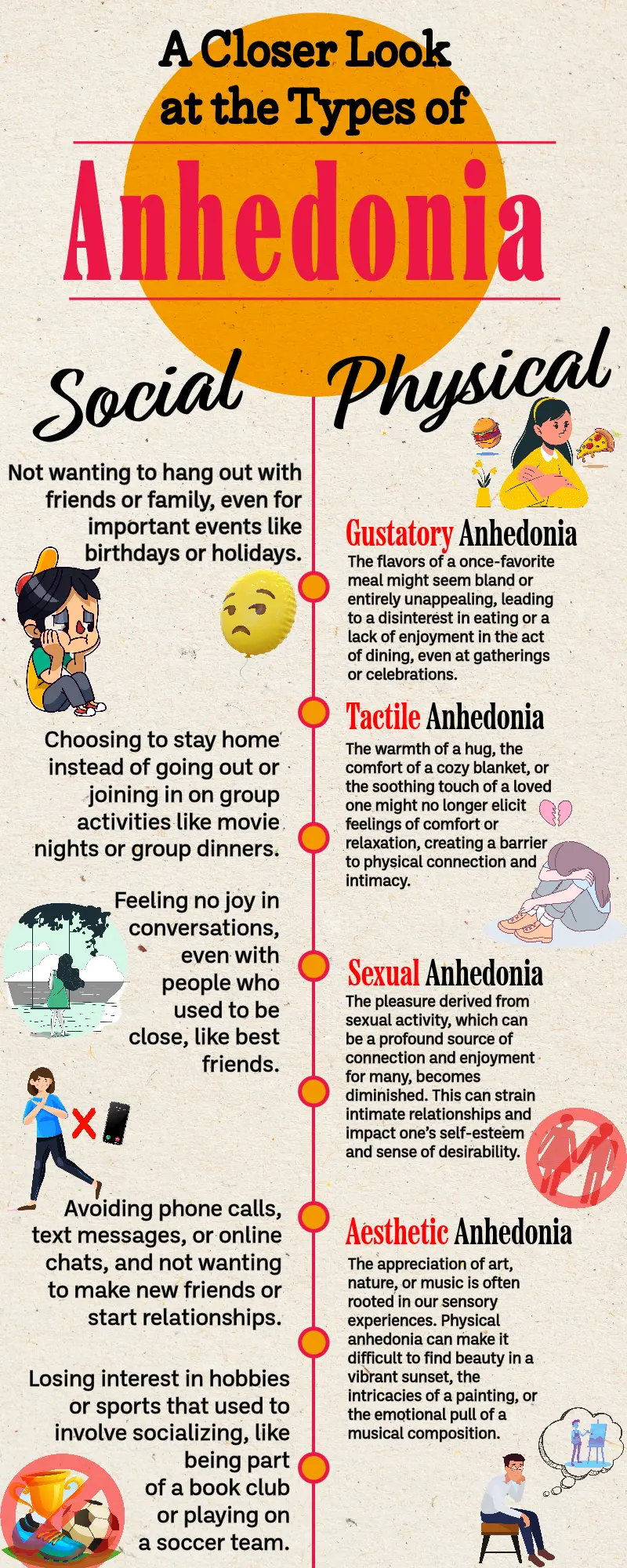
Social anhedonia
The reward normally produced by company — conversation, closeness, being liked, belonging — stops registering. People with social anhedonia tend to decline invitations not because gatherings feel threatening but because they feel pointless. Friendships thin out by drift rather than by conflict.
The distinction from social anxiety is important and frequently confused. In social anxiety, the desire for connection is intact and fear blocks it; people want to go and dread going. In social anhedonia there is no dread, and no wanting either. The two can coexist, but they call for different treatment, so it is worth being precise about which one you recognise. Our social anhedonia test is built around that difference.
Persistent social anhedonia also has particular clinical significance: it is one of the negative symptoms associated with schizophrenia spectrum conditions, and it appears in schizotypal personality traits. That does not mean anyone experiencing it has such a condition — it is far more often a feature of depression — but it is a reason to have it assessed rather than ignored.
Physical anhedonia
Here the losses are sensory. Food tastes flat or becomes purely functional. Music that once produced a physical response — the shiver at a particular passage — produces nothing. Touch, warmth, scent and sex lose their pull. People often describe this as the world going grey or muted, and because it is so hard to convey, it frequently goes unmentioned in appointments.
Specific variants are recognised, including musical anhedonia, in which someone has otherwise normal pleasure responses but no emotional reaction to music at all.
Anticipatory and consummatory anhedonia: which part of reward fails
Reward is not one process. Psychologists separate wanting (the drive to pursue something) from liking (the enjoyment once you have it), and these depend on partly different brain systems. Anhedonia can affect either.
Anticipatory anhedonia — losing the wanting
You can still enjoy things once they are happening, but you cannot generate any desire to begin. Someone with anticipatory anhedonia will often report having had a genuinely good evening that they had to be dragged to. From outside this reads as laziness or avoidance, which is one reason it attracts unfair judgement. It is closely tied to motivation and to dopamine signalling in the ventral striatum.
Consummatory anhedonia — losing the liking
You get there, you do the thing, and it delivers nothing. This tends to be the more distressing pattern, because effort no longer pays and the usual advice to “just go anyway” stops working. It is more strongly associated with the sensory and emotional flatness people describe in severe depression.
Why the distinction changes what helps
This is the practical payoff of classifying anhedonia at all.
- If the problem is anticipatory, behavioural activation — scheduling activity and going regardless of how you feel beforehand — is well matched to it, because the capacity for enjoyment is still intact once you arrive. Waiting to feel like it will not work, since feeling like it is precisely what is missing.
- If the problem is consummatory, pushing through activity often produces frustration rather than benefit. Treatment focuses more on the underlying condition, on reviewing medication that may be blunting emotion, and on approaches that rebuild reward sensitivity gradually.
- If it is specifically social, the question of whether fear or indifference is driving withdrawal determines whether exposure-based or reward-based approaches fit.
Most people do not fall neatly into one box, and the pattern can shift over the course of an episode. The categories are a way of asking better questions, not labels to settle on.
Anhedonia, apathy and emotional blunting
Three related states get used interchangeably and should not be.
- Anhedonia is a loss of pleasure. You may still care intensely about things you no longer enjoy.
- Apathy is a loss of caring — reduced motivation, goal-directed behaviour and emotional concern. It is especially common in Parkinson’s disease and after brain injury.
- Emotional blunting is a flattening of feeling in both directions, positive and negative. It is a recognised side effect of SSRI antidepressants, and it is regularly mistaken for the depression not responding.
The distinction has direct consequences: blunting that began after starting an antidepressant may call for a medication review rather than more treatment for depression. Raise it with the prescriber rather than adjusting anything yourself.
Frequently asked questions
How many types of anhedonia are there?
Two classifications are in common use. By domain, anhedonia is either social or physical. By reward process, it is either anticipatory (loss of wanting) or consummatory (loss of liking). These overlap rather than compete — social anhedonia can be anticipatory or consummatory, for example.
What is the difference between social anhedonia and social anxiety?
Social anxiety is wanting connection but fearing it; the desire is intact and fear blocks it. Social anhedonia is not finding connection rewarding in the first place, with no fear involved. Someone with social anxiety usually wishes they could go; someone with social anhedonia does not see the point.
Can you have anhedonia without being depressed?
Yes. Anhedonia occurs in schizophrenia spectrum conditions, PTSD, substance use disorders, Parkinson’s disease and after brain injury, as well as during burnout, chronic stress and sleep deprivation, and as a medication side effect. It is a symptom, not a diagnosis.
Which type of anhedonia is most common in depression?
Both occur, but anticipatory anhedonia — the loss of drive to start things — is especially characteristic and is often what others notice first, usually misreading it as laziness. Consummatory anhedonia tends to feature more in severe episodes.
Related tests and reading
- What is anhedonia? — symptoms, causes, assessment and treatment.
- Free anhedonia test — a short self-check on loss of pleasure.
- Social anhedonia test — focused on pleasure in company and connection.
- Clinical depression test (PHQ-9) — the standard depression screen.
This article is for information only and is not a substitute for professional medical advice, diagnosis or treatment. If loss of pleasure is persistent or affecting your daily life, speak to a doctor or mental health professional. If you are having thoughts of suicide, call or text 988 in the US and Canada, 116 123 in the UK and Ireland, 13 11 14 in Australia, or find a local helpline at findahelpline.com.
Related Reading
See All Posts →
You may also like
See All Quiz →