

Drug Addiction Test: Free & Confidential DAST-10 Screening
Take the free, confidential Drug Addiction Test (DAST-10) - a validated 10-question screen for drug use problems. Instant results and support resources.
Published Updated
This free, confidential drug addiction test uses the DAST-10 — the Drug Abuse Screening Test, a validated 10-question screen used by clinicians worldwide — to help you understand whether your drug use may have become a problem. It looks at your experiences with drugs (other than alcohol and tobacco) over the past year, and gives you an instant, private result along with real support resources. It’s a screening tool for reflection, not a diagnosis.
Asking the question takes courage, and it matters more than the answer. Whatever your result, please know that problematic drug use is a recognized medical condition — not a moral failing or a lack of willpower — and it is treatable. Understanding where you stand is a genuine first step, and help is available whenever you’re ready.
Support is available — free and confidential.
📞 SAMHSA National Helpline: 1-800-662-4357 — free, confidential, 24/7 treatment referral and information (US), for individuals and families facing substance use.
In emotional crisis or having thoughts of self-harm, call or text 988 (Suicide & Crisis Lifeline).
If you or someone else may be overdosing, call 911 immediately — naloxone (Narcan) can reverse an opioid overdose while you wait for help.
What Is Drug Addiction?
Drug addiction — known clinically as a substance use disorder — is a chronic but treatable medical condition in which a person continues using a drug despite harmful consequences, often losing the ability to control that use. It’s characterized by intense cravings, difficulty cutting down, and continued use even when it damages health, relationships, or responsibilities. Importantly, it is understood by medical science as a brain disease, not a character flaw.
Dr. Nora Volkow, Director of the National Institute on Drug Abuse (NIDA), has been central to this understanding. Her research shows how repeated drug use changes the brain’s structure and function — particularly the circuits governing reward, motivation, and self-control — which is why stopping can be so difficult and why willpower alone is often not enough. Volkow has long argued for viewing addiction not as a moral failing to be judged, but as a medical condition to be treated.
This shift matters practically: shame and stigma are among the biggest barriers that keep people from seeking help, and they are never deserved. The DSM-5-TR recognizes substance use disorders along a spectrum from mild to severe, based on how many of eleven criteria — loss of control, cravings, tolerance, withdrawal, and continued use despite harm among them — are present.
About the DAST-10 Drug Addiction Test
The DAST-10 is a validated 10-item screening questionnaire that measures the degree of problems related to drug use over the past 12 months. It was developed in 1982 by Dr. Harvey Skinner at the Centre for Addiction and Mental Health in Toronto, and it’s used widely in clinical and research settings because it’s brief, reliable, and effective at flagging when drug use may warrant a closer look. This page reproduces it faithfully.
A few things to know about what it covers. The DAST-10 asks specifically about drug use other than alcohol and tobacco — that includes illegal drugs as well as the non-medical use of prescription or over-the-counter medications (taking them in ways or amounts not prescribed). It focuses on the consequences of use rather than how much you take, which is what makes it a good measure of whether use has become genuinely problematic. If your concern is alcohol specifically, our alcohol addiction test is the better fit.
Signs of Drug Addiction
Drug addiction shows up through a recognizable set of behavioral, physical, and psychological signs — the same features clinicians look for when diagnosing a substance use disorder. As you read these, notice which feel familiar over the past year. Recognizing several, especially as an ongoing pattern, is worth taking seriously.
Loss of control over use
Using more of a drug, or using it for longer, than you intended — and finding that repeated efforts to cut down or stop don’t succeed. This loss of control is one of the most central signs of addiction, and often one of the most distressing.
Strong cravings or preoccupation
Experiencing powerful urges to use, and spending a lot of mental energy thinking about drugs — obtaining them, using them, or looking forward to the next time. Cravings can feel overwhelming and are a hallmark of how addiction changes the brain’s reward system.
Tolerance and withdrawal
Needing more of a drug to get the same effect (tolerance), or feeling physically or emotionally unwell — sick, shaky, anxious, irritable — when you stop or cut back (withdrawal). These are signs the body has adapted to the drug’s presence. Withdrawal from some substances can be medically dangerous, which is one reason stopping is best done with professional support.
Neglecting responsibilities and relationships
Drug use starts interfering with work, school, or home — missed obligations, declining performance, or pulling back from family and friends. People close to you may express concern about your involvement with drugs.
Giving up activities you used to value
Important social, occupational, or recreational activities get reduced or abandoned because of drug use — hobbies, relationships, and goals quietly falling away as use takes up more space.
Continued use despite harm
Keeping on using even though you know it’s causing or worsening problems — to your physical or mental health, your relationships, your finances, or your legal standing. Continuing in the face of clear harm is one of the defining features of addiction.
Using in risky situations
Using drugs in situations where it’s physically hazardous — such as before driving or operating machinery — or taking risks to obtain them. This reflects how addiction can override normal judgment about safety.
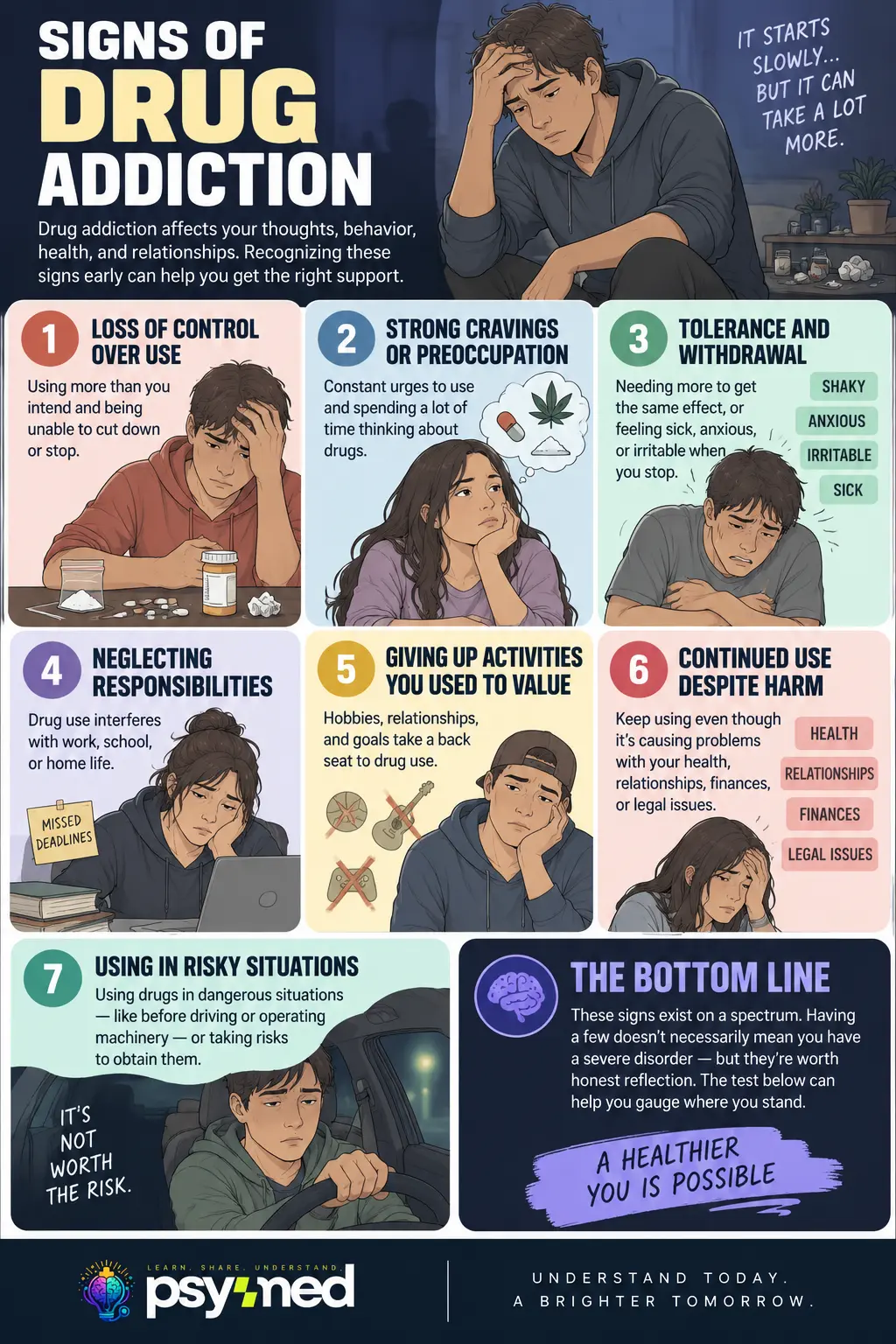
These signs exist on a spectrum, and having a few doesn’t necessarily mean you have a severe disorder — but they’re worth honest reflection, and the test below can help you gauge where you stand.
How This Drug Addiction Test Works
The DAST-10 asks 10 simple yes-or-no questions about your experiences with drugs over the past 12 months — again, not including alcohol or tobacco. Answer each as honestly as you can; there’s no judgment here, only a clearer picture.
Each answer that indicates a drug-related problem adds one point, for a total score from 0 to 10. A higher score reflects a greater degree of problems associated with drug use. Scores are grouped into five levels — from “no problems reported” up to “severe” — and a score of 3 or more generally suggests it’s worth speaking with a professional. Your answers are private.
Understanding Your DAST-10 Score
Your total score places you in one of five levels of drug-related problems. Read your result as a screening signal, not a diagnosis — only a qualified professional can properly assess a substance use disorder.
| Score | Level | What It Suggests |
|---|---|---|
| 0 | No Problems Reported | No drug-related problems indicated in the past year. |
| 1 – 2 | Low Level | A low level of problems; worth monitoring and reflecting on. |
| 3 – 5 | Moderate Level | A moderate level of problems; a professional conversation is recommended. |
| 6 – 8 | Substantial Level | A substantial level of problems; professional support is strongly encouraged. |
| 9 – 10 | Severe Level | A severe level of problems; reaching out for professional help is important. |
Treatment and Recovery
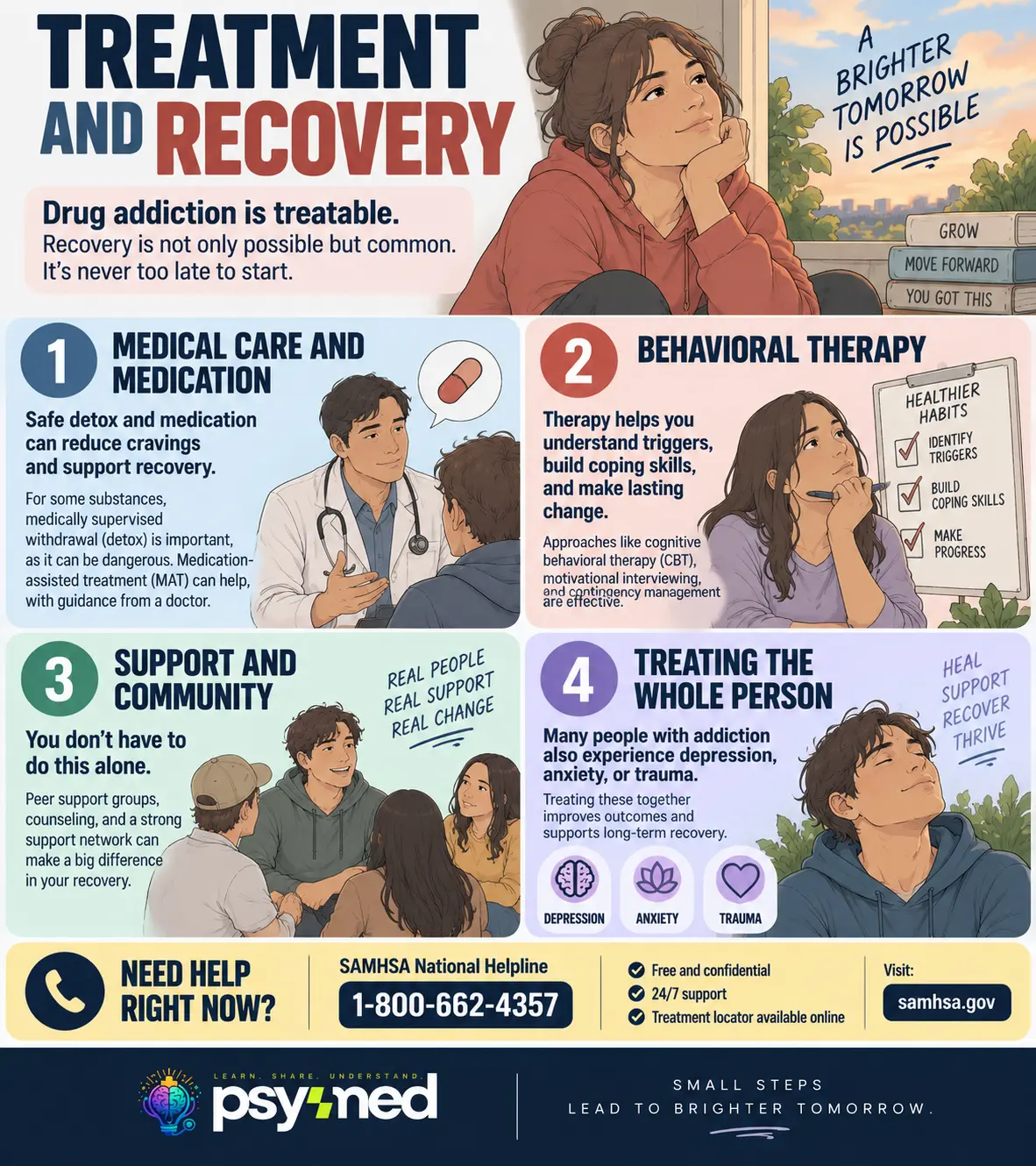
Drug addiction is treatable, and recovery is not only possible but common — the earlier support begins, the better, though it’s never too late to start. Effective treatment is usually tailored to the person and often combines several approaches, and it works best when addiction is treated as the medical condition it is.
Medical care and, where appropriate, medication
For some substances, medically supervised withdrawal (detox) is an important and safe first step, since withdrawal can be dangerous. Medication-assisted treatment (MAT) — for example for opioid or other dependencies — can reduce cravings and support recovery, decided with a doctor.
Behavioral therapy
Approaches like cognitive behavioral therapy (CBT), motivational interviewing, and contingency management help people understand triggers, build coping skills, and sustain change; our understanding of relapse as part of many recovery journeys (not a failure) comes from this work.
Support and community
Peer support groups, counseling, and rebuilding a supportive network are powerful parts of lasting recovery.
Treating the whole person
Addiction often co-occurs with depression, anxiety, or trauma, and treating those together improves outcomes. To find help, the free, confidential SAMHSA National Helpline (1-800-662-4357) and its online treatment locator are excellent starting points. Recovery is rarely a straight line — and every step toward help counts.
Frequently Asked Questions
Can this test diagnose drug addiction?
No. The DAST-10 is a validated screening tool, not a diagnostic instrument. It can indicate the likelihood and degree of drug-related problems, but only a qualified professional — a doctor, psychologist, or addiction specialist — can diagnose a substance use disorder through a comprehensive assessment that considers your full history and circumstances. A higher score means it’s worth seeking a professional evaluation; it doesn’t by itself confirm addiction. Think of your result as useful information that helps you decide whether to reach out — and if you’re worried, that step is worthwhile regardless of the exact number.
What counts as a “drug” for this test?
The DAST-10 asks about drug use other than alcohol and tobacco. That includes illegal or illicit drugs, and also the non-medical use of prescription or over-the-counter medications — meaning taking them in ways, amounts, or for reasons other than prescribed (for example, taking more than directed, or using someone else’s medication to get high). It does not include medications taken exactly as prescribed for a legitimate medical reason. If your main concern is alcohol, our alcohol addiction test is a better fit, since alcohol use is screened with different tools.
Is drug addiction a disease or a choice?
Medical and scientific consensus is clear that addiction is a chronic, treatable brain disease, not simply a choice or a lack of willpower. While the initial decision to use a drug may be voluntary, repeated use can change the brain’s reward, motivation, and self-control systems in ways that make continued use feel compulsive and quitting extremely difficult — as leading researchers like Dr. Nora Volkow of NIDA have documented. This is why willpower alone is often not enough and why professional treatment works. Understanding addiction as a medical condition, rather than a moral failing, isn’t about removing responsibility — it’s about opening the door to effective help and reducing the shame that keeps people from seeking it.
Can you recover from drug addiction?
Yes — recovery from drug addiction is absolutely possible, and millions of people achieve it. Like other chronic conditions, addiction can be managed successfully with the right treatment and support, and many people go on to live full, healthy lives in lasting recovery. Recovery looks different for everyone and often isn’t a straight line: setbacks or relapses can happen and are considered part of the process for many people, not a sign of failure or a reason to give up. What matters most is starting, and continuing to reach for support. The earlier treatment begins the better the outcomes tend to be, but people recover even after decades of use. There is genuine hope at every stage.
How do I help someone who may be addicted to drugs?
Approach them with compassion rather than confrontation or judgment. Choose a calm, private moment, express your care and specific concerns without blame (“I’ve noticed some things and I’m worried because I care about you”), and listen more than you lecture. Avoid shaming, ultimatums delivered in anger, or trying to force change — stigma and shame tend to push people away from help, not toward it.
You can share that treatment works and offer to help them take a first step, such as calling the SAMHSA National Helpline (1-800-662-4357) together. Set healthy boundaries to protect your own well-being, and consider support for yourself too, such as groups for families affected by addiction. Remember you can’t force someone into recovery, but steady, non-judgmental support genuinely helps.
Related Tests
- Alcohol Addiction Test — for concerns specifically about alcohol use
- Internet Addiction Test — for problematic internet or digital use
- Impulse Control Disorder Quiz — for difficulty resisting urges more broadly
- Depression Test — depression commonly co-occurs with substance use
- Anxiety Test — anxiety often accompanies and can fuel substance use
- Gambling Addiction Test — for a behavioral addiction with overlapping features
References
- Skinner, H.A. (1982). The Drug Abuse Screening Test. Addictive Behaviors, 7(4), 363–371. [The original DAST / DAST-10] pubmed.ncbi.nlm.nih.gov
- American Psychiatric Association. (2022). Diagnostic and Statistical Manual of Mental Disorders (5th ed., text rev.; DSM-5-TR). [Substance use disorder criteria] psychiatry.org
- National Institute on Drug Abuse (NIDA). Drugs, Brains, and Behavior: The Science of Addiction. [Addiction as a treatable brain disease; Volkow’s research] nida.nih.gov
- Substance Abuse and Mental Health Services Administration (SAMHSA). National Helpline (1-800-662-4357) and treatment resources. samhsa.gov
Related Tests
See All Quiz →
Addiction and Impulse Control
Is Gambling Becoming a Problem? Take This Free Gambling Addiction Test (PGSI)
→

Addiction and Impulse Control
Are You Addicted to the Internet? Take the Ultimate Digital Dependency Test
→
You may also like
See All Quiz →Addiction and Impulse Control
Are You Addicted to the Internet? Take the Ultimate Digital Dependency Test
→