
What Is Anhedonia? Symptoms, Causes, and Treatment

Anhedonia is the reduced ability to feel pleasure or interest in things that used to be enjoyable. It is a symptom rather than a diagnosis in its own right, and it is one of the two core features clinicians look for when assessing depression. It can affect food, music, sex, work, friendship or hobbies, and it ranges from a slight dulling to the complete absence of enjoyment.
Anhedonia is a symptom, not a diagnosis
This is worth stating plainly, because it is often described as though it were a standalone illness. You cannot be diagnosed with anhedonia the way you can be diagnosed with major depressive disorder. Anhedonia is a clinical feature that appears within a number of conditions, and identifying it matters mainly because it points towards what is going on underneath and how well treatment is likely to work.
In the DSM-5-TR, a major depressive episode requires at least one of two core symptoms to be present for most of the day, nearly every day, for at least two weeks: depressed mood, or markedly diminished interest or pleasure in all, or almost all, activities. That second criterion is anhedonia. A person can meet the threshold for depression without ever describing themselves as sad.
What anhedonia actually feels like
People rarely arrive at a clinic saying “I have anhedonia.” They describe it in other terms: food tastes like nothing, music that used to move them sounds flat, they finish something they worked hard for and feel no satisfaction, or they go through the motions of seeing friends while feeling nothing much at all. A common description is watching your own life through glass.
Typical signs include:
- Hobbies and interests that once mattered now feel pointless rather than actively unpleasant.
- Withdrawal from other people, driven by indifference rather than fear.
- Emotional flatness in both directions — good news and bad news land the same way.
- Difficulty anticipating that anything will be enjoyable, so plans stop getting made.
- Sensory dulling: food, touch, music and sex lose their edge.
The two distinctions that matter clinically
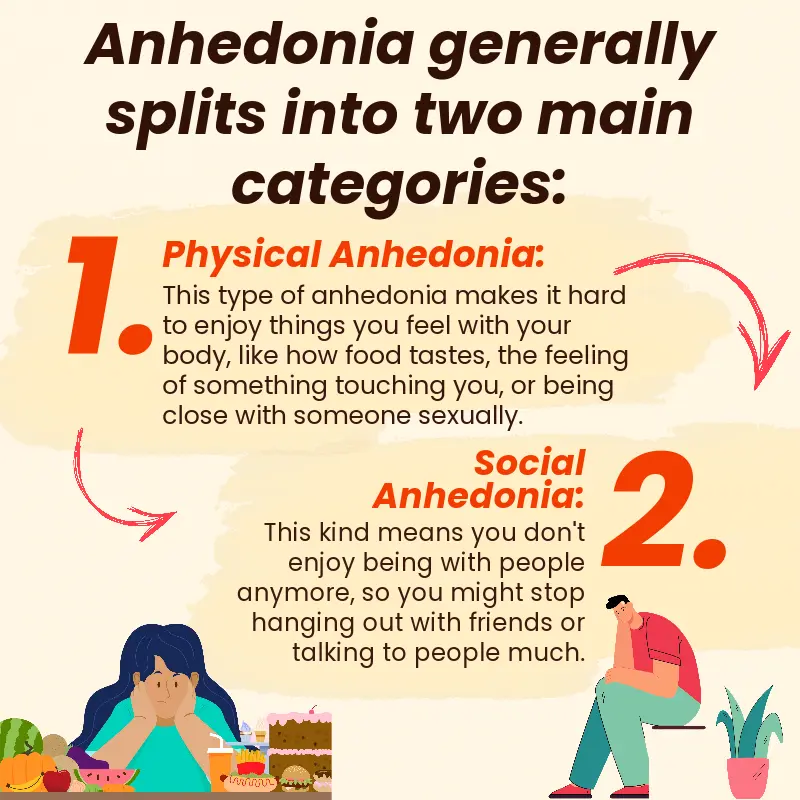
Older writing splits anhedonia into social (loss of pleasure in company) and physical (loss of pleasure in sensory experience). That division is still useful for describing where the problem shows up, but research has largely moved to a second distinction that describes which part of the reward process has broken down:
- Anticipatory anhedonia — the “wanting” side. You can still enjoy something once you are doing it, but you cannot summon any desire to start. This is what makes people look unmotivated.
- Consummatory anhedonia — the “liking” side. You do the thing, and it delivers nothing.
The difference is practical. Anticipatory anhedonia often responds to behavioural approaches that get someone started regardless of how they feel beforehand, because the pleasure is still intact once the activity begins. We cover both frameworks in more detail in our guide to the types of anhedonia.
Which conditions involve anhedonia?
Anhedonia appears across both psychiatric and neurological conditions, which is part of why it is a poor diagnostic signpost on its own.
Psychiatric conditions: major depressive disorder, persistent depressive disorder, bipolar disorder (particularly in depressive episodes), schizophrenia and related psychotic disorders, where it is counted among the negative symptoms, post-traumatic stress disorder, and substance use disorders.
Neurological and medical conditions: Parkinson’s disease, where it is common and linked to the same dopamine pathways affected by the illness, along with other conditions affecting reward circuitry. Anhedonia is also reported after traumatic brain injury and during chronic illness.
It also occurs without any diagnosis at all — during burnout, prolonged stress, grief, poor sleep, or as a side effect of medication.
What causes anhedonia?
The current understanding centres on the brain’s reward circuitry rather than on any single “chemical imbalance.” The pathway most implicated runs from the ventral tegmental area to the ventral striatum, including the nucleus accumbens, and connects onward to the orbitofrontal and ventromedial prefrontal cortex. Dopamine signalling along this mesolimbic pathway is central to motivation and reward anticipation, and reduced responsiveness in the ventral striatum is one of the more consistent findings in imaging studies of anhedonia.
That said, the mechanism is not settled, and describing anhedonia as simply “low dopamine” overstates what is known. Inflammation, chronic stress and disrupted sleep all appear to influence the same circuitry, and psychological factors — prolonged lack of reward in someone’s actual life — matter as well.
How is anhedonia assessed?
There is no blood test or scan. A clinician assesses it through interview, asking what someone used to enjoy, what that is like now, and whether the change is a loss of enjoyment or a loss of interest. Structured questionnaires such as the Snaith–Hamilton Pleasure Scale are used in research and sometimes in practice. Depression screening tools including the PHQ-9 contain an anhedonia item, which is why the symptom often surfaces during a routine depression screen.
If you want a structured place to start before speaking to someone, our free anhedonia test and PHQ-9 depression test are self-checks, not diagnoses.
How is anhedonia treated?
Treatment targets the underlying condition, but anhedonia is known to be one of the more stubborn symptoms and it deserves to be raised explicitly with a clinician rather than left to resolve on its own.
- Behavioural activation. Scheduling meaningful activity regardless of whether you feel like it, on the basis that motivation tends to follow action rather than precede it. This is among the better-supported approaches when the problem is anticipatory.
- Cognitive behavioural therapy, often with a specific focus on re-engaging with reward rather than only on challenging negative thoughts.
- Medication review. This is the point most often missed: SSRIs relieve depression for many people but can themselves cause emotional blunting, which patients frequently experience as anhedonia. If your flatness began or worsened after starting an antidepressant, that is worth raising, as it may be a side effect rather than the illness. Clinicians sometimes consider agents acting on dopamine and noradrenaline instead, though the evidence base is still developing.
- Sleep, exercise and substance use. Each affects reward circuitry directly, and all three are modifiable.
Anhedonia that persists after mood has otherwise improved predicts a higher chance of relapse, which is a further reason to treat it as a target in its own right rather than as a leftover.
Frequently asked questions
Is anhedonia the same as depression?
No. Anhedonia is a symptom that appears in depression and in several other conditions. It is one of the two core criteria for a major depressive episode, so it is possible to be depressed primarily through anhedonia without feeling sad — but anhedonia can also occur in schizophrenia, PTSD, Parkinson’s disease, burnout and as a medication side effect.
What is the difference between anhedonia and apathy?
Anhedonia is a loss of pleasure; apathy is a loss of caring. Someone with anhedonia may still care a great deal about their family or work while getting no enjoyment from either. Someone with apathy is indifferent to outcomes altogether. The two often occur together, and they can be hard to separate without a careful interview.
Can anhedonia be cured?
It commonly resolves when the underlying cause is treated, though it often improves more slowly than mood does. Recovery tends to be gradual rather than sudden — enjoyment usually returns in small, partial ways before it returns fully.
Can antidepressants cause anhedonia?
They can. Emotional blunting is a recognised side effect of SSRIs, described as a flattening of both positive and negative emotion, and it is easily mistaken for the depression itself failing to lift. If the flatness started after a dose change, tell the prescribing clinician. Do not stop or change an antidepressant on your own.
How long does anhedonia last?
It depends entirely on the cause. Anhedonia from short-term stress or sleep loss can lift within weeks once the cause is addressed. Anhedonia within a depressive episode typically tracks that episode, but may outlast the low mood. Persistent anhedonia lasting months warrants clinical assessment.
Related tests and reading
- Free anhedonia test — a short self-check on loss of pleasure.
- Social anhedonia test — focused on pleasure in company and connection.
- Clinical depression test (PHQ-9) — the standard depression screening questionnaire.
- High-functioning depression test — for depression that coexists with holding everything together.
- Types of anhedonia explained — social, physical, anticipatory and consummatory.
This article is for information only and is not a substitute for professional medical advice, diagnosis or treatment. If loss of pleasure is persistent or affecting your daily life, speak to a doctor or mental health professional. If you are having thoughts of suicide, call or text 988 in the US and Canada, 116 123 in the UK and Ireland, 13 11 14 in Australia, or find a local helpline at findahelpline.com.
Related Reading
See All Posts →
You may also like
See All Quiz →