

Am I Dating a Chud? – Free 15-Item Quiz
Am I dating a chud? Take this free, private quiz - built on Gottman's relationship research - to see if your partner is disrespectful, low-effort, or wrong for you.
Published Updated
“Chud” has become internet shorthand for a partner who’s disrespectful, self-absorbed, low-effort, or just plain wrong for you — and if you’ve found yourself wondering, “am I dating a chud?”, this free, private quiz gives you a real answer instead of a meme. It looks past the slang at the patterns that actually predict whether a relationship is healthy: respect, effort, how conflict goes, and whether your core needs and values fit. It’s built on established relationship research, not vibes, and it’s a reflection tool, not a verdict.
Behind the joke is a genuine question worth taking seriously: is my partner treating me well, and is this relationship right for me? Every relationship has rough patches and annoying habits, so the goal here isn’t to catch your partner being a “chud” on one bad day — it’s to help you tell the difference between normal friction you can work through, real incompatibility, and the kind of red flags worth taking seriously. Answer honestly about how things usually are, and you’ll get a clearer, calmer read on where your relationship actually stands.
A note before you start: this quiz is about whether a relationship is right and healthy for you — not about abuse. If you ever feel afraid of your partner, controlled, or unsafe, that’s more urgent than compatibility, and you deserve support now. In the US, you can reach the National Domestic Violence Hotline at 1-800-799-7233 (or text START to 88788), 24/7 and confidential. Our Toxic Relationship Quiz may also help you look at that.
What Does “Chud” Actually Mean?
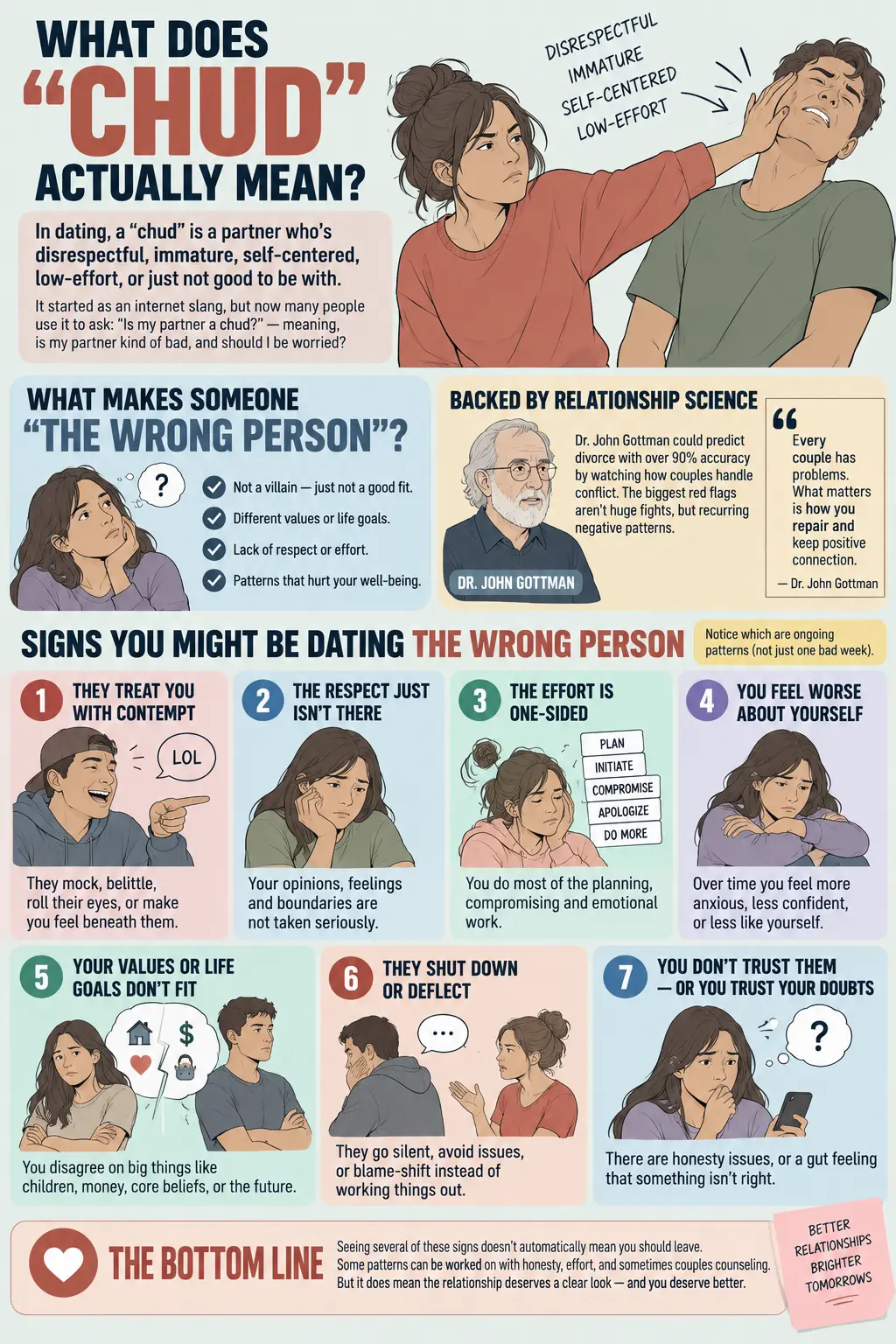
“Chud” is internet slang that, in dating talk, has come to mean a partner who’s disrespectful, immature, self-centered, low-effort, or generally not good to be with — the opposite of a considerate, respectful partner. It started as a niche insult and spread through memes, and today most people use “is my partner a chud?” simply to ask, only half-jokingly, “is my partner kind of bad — and should I be worried?” This page takes that real question seriously, using what relationship science actually says about disrespect, effort, and compatibility. (We’re using the everyday “bad partner” meaning here, not any political sense of the word.)
What Makes Someone “the Wrong Person”?
The “wrong person” usually isn’t a villain — more often it’s someone who, for real reasons, isn’t a good fit for you or doesn’t treat you the way a healthy partnership requires. Being wrong for you can look like deep incompatibility of values or life goals, a persistent lack of respect or effort, or patterns that slowly erode your well-being — even if your partner is a decent person in other ways. It’s less about blame and more about fit and health.
Relationship researcher Dr. John Gottman spent decades studying what separates relationships that last from those that don’t. His team could predict divorce with over 90% accuracy by watching how couples handle conflict — and the strongest warning signs weren’t big dramatic fights, but specific, corrosive patterns. Those patterns, plus questions of respect, effort, and compatibility, are what this quiz looks at. Crucially, Gottman also found that every couple shows some of these sometimes; what separates healthy relationships is how reliably they repair and how much positive connection outweighs the negative.
Signs You Might Be Dating the Wrong Person
The clearest signs aren’t about whether you argue — they’re about respect, effort, and how you feel over time. As you read these, notice which ring true as ongoing patterns (not one bad week). The more that fit, and the more often, the more worth taking seriously.
They treat you with contempt
Contempt — mockery, sarcasm, eye-rolling, name-calling, being made to feel beneath them — is the single strongest predictor of a relationship ending, according to Gottman’s research. It’s different from ordinary conflict because it communicates disgust and superiority rather than a specific complaint. Persistent contempt is one of the most serious signs of all.
The respect just isn’t there
You feel looked down on, dismissed, belittled, or not taken seriously. Your opinions, feelings, time, or boundaries are routinely treated as less important than theirs. Basic respect is the foundation a good relationship runs on, and its absence is hard to work around.
The effort is one-sided
You’re consistently the one initiating, planning, compromising, apologizing, and carrying the relationship’s emotional weight. A healthy partnership is roughly mutual over time; a chronic imbalance where you give far more than you receive is a real red flag, not just a rough patch.
You feel worse about yourself in the relationship
Over time you feel smaller, more anxious, less confident, or less like yourself. A relationship that’s right for you generally makes you feel more secure and more yourself, not less. Persistent shrinking is important information.
Your core values or life goals don’t fit
You clash fundamentally on things that are hard to compromise — whether to have children, how to handle money, core beliefs, honesty, or the kind of life you each want. You can love someone and still be genuinely incompatible on the things that shape a shared future.
They shut down or deflect instead of working things out
When problems come up, your partner stonewalls (withdraws, goes silent, refuses to engage) or gets defensive (deflects all responsibility, turns it back on you) — two more of Gottman’s warning patterns — so nothing ever actually gets resolved and the same issues keep recurring.
You don’t trust them — or you trust your doubts
There’s a persistent lack of trust, honesty problems, or a quiet gut feeling that something isn’t right that won’t go away no matter how you reason with it. That steady inner doubt is worth listening to rather than arguing yourself out of.
Seeing several of these doesn’t automatically mean you should leave — some patterns are workable with honesty and effort (and sometimes couples counseling). But it does mean the relationship deserves a clear-eyed look rather than more benefit of the doubt.
Red Flags vs. Normal Relationship Friction
Not every problem is a red flag — the difference is about pattern, repair, and respect, not whether difficulties exist at all. Every real relationship has conflict, annoying habits, and hard seasons; that’s normal and not a sign you’re with the wrong person. What distinguishes a genuine warning sign is when a problem is persistent, goes unrepaired, and involves a loss of respect.
Gottman’s research is reassuring here: healthy couples still argue and still slip into bad patterns sometimes. What sets them apart is that they repair — they apologize, soften, reconnect — and they keep the overall balance of the relationship positive (his research points to roughly five positive interactions for every negative one). So the question isn’t “do we have problems?” but “when we have problems, do we come back from them, and do we still fundamentally respect and like each other?” A rough patch you can repair together is very different from a steady pattern of contempt, imbalance, or incompatibility that never improves.
How This Am I Dating a Chud Quiz Works
This quiz asks 15 questions about how your relationship usually works — how your partner treats you, how conflict goes, how effort and values line up, and how you feel. Answer based on the general pattern, not one exceptional day, choosing how often each is true:
Never = 0 | Rarely = 1 | Sometimes = 2 | Often = 3 | Always = 4
Your answers add up to a score from 0 to 60. A higher score means more of the patterns that suggest a relationship may not be right or healthy for you; a lower score suggests a fundamentally solid one. Whatever the number, treat it as a starting point for reflection — you know your relationship better than any quiz. Your answers are private.
Understanding Your Results
Your score points to how many concerning patterns are present and how often — but you get the final say. Read your result as insight to reflect on, not a directive to stay or leave.
| Score | Result | What It Suggests |
|---|---|---|
| 0 – 15 | Mostly Green Flags | This looks like a fundamentally healthy, respectful relationship with normal ups and downs. |
| 16 – 30 | Some Things Worth Talking About | Some real issues worth addressing, but not necessarily signs you’re with the wrong person. |
| 31 – 45 | Real Red Flags | Significant patterns that deserve honest reflection and, ideally, a real conversation or support. |
| 46 – 60 | Serious Doubts | Many signs this relationship may not be right or healthy for you. You deserve to take that seriously. |
What to Do If You’re Not Sure
Uncertainty itself is worth sitting with rather than rushing past — and there are constructive ways to get clarity beyond a quiz. If your result (or your gut) has left you unsure, a few things tend to help.
Name the specific patterns, not just a vague feeling
“I feel like I do all the planning and my ideas get dismissed” is something you can actually raise and test; “something’s off” is harder to act on. Getting specific also tells you whether the issue is fixable friction or a deeper mismatch
Have the honest conversation
How your partner responds when you calmly raise a real concern — whether they can listen, take some responsibility, and adjust — is often more revealing than the original problem.
Watch the trend, not just the snapshot
Are things slowly improving, holding steady, or getting worse over months? Direction matters.
Consider support
A therapist can help you think clearly (individually, even if your partner won’t go), and couples counseling helps many relationships that both people want to save.
If you also struggle with self-worth in relationships, our Self-Esteem Test may be worth taking, since it shapes what we believe we deserve. There’s no prize for deciding quickly — only for deciding honestly.
Frequently Asked Questions
How do I know if I’m dating the wrong person or just going through a rough patch?
The key differences are pattern, repair, and respect. A rough patch is usually tied to a specific stressor (work, money, a hard season), and even while struggling, you and your partner still fundamentally respect each other and can reconnect after conflict. Being with the wrong person tends to look more like persistent patterns that don’t improve — ongoing disrespect or contempt, a chronic imbalance of effort, deep incompatibility of values, or a steady sense that you feel worse in the relationship over time.
Gottman’s research highlights repair as the crucial factor: healthy couples still argue and slip up, but they come back from it. If problems keep recurring, never resolve, and you’ve lost basic respect or fondness, that points more toward a fundamental mismatch than a temporary rough patch.
Can you love someone and still be with the wrong person?
Yes, absolutely — and this is one of the hardest truths about relationships. Love alone doesn’t guarantee compatibility, respect, or a healthy dynamic. You can genuinely love someone and still be fundamentally incompatible on values or life goals, still be in a relationship where effort is badly imbalanced, or still feel diminished over time.
Love is necessary but not sufficient; a lasting, healthy relationship also needs mutual respect, compatibility on the things that matter, willingness to work through conflict, and both people feeling good in it. If you love your partner but keep landing on serious doubts, it’s worth reflecting honestly on whether love is enough to build the life you actually want — sometimes it is, with work, and sometimes it isn’t.
What is the biggest red flag in a relationship?
According to Dr. John Gottman’s decades of research, contempt is the single strongest predictor that a relationship will end. Contempt means treating your partner with disrespect, disgust, or superiority — mockery, sarcasm, name-calling, eye-rolling, sneering, being made to feel beneath them. It’s more corrosive than ordinary conflict because it attacks a person’s worth rather than addressing a specific problem, and it erodes the fondness and respect a relationship depends on.
If contempt runs in both directions or defines the relationship, that’s a serious warning sign. (Other major red flags include a chronic lack of respect or effort, and — in a different and more urgent category — any pattern of control, fear, or abuse, which is beyond “wrong for me” and warrants specialized support.)
Should I break up or try to fix things?
This quiz can’t and shouldn’t answer that for you — but a few questions can help you think it through. Is the core issue fixable friction (communication, habits, a rough season) or a fundamental mismatch (values, respect, whether you feel good in the relationship)? Is your partner willing and able to hear your concerns and work on them, or do problems keep recurring unaddressed? Do you feel fundamentally respected, or has respect eroded?
Many relationships with real problems do recover, especially with honest effort from both people and sometimes couples counseling. Others are a genuine mismatch that no amount of effort resolves. There’s no shame in either path — working to save something worth saving, or leaving something that isn’t right for you. If it would help to think it through with support, a therapist is a good, neutral place to start.
Is it normal to question your relationship?
Yes — questioning your relationship at times is completely normal and doesn’t mean you’re disloyal or that the relationship is doomed. Most people in long-term relationships have periods of doubt, and reflecting honestly on whether a relationship is healthy and right for you is a sign of self-awareness, not betrayal. What matters is what the questioning is pointing at. Occasional doubts during a hard patch are ordinary. A persistent, recurring sense that something is fundamentally wrong — especially alongside disrespect, imbalance, or feeling worse over time — is worth taking more seriously. Either way, letting yourself ask the question honestly, rather than suppressing it, is how you eventually get to clarity.
Related Tests
- Toxic Relationship Quiz — if the issue may be beyond incompatibility: control, harm, or feeling unsafe
- Am I Being Manipulated? Quiz — for specific manipulation tactics like gaslighting and guilt-tripping
- Emotional Availability Test — how open and present you (or a partner) are in a relationship
- Attachment Style Test — how your attachment style shapes what you feel in relationships
- Self-Esteem Test — self-worth shapes what we believe we deserve from a partner
- Codependency Test — for patterns of over-giving and losing yourself in a relationship
References
- Gottman, J.M., & Silver, N. (1999). The Seven Principles for Making Marriage Work. [The Four Horsemen; contempt as the strongest predictor of divorce] gottman.com
- Gottman, J.M., & Levenson, R.W. (2000). The timing of divorce: Predicting when a couple will divorce over a 14-year period. Journal of Marriage and Family, 62(3), 737–745. [Predictive accuracy of conflict patterns] pubmed.ncbi.nlm.nih.gov
- The Gottman Institute. The Four Horsemen: Criticism, Contempt, Defensiveness, and Stonewalling. gottman.com
- American Psychological Association. Health relationships and relationship satisfaction. apa.org
Related Tests
See All Quiz →

You may also like
See All Quiz →