
Mental health self-assessment · Personality disorders
ASPD Test: Explore antisocial personality traits.
Do rules, honesty, anger or other people's feelings keep causing problems in your life? Answer 15 questions based on the signs of antisocial personality disorder (ASPD), then learn how it is diagnosed and treated.
For self-reflection only, not a medical diagnosis. If you feel an urge to hurt yourself or someone else, call or text 988 (US) or visit findahelpline.com. In an emergency, call 911.
-
THE SELF-CHECK15 focused questionsReflect on patterns since your teens, not one bad day.
-
PRIVACY FIRSTNo account neededFree to take, with no sign-up. Your result appears right away.
-
CLEAR BOUNDARIESInformation, not a diagnosisLearn what your answers can and cannot tell you.
The self-check
Take the ASPD test
Explore how often you notice traits linked to antisocial personality disorder, such as breaking rules, deceiving people, acting on impulse, aggression and a lack of remorse. Think about how you have usually been since your teens, not one incident. This self-check is written for adults. Answer honestly; nobody else sees your answers. It can support reflection, but it cannot diagnose ASPD.
Your score
What the bands mean
- 0–15 Low — few ASPD-related traits reported
- 16–30 Mild — some ASPD-related traits reported
- 31–45 Moderate — frequent ASPD-related traits reported
- 46–60 High — very frequent ASPD-related traits reported
Each answer scores 0 (Never) to 4 (Always), for a total of 0–60. Bands describe how often you reported these traits. They are a guide, not clinical cutoffs.
ASPD is diagnosed only in adults, with signs of conduct disorder before age 15.
The short answer
What is antisocial personality disorder (ASPD)?
Antisocial personality disorder (ASPD) is a personality disorder defined by a pervasive pattern of disregard for and violation of the rights of others, occurring since age 15 (APA, 2022). People with ASPD may lie, manipulate, break the law, act on impulse or put others at risk, and they often feel little remorse afterward.
ASPD is one of the 10 personality disorders described in the DSM-5-TR, the diagnostic manual used by US clinicians, and its ICD-10-CM code is F60.2. It is the formal diagnosis closest to what people informally call sociopathy or psychopathy. The pattern is lasting and shows up across many areas of life, such as work, money, relationships and the law. It is not the same as being “antisocial” in the everyday sense of not liking other people’s company or preferring to be alone.
A pattern, not a single act. One lie or one broken rule is not ASPD. ASPD describes a pervasive pattern of disregard for the rights of others, since age 15, that shows up across many areas of life.
An estimated 2% to 5% of people meet criteria for ASPD at some point in their lives, based on large US and UK surveys, and it is about three times more common in males than in females. This is a population estimate, not a way to judge one person’s traits.
View sourceKnow the signs
What are the signs of antisocial personality disorder?
The DSM-5-TR lists seven signs of ASPD, and a diagnosis needs at least three of them, together with other criteria. Clinical references also describe how the pattern can look in everyday life.
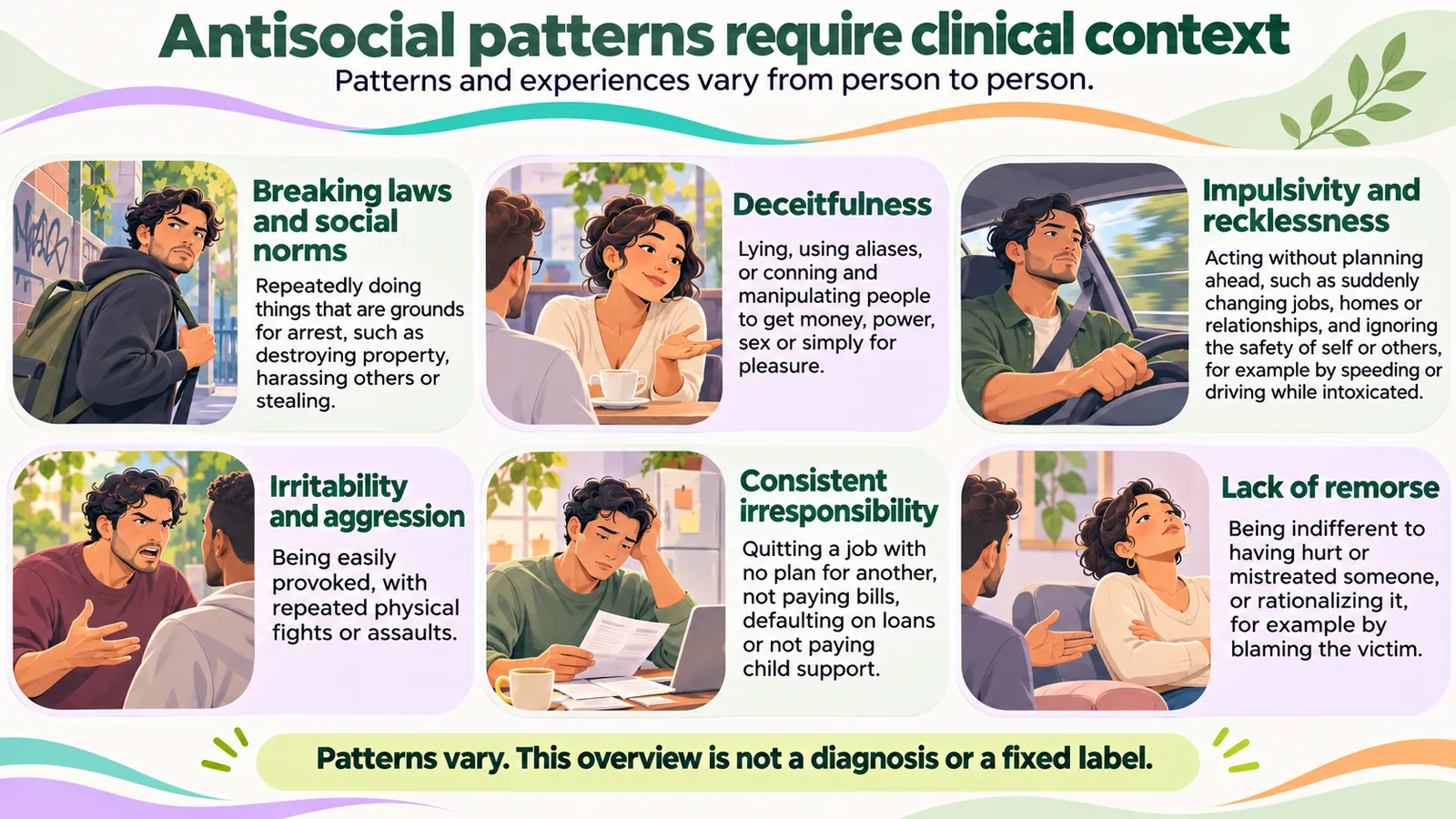
Breaking laws and social norms
Repeatedly doing things that are grounds for arrest, such as destroying property, harassing others or stealing.
Deceitfulness
Lying, using aliases, or conning and manipulating people to get money, power, sex or simply for pleasure. Clinical references also note, although it is not one of the seven criteria, that people with ASPD may be charming and smooth-talking while staying indifferent to others’ feelings.
Impulsivity and recklessness
Acting without planning ahead, such as suddenly changing jobs, homes or relationships, and ignoring the safety of self or others, for example by speeding or driving while intoxicated. These are two of the seven signs.
Irritability and aggression
Being easily provoked, with repeated physical fights or assaults. This can include abusing a partner.
Consistent irresponsibility
Quitting a job with no plan for another, not paying bills, defaulting on loans or not paying child support.
Lack of remorse
Being indifferent to having hurt or mistreated someone, or rationalizing it, for example by blaming the victim.
ASPD vs. sociopathy vs. psychopathy
The three words are often used as if they mean the same thing. Only one of them is a formal diagnosis. If your questions are really about the informal labels, the Sociopath Test looks at sociopathic traits in more depth, and the Psychopath Test looks at boldness, meanness and disinhibition.
| Feature | Antisocial personality disorder | Sociopathy | Psychopathy |
|---|---|---|---|
| Formal diagnosis? | Yes. A DSM-5-TR personality disorder (ICD-10-CM F60.2). | No. An informal term; MedlinePlus lists it as another name for ASPD. | No. Not one of the 10 DSM-5-TR personality disorders. |
| How it is assessed | A clinical evaluation against the DSM-5-TR criteria. | Not assessed separately from ASPD. | No separate diagnosis. For UK forensic services, NICE recommends measures such as the PCL-R (Psychopathy Checklist-Revised) to assess the severity of ASPD. |
| How they relate | Some clinicians see psychopathy as the same disorder as ASPD; others see it as a similar but more severe condition. NICE describes people with psychopathy as a small proportion of people with ASPD. | ||
What clinicians look for
How is antisocial personality disorder diagnosed?
ASPD is diagnosed by clinical criteria in a psychological evaluation, not by an online score, a blood test or a brain scan. A clinician looks at your history across your whole life, not only your recent behavior.
- 01 Pattern
Three or more of the seven signs
A lasting disregard for the rights of others, occurring since age 15, shown by at least three of the seven signs listed above.
- 02 Age
18 or older, with conduct disorder before 15
ASPD is diagnosed only in adults. There must also be evidence of conduct disorder before age 15, such as aggression, lying, stealing or serious rule-breaking in childhood.
- 03 Clinical context
Other explanations
Clinicians check whether substance use, narcissistic personality disorder or borderline personality disorder explains the behavior better, and they look for other conditions that often occur alongside ASPD.
Antisocial behavior that starts in adulthood is not ASPD. ICD-10-CM has a separate code, Z72.811, for adult antisocial behavior. In one large US survey, adult antisocial behavior (12.3% lifetime) was much more common than ASPD (3.6%). This page cannot confirm or rule out either.
Understanding the context
What causes antisocial personality disorder?
The exact cause is unknown. Both genetic and environmental factors contribute. The factors below raise the risk of ASPD; they do not mean a person will develop it.
Family and genes
ASPD is more common among first-degree relatives of people with the disorder, and there is a strong heritable component. Having an antisocial or alcoholic parent raises the risk. The risk is higher in both adopted and biological children of parents with ASPD, which points to both genes and environment.
Childhood experiences
Abuse or neglect in childhood may contribute. The risk that conduct disorder develops into ASPD may be higher when parents abuse or neglect a child, or are inconsistent in discipline or parenting style.
Early conduct problems
ASPD usually begins before age 15 as conduct disorder. If conduct disorder together with ADHD develops before age 10, the risk of ASPD in adulthood is higher. Disregard for others’ pain in early childhood has also been linked to antisocial behavior in late adolescence.
Evidence-based care
Can antisocial personality disorder be treated?
ASPD is one of the hardest personality disorders to treat, and the research evidence is limited. Many people with ASPD don’t see a problem in their behavior, and some only start therapy when a court requires it. Even so, some approaches can help with specific behaviors and with related conditions.
- 01 / TALK THERAPY
Cognitive and behavioral programs
NICE suggests group-based cognitive and behavioral programs to work on impulsivity, relationship problems and antisocial behavior. For people with a history of offending, programs such as Reasoning and Rehabilitation focus on reducing offending. The American Psychiatric Association notes some evidence for CBT, mentalization-based treatment, skills training and motivational interviewing.
- 02 / RELATED CONDITIONS
Treating co-occurring conditions
Most people with ASPD also have a substance use disorder. Mood and anxiety disorders, ADHD, gambling disorder, impulse control disorders and borderline personality disorder are also common alongside it. Depression, anxiety and drug or alcohol problems should be treated in their own right, whether or not the ASPD itself is being treated. For drug misuse, NICE recommends psychological approaches such as contingency management, which rewards specific behavior changes.
- 03 / MEDICATION
Medication has a limited role
No medicine is approved to treat ASPD itself. NICE advises against routinely using medication for ASPD or for aggression, anger and impulsivity. Medicines may be used for co-occurring conditions, and some aggressive people with marked impulsivity and mood swings may benefit from medication.
Clinical guidance: NICE guideline CG77, antisocial personality disorder. Do not start or stop medication based on an online result.
Practical next steps
What should you do if your score worries you?
Taking an honest look at your own behavior is a useful start. You don’t need a high score to ask for help.
- 01
Book an assessment
See a primary care doctor, psychiatrist or psychologist. Say which patterns concern you, such as anger, lying, risk-taking or trouble with work or the law, and how long they have been going on.
- 02
Be open about the full picture
Mention childhood behavior problems, drinking or drug use, low mood or anxiety, and attention problems. These can be treated in their own right.
- 03
Ask what help fits
Ask about structured therapy programs, support for anger or substance use, and how to involve people close to you if you want to.
In the US, call 911 for an emergency, or call or text 988 (Suicide & Crisis Lifeline, 24/7) if you feel an urge to hurt yourself or others. If a partner or family member is hurting or threatening you, the National Domestic Violence Hotline is at 1-800-799-7233 (or text START to 88788). Elsewhere, contact local emergency services or find a helpline at findahelpline.com. A quiz is not the right tool for a crisis.
Good questions to ask
ASPD test FAQs
Short, practical answers to the most common questions about antisocial personality disorder and this test.
Only a qualified clinician can tell you. ASPD involves a lasting pattern of disregard for the rights of others since age 15, shown by at least three of seven signs: breaking the law, deceitfulness, impulsivity, aggression, recklessness, irresponsibility and lack of remorse. It is diagnosed only in adults 18 or older who showed signs of conduct disorder before 15. This test shows how often you report traits like these. It is not a validated clinical scale and cannot confirm or rule out ASPD, but a high score is a good reason to talk to a mental health professional.
No. ASPD is diagnosed in a psychological evaluation that looks at your history over your whole life, including childhood. UK guidance from NICE recommends that specialists use structured assessment methods and check for other mental health conditions. When assessing risk, NICE also advises adding information from records or family members, with the person’s consent, because the person might not always be a reliable source of information. That is also why a self-report quiz, which relies only on your own answers, can’t make a diagnosis. The 15-question self-check on this page is an original educational questionnaire, not a validated screening tool.
“Sociopath” is an everyday word, not a diagnosis. MedlinePlus lists sociopathy as another name for antisocial personality disorder, which is the formal diagnosis clinicians use. If you want to explore the informal label, try the Sociopath Test.
Not exactly. Psychopathy is not a separate DSM-5-TR diagnosis. Some clinicians regard it as the same disorder as ASPD, and others as a similar but more severe condition. UK guidance describes people with psychopathy as a small proportion of people with ASPD. For forensic services, NICE recommends measures such as the PCL-R (Psychopathy Checklist-Revised) to assess the severity of ASPD.
No. Evidence of conduct disorder before age 15 is part of the diagnostic criteria. Adults who show antisocial behavior without that childhood history may be described as showing adult antisocial behavior, which is coded separately (ICD-10-CM Z72.811) and is not a personality disorder diagnosis.
Estimates vary by survey. Lifetime estimates range from about 2% to 5% in large US and UK surveys, and one US national survey found 3.6%. ASPD is about three times more common in men than in women. It is much more common in prisons: a review of 62 prison surveys in Western countries found ASPD in 47% of male and 21% of female prisoners.
Yes, to a degree. Treatment evidence is limited, but structured cognitive and behavioral programs, treatment for substance use and other conditions, and support to stay in treatment can help. Symptoms tend to peak in the late teens and early 20s and sometimes improve by the 40s, and the number of people who meet the criteria falls with age. This suggests that people can learn to change over time.
No, although they can look alike. People with either condition may exploit others and lack empathy, but people with narcissistic personality disorder tend not to be as aggressive and deceitful as people with ASPD. The Narcissistic Personality Disorder Test looks at that pattern.
This test is written for self-reflection and can’t tell you whether another person has ASPD. Focus on your own safety. If someone is hurting, threatening or controlling you, call 911 if you are in immediate danger, or contact the National Domestic Violence Hotline at 1-800-799-7233 (text START to 88788) to talk through a safety plan.
Editorial transparency
Sources and review information
Prepared by the PsyMed Editorial Team from the public clinical resources listed here. We are writers and researchers, not clinicians, and no licensed clinician is claimed as a reviewer. The questions are an original educational scale based on the DSM-5-TR criteria and related traits, and have not been clinically validated. Read how we build our tests and who we are.
Medical and editorial references
- American Psychiatric Association. (2022). Diagnostic and Statistical Manual of Mental Disorders (5th ed., text rev.). Antisocial personality disorder, F60.2.
- American Psychiatric Association (2022): Antisocial Personality Disorder: Often Overlooked and Untreated
- Merck Manual Professional Version: Antisocial Personality Disorder (ASPD) (DSM-5-TR criteria summary)
- MedlinePlus: Antisocial personality disorder
- NICE CG77: Antisocial personality disorder: prevention and management
- Cleveland Clinic: Antisocial Personality Disorder
- Compton WM, Conway KP, Stinson FS, Colliver JD, Grant BF. Prevalence, correlates, and comorbidity of DSM-IV antisocial personality syndromes and alcohol and specific drug use disorders in the United States. J Clin Psychiatry. 2005;66(6):677-685.
- Fazel S, Danesh J. Serious mental disorder in 23000 prisoners: a systematic review of 62 surveys. Lancet. 2002;359(9306):545-550.
- National Library of Medicine: ICD-10-CM codes F60.2 and Z72.811
Honest reflection is a start
Looking honestly at a pattern is the first step to changing it.
Use this check-in to organize your thoughts, then speak with a qualified professional if these traits are affecting your life or the people around you.
Take the self-check