


Free Sociopath Test — Do I Have Sociopathic Traits?
Wondering if you or someone you know has sociopathic traits? This free Sociopath Test screens for ASPD patterns using DSM-5-TR criteria. Instant result.
Published Updated
A screening tool for self-reflection, not a diagnosis. How we build our tests
“Sociopath” is an informal term, not a DSM-5-TR diagnosis. The closest formal diagnosis is antisocial personality disorder (ASPD), a pervasive pattern of disregard for and violation of the rights of others (APA, 2022). This free 20-question test looks at those traits. It is a self-assessment, not a diagnosis.
The rules that govern other people’s behavior have never felt like they quite apply to you. It’s not that you’re reckless. You can be strategic, even patient. But the unwritten rules others seem to follow by instinct feel more like suggestions than duties to you. You’ve always moved through the world on your own terms.
Maybe that’s served you well in some ways. Maybe it hasn’t. Maybe you’re here because someone in your life has used this word — sociopath — and you want to understand what it actually means. Maybe you’ve been observing patterns in yourself that you can’t quite name. Or maybe you’re here about someone else.
Whatever brought you here, this Sociopath test will give you an honest, clinically grounded picture. It screens for the antisocial personality traits linked to sociopathy. When these traits occur together and last across time and settings, they fall under the diagnosis of Antisocial Personality Disorder (ASPD). 20 questions. Instant, private results.
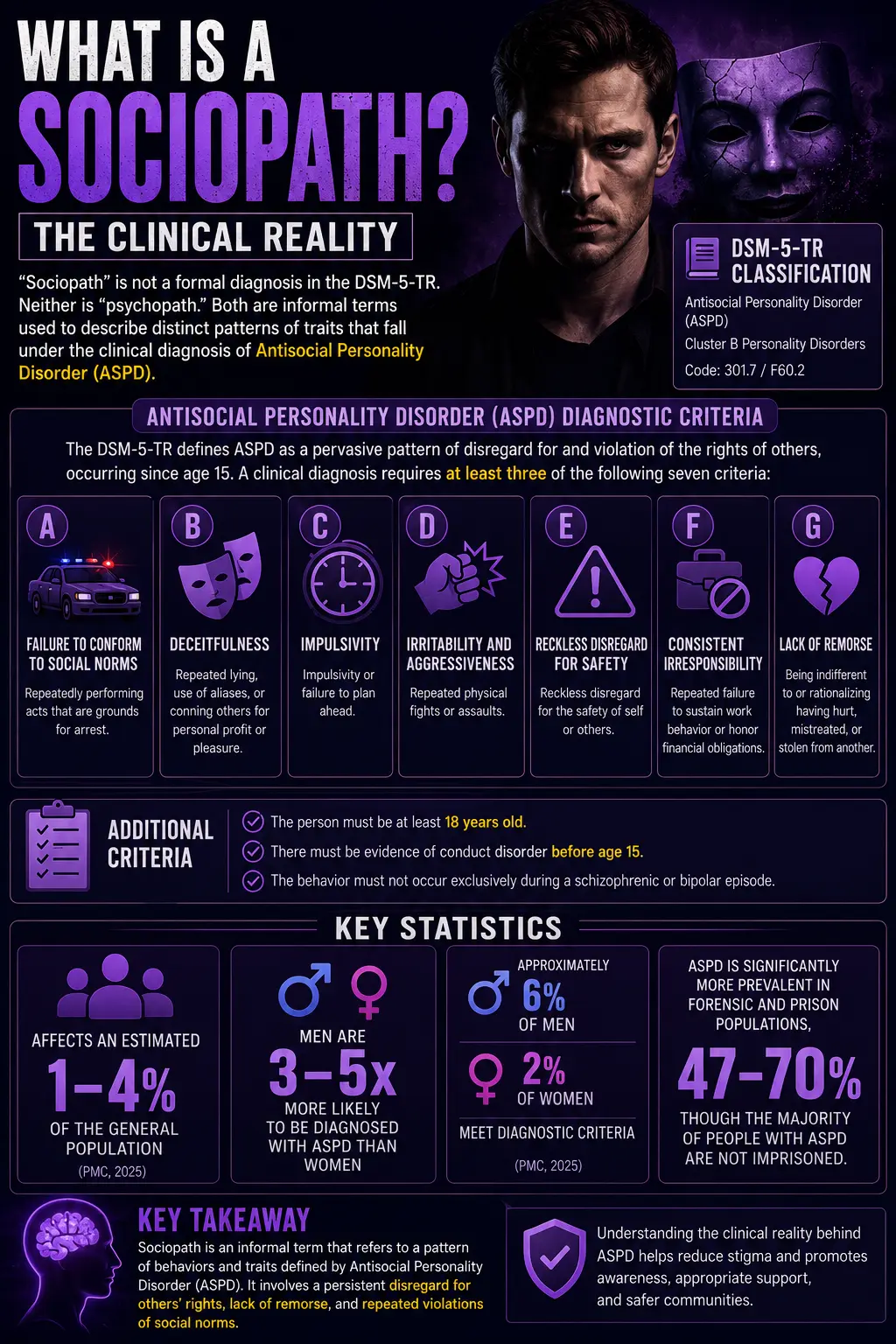
What Is a Sociopath? The Clinical Reality
“Sociopath” is not a formal diagnosis in the DSM-5-TR. Neither is “psychopath.” Both are informal terms for different trait patterns that fall under one diagnosis: Antisocial Personality Disorder (ASPD). The DSM-5-TR lists it with the Cluster B Personality Disorders (ICD-10-CM F60.2).
The DSM-5-TR defines ASPD as a pervasive pattern of disregard for and violation of the rights of others, occurring since age 15. A clinical diagnosis requires at least three of the following seven criteria:
- A. Failure to conform to social norms with respect to lawful behaviors — repeatedly performing acts that are grounds for arrest.
- B. Deceitfulness — repeated lying, use of aliases, or conning others for personal profit or pleasure.
- C. Impulsivity or failure to plan ahead.
- D. Irritability and aggressiveness — repeated physical fights or assaults.
- E. Reckless disregard for the safety of self or others.
- F. Consistent irresponsibility — repeated failure to sustain work behavior or honor financial obligations.
- G. Lack of remorse — being indifferent to or rationalizing having hurt, mistreated, or stolen from another.
Other criteria: the person must be at least 18. There must be signs of conduct disorder before age 15. And the behavior must not happen only during a schizophrenic or bipolar episode.
ASPD affects an estimated 1–4% of the general population (PMC, 2025). Men are three to five times more likely to be diagnosed with ASPD than women — approximately 6% of men and 2% of women meet diagnostic criteria (PMC, 2025). ASPD is significantly more prevalent in forensic and prison populations, where estimates range from 47–70%, though the majority of people with ASPD are not imprisoned.
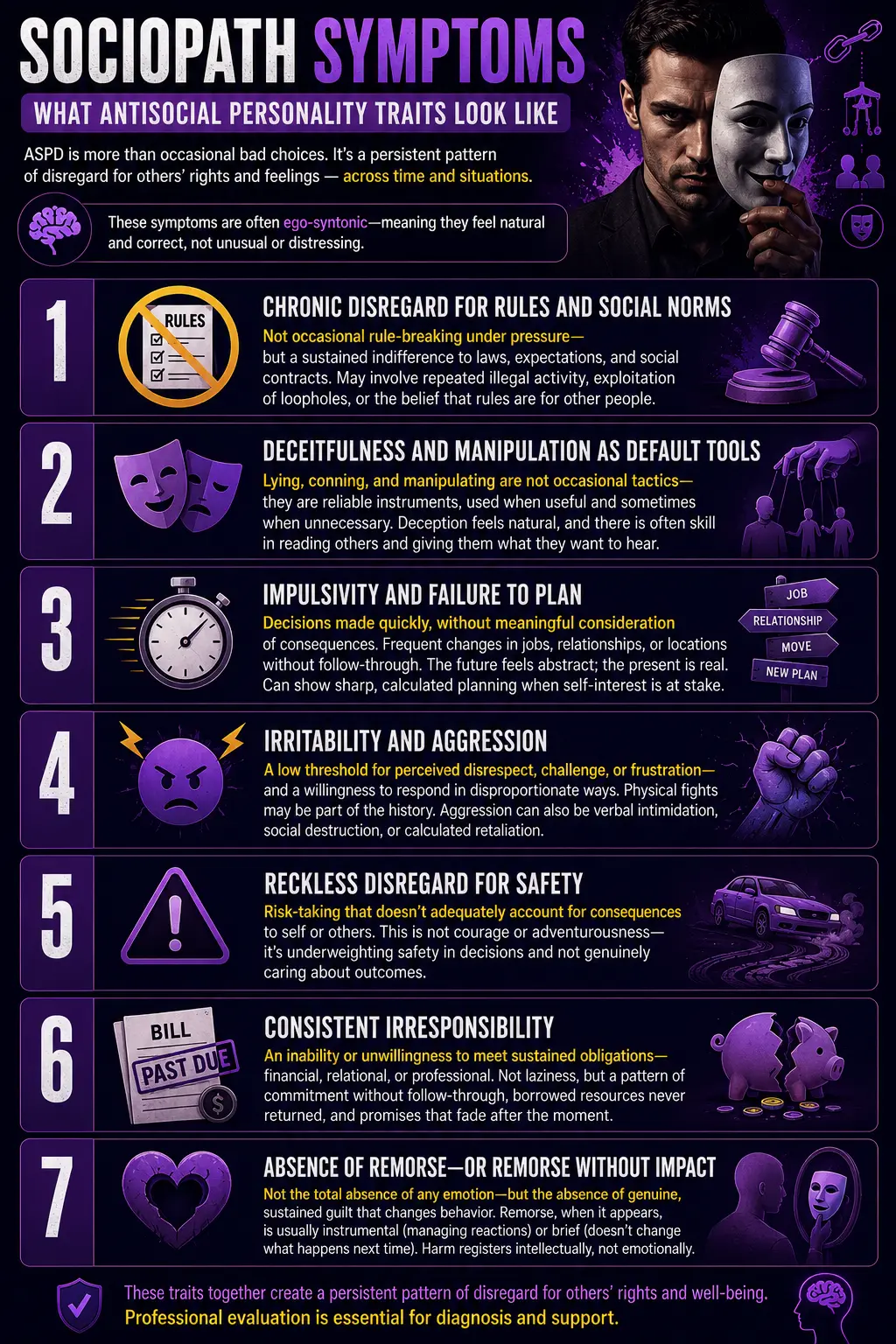
Sociopath Symptoms — What Antisocial Personality Traits Look Like
What sets ASPD apart from ordinary bending of the rules or looking out for yourself is that it shows up everywhere, stays the same across settings, and follows a specific pattern. People with ASPD don’t always see these behaviors as unusual. Many are “ego-syntonic”: they feel natural and right, not strange or upsetting.
Chronic disregard for rules and social norms.
Not occasional rule-breaking under pressure — but a sustained, pattern-level indifference to the laws, expectations, and social contracts that most people experience as genuinely binding. This may manifest as repeated illegal activity, systematic exploitation of loopholes, or a simple sense that rules are for other people who need them.
Deceitfulness and manipulation as default tools.
Lying, conning, and manipulating others are not occasional tactics deployed under pressure — they are reliable instruments, used when useful and sometimes when unnecessary. The deception tends to feel natural rather than guilty. There is often genuine skill in reading what others want to hear and providing it.
Impulsivity and failure to plan.
Decisions made quickly, without meaningful consideration of consequences. Moving from situation to situation — jobs, relationships, cities — without sustained engagement or follow-through. The future feels abstract; the present is what’s real. This impulsivity often coexists with moments of sharp, calculated planning — particularly when self-interest is clearly at stake.
Irritability and aggression.
A low threshold for perceived disrespect, challenge, or frustration — and a willingness to respond in ways that others would consider disproportionate. Physical confrontation may have featured in the person’s history. The aggression is not always overt — it can be expressed through sustained verbal intimidation, social destruction, or calculated retaliation.
Reckless disregard for safety.
Risk-taking that doesn’t adequately account for consequences to self or others. This is not the same as courage or adventurousness — it’s an underweighting of safety in decision-making, reflecting a reduced capacity to genuinely care about outcomes.
Consistent irresponsibility.
Being unable or unwilling to keep up long-term obligations, whether money, relationships, or work. It isn’t laziness. It is a pattern of commitments without follow-through, borrowed things never returned, and promises that mean something when made and less later.
Absence of remorse — or remorse without impact.
This is the core affective feature. Not the total absence of any emotional response — but the absence of genuine, sustained guilt that changes behavior. Remorse, when it appears, tends to be instrumental (managing someone else’s reaction) or brief (not changing what happens next time). The harm done to others registers intellectually but doesn’t carry the emotional weight that would alter future behavior.
Sociopath vs. Psychopath vs. ASPD — The Definitive Comparison
These three terms are used interchangeably in popular culture and incorrectly in most online content. The actual clinical picture is more nuanced and more important to understand accurately.
| Feature | Sociopath | Psychopath | ASPD (Clinical Diagnosis) |
|---|---|---|---|
| Official DSM-5-TR status | Informal term — not a diagnosis | Informal term — not a diagnosis | Official Cluster B personality disorder (ICD-10-CM F60.2) |
| Origin theory | Primarily environmental — trauma, upbringing, social factors | Primarily neurobiological — genetic, brain structure differences | Both genetic and environmental factors; conduct disorder required before 15 |
| Emotional profile | May have fleeting emotional connections; capable of some attachment | Profound emotional shallowness; genuine empathy largely absent | Spectrum — from mild to profound emotional deficits |
| Behavior style | More impulsive, erratic, emotionally reactive | More calculated, controlled, long-term planning | Covers both patterns |
| Remorse | Rare and fleeting — may experience brief guilt | Absent — no genuine guilt | Absent or insufficient to change behavior |
| Social functioning | More difficulty maintaining stable relationships and work | Can maintain a convincing social facade for extended periods | Consistent irresponsibility across relationships and work |
| Violence risk | Elevated — more impulsive aggression | Elevated — but more calculated and predatory | Elevated, particularly with substance use comorbidity |
| Assessment tool | ASPD criteria (DSM-5-TR) | PCL-R (Hare Psychopathy Checklist-Revised) | Structured clinical interview — DSM-5-TR criteria |
If the psychopathy dimension feels more relevant to your experience or concern, our dedicated Psychopath Test covers the PCL-R four-facet model in full.
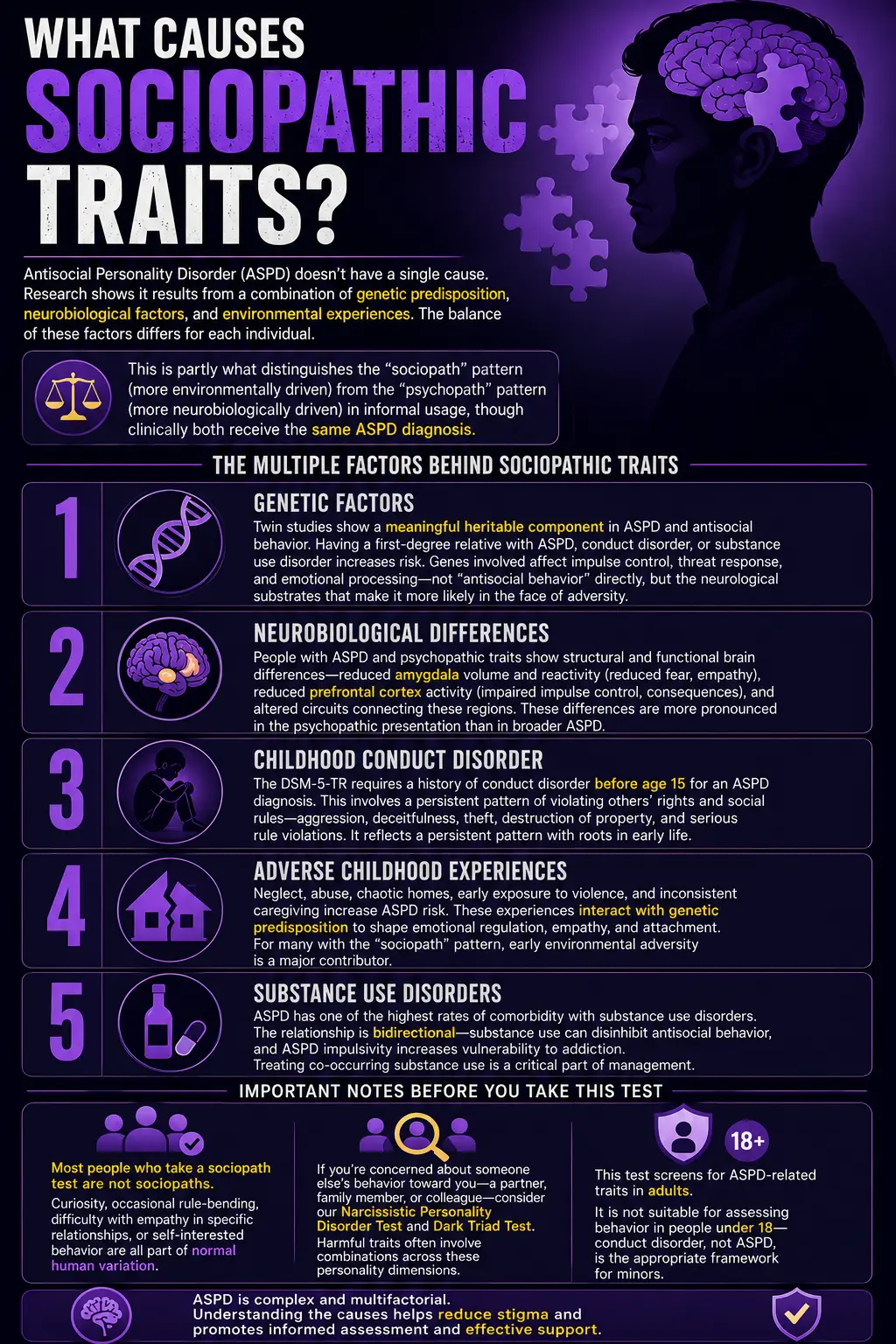
What Causes Sociopathic Traits?
ASPD has no single cause. Research points to a mix of genes, brain biology, and life experience, and the balance differs a lot from person to person. In everyday use, this is partly what separates the “sociopath” pattern (shaped more by surroundings) from the “psychopath” pattern (rooted more in biology). In clinical practice, both get the same ASPD diagnosis.
Genetic factors.
Twin studies show that ASPD and antisocial behavior are partly inherited. Having a parent, sibling, or child with ASPD, conduct disorder, or a substance use disorder greatly raises the risk. The genes involved affect impulse control, reactions to threat, and how emotions are processed. They don’t cause “antisocial behavior” directly. They shape the brain in ways that make it more likely when life is hard.
Neurobiological differences.
Research has found brain differences in people with ASPD and psychopathic traits. The amygdala tends to be smaller and less reactive, which helps explain less fear and less emotional empathy. The prefrontal cortex is less active, which helps explain weaker impulse control and less thought about consequences. The links between these areas also work differently. These findings are stronger in psychopathy than in ASPD as a whole.
Childhood conduct disorder.
The DSM-5-TR requires a history of conduct disorder before age 15 for an ASPD diagnosis. Conduct disorder involves a persistent pattern of violating others’ rights and social rules in childhood — aggression, destruction of property, deceitfulness, theft, and serious rule violations. This requirement reflects the developmental understanding of ASPD as a persistent pattern with roots in early life, not a condition that emerges suddenly in adulthood.
Adverse childhood experiences.
Neglect, physical or emotional abuse, chaotic or unpredictable home environments, early exposure to violence, and inconsistent caregiving all increase ASPD risk significantly. These experiences don’t cause ASPD directly — they interact with genetic predisposition to alter the developmental trajectory of emotional regulation, empathy, and attachment. For many people whose ASPD presentation fits the “sociopath” informal pattern, early environmental adversity is a major contributor.
Substance use disorders.
ASPD has one of the highest rates of comorbidity with substance use disorders of any personality disorder. The relationship is bidirectional — substance use can disinhibit antisocial behavior, and the impulsivity of ASPD increases vulnerability to addiction. Treating co-occurring substance use is a critical component of ASPD management.
An Important Note Before You Take This Test
Most people who take a sociopath test are not sociopaths. Being curious about dark traits, bending rules now and then, struggling with empathy in some relationships, or acting in your own interest are all normal. The traits in this test only matter clinically when they show up everywhere, stay steady across settings, have been present since the teen years, and cause real harm to others or to the person’s own life.
If you are taking this test because you’re concerned about someone else’s behavior toward you — a partner, family member, or colleague — please also consider our Narcissistic Personality Disorder Test and Dark Triad Test. The traits that harm others most often come in combination.
This test screens for ASPD-related traits in adults. It is not suitable for assessing behavior in people under 18 — conduct disorder, not ASPD, is the appropriate framework for minors.
How This Sociopath Test Works
This test covers the seven DSM-5-TR ASPD criteria plus the core affective and interpersonal features most consistently associated with sociopathic presentation. Questions assess behavior patterns, emotional responses, interpersonal patterns, and functional impact across 20 items.
Answer based on your consistent, typical pattern across your life — not your best day or your worst. The scale is:
- Never = 0
- Rarely = 1
- Sometimes = 2
- Often = 3
- Always = 4
Total range: 0–80. This is a screening tool — not a diagnosis. A significant score indicates a pattern worth exploring with a mental health professional.
Understanding Your Sociopath Test Score
| Score Range | Category | What It Suggests |
|---|---|---|
| 0 – 20 | Low — Few Antisocial Trait Indicators | Responses suggest few significant patterns of antisocial personality traits. Normal self-interest and occasional rule-bending are present in most people and don’t constitute ASPD. |
| 21 – 40 | Mild — Some Patterns Present | Some antisocial trait patterns are present. These may reflect subclinical traits, specific life circumstances, or co-occurring conditions. Worth exploring with a professional. |
| 41 – 60 | Moderate — Significant Trait Pattern | Multiple antisocial trait patterns are present across several domains. This pattern likely reflects a meaningful impact on relationships and functioning. Professional evaluation is recommended. |
| 61 – 80 | High — Strong ASPD Trait Indicators | Strong, pervasive antisocial personality trait patterns are indicated across multiple domains. A formal clinical evaluation by a mental health professional is strongly recommended. |
Can Sociopathic Traits Be Treated?
ASPD has long been seen as one of the harder personality disorders to treat, and that reputation is partly fair. The traits feel right, not wrong. Motivation to change is often low. And substance use problems are common. All of this makes treatment harder. But the clinical picture is more nuanced than “untreatable.”
Schema Therapy
One of the most evidence-supported approaches for ASPD specifically. Schema Therapy identifies and targets early maladaptive schemas — deeply held beliefs about the self, others, and the world, formed in early development — that drive antisocial behavior. It has shown efficacy in forensic and community samples and is increasingly used as a first-line treatment for personality disorders.
Mentalization-Based Treatment (MBT)
Developed by Peter Fonagy, MBT targets the capacity to understand mental states — one’s own and others’. Research suggests MBT can improve mentalizing capacity even in individuals with significant antisocial traits, and improved mentalizing correlates with improved interpersonal behavior.
Cognitive Behavioral Therapy (CBT)
Adapted CBT that focuses on impulse control, consequence evaluation, and perspective-taking has shown benefit, particularly for the impulsivity and aggression dimensions of ASPD. The difficulty is engagement: CBT requires motivation to change, which ASPD often undermines.
Addressing co-occurring conditions
Substance use disorders, depression, anxiety, and ADHD all frequently co-occur with ASPD and compound its severity. Treating these independently can meaningfully reduce the overall behavioral picture even when the underlying ASPD proves harder to shift directly.
The motivation question
The best predictor of whether treatment works in ASPD is the person’s own motivation: a real wish to change, even if it starts from self-interest (avoiding legal trouble, improving relationships, steadying their life). That motivation can be built. It is not fixed.
Frequently Asked Questions
What is a sociopath?
“Sociopath” is an informal term, not a formal diagnosis. It describes a pattern of antisocial traits that falls under Antisocial Personality Disorder (ASPD) in the DSM-5-TR (ICD-10-CM F60.2). The sociopath pattern usually involves more impulsive, erratic behavior and may include brief emotional bonds. The psychopath pattern is more calculated and emotionally shallow. Both are subsumed under the ASPD diagnosis in formal clinical practice. ASPD affects approximately 1–4% of the general population.
What is the difference between a sociopath and a psychopath?
Both are informal subtypes of Antisocial Personality Disorder. Neither is a separate DSM-5-TR diagnosis. In clinical and research use, psychopathy is seen as more rooted in biology, more emotionally shallow, more calculated, and more predatory. Sociopathy is seen as more shaped by surroundings, more impulsive and erratic, and may allow some emotional bonds in a few relationships. Research using the PCL-R (Hare Psychopathy Checklist) draws these distinctions most formally — our dedicated Psychopath Test covers the PCL-R framework.
Can you be a sociopath and not know it?
Yes, and this is one of the most important features of ASPD. The traits mostly feel normal and fitting from the inside, not strange or upsetting. People with ASPD don’t usually see their behavior as a problem. They see others as oversensitive, unreasonable, or naive. Realizing that you relate to rules, people, and consequences differently often comes from outside: broken relationships, legal trouble, or feedback that builds into a pattern. The fact that someone is asking these questions at all is itself clinically meaningful.
Is ASPD the same as being evil?
No. That view is unhelpful and wrong. ASPD is a personality disorder with roots in biology, genes, and childhood. People with ASPD are not evil. They have a condition that affects how they handle emotion, consequences, and what others think and feel. It often comes from hard early experiences combined with inborn traits. The harm they cause is real, and it matters. But seeing it as a disorder, not a moral label, is more accurate and more useful for everyone, including the people affected.
Can sociopathic traits change over time?
Yes, and this is one of the most important findings in ASPD research. Long-term studies show that antisocial behavior tends to decrease with age. This is sometimes called “burning out.” People with ASPD over 40 show much less impulsive and aggressive behavior than younger adults with the same diagnosis. The emotional traits (lack of empathy, coldness) change less than the behavior. But real improvement in daily life is possible, especially when substance use is treated and the person takes part in treatment.
Should I be worried if someone I know scored high on this test?
If someone close to you keeps manipulating you, lying, ignoring your well-being, or hurting you emotionally, the most important thing is to protect yourself. Get support, and talk with a therapist about what you’re going through. You can’t diagnose someone else, and you can’t make them change. What you can do is make honest choices about your own safety and well-being, based on the behavior you’ve seen, not on explanations or promises. If you feel unsafe, contact the National Domestic Violence Hotline at 1-800-799-7233. Our NPD Test and Dark Triad Test may also be relevant to your experience.
Further reading
Sociopathic traits tend to show up as impulsivity and disregard for rules. If what you recognise is closer to deliberate long-game strategy than to recklessness, the Machiavellianism test is the better fit.
About this test: The questions were written by the PsyMed Editorial Team from the DSM-5-TR criteria for antisocial personality disorder and related traits described in the research literature. It is an original educational scale that has not been clinically validated, so the score bands are a guide rather than clinical cutoffs. Read how we build our tests and who we are.
Related Tests
ASPD rarely stands alone. These tests cover the conditions most often linked with it or mistaken for it:
- Psychopath Test — based on the four parts of the PCL-R; covers the more biology-driven, emotionally shallow psychopathic pattern
- Narcissistic Personality Disorder Test — NPD and ASPD share manipulation and lack of empathy; they frequently co-occur in the Dark Triad
- Dark Triad Test — screens for Narcissism, Machiavellianism, and Psychopathy together; often the most complete picture of harmful personality constellations
- Antisocial Personality Disorder Test — our dedicated ASPD assessment covering the formal DSM-5-TR diagnostic criteria directly
- ADHD Test — ADHD and ASPD share impulsivity, low frustration tolerance, and inconsistency; they co-occur at meaningful rates, and the distinction matters for treatment
- Depression Test — depression frequently co-occurs with ASPD; addressing it can meaningfully reduce the severity of antisocial behavior
For more personality disorder screenings, visit the Personality Disorder Test Hub, which sets the antisocial pattern alongside the other nine DSM-5-TR types.
References
- American Psychiatric Association. (2022). Diagnostic and Statistical Manual of Mental Disorders, Fifth Edition, Text Revision (DSM-5-TR). F60.2 Antisocial Personality Disorder. psychiatry.org
- Wynn, R., et al. (2025). Epidemiology, Comorbidity, and Behavioral Genetics of Antisocial Personality Disorder and Psychopathy. PMC, 2025. pmc.ncbi.nlm.nih.gov
- Hare, R.D. (1991). The Hare Psychopathy Checklist-Revised (PCL-R). Multi-Health Systems.
- Cleveland Clinic. (2025). Psychopathy vs. Sociopathy: The Differences. health.clevelandclinic.org
- MSD Manual Professional Edition. (n.d.). Antisocial personality disorder (ASPD). Merck & Co. msdmanuals.com
Related Tests
See All Quiz →

You may also like
See All Quiz →