
Self-reflection · Identity
Bisexual Quiz: explore attraction without a verdict
Wondering whether bisexual describes you? This 15-question bisexual quiz offers a way to reflect on attraction and language. Its score cannot establish your orientation, measure how bisexual you are, or decide what you should call yourself.
Not a diagnostic or validated identity test. You decide how you identify, regardless of your score.
-
SELF-REFLECTION15 existing questionsA prompt for your own words, not a way to assign an identity.
-
TAKE YOUR TIMENo pressure to decidePause or stop whenever you want. You do not need a label to continue.
-
CLEAR LIMITSA score is not a verdictThese ranges describe answers to one questionnaire, not your orientation.
The self-check
Take the Bisexual Quiz
Answer about your own experience. Choose the closest available response; there are no right answers. The questions are preserved from the existing quiz and are not a validated identity measure.
Reading your answers
Four descriptive answer ranges
- 0–15 Fewer endorsements
- 16–30 Mixed endorsements
- 31–45 Many endorsements
- 46–60 Most statements endorsed
Each item scores 0 to 4, for a total of 0–60. The four ranges are editorial groupings, not validated thresholds or identity categories. A self-reflection quiz, not a label. Only you can decide how you identify.
An item count, not a measure of how valid your identity is.
The short answer
What is bisexuality?
Bisexuality describes the capacity for romantic, emotional, or sexual attraction to more than one gender. A bisexual quiz can offer reflection prompts, but only you choose whether this word fits your experience.
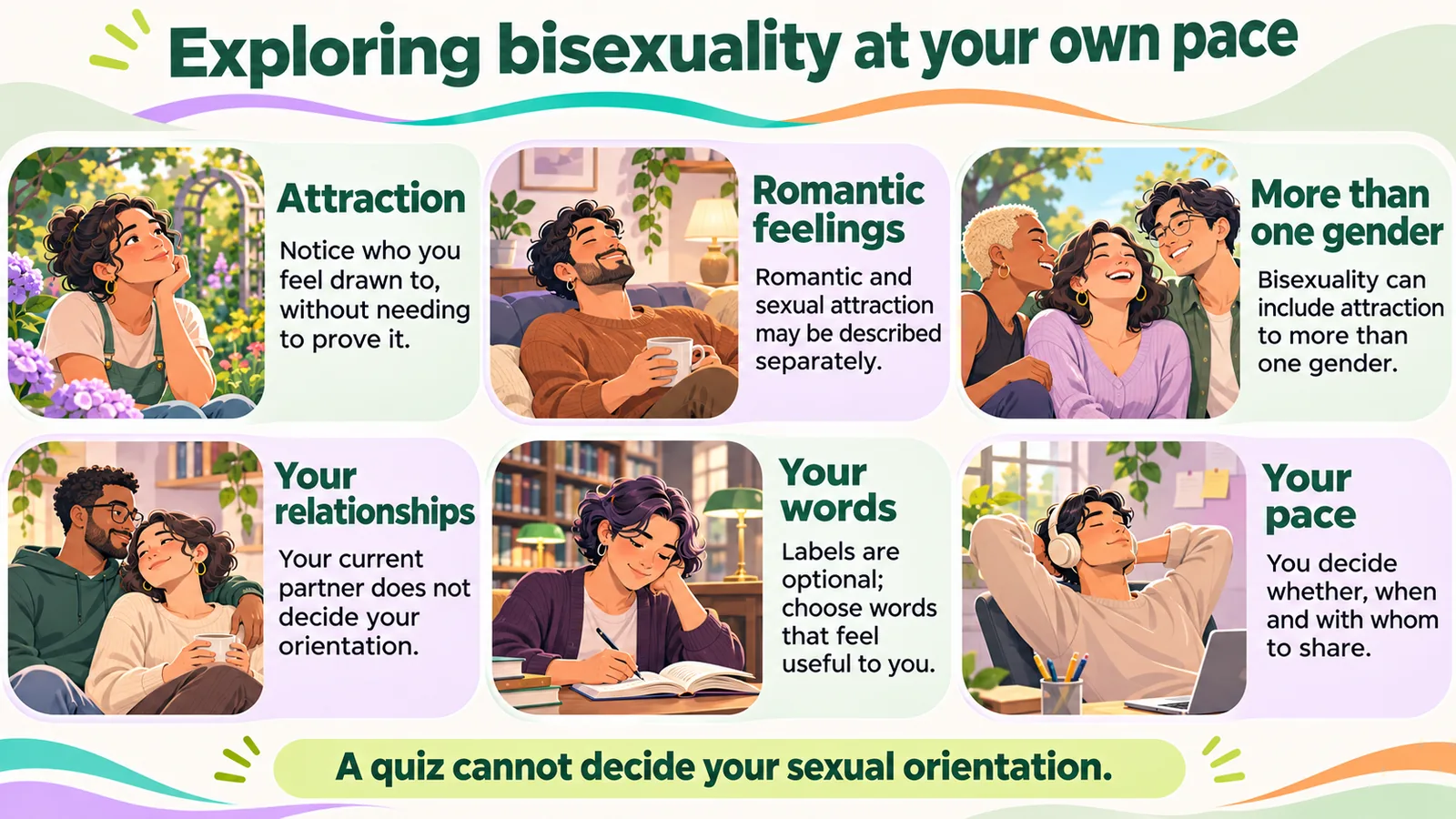
Attraction does not need to be evenly divided, simultaneous, or demonstrated through a dating history. Someone can use bisexual, another label, several labels, or none. There is no relationship experience you must collect to earn an identity.
Your current partner does not define the whole of your attraction. A relationship is a relationship; an orientation is how you describe your experience.
The APA Dictionary defines bisexuality in terms of attraction or relationships involving more than one gender. It does not define it by a quiz score.
View sourceReflect without a checklist identity
Experiences you might want to explore
These prompts are not signs of a disorder or requirements for an identity. Use the ones that help you describe your own experience.
Attraction beyond one gender
Think about actual crushes or attraction you have noticed, rather than what you believe you ought to feel. There is no required number of examples.
Different kinds of closeness
Separate wanting romance, wanting sexual contact, enjoying companionship, and finding someone beautiful. You can write down what each feels like to you.
Uneven attraction
A stronger pull toward one gender does not by itself make bisexual an unavailable word. Avoid turning your feelings into a required ratio.
A partner is one part of the picture
Consider your experience beyond your current relationship. You do not need to date anyone else or change a commitment to reflect on attraction.
Language that feels useful
Notice whether bisexual feels clarifying, limiting, unfamiliar, or simply unnecessary. These reactions are prompts for thought, not a score you must improve.
Room for uncertainty
You may know who attracts you before knowing what to call it. You can leave the label open without treating uncertainty as a problem to solve immediately.
Distinctions that keep a result in perspective
A quiz total combines answers; your life contains distinctions worth keeping separate.
| Question | What it concerns | What it does not establish |
|---|---|---|
| Attraction | Who you feel drawn to and what kind of closeness you want. | A requirement to act on a feeling. |
| Identity | The words you choose for your own experience. | A label someone else can assign from your score. |
| Relationship | Your agreements, choices, and commitments. | The full range of your attraction. |
| Quiz result | Your responses to this item set. | A probability, diagnosis, or orientation verdict. |
Interpretation, not diagnosis
What can your result tell you?
Three ways to keep the total in its proper place.
- 01 Your words
Start with the answers
Choose one response that felt clear and one that felt difficult. Write what the question meant to you before interpreting the total.
- 02 The limits
Separate the ingredients
This questionnaire mixes experiences, openness, and label preference. A single total cannot tell you which of those produced your score.
- 03 Your choice
Decide what is useful
Keep a word if it helps, leave it open if it does not, and change how you describe yourself when you want to. No quiz threshold is required.
The four stored ranges are retained for continuity with the existing quiz. They have not been validated to identify orientation, distinguish labels, or measure how strongly an identity belongs to someone.
Context matters
Give yourself room to describe the experience
Use these practical questions to add context. They are optional reflection exercises, not explanations of what caused your orientation.
Your setting
Would you answer differently if nobody else would see or judge the answer? Notice that question without assuming it explains your total.
Your experience
Which answers describe something you have felt, and which describe a possibility? There is no need to seek a particular experience to settle the difference.
Your language
Does the wording fit how you understand gender and attraction? You can describe an experience more precisely in your own words than in a multiple-choice answer.
Affirming support
What can help while you explore?
Support can make space for your questions without trying to decide your identity for you.
- 01 / LEARN
Use clear definitions
Read about bisexuality and pansexuality from LGBTQ+ organizations. Compare the words with your experience rather than looking for a rule that licenses a label.
- 02 / REFLECT
Choose a manageable prompt
Write a few lines about attraction, romance, or a word you are considering. You can stop when reflection starts to feel repetitive or pressured.
- 03 / CONNECT
Look for affirming conversation
If you want to talk, choose someone who respects your privacy and accepts that you make the identity decision. A qualified affirming counselor can help with distress without treating orientation as an illness.
For learning and reflection: The Trevor Project’s bisexuality resource. Support is about your wellbeing, not changing your orientation.
Practical next steps
What should you do after this quiz?
Choose one small action that serves you. There is no identity deadline.
- 01
Name one useful observation
Finish the sentence “One thing I noticed about my answers was…” without turning it into a verdict.
- 02
Keep your boundaries
You do not need to date, have sex, end a relationship, or disclose anything because of a quiz.
- 03
Choose support if you want it
Read an affirming resource or speak with a trusted person. If you are distressed, you can ask a qualified professional for help regardless of the score.
If sharing a label could put your housing, finances, privacy, or physical safety at risk, you can wait or choose a smaller audience. The Coming Out Handbook offers questions for planning. This quiz creates no obligation to disclose.
Good questions to ask
Bisexual Quiz FAQs
Straightforward answers about the language, the score, and your choices.
Only you can decide whether bisexual is a useful description of your attraction. This quiz cannot answer that for you. Reflect on who you feel drawn to, what kind of closeness you want, and which words feel comfortable; no total overrides your own account.
No equal split is required. Bisexual does not mean every gender attracts you in the same way or to the same degree. A score cannot turn your experience into a required proportion.
Yes. Attraction does not require a relationship or sexual experience to become valid. You do not need to experiment, date anyone, or cross a boundary to establish a label.
The words can overlap, and some people use both. Bisexual commonly refers to attraction to more than one gender; pansexual often emphasizes attraction across or regardless of gender. Neither is a better or more inclusive identity by default.
No. Orientation does not determine whether someone chooses monogamy or consensual non-monogamy. Your relationship agreements, consent, and behavior are separate questions.
It means you endorsed fewer of these particular statements. It cannot rule out bisexuality, establish another orientation, or show that your curiosity was mistaken. Read your individual answers rather than treating the band as a label.
It means you endorsed more of this item set. It is not a percentage chance of being bisexual, proof that you must come out, or a reason to change your relationship. You may still prefer a different word or no label.
No. Disclosure is your choice. Before sharing, consider privacy, the people involved, and practical safety. You can tell selected people, wait, or keep this information to yourself.
The 15 items each carry a stored weight from 0 to 4, giving a possible total of 0 to 60. The four ranges are editorial groupings, not validated identity thresholds. Some items overlap and mix attraction with openness or label preference, which limits interpretation.
Editorial transparency
Sources and review information
Prepared by the PsyMed Editorial Team from the educational resources listed here. This is an existing PsyMed reflection quiz, not a validated instrument. No licensed clinical reviewer is claimed. Source checks: November 15, 2026. Read how we build our tests and who we are.
You choose the words
A score cannot decide who you are.
Use the questions to clarify your own thoughts. Keep what helps, leave what does not, and take your time.
Take the self-check