
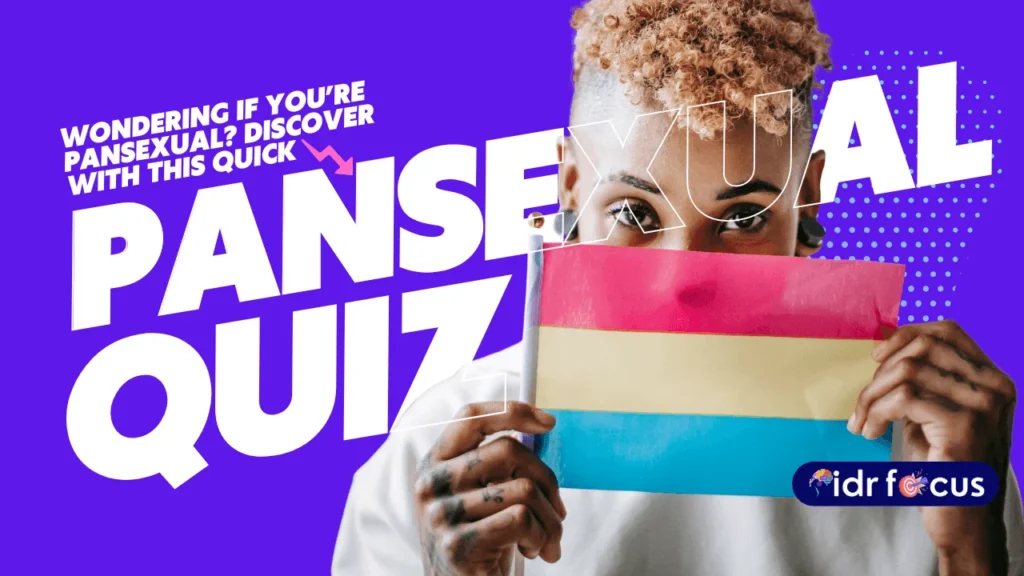
Pansexual Quiz: Am I Pansexual?
Wondering "am I pansexual?" This free, private pansexual quiz helps you explore attraction regardless of gender — no labels forced, no wrong answers
Published Updated
If you’ve been wondering whether you might be pansexual, that’s a real and valid question worth exploring — and you’re in good company. Plenty of people take time to reflect on who they’re drawn to and what that says about their identity. There’s no rush, no test you can fail, and no wrong answer to land on.
Let’s be clear about one thing up front: a quiz cannot tell you your sexual orientation. Only you can know that, and it’s completely okay if you’re not sure yet, or if your understanding shifts over time. What this pansexual quiz can do is give you a private, structured way to reflect on your own attractions — specifically, on whether gender tends to be a deciding factor for you or not, which is the heart of what pansexuality describes. Think of it as a mirror for your own feelings, not a verdict. 15 questions, completely private, no sign-up.
What Does It Mean to Be Pansexual?
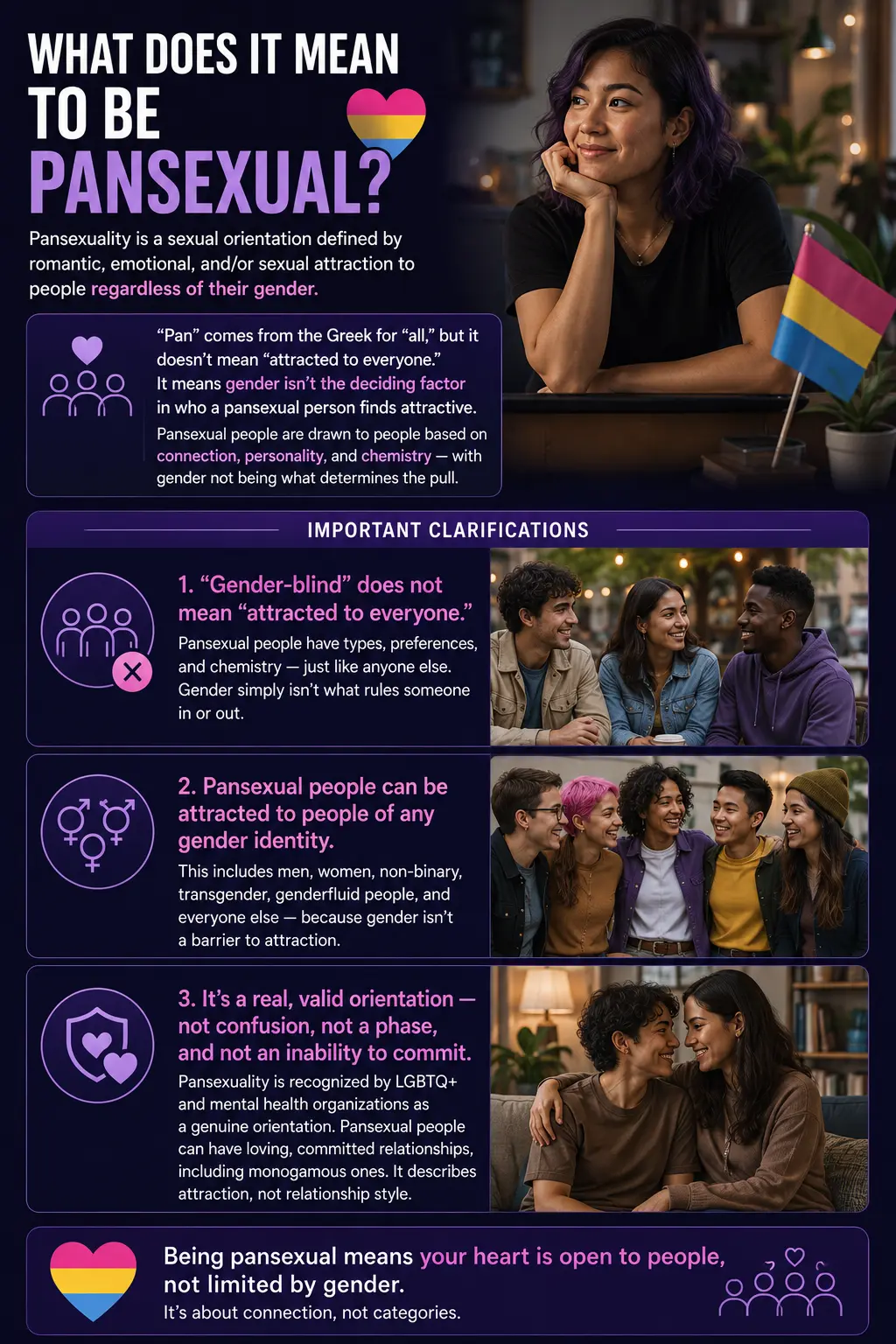
Pansexuality is a sexual orientation defined by romantic, emotional, and/or sexual attraction to people regardless of their gender. The prefix “pan” comes from the Greek for “all,” but the truest sense of the word isn’t “attracted to everyone” — it’s that gender isn’t the deciding factor in who a pansexual person finds attractive. Many pansexual people describe themselves as “gender-blind,” meaning gender simply isn’t the filter through which their attraction works. They’re drawn to people based on connection, personality, chemistry — with gender not being what determines the pull.
A few important clarifications, because they’re widely misunderstood:
-
“Gender-blind” does not mean “attracted to everyone.”
This is the single most common misconception. Being pansexual doesn’t mean you’re attracted to every person you meet, any more than a straight person is attracted to everyone of their preferred gender. Pansexual people have types, preferences, and chemistry like anyone else — gender just isn’t the thing that rules someone in or out.
-
Pansexual people can be attracted to people of any gender identity.
That includes men, women, non-binary people, transgender people, genderfluid people, and everyone else — not because pan people are “attracted to all,” but because gender isn’t a barrier or a category that shapes their attraction in the first place.
-
It’s a real, valid orientation — not confusion, not a phase, and not an inability to commit.
Pansexuality is recognized within LGBTQ+ communities and by mental health and educational organizations as a genuine orientation. Pansexual people form loving, committed relationships, including monogamous ones, exactly like anyone else. Pansexuality describes attraction, not relationship style.
Pansexual vs Bisexual: What’s the Difference?
This is the question that comes up most, and it deserves a clear, respectful answer — because the two identities overlap a great deal, and there’s a lot of unnecessary friction around the distinction.
The most common way to describe it: bisexuality is attraction to more than one gender, while pansexuality is attraction regardless of gender — meaning gender isn’t a factor at all. For a bisexual person, gender may still play some role in their attraction (they’re attracted to more than one, but perhaps experience those attractions differently). For a pansexual person, gender isn’t part of the equation.
| Aspect | Pansexual | Bisexual |
|---|---|---|
| Core meaning | Attraction regardless of gender — gender isn’t a factor | Attraction to more than one gender |
| Role of gender | Not a deciding factor (“gender-blind”) | May still play a role in how attraction is experienced |
| Who it can include | People of any and all gender identities | People of two or more genders (never limited to just two) |
| PsyMed test | This quiz | Bisexual Test |
Two things really matter here.
First: neither label is “more inclusive” or “better” than the other. You’ll sometimes hear bisexuality wrongly described as “only two genders” — but bisexuality has never been limited to two genders, and putting one identity down to elevate the other isn’t accurate or kind. Both are valid, both can include attraction to people across the gender spectrum, and they simply frame the experience differently.
Second: the right label is whichever one feels true to you. Many people find their experience fits both, use the words interchangeably, or move between them over time. Some people are clearly one or the other. There’s no test that assigns you a label — only your own sense of what describes you best, which you’re free to change as you learn more about yourself. If “attraction to more than one gender” resonates more than “regardless of gender,” our Bisexual Test may fit you better.
Signs You Might Be Pansexual
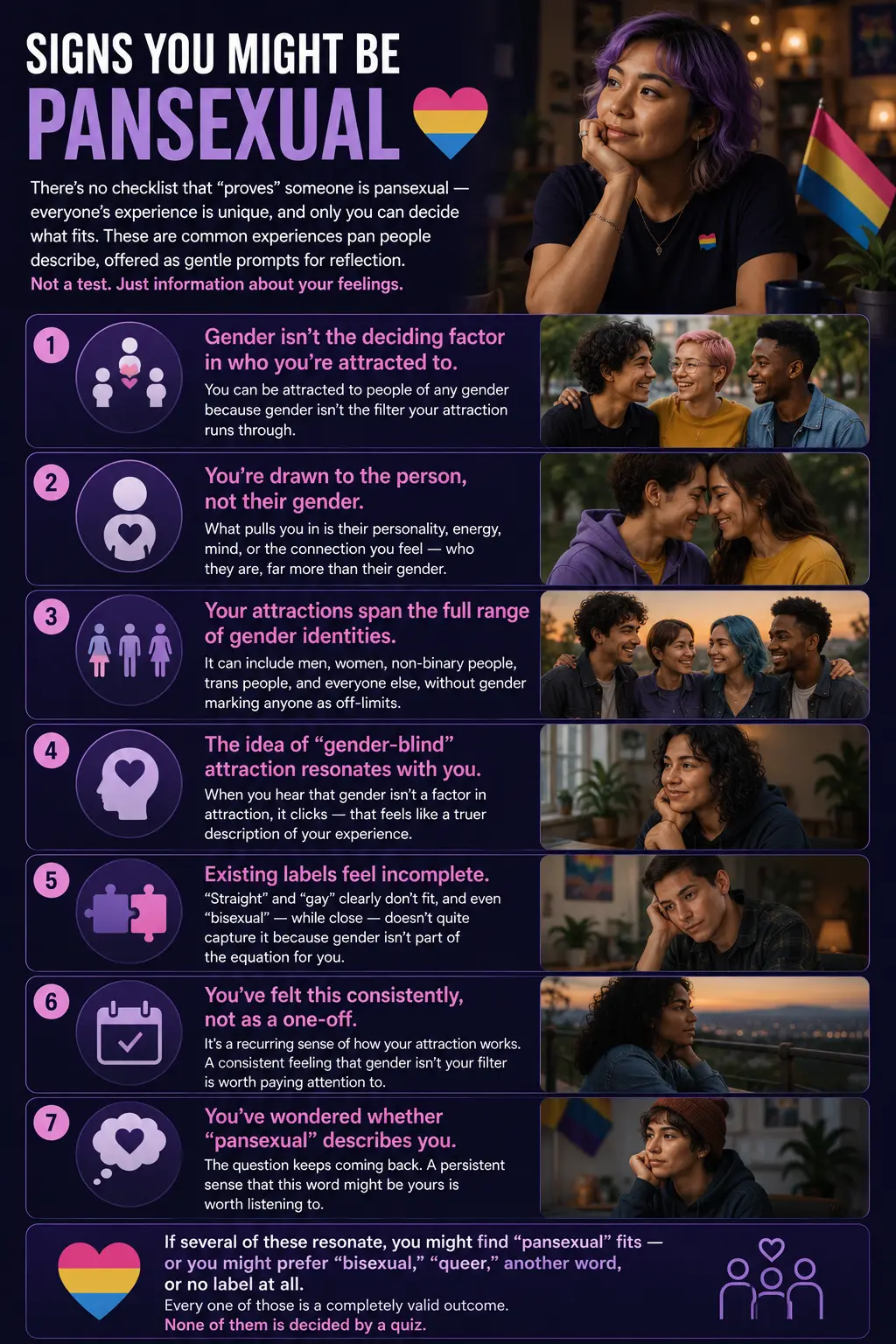
There’s no checklist that “proves” someone is pansexual — everyone’s experience is unique, and only you can decide what fits. But these are experiences pansexual people commonly describe, offered as gentle prompts for reflection rather than a test to pass. Recognizing some of these doesn’t obligate you to any label; it’s simply information about your own feelings.
-
Gender isn’t the deciding factor in who you’re attracted to
The central thread of pansexuality: when you’re drawn to someone, their gender isn’t what determines it. You could find yourself attracted to a person of any gender, because gender isn’t the filter your attraction runs through.
-
You’re drawn to the person, not their gender
What pulls you toward someone is their personality, energy, mind, or the connection you feel — “who they are” far more than “what gender they are.” Many pan people describe falling for the person and finding gender almost beside the point.
-
Your attractions span the full range of gender identities
Looking at who you’ve been drawn to (or can imagine being drawn to), it isn’t limited by gender — it can include men, women, non-binary people, trans people, and everyone else, without gender marking any of them as off-limits.
-
The idea of “gender-blind” attraction resonates with you
When you hear pansexuality described as gender not being a factor in attraction, it clicks — that feels like a truer description of your experience than “attracted to both” or any gender-specific label.
-
Existing labels feel incomplete
“Straight” and “gay” clearly don’t fit, and even “bisexual” — while close — doesn’t quite capture it, because for you gender genuinely isn’t part of the equation rather than being something you cross between.
-
You’ve felt this consistently, not as a one-off
This isn’t a single passing thought but a recurring sense of how your attraction works. A consistent feeling that gender isn’t your filter is worth paying attention to.
-
You’ve wondered whether “pansexual” describes you
The question itself keeps coming back. Questioning doesn’t automatically mean you’re pansexual, but a persistent sense that this word might be yours is worth listening to.
If several of these resonate, you might find “pansexual” fits — or you might prefer “bisexual,” “queer,” another word, or no label at all. Every one of those is a completely valid outcome, and none of them is decided by a quiz.
How This Pansexual Quiz Works
This quiz asks 15 questions about your attractions and feelings — centered on whether gender tends to be a deciding factor for you. For each, choose the answer that best reflects how you genuinely feel, not what you think you “should” feel:
Not at all = 0 | Rarely = 1 | Sometimes = 2 | Often = 3 | Very much = 4
Your answers add up to a score from 0 to 60 reflecting how much your attraction tends to work “regardless of gender.” Please read the result in the spirit it’s meant: it reflects what you told it, not a ruling on who you are. There’s no score that “makes” you pansexual or rules it out — only you can know your orientation, and it’s genuinely okay for that to be a work in progress. Answer honestly and privately; no one sees your results but you.
Your Results
Before your result, one reminder worth holding onto: these bands describe where your answers landed today, not a fixed truth about you. Sexuality is clear for some people and takes years to understand for others, and both are normal. Whatever your score, the only person who gets to name your orientation is you — and “pansexual,” “bisexual,” “queer,” another word, or no label are all valid places to land.
| Score Range | Reflection | What It Might Suggest |
|---|---|---|
| 0 – 15 | Gender May Matter to You | Gender seems to play a role in your attraction — though only you can say what fits. |
| 16 – 30 | Some Gender-Blind Attraction | Some of your attraction seems to work regardless of gender. Worth reflecting on, at your own pace. |
| 31 – 45 | Notable Pansexual Leanings | Gender often isn’t your deciding factor — a pattern many pansexual people recognize. |
| 46 – 60 | Strong Pansexual Pattern | Your attraction strongly tends to work regardless of gender, closely matching how pansexuality is described. |
Coming to understand your sexuality can feel exciting, freeing, confusing, or daunting — sometimes all at once, especially if the people around you aren’t supportive. If you’re finding it hard, you don’t have to carry it alone. The Trevor Project offers free, confidential support for LGBTQ+ young people, any time, at 1-866-488-7386 (or text START to 678-678). No question is too big or too small to reach out about.
Related Identities and Terms
Sexuality has a rich vocabulary, and finding the word that fits can be genuinely affirming. A few terms often come up alongside pansexuality, in case one resonates more:
-
Omnisexual
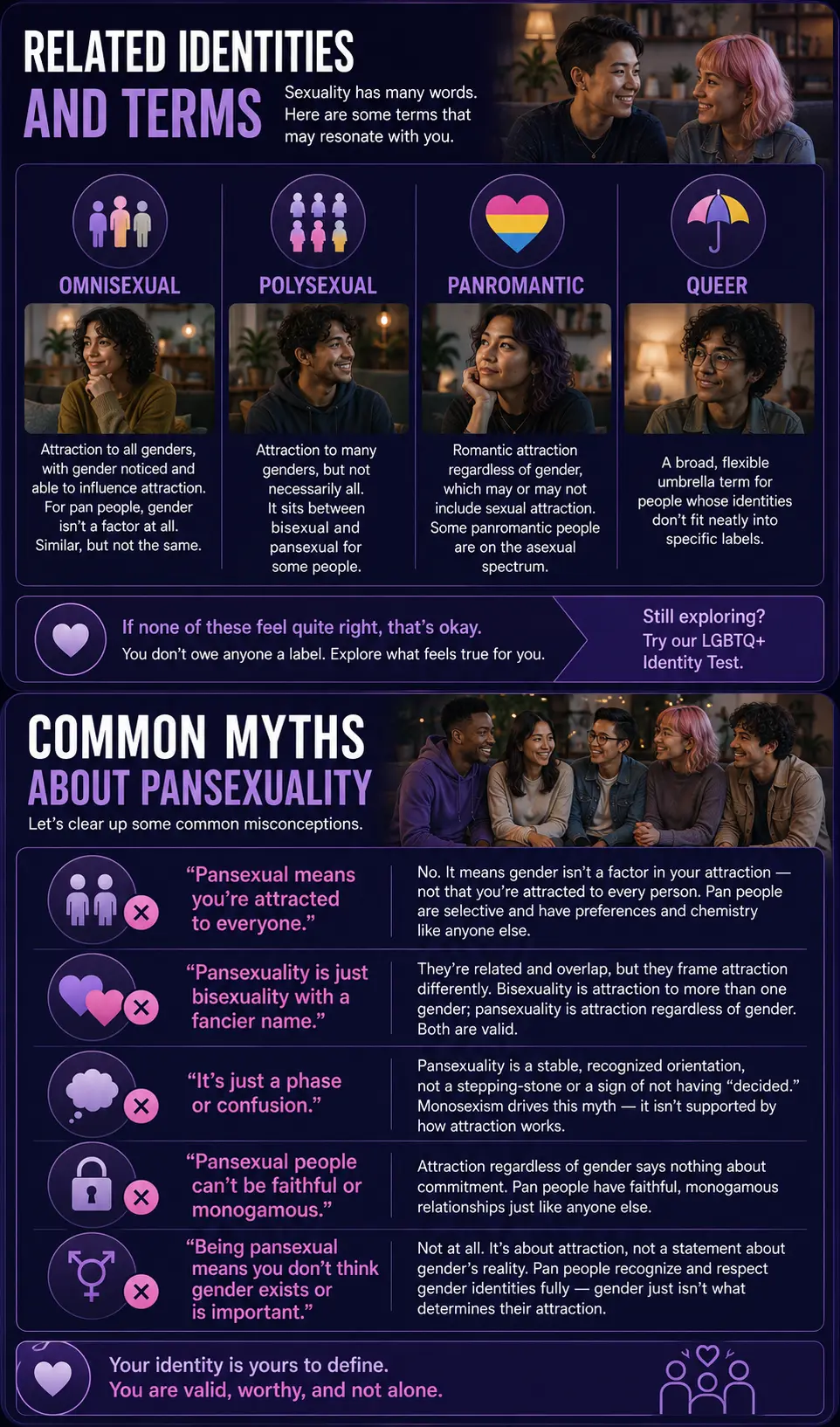
Attraction to people of all genders, but where gender is still noticed and may influence the nature of the attraction. The difference from pansexual is subtle: for pan people gender isn’t a factor at all, while for omnisexual people it’s present but not limiting. Both “pan” and “omni” come from roots meaning “all,” and some people use them interchangeably.
-
Polysexual
Attraction to people of many genders, but not necessarily all. It sits between bisexual and pansexual for some people.
-
Panromantic
Romantic attraction regardless of gender, which may or may not come with sexual attraction — some panromantic people are on the asexual spectrum. Romantic and sexual attraction don’t always align, and having different words for them can help.
-
Queer
A broad, flexible umbrella term some people prefer when specific labels feel too narrow or they’d rather not pin things down precisely.
If none of these feel quite right, that’s okay too — you don’t owe anyone a precise label, and plenty of people are content to simply describe their experience without one. Our LGBTQ+ Identity Test takes a wider view if you’re still exploring.
Common Myths About Pansexuality
A few persistent myths cause real confusion and hurt, so they’re worth clearing up directly.
-
“Pansexual means you’re attracted to everyone.”
No. It means gender isn’t a factor in your attraction — not that you’re attracted to every person. Pansexual people are selective and have preferences and chemistry like anyone else; gender just isn’t the filter.
-
“Pansexuality is just bisexuality with a fancier name.”
They’re related and overlap, but they frame attraction differently — bisexuality as attraction to more than one gender, pansexuality as attraction regardless of gender. Neither is “better,” and the choice of label is personal. Both are valid.
-
“It’s just a phase or confusion.”
Pansexuality is a stable, recognized orientation, not a stepping-stone or a sign of not having “decided.” The assumption that everyone is really only attracted to one gender — sometimes called monosexism — is what drives this myth, and it isn’t supported by how human attraction actually works.
-
“Pansexual people can’t be faithful or monogamous.”
Being attracted to people regardless of gender says nothing about someone’s capacity for commitment. Pansexual people have faithful, monogamous relationships just like anyone else. Attraction to a wider range of people doesn’t mean needing more than one partner.
-
“Being pansexual means you don’t think gender exists or is important.”
Not at all. Pansexuality is about attraction, not a statement about gender’s reality or significance. Pansexual people recognize and respect gender identities fully — gender simply isn’t what determines their attraction.
Questioning Your Sexuality Is Healthy
If you’re in a period of questioning, here’s something worth hearing plainly: this is a normal, healthy part of understanding yourself, not a problem or a sign that anything is wrong. Lots of people explore these questions, and there’s no deadline for reaching an answer — or any requirement to reach a fixed one at all.
A few things that many people find helpful: give yourself permission to explore without pressure to conclude; remember that labels are tools that serve you, not boxes you owe anyone; know that whatever you discover — pansexual, bisexual, queer, straight, gay, unsure — is valid; and be as gentle with yourself as you’d be with a good friend working through the same thing. If you’d like support, it can come from LGBTQ+ community spaces, an affirming therapist, trusted friends, or resources like The Trevor Project. Understanding yourself is a journey, and you’re allowed to take it at whatever pace feels right.
Frequently Asked Questions
Can a quiz tell me if I’m pansexual?
No — and any quiz claiming to definitively do so is overpromising. Your sexual orientation is something only you can determine, based on your own attractions and feelings. What a pansexual quiz like this one can genuinely offer is a structured, private way to reflect on your experiences — particularly on whether gender tends to be a deciding factor in your attraction, which is the core of pansexuality. Think of your result as organized information about your own feelings, a mirror rather than a verdict. Some people take a quiz like this and feel a click of recognition; others feel more uncertain, and both are completely okay. The goal is thoughtful self-reflection, not a label handed down by a score.
What’s the difference between pansexual and bisexual?
The most common distinction: bisexuality is attraction to more than one gender, while pansexuality is attraction regardless of gender — meaning gender isn’t a deciding factor at all. For a pansexual (often “gender-blind”) person, gender isn’t part of what draws them to someone; for a bisexual person, gender may still play some role in how they experience attraction, even though it spans more than one.
That said, the two overlap enormously, many people use the words interchangeably, and bisexuality has never been limited to “just two genders.” Neither label is more valid or more inclusive than the other — the right one is simply whichever fits your experience best, and you’re free to use both or to change your mind over time.
Does being pansexual mean I’m attracted to everyone?
No — this is the most common misconception about pansexuality. Being pansexual doesn’t mean being attracted to every person you encounter, any more than being straight means being attracted to everyone of your preferred gender. Pansexual people have preferences, types, and chemistry just like anyone else. What “pansexual” means is that gender isn’t the factor that determines attraction — not that attraction is universal or indiscriminate. You can be pansexual and still be drawn to only certain people; it’s just that gender isn’t what rules someone in or out for you.
Can you be pansexual and only have dated one gender?
Absolutely. Your orientation is defined by your attractions, not by your dating history or experience. Plenty of pansexual people have only dated one gender — because of circumstance, because they realized their orientation later, or simply because that’s how their life unfolded. Some pansexual people haven’t dated anyone at all and still know that gender isn’t a factor in their attraction. You don’t have to “prove” your pansexuality through experience; the way you experience attraction is what counts, whatever your relationship history looks like.
Is pansexuality a real sexual orientation?
Yes. Pansexuality is a real, valid sexual orientation, recognized within LGBTQ+ communities and by many mental health and educational organizations. It reflects a genuine experience of attraction to people regardless of their gender, and it deserves the same respect and understanding as any other orientation. It isn’t confusion, a phase, or an attempt to seem interesting — it’s simply how some people’s attraction works. The idea that it can’t be “real” usually rests on an assumption (sometimes called monosexism) that everyone is really only attracted to one gender, which doesn’t match the actual diversity of human attraction.
I think I might be pansexual. What should I do?
First, know there’s nothing you’re required to do — no obligation to label yourself, come out, or take any particular step on anyone’s timeline but your own. If you’d like to explore, some things people find helpful include reflecting honestly on your attractions without pressure, learning about others’ experiences (which can make you feel less alone), and, if it feels right, talking with people you trust or an affirming therapist.
Coming out to others is entirely your choice and something to do only if and when you feel safe and ready. Go at your own pace, be kind to yourself, and remember that understanding your sexuality is a personal journey with no fixed finish line. If you’re struggling, especially without support around you, resources like The Trevor Project (1-866-488-7386) are there for exactly this.
Related Tests
- Bisexual Test — if “attraction to more than one gender” resonates more than “regardless of gender,” this may fit you better
- LGBTQ+ Identity Test — a broader exploration of sexual orientation and identity if you’re questioning more widely
- Am I Gay? Test — focused reflection on same-gender attraction
- Am I Lesbian? Test — for women and questioning individuals reflecting on attraction to women
- Gender Identity Test — sexual orientation and gender identity are different things; this explores the latter
- Self-Esteem Test — coming to understand your identity can affect self-worth, especially without support
References
- WebMD. What Does It Mean to Be Pansexual? [Attraction regardless of gender; pan vs bi vs poly; omnisexual] webmd.com
- Ferguson, S. / Medical News Today. (2023). Bisexual vs. pansexual: What is the difference? [Bi = more than one gender; pan = regardless of gender; definitions vary and evolve] medicalnewstoday.com
- Medical News Today. Pansexual: Meaning, origins, signs, and myths. [“Gender-blind”; polysexual distinction; monosexism; myths] medicalnewstoday.com
- GLAAD. Media Reference Guide — LGBTQ Terms. [Respectful, accurate terminology for orientation] glaad.org
- The Trevor Project. Sexual Orientation resources and support for LGBTQ young people. thetrevorproject.org
-
Question of
When meeting someone, do you notice their gender first, or do other qualities stand out more?
-
Never
-
Rarely
-
Sometimes
-
Often
-
Very Often
Correct Wrong
-
-
Question of
Do you feel open to forming romantic or emotional connections with people of any gender?
-
Never
-
Rarely
-
Sometimes
-
Often
-
Very Often
Correct Wrong
-
-
Question of
Are you attracted to personality traits or emotional connections regardless of gender?
-
Never
-
Rarely
-
Sometimes
-
Often
-
Very Often
Correct Wrong
-
-
Question of
When considering a partner, do you find gender to be less important than how they make you feel?
-
Never
-
Rarely
-
Sometimes
-
Often
-
Very Often
Correct Wrong
-
-
Question of
Have you felt attraction toward people who identify in nontraditional gender roles or nonbinary identities?
-
Never
-
Rarely
-
Sometimes
-
Often
-
Very Often
Correct Wrong
-
-
Question of
Do you feel like traditional gender categories don’t fully capture your attraction patterns?
-
Never
-
Rarely
-
Sometimes
-
Often
-
Very Often
Correct Wrong
-
-
Question of
Are you open to dating people based on emotional and personal connections rather than gender?
-
Never
-
Rarely
-
Sometimes
-
Often
-
Very Often
Correct Wrong
-
-
Question of
Do you feel comfortable with the idea of loving a person, no matter their gender identity?
-
Never
-
Rarely
-
Sometimes
-
Often
-
Very Often
Correct Wrong
-
-
Question of
Have you explored or been curious about gender-fluid or nonbinary relationships?
-
Never
-
Rarely
-
Sometimes
-
Often
-
Very Often
Correct Wrong
-
-
Question of
Do you feel your romantic attraction is more flexible or inclusive than specific?
-
Never
-
Rarely
-
Sometimes
-
Often
-
Very Often
Correct Wrong
-
Related Tests
See All Quiz →
Sexual Orientation & Gender Identity
Free Kinsey Scale Test — Where Do You Fall on the Sexual Spectrum?
→
Sexual Orientation & Gender Identity
What Type of Lesbian Am I Quiz – Discover Your Lesbian Identity
→
You may also like
See All Quiz →