
Relationships & safety
Narcissistic Abuse Test: Reflect on harmful relationship patterns.
Explore 15 statements about another person’s behavior and its effect on you. This self-check can help you name concerns; it cannot diagnose anyone or measure whether you are safe.
This original questionnaire has not been clinically validated. Its bands describe your answers, not a diagnosis or a safety assessment. Harm matters at any score.In the US, the National Domestic Violence Hotline offers support and safety planning: call 1-800-799-7233 or text START to 88788. If you are in immediate danger, call 911 or your local emergency number. Outside the US, visit findahelpline.com.
- THE SELF-CHECKNarcissistic Abuse Test15 original statements for reflection.
- YOUR CHOICENo account neededYou can pause or stop when you choose.
- CLEAR BOUNDARIESInformation, not a diagnosisYour circumstances matter beyond a score.
The self-check
Take the narcissistic abuse test
This self-check is written for adults. Think about one relationship. Choose how often each statement is true of that relationship as you generally experience it. You may pause or stop at any point.
Your score
What the bands mean
- 0–15 Few Signs — fewer reported patterns
- 16–30 Some Signs — some reported patterns
- 31–45 Strong Signs — many reported patterns
- 46–60 Severe Signs — very frequent reported patterns
Each answer scores 0–4; the total is 0–60. This original questionnaire has not been clinically validated. Its bands describe your answers, not a diagnosis or a safety assessment. Harm matters at any score.
A self-check opens a conversation. It cannot settle a diagnosis.
The short answer
What is narcissistic abuse?
“Narcissistic abuse” is a commonly used description of harmful relationship behavior, not a diagnosis this test can establish. This page focuses on emotional abuse, control and their effects on the person experiencing them.
The other person’s label does not determine whether you deserve help. This quiz does not assess narcissistic personality disorder or require you to know another person’s intentions.
Your answers describe your experience of the listed statements. The bands have not been established as clinical cutoffs.
Emotional abuse can involve nonphysical behavior used to control, isolate or frighten someone. Physical violence is not required for a concern to deserve support.
Understand the pattern
Signs and patterns to notice
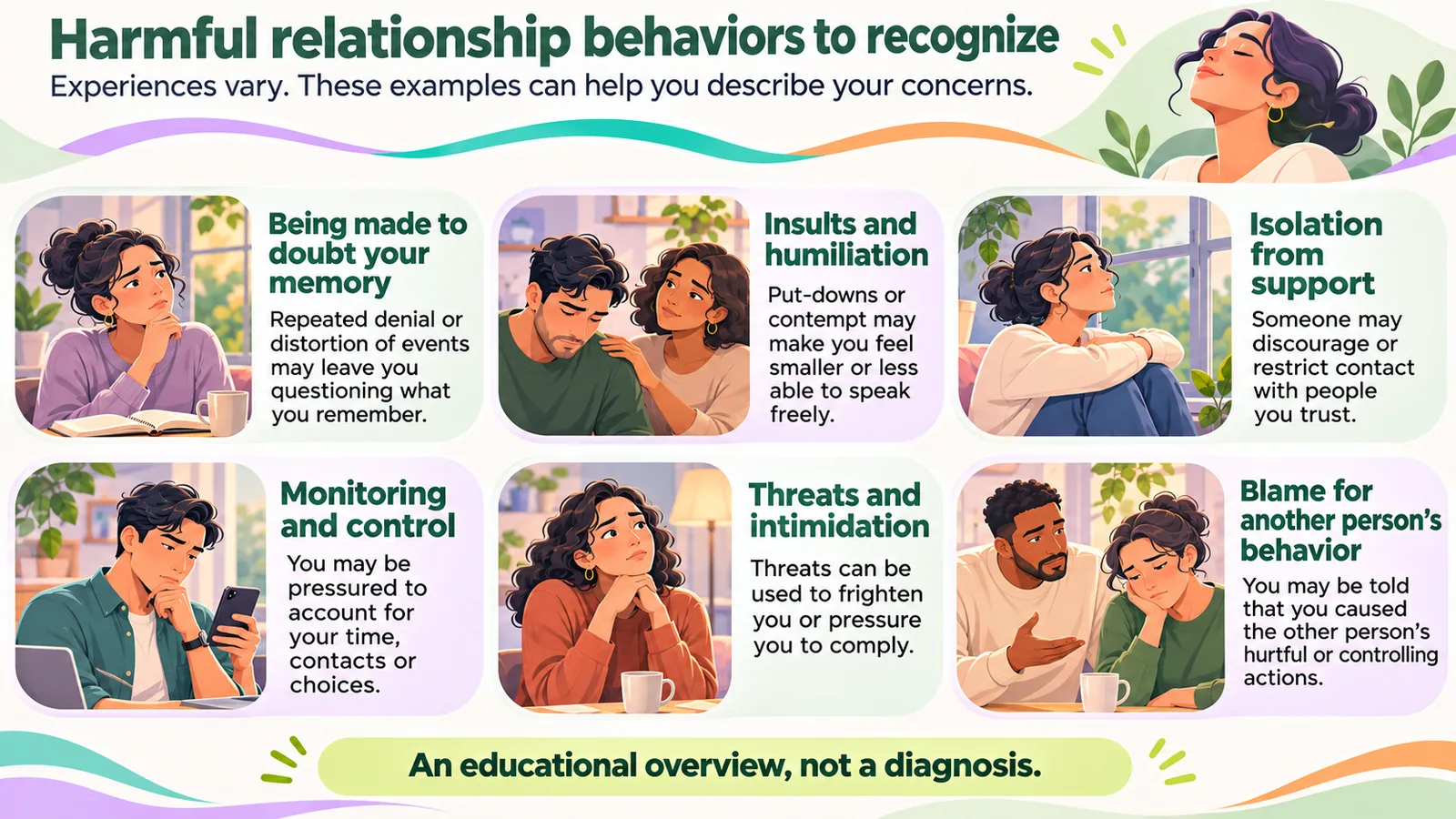
Being made to doubt your memory
Repeated denial or distortion of events may leave you questioning what you remember.
Insults and humiliation
Put-downs or contempt may make you feel smaller or less able to speak freely.
Isolation from support
Someone may discourage or restrict contact with people you trust.
Monitoring and control
You may be pressured to account for your time, contacts or choices.
Threats and intimidation
Threats can be used to frighten you or pressure you to comply.
Blame for another person’s behavior
You may be told that you caused the other person’s hurtful or controlling actions.
Related ideas are not interchangeable
Look at the full picture rather than treating one reaction as a diagnosis.
| Topic | Focus | Limit |
|---|---|---|
| Disagreement | People can disagree without using threats or restricting each other’s choices. | A quiz cannot decide the full context. |
| Emotional abuse | Nonphysical behavior can be used to control, frighten or isolate. | A low total does not make an individual threat safe. |
| A personality-disorder diagnosis | This quiz does not assess the other person. | Support does not depend on a diagnosis. |
Understanding the result
What can this relationship self-check tell you?
Your answers can help name concerns. They cannot investigate a relationship, diagnose anyone or determine whether you are safe.
- 01 Your perspective
The behavior you experience
Answer from the perspective of the person experiencing the behavior. Think about one relationship and the patterns that concern you.
- 02 The score
A descriptive total
Each answer contributes 0–4 points. The 0–60 total describes your responses; it does not measure how safe a relationship is.
- 03 The limit
No diagnosis required
This quiz does not assess narcissistic personality disorder. Support does not depend on a diagnosis for anyone involved.
A low total does not make an individual threat safe. These descriptive bands are preserved from the existing quiz and are not research-derived clinical thresholds.
Understanding the context
Understand behavior in its context
A disagreement is not the same as an ongoing pattern of intimidation or control. This self-check cannot investigate events, identify someone’s intentions or determine a diagnosis.
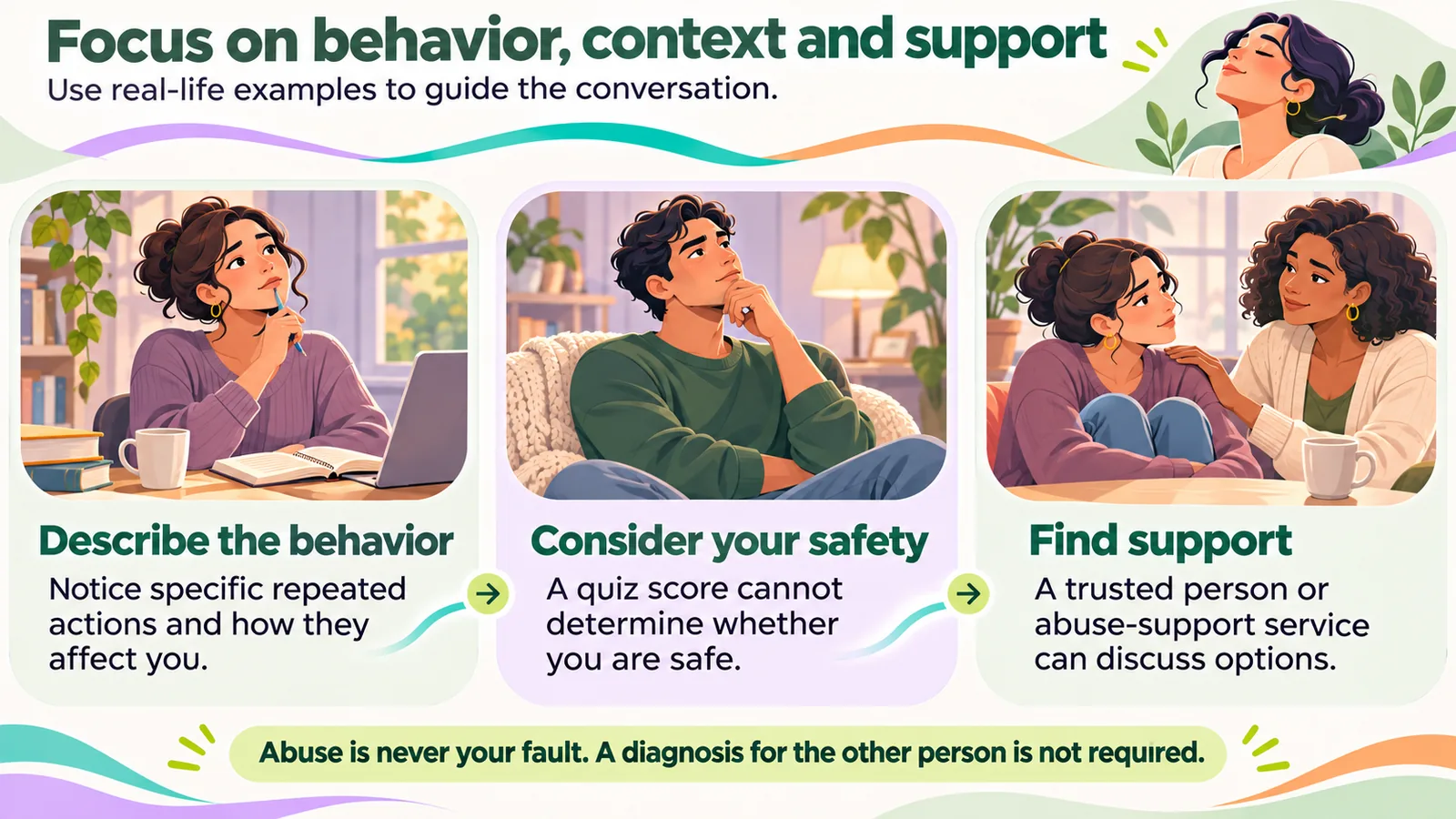
Focus on specific behavior
Focus on specific behavior and how it affects your freedom and safety.
You do not need the other person’s label
You do not need to decide whether the other person is “really a narcissist.”
A different quiz cannot explain away harm
The Attachment Style Test explores relationship preferences; it is not a way to explain away threats or control.
Support that fits your circumstances
What support and safety planning can help you consider?
The focus is your support and choices. This quiz does not offer treatment advice for the other person or tell you to leave.
- 01 / TRUSTED SUPPORT
Talk to someone safely
If it is safe to do so, consider speaking with a trusted person or an abuse-support advocate about the behavior that concerns you.
- 02 / SAFETY PLANNING
Make a personal safety plan
An advocate can help you explore practical choices for your circumstances. Safety planning can be useful while staying, considering a change, or after leaving.
- 03 / SUPPORT FOR YOU
Get support for the impact
A mental health professional can help you discuss distress. The Complex PTSD Test or Anxiety Test explores effects, without establishing their cause.
Understand the pattern
What can you do if these patterns feel familiar?
- 01
Notice specific concerns
Consider which behaviors stood out, rather than using the total as the whole story.
- 02
Consider a safer conversation
You can contact a support service without first proving that the other person has a diagnosis.
- 03
Keep decisions personal
An advocate can help you consider choices that fit your circumstances. The quiz should not decide them for you.
Fear, practical constraints and affection can make choices complicated. Leaving can increase danger. An advocate can help you plan around your circumstances; a quiz should not tell you to leave immediately.
In the US, the National Domestic Violence Hotline offers support and safety planning: call 1-800-799-7233 or text START to 88788. If you are in immediate danger, call 911 or your local emergency number. Outside the US, visit findahelpline.com.
Good questions to ask
Frequently asked questions
What this self-check can and cannot tell you.
This quiz cannot determine that. Consider the specific behaviors, their impact and any safety concerns. You can contact an advocate even if you are unsure what to call your experience.
No. This questionnaire does not assess narcissistic personality disorder. You can seek support about harmful behavior without a diagnosis for anyone involved.
Yes. Emotional abuse can include threats, humiliation, isolation or control without physical assault. A lack of physical violence does not make those behaviors unimportant.
You reported fewer of the listed patterns. It does not establish that a relationship is safe. A single threat, incident or concern may deserve support regardless of the total.
The score cannot make that decision. Leaving can increase danger in an abusive relationship. An advocate can help you consider options and plan around your circumstances without pressuring you.
Fear, financial or practical constraints, children, affection and hope can all affect decisions. Difficulty leaving is not a character flaw. Support should respect your choices.
In the US, call the National Domestic Violence Hotline at 1-800-799-7233 or text START to 88788. Use a safer device if monitoring is a concern. In immediate danger call 911 or your local emergency number; outside the US find local services through findahelpline.com.
Editorial transparency
Sources and review information
Editorially reviewed by the PsyMed Editorial Team on . This is an editorial source review, not a clinical review.
Methodology
Prepared by the PsyMed Editorial Team. We are writers and researchers, not clinicians, and no licensed clinician is claimed as a reviewer. This is an original 15-item house questionnaire. It is not a validated diagnostic instrument. Items, answer labels, weights and band boundaries are preserved from the existing quiz; result explanations have been clarified.
Each item contributes 0–4 points, producing 0–60 in total. The four descriptive bands are 0–15, 16–30, 31–45 and 46–60. These descriptive bands are preserved from the existing quiz and are not research-derived clinical thresholds.
Read how we build our tests and who we are.
References
- National Domestic Violence Hotline: What Is Emotional Abuse?
- National Domestic Violence Hotline: What Is Gaslighting?
- National Domestic Violence Hotline: Create Your Personal Safety Plan
- National Domestic Violence Hotline: Why People Stay
- 988 Suicide & Crisis Lifeline
- Find A Helpline
- National Domestic Violence Hotline
A place to begin
Your experience deserves attention.
Use this self-check to organize your thoughts, then choose support that fits your circumstances.
Take the self-check