

Is My Friend Toxic Quiz
Is my friend toxic quiz is a free 15-item test that spot the signs of a toxic friendship, draining, one-sided, or belittling - and understand how it affects you
Published Updated
If you’ve been wondering “is my friend toxic?“, this free, private “Is My Friend Toxic quiz” can help you make sense of that feeling. A toxic friendship is one that consistently leaves you drained, diminished, or worse about yourself rather than supported — and it can be genuinely hard to see clearly, especially with someone you’ve cared about for a long time. This quiz looks at the patterns that actually define an unhealthy friendship, so you can trust your read on it.
One thing worth saying up front: if a friendship regularly makes you feel bad, that feeling is information worth taking seriously — not something to explain away. This isn’t about labeling your friend a bad person (toxic dynamics often come from people who don’t even realize what they’re doing), and it’s not about one-off days. It’s about the overall pattern, and whether this friendship is good for you. Answer honestly about how things usually are, and you’ll get a clearer picture.
What Is a Toxic Friendship?
A toxic friendship is a relationship that consistently harms your well-being — leaving you drained, criticized, unsupported, or worse about yourself — instead of the mutual support, trust, and enjoyment a healthy friendship provides. The defining feature isn’t the occasional argument or annoying habit (every friendship has those); it’s a recurring pattern where the relationship costs you more than it gives.
Toxic friendships are often hard to recognize precisely because they usually don’t start that way. Many begin as close, genuine connections, and the toxic elements build gradually — which is part of why you can find yourself staying, confused, wondering if it’s you. Healthy friendships, by contrast, tend to share a few reliable qualities: reciprocity (both people give and receive), mutual respect, trust, and genuine happiness at each other’s successes. When those are consistently missing — when one person takes far more than they give, belittles the other, or resents their happiness — the friendship has tipped into unhealthy territory.
It’s also worth remembering that “toxic” doesn’t necessarily mean malicious; some people repeat patterns they learned or don’t see the effect they have. That doesn’t make the impact on you any less real, or your feelings any less valid.
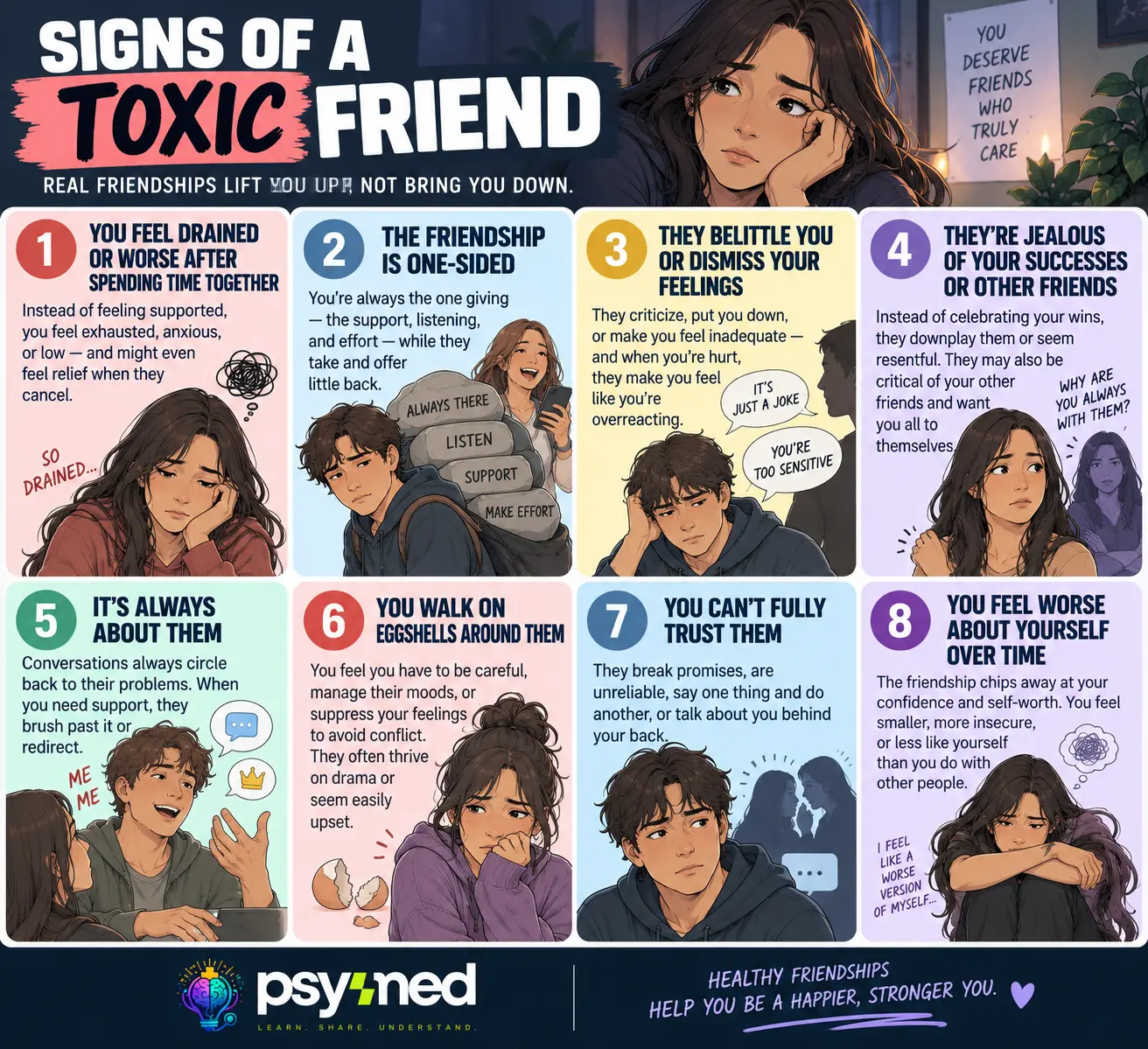
Signs of a Toxic Friend
Toxic friendships share a recognizable set of signs — and the clearest one is often simply how you feel around the person. As you read these, notice which show up as ongoing patterns rather than rare bad days. The more that fit, and the more often, the more worth taking seriously.
You feel drained or worse after spending time together
The single most telling sign: instead of feeling supported or recharged, you feel exhausted, deflated, anxious, or low after seeing them — and you might even feel relief when they cancel. How you consistently feel around someone is honest data about the friendship.
The friendship is one-sided
You’re always the one giving — the support, the listening, the effort, the emotional labor — while they take, take, take and offer little back. No friendship is a perfect 50/50, but a chronic imbalance where you carry it is a core marker of toxicity.
They belittle you or dismiss your feelings
They criticize, put you down, or make you feel inadequate — sometimes as “jokes” — and when you’re hurt, they dismiss it or make you feel like you’re overreacting. A friend who consistently invalidates your emotions rather than offering empathy is a red flag.
They’re jealous of your successes or other friends
Instead of celebrating your wins, they downplay them, change the subject, or seem resentful. They may also be possessive or critical of your other friends and relationships, wanting to be the most important person. A good friend is genuinely glad when good things happen for you.
It’s always about them
Conversations circle back to their problems and their life; when you need support, they brush past it or redirect. You could be sharing something that matters to you and somehow end up comforting them instead.
You walk on eggshells around them
You feel you have to be careful — managing their moods, suppressing your feelings to avoid conflict, or bracing yourself before you see them. Toxic friends often thrive on drama or seem frequently upset with you, keeping you anxious and off-balance.
You can’t fully trust them
They break promises, are unreliable, say one thing and do another, or you’ve caught them being dishonest. In some cases, they talk about you behind your back or share things you told them in confidence. Trust is the foundation of friendship, and its absence is corrosive.
You feel worse about yourself over time
Being in the friendship chips away at your confidence and self-worth. You feel smaller, more insecure, or less like yourself than you do with other people — a sign the relationship is affecting you in a real and lasting way.
Recognizing several of these doesn’t automatically mean you should end the friendship — some can improve with honest conversation and boundaries. But it does mean the friendship deserves a clear-eyed look, and that your instinct that “something’s off” is worth trusting.
Toxic Friend vs. Fake Friend: What’s the Difference?
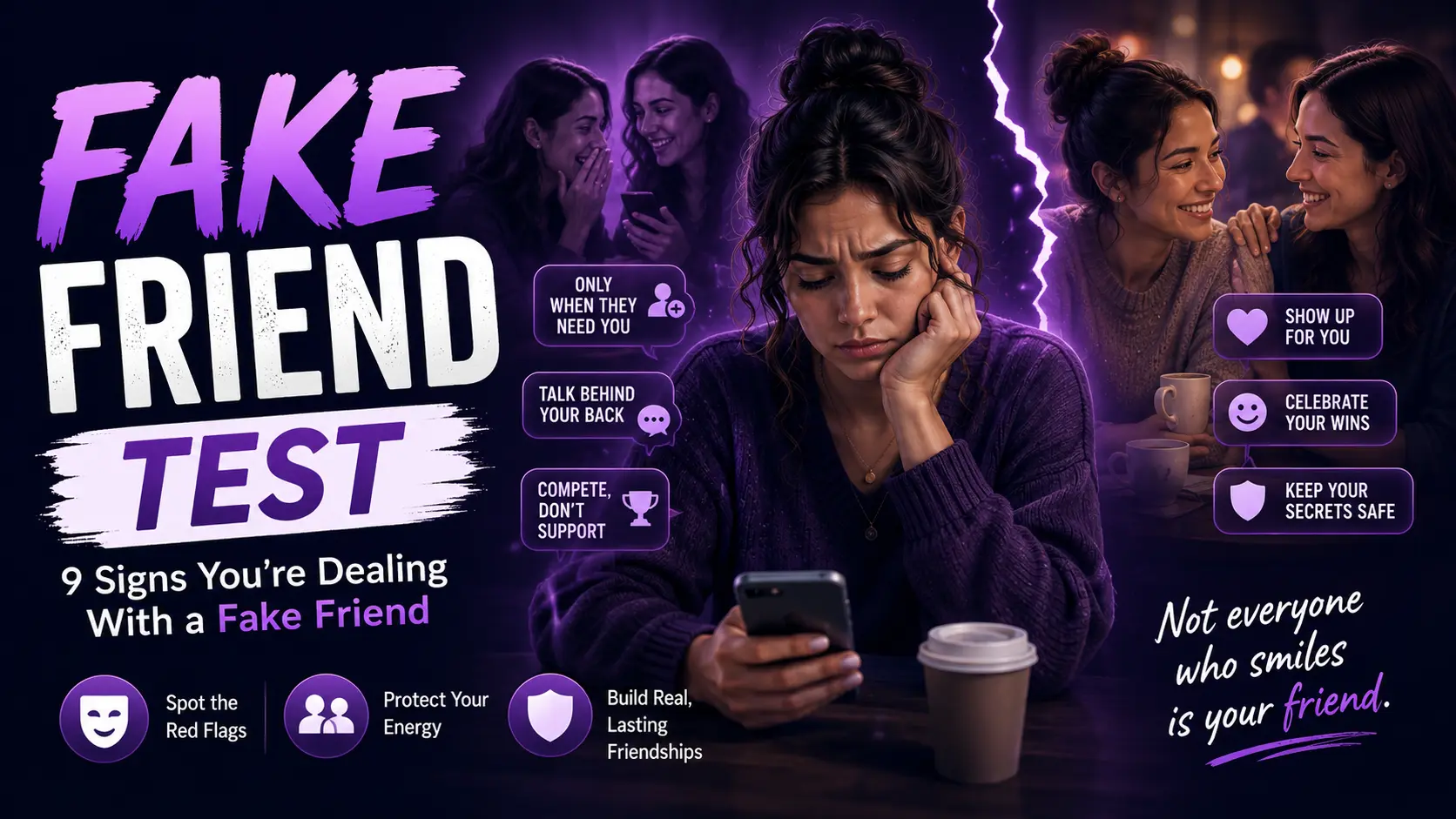
They overlap but aren’t the same thing, and telling them apart helps you understand what you’re dealing with. A toxic friend is about the dynamic — the friendship actively harms your well-being through draining, one-sided, or belittling patterns, even if the person genuinely cares about you in their way. A fake friend is about authenticity — someone who isn’t a real friend at all: two-faced, only around when it benefits them, or secretly unsupportive beneath a friendly surface.
A friend can be toxic without being fake (they truly care but the relationship is unhealthy), fake without being obviously toxic (pleasant enough, but not genuine), or both at once. If your gut says the issue is more about whether they’re a real friend than about a draining dynamic, our Fake Friend Test may fit better. And if the behavior goes beyond toxicity into deliberate manipulation — guilt-tripping, gaslighting, controlling you — our Am I Being Manipulated? Quiz looks at that specifically.
How This “Is My Friend Toxic Quiz” Works
This quiz asks 15 questions about how your friendship usually feels and functions — how they treat you, how balanced it is, and how you feel around them. Answer based on the general pattern rather than one unusual day, choosing how often each is true:
Never = 0 | Rarely = 1 | Sometimes = 2 | Often = 3 | Always = 4
Your answers add up to a score from 0 to 60. A higher score means more of the patterns associated with a toxic friendship; a lower score suggests a fundamentally healthy one. Whatever the number, you know this friendship better than any quiz — treat the result as a starting point for reflection. Your answers are private.
Understanding Your Results
Your score points to how many toxic patterns are present and how often — but you get the final say on what to do with that. Read your result as insight to reflect on, not a directive.
| Score | Result | What It Suggests |
|---|---|---|
| 0 – 15 | Mostly Healthy | This looks like a fundamentally healthy friendship with normal ups and downs. |
| 16 – 30 | Some Concerns | Some unhealthy patterns worth reflecting on and maybe addressing directly. |
| 31 – 45 | Significantly Toxic | Significant toxic patterns that are likely affecting your well-being. |
| 46 – 60 | Seriously Toxic | Many serious signs of a toxic friendship. You deserve to take that seriously. |
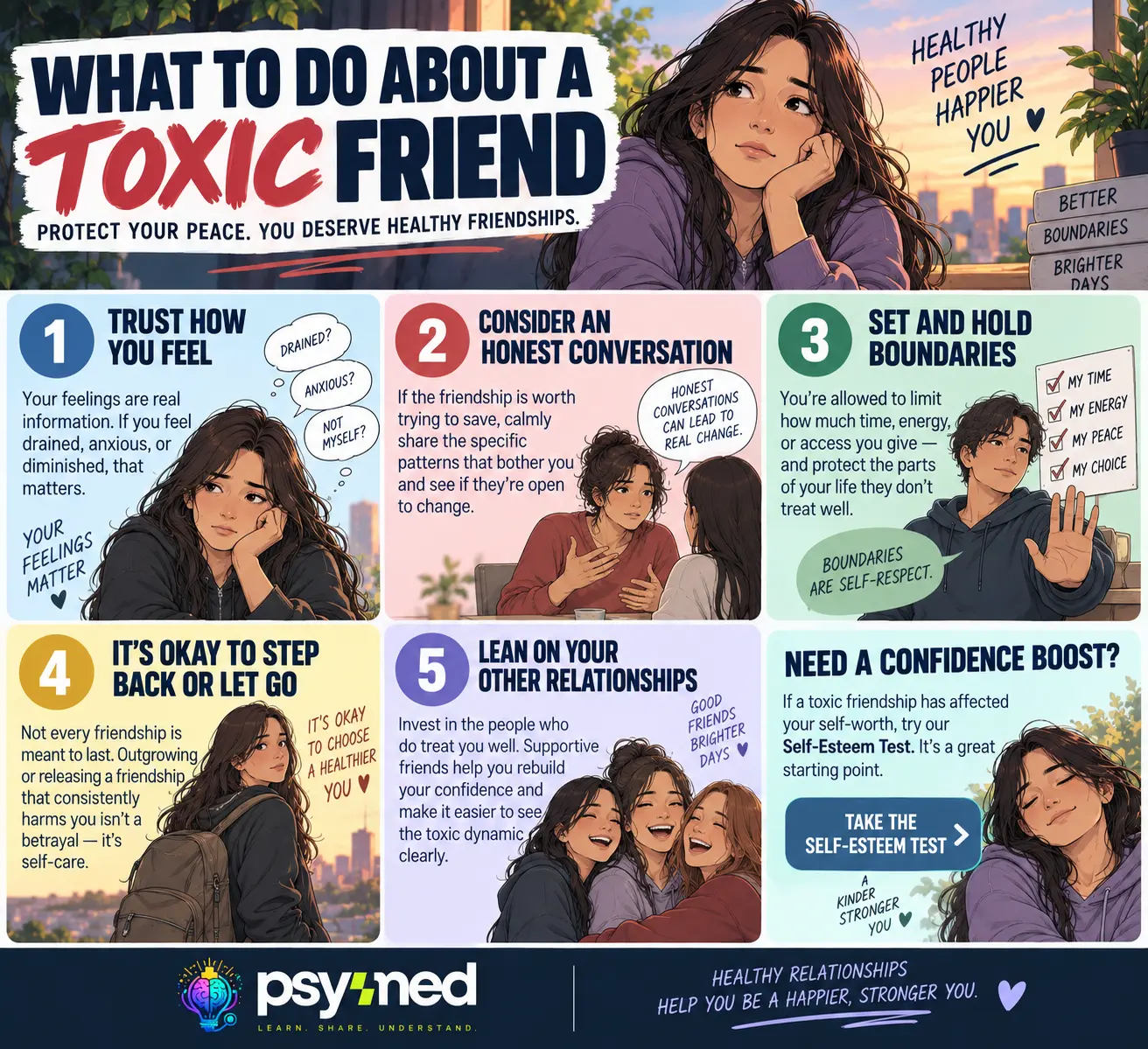
What to Do About a Toxic Friend
Recognizing a toxic friendship is the hard part; what you do next depends on the friendship and what you need — and there’s no single right answer. A few approaches tend to help.
- Trust how you feel
The way you consistently feel around someone is real information. If you feel drained, anxious, or diminished, that matters, even if you can’t point to one dramatic incident. - Consider an honest conversation.
If the friendship is worth trying to save, calmly naming the specific patterns that bother you — and seeing whether your friend can hear it and change — is often the clearest test of whether things can improve. - Set and hold boundaries
You’re allowed to limit how much time, energy, or access you give someone, and to protect the parts of your life they don’t treat well. How they respond to reasonable boundaries is telling. - It’s okay to step back or let go
Not every friendship is meant to last, and outgrowing or releasing one that consistently harms you isn’t a betrayal — even a long history doesn’t obligate you to stay. - Lean on your other relationships
Investing in the people who do treat you well, and rebuilding your confidence, makes it easier to see the toxic dynamic clearly.
If a toxic friendship has worn down your self-worth, our Self-Esteem Test may be worth taking. There’s no prize for staying loyal to something that hurts you — only for taking your own well-being seriously.
Frequently Asked Questions
How do I know if my friend is toxic or just going through a hard time?
The key is pattern versus phase. Anyone can be self-absorbed, irritable, or unreliable during a genuinely hard period — grief, stress, depression — and a good friendship can absorb that with some patience and honesty. What distinguishes a toxic friend is a persistent pattern that defines the friendship over time, rather than a temporary rough patch: consistent one-sidedness, ongoing belittling or jealousy, and a steady sense that you feel worse for the relationship.
Ask yourself whether this is a change from how they usually are (a phase) or simply how the friendship reliably works (a pattern). It also helps to notice whether they can acknowledge the impact of their behavior when you raise it — someone going through a hard time can usually still hear you, while a toxic dynamic tends to deflect or dismiss.
Can a toxic friendship be fixed?
Sometimes, yes — it depends on the friend’s awareness and willingness to change, and on how deep the patterns run. Some toxic dynamics come from people who genuinely care but have blind spots or learned unhealthy habits, and those can improve with an honest conversation, clear boundaries, and effort from both sides.
The “Is My Friend Toxic Quiz” is usually how your friend responds when you calmly name the problem: someone capable of change will take some responsibility and adjust, while someone who dismisses you, turns it around on you, or briefly improves and then reverts is showing you the friendship may not be fixable. It’s also okay to decide that trying to fix it costs you more than it’s worth. You can care about someone and still recognize that the friendship isn’t good for you.
Is it okay to end a friendship?
Yes. Ending a friendship that consistently harms your well-being is a valid, healthy choice, not a moral failing — and you don’t need a dramatic reason or the other person’s agreement to do it. We’re often taught to stay loyal to friends, especially long-standing ones, but loyalty to a relationship that repeatedly hurts you can come at the cost of loyalty to yourself.
People also simply grow and change, and outgrowing a friendship is a normal part of life. You can end it directly with a conversation, or gradually create distance, depending on what feels safe and right. However you do it, choosing to step away from something that damages you is an act of self-respect, and it makes room for the friendships that actually support you.
Why do I feel guilty about thinking my friend is toxic?
Guilt is extremely common here, and it doesn’t mean you’re wrong. Several things fuel it: loyalty (especially to a long friendship), shared history and good memories, the sense that you “should” be able to fix it, and the fact that toxic friends often aren’t toxic all the time — the good moments can make you doubt the bad ones.
You might also worry you’re being unfair or overreacting, particularly if your friend has struggles of their own. But recognizing that a friendship is harming you, and wanting to protect yourself, is not a betrayal — it’s honesty and self-care. Feeling guilty is a sign of how much you’ve cared, not evidence that your perception is wrong. Your wellbeing is allowed to matter as much as the friendship.
Further reading
This test looks outward, at how someone else treats you. The mirror of it looks inward: am I a good friend? asks the same questions about your own behaviour, which is worth doing even when the problem really is them.
Related Tests
- Fake Friend Test — if the real question is whether this person is a genuine friend, not just a draining one
- Am I Being Manipulated? Quiz — if the friend uses guilt-tripping, gaslighting, or control
- Toxic Relationship Quiz — for a toxic romantic or intimate relationship
- Self-Esteem Test — a toxic friendship can wear down self-worth over time
- Codependency Test — for patterns of over-giving and losing yourself in relationships
- Emotional Availability Test — how open and present people are in close relationships
References
- Psych Central. Signs You Have a Toxic Friendship. [Clinical overview of toxic-friendship signs] psychcentral.com
- Choosing Therapy. Toxic Friends: Signs & What to Do About It. [Therapist-reviewed signs and coping] choosingtherapy.com
- American Psychological Association. Healthy relationships and social support. [Reciprocity, respect, and wellbeing] apa.org
- Mental Health America. Types of relationships and setting boundaries. mhanational.org
Related Tests
See All Quiz →

You may also like
See All Quiz →