


Free 15-Item Codependency Test
Do you lose yourself in caring for others? This free codependency test screens for caretaking, enabling, and boundary patterns. 15 questions, private results.
Published Updated
Caring deeply about the people you love is not a problem — it’s one of the best things about being human. But for some people, caring tips into something that quietly costs them: consistently putting everyone else first, feeling responsible for other people’s feelings and problems, losing track of their own needs, and deriving their sense of worth almost entirely from being needed. When looking after others becomes the way you hold yourself together — and when it comes at the steady expense of your own wellbeing — that pattern is often called codependency.
This free, confidential codependency test looks at the patterns most associated with codependency: caretaking, difficulty with boundaries, over-responsibility for others, and self-worth tied to being needed. Before you start, one honest and important point: codependency is not a clinical diagnosis. It isn’t in the DSM, and there’s no official medical definition or test for it. It’s a widely used, useful concept for describing a real relational pattern — so treat this as a tool for honest self-reflection, not a diagnosis. 15 questions, private results.
What Is Codependency?
Codependency describes a pattern of relating to others in which a person’s focus, energy, and sense of self become excessively organized around other people — typically through caretaking, over-responsibility, and a need to be needed — at the expense of their own needs, feelings, and identity. The couples therapist and researcher Lynda Spann distilled it to three core elements: an extreme focus outside of the self, difficulty openly expressing one’s own feelings, and deriving purpose and meaning through relationships with others rather than from oneself.
The concept has specific roots. It grew out of the addiction-recovery world in the mid-20th century — particularly Al-Anon, founded in 1951 to support the families of people with alcoholism — where it was first noticed that partners and relatives often developed their own painful pattern of “enabling”: trying to manage, rescue, and take responsibility for the addicted person in ways that unintentionally sustained the addiction. The term was popularized by Melody Beattie’s 1986 book Codependent No More, which sold millions of copies and gave rise to the twelve-step fellowship Co-Dependents Anonymous (CoDA). While the concept has since broadened well beyond addiction, that origin explains its core: codependency is fundamentally about losing yourself in the attempt to hold someone else together.
It’s worth being clear-eyed about the concept’s status. Codependency is not a recognized mental health diagnosis — the American Psychiatric Association doesn’t list it, largely because there’s never been consensus on a single definition or enough empirical research to establish one. Some clinicians find it a genuinely useful lens; others criticize it as too broad or as pathologizing ordinary care and empathy. Both things can be true: it can describe a real and painful pattern that many people recognize in themselves, while not being a clinical disorder. This test reflects that honestly — it’s a structured way to reflect on relational patterns, not a diagnostic instrument.
Codependency vs Dependent Personality Disorder
These two are frequently confused, and the difference matters — including because one is a clinical diagnosis and the other isn’t.
| Feature | Codependency | Dependent Personality Disorder |
|---|---|---|
| Clinical status | Not a formal diagnosis; a relational concept | A recognized DSM-5 personality disorder (Cluster C) |
| Core direction | Compulsively caring for others; needing to be needed | Needing to be taken care of; relying on others to run one’s life |
| Characteristic stance | The caretaker, rescuer, or fixer | The passive, submissive, reassurance-seeking one |
| Typical behavior | Over-giving, enabling, controlling through helping | Clinging, difficulty making decisions alone, fear of being left to cope |
| PsyMed test | This test | Dependent Personality Disorder Test |
The simplest way to hold the distinction: dependent personality disorder is centered on needing to be cared for — leaning on others to make decisions, feeling helpless when alone, submitting to keep relationships intact. Codependency is, in a sense, the mirror image — centered on compulsively caring for others, taking responsibility for their problems, and building one’s identity around being the one who helps. They can overlap and share roots (low self-esteem, fear of abandonment), but they point in opposite directions. If your pattern is more about relying on others to take care of you and being unable to function independently, our Dependent Personality Disorder Test is the more relevant screen.
Signs You Might Be Codependent
These are the patterns most consistently associated with codependency. Note as you read: many of these, in moderation, are simply signs of a caring person — the question is whether they’ve become compulsive, one-sided, and costly to you. It’s the pattern and the price, not the presence of care, that matters.
You feel responsible for other people’s feelings and problems
When someone close to you is upset, struggling, or in trouble, you feel it’s your job to fix it — and you feel guilty or anxious when you can’t. You take on responsibility for how others feel to a degree that goes well beyond ordinary compassion.
You put others’ needs so far ahead of your own that you lose track of yours
You’re so attuned to what everyone else needs that your own needs become faint or invisible, even to you. Asked what you want, you might genuinely not know. Self-neglect isn’t a side effect here — it’s built into the pattern.
Your self-worth depends on being needed
Being the helper, the rescuer, the dependable one is central to how you feel valuable. When you’re not needed, you may feel empty, anxious, or unsure of your worth. Being indispensable has become tangled up with being lovable.
You have difficulty setting boundaries or saying no
Saying no feels selfish or dangerous, so you over-commit, tolerate things that hurt you, and let others’ demands override your limits. You may not feel entitled to boundaries at all.
You try to control or “fix” the people you care about
Often without meaning to, your caretaking becomes a form of control — managing, advising, rescuing, and taking over — because if you can just fix them, everything will be okay. Codependency and control are two sides of the same coin.
You stay in imbalanced relationships where you give far more than you get
You find yourself in relationships — romantic, family, friendships — where you’re the one who gives, sacrifices, and holds things together, often with people who are struggling, unavailable, or take more than they give. The imbalance feels normal, even necessary.
You find it hard to express your own feelings
You minimize, hide, or deny what you feel — partly to keep the peace, partly because your feelings have taken a back seat for so long. Conflict feels threatening, so you accommodate rather than say what’s true for you.
You fear abandonment or rejection
A deep worry that if you stop giving, stop caring, or start having needs, people will leave. This fear often drives the over-giving — the caretaking is, in part, an attempt to secure a relationship that feels conditional.
You feel anxious, resentful, or depleted — but keep going anyway
Underneath the caretaking, there’s often exhaustion and quiet resentment. You may feel taken for granted, but the idea of stopping — of letting someone face their own consequences, or of putting yourself first — feels impossible or wrong.
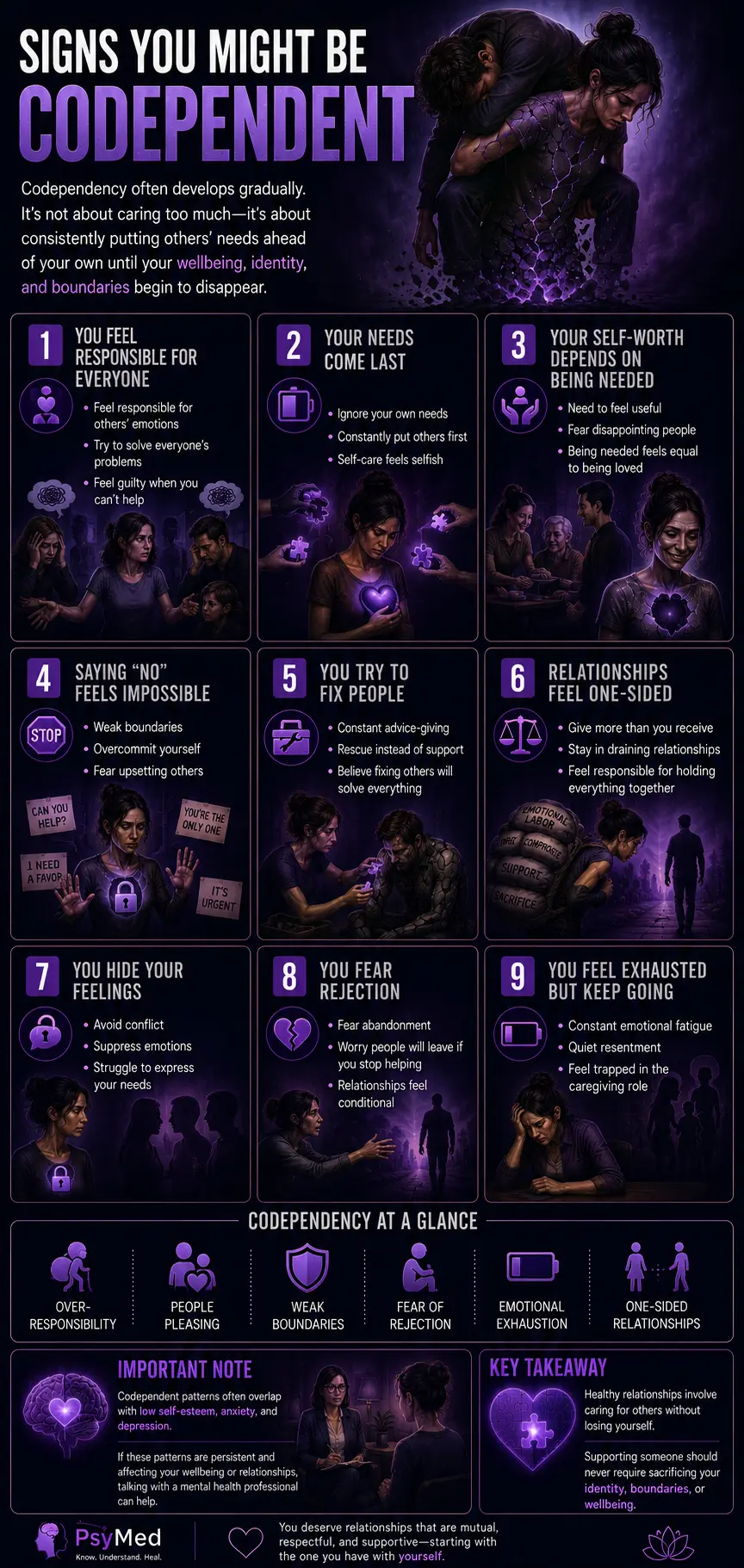
An important note: if you recognize yourself here, it’s worth knowing that codependent patterns very often sit on top of low self-esteem and can feed anxiety and depression. And one crucial caveat covered in the next section: sometimes what gets called “codependency” is actually a response to someone else’s controlling or abusive behavior — which is a different situation entirely.
An Important Caveat: Codependency Is Not the Same as Being Mistreated
This deserves its own section, because it’s frequently misunderstood in a way that can cause real harm.
Many people arrive at a “codependency test” because a relationship is making them miserable, and they’ve been led — sometimes by the very person mistreating them — to believe the problem is that they care too much, give too much, or are “too codependent.” Please hear this clearly: if someone is controlling, manipulating, coercing, or abusing you, that is not codependency, and it is not your fault for caring. Reframing abuse as your own “codependency” is a way the responsibility gets shifted onto the person being harmed.
Codependency describes your pattern of over-giving and self-loss. It does not mean you are responsible for someone else’s mistreatment of you. If your relationship involves fear, control, monitoring, coercion, or any form of abuse, that is the more urgent issue — and it’s not addressed by working on being “less codependent.” Our Toxic Relationship Quiz may be more relevant, and if you’re ever afraid of a partner, the National Domestic Violence Hotline (1-800-799-7233, or text START to 88788) is free, confidential, and available 24/7. Caring about someone does not make their treatment of you your fault.
How This Codependency Test Works
This test contains 15 questions about how you tend to relate to others — caretaking, boundaries, responsibility, and where your sense of worth comes from. For each, choose how often it applies to you:
Never = 0 | Rarely = 1 | Sometimes = 2 | Often = 3 | Always = 4
Your answers add up to a score from 0 to 60. Answer based on your general pattern across relationships, not one specific situation. Remember: this is a reflection tool, not a diagnosis — codependency isn’t a clinical condition, and this test is a structured way to think about your relational patterns, not a medical assessment.
Understanding Your Results
| Score Range | Level | What It Suggests |
|---|---|---|
| 0 – 15 | Few Codependent Patterns | Few signs of codependency. You seem able to care for others while keeping your own needs and boundaries intact. |
| 16 – 30 | Some Codependent Patterns | Some codependent tendencies. Worth reflecting on where caretaking may be crowding out your own needs. |
| 31 – 45 | Notable Codependent Patterns | A notable codependent pattern that’s likely costing you. Support in building boundaries and self-focus would help. |
| 46 – 60 | Strong Codependent Patterns | A strong codependent pattern. Working with a therapist or a group like CoDA could be genuinely valuable. |
What Causes Codependency?
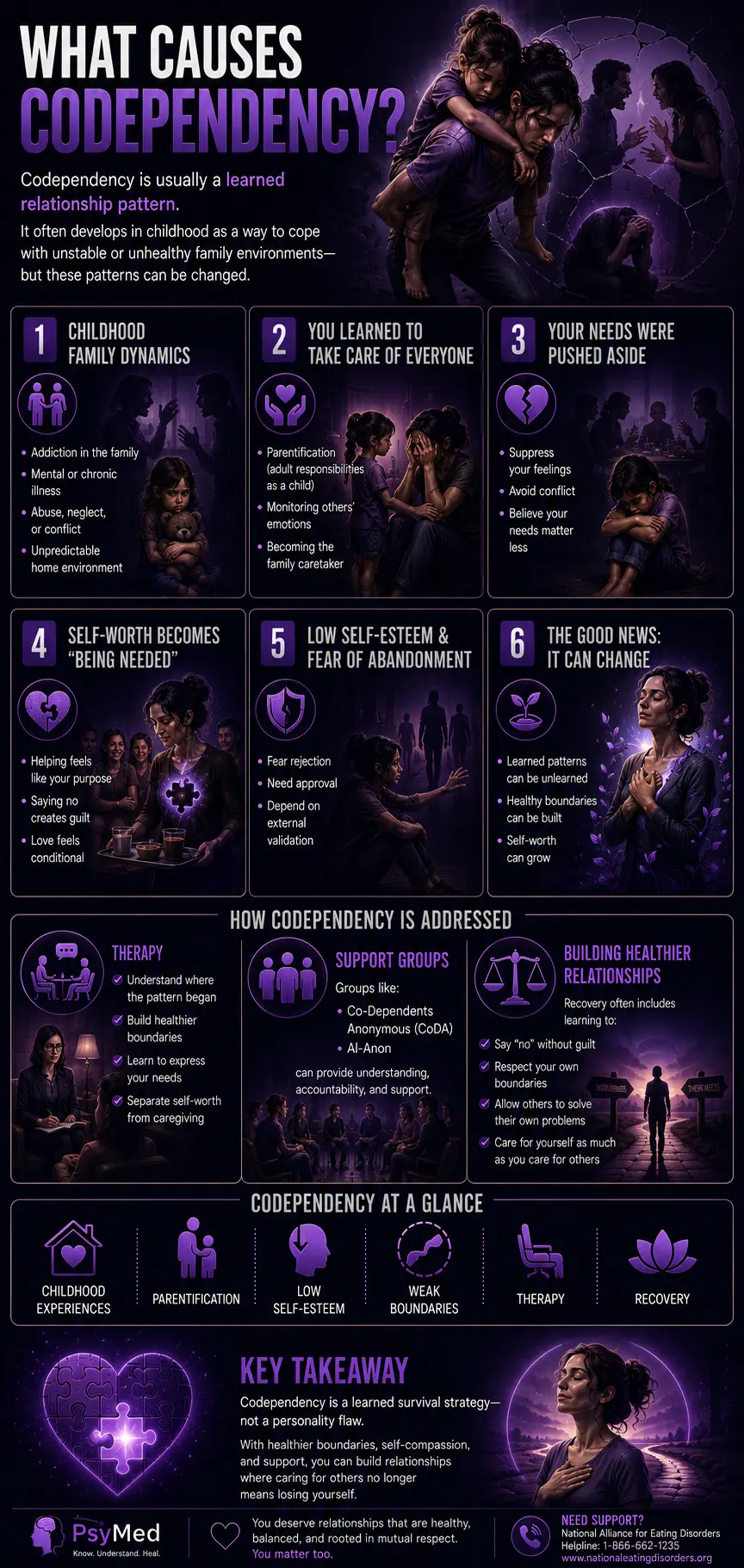
Codependency is generally understood as a learned pattern rather than something innate — usually rooted in early experiences and family dynamics. It’s strongly associated with growing up in dysfunctional family environments, particularly those involving addiction, but also those marked by mental illness, chronic illness, abuse, neglect, or high conflict. In such families, a child often learns to survive by becoming attuned to others’ needs and moods, taking on responsibility beyond their years (sometimes called “parentification”), suppressing their own needs and feelings to avoid rocking an unstable boat, and finding safety and worth in being helpful and good.
These are intelligent adaptations to a difficult childhood — but they can harden into a lifelong template in which the person continues, as an adult, to organize themselves around others’ needs and to feel worthy only when useful. Underlying factors commonly include low self-esteem, a deep fear of abandonment, and difficulty believing that one’s own needs are legitimate. Because it’s learned, codependency can also be unlearned — which is the hopeful core of why therapy and recovery work help.
How Codependency Is Addressed
Because codependency isn’t a clinical diagnosis, there’s no formal “treatment” — but the patterns respond well to focused psychological work and support, and many people meaningfully change them.
- Individual therapy is often the most powerful path. It can help you trace where the pattern came from, understand what it’s protecting you from, and gradually build the skills that don’t yet feel natural — setting boundaries, tolerating the guilt that comes with saying no, identifying and voicing your own needs and feelings, and separating your worth from your usefulness. Approaches that address underlying beliefs and early experiences tend to be especially helpful.
- Support groups help many people. Co-Dependents Anonymous (CoDA), Al-Anon (for those affected by someone else’s addiction), and similar twelve-step fellowships offer community, structure, and the relief of recognizing your experience in others — which directly counters the isolation codependency creates.
- Building self-worth and boundaries is the throughline of recovery. Learning that you’re allowed to have needs, that “no” is a complete sentence, that letting someone face their own consequences isn’t cruelty, and that your value doesn’t depend on being needed — these are the shifts that loosen the pattern. Because codependency so often rests on low self-esteem, work in that area (our Self-Esteem Test is a starting point) tends to help. The goal isn’t to care less about people — it’s to include yourself among the people you care for.
Frequently Asked Questions
Is codependency a real mental health condition?
Codependency is a real and widely recognized pattern, but it is not a formal mental health diagnosis. It isn’t listed in the DSM, and there’s no official clinical definition or diagnostic test for it — largely because experts have never reached consensus on exactly how to define it, and the research base is limited. It emerged from the addiction-recovery world (particularly Al-Anon) and was popularized in the 1980s. Many clinicians find it a useful way to describe a genuine relational pattern that people recognize in themselves; others critique it as too vague or as pathologizing normal caring. So it’s best understood as a meaningful concept for self-reflection and growth, not a clinical disorder you can be diagnosed with.
What is the difference between codependency and dependent personality disorder?
They’re often confused but point in opposite directions. Dependent personality disorder (DPD) is a recognized DSM-5 personality disorder centered on needing to be taken care of — relying on others to make decisions, feeling helpless or anxious when alone, and submitting to others to maintain relationships. Codependency is not a clinical diagnosis and centers on compulsively caring for others — over-giving, taking responsibility for others’ problems, enabling, and deriving self-worth from being needed. Put simply: the person with DPD needs to be looked after; the codependent person needs to be the one looking after someone. They can share roots like low self-esteem and fear of abandonment, but they’re distinct. If your pattern is more about depending on others than caretaking them, our Dependent Personality Disorder Test is more relevant.
Can you be codependent and still be a caring, good person?
Absolutely — and this is important. Codependency isn’t about being a bad person or caring “too much” in some moral sense; the capacity for care and empathy at its heart is genuinely good. The issue is when caring becomes compulsive, one-sided, and self-erasing — when you consistently lose yourself, neglect your own needs, and tie your entire worth to being needed. The goal of addressing codependency isn’t to become less caring or more selfish; it’s to include yourself in your own circle of care, so that giving to others comes from fullness and choice rather than from fear, guilt, or a sense that you only matter when useful. You can be deeply caring and have healthy boundaries — in fact, that combination is where care becomes sustainable.
What causes someone to become codependent?
Codependency is generally understood as a learned pattern, usually rooted in early family experiences. It’s strongly associated with growing up in dysfunctional environments — especially families affected by addiction, but also those involving mental or chronic illness, abuse, neglect, or high conflict. Children in these settings often learn to survive by becoming hyper-attuned to others’ needs, taking on adult responsibilities too early, and suppressing their own needs to keep an unstable situation calm. These are smart adaptations to a hard childhood, but they can harden into an adult template of over-giving and self-neglect. Underlying threads usually include low self-esteem, fear of abandonment, and difficulty believing one’s own needs are legitimate. Because it’s learned, it can also be unlearned.
How do I stop being codependent?
Change is very possible, though it takes time, because you’re revising a pattern that’s often decades old. The most effective paths are individual therapy — which helps you understand the pattern’s origins and build boundary-setting, self-awareness, and the ability to identify and voice your own needs — and support groups like Co-Dependents Anonymous (CoDA), which counter the isolation the pattern creates. Practically, recovery involves learning to tolerate the guilt that comes with saying no, letting others face their own consequences instead of rescuing them, reconnecting with what you need and feel, and building self-worth that doesn’t depend on being useful. Because codependency usually rests on low self-esteem, working on that (our Self-Esteem Test can be a start) tends to help the whole pattern shift. The aim isn’t to care less — it’s to finally include yourself among those you care for.
Is my relationship problem codependency, or am I being mistreated?
This is a crucial distinction. Codependency describes your pattern of over-giving and self-loss — something you can work on and change. But sometimes what gets labeled “codependency” is actually a response to another person’s controlling, manipulative, or abusive behavior, and the two are very different. If your relationship involves fear, control, coercion, monitoring, or any form of abuse, the problem is not that you “care too much,” and it won’t be solved by becoming “less codependent” — that framing can even shift blame onto the person being harmed. In that case, the more relevant issue is the mistreatment itself. Our Toxic Relationship Quiz may help, and if you’re ever afraid of a partner, the National Domestic Violence Hotline (1-800-799-7233) is free, confidential, and available 24/7. Caring about someone never makes their mistreatment of you your fault.
How accurate is this codependency test?
This test is a structured reflection tool based on the widely described characteristics of codependency and informed by measures like the Spann-Fischer Codependency Scale — but because codependency itself has no single agreed clinical definition or fully validated diagnostic instrument, no codependency test can be “accurate” in the way a validated diagnostic tool is. Think of your result as a mirror rather than a measurement: a way to see your relational patterns more clearly and decide whether they’re worth exploring further. It can’t tell you that you “have” codependency (which isn’t a diagnosable condition), but it can help you recognize patterns that many people find valuable to understand and, where they’re costly, to change.
Further reading
Over-giving is often mistaken for being a good friend, but healthy friendship runs both ways. If the imbalance is coming from their side rather than yours, the fake friend test looks at that instead. The am I a good friend quiz is built around that balance — it scores letting friends support you, and respecting their boundaries, as strengths rather than failings. Codependency and control can look like opposites — over-giving versus over-directing — but both are ways of managing anxiety through other people. The control freak quiz measures the directing version.
Related Tests
- Dependent Personality Disorder Test — the clinical condition centered on needing to be cared for, distinct from codependency’s caretaking
- Fake Friend Test — for when the one-sided giving is happening in a friendship and you suspect it is not mutual
- Toxic Relationship Quiz — if the real issue may be a controlling or harmful relationship rather than your own caretaking pattern
- Self-Esteem Test — low self-worth sits underneath most codependent patterns; the Rosenberg scale measures it
- Narcissistic Personality Disorder Quiz — codependency and narcissism often pair together in relationships; worth understanding if that dynamic feels familiar
- Anxiety Test — chronic anxiety commonly accompanies codependent patterns and the fear of abandonment beneath them
- Clinical Depression Test — the self-neglect and resentment of codependency can feed depression; worth screening alongside
- Attachment Style Test — codependent patterns often reflect anxious attachment; understanding your attachment style can add insight
References
- Beattie, M. (1986). Codependent No More: How to Stop Controlling Others and Start Caring for Yourself. Hazelden. [Foundational popular work; caretaking, control, self-loss]
- Spann, L., & Fischer, J.L. (1990). The Spann-Fischer Codependency Scale. Texas Tech University. [16-item semi-validated measure; three core elements of codependency] en.wikipedia.org
- Cermak, T.L. (1986). Diagnostic Criteria for Codependency. Journal of Psychoactive Drugs, 18(1), 15–20. [Extreme caretaking; excessive responsibility for others; neglect of own needs]
- Encyclopaedia Britannica. Codependency. [Not a formal psychiatric diagnosis; Al-Anon origins; enabling; low self-esteem and approval-seeking] britannica.com
- Co-Dependents Anonymous (CoDA). Patterns and Characteristics of Codependence. [Patterns of denial, low self-esteem, compliance, and control] coda.org
Related Tests
See All Quiz →

You may also like
See All Quiz →